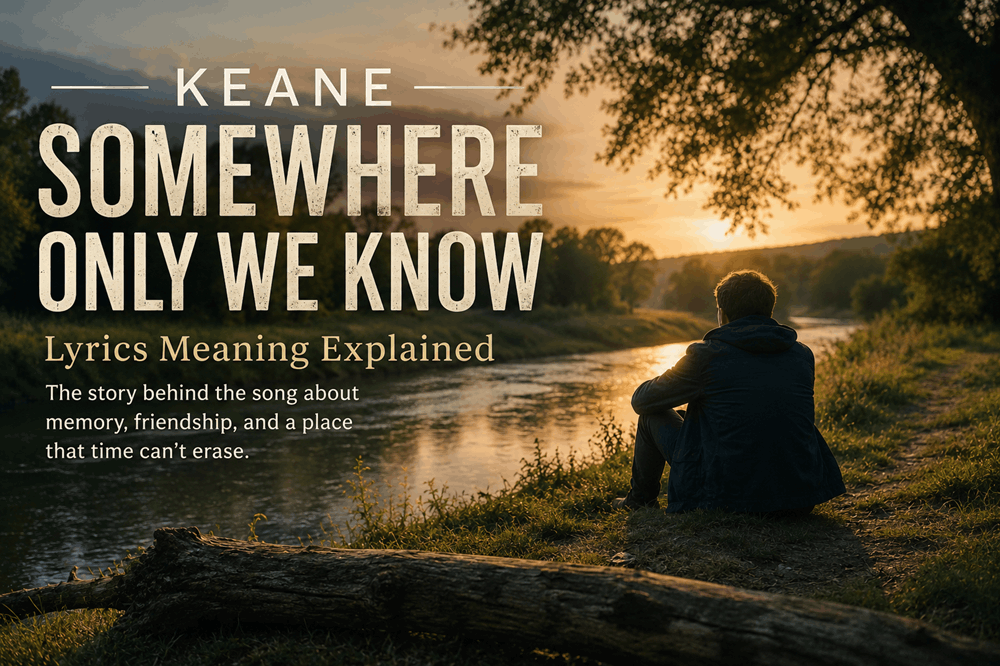
Keane Somewhere Only We Know Lyrics Meaning
Keane’s “Somewhere Only We Know” is about returning to a place associated with youth, friendship, safety, and a less complicated period of life.
The narrator still recognizes the landscape, but time has changed both the place and the people connected to it. Feeling tired and uncertain, he asks someone who shares those memories to meet him there before an important relationship, dream, or chapter of life comes to an end.
Although the song can sound romantic, Keane’s members have connected it more directly to the countryside where they grew up, their long friendship, and their experiences building the band together. Tom Chaplin has described the song as a longing for something “pure and simple” and said he associates it with the school grounds where the friends spent time as teenagers.
Looking for the complete lyrics?
Read the full “Somewhere Only We Know” lyrics on Apple Music, or watch Keane’s official music video. Apple Music may require you to sign in before displaying the complete lyrics.
“Somewhere Only We Know” Song Facts
- Artist: Keane
- Album: Hopes and Fears
- Single release: February 16, 2004
- Length: 3:58
- Songwriters: Tom Chaplin, Tim Rice-Oxley, and Richard Hughes
- Producers: Keane and Andy Green
Keane’s official website dates the single to February 16, 2004, and the album Hopes and Fears to May 10, 2004. Apple Music lists the official writing and production credits, while the UK’s Official Charts Company records a No. 3 chart peak for the original single.
The song is officially credited to Chaplin, Rice-Oxley, and Hughes, although Rice-Oxley has been identified as the person who originated it at the piano in his parents’ front room.
What Do the “Somewhere Only We Know” Lyrics Mean?
The lyrics describe someone looking for emotional stability while confronting the passing of time.
The narrator walks through a familiar landscape and remembers how secure it once made him feel. The pathway, river, earth, and trees are still recognizable, but the surrounding emptiness suggests that the life connected to the place has changed.
He does not simply miss the physical location. He misses the feeling of certainty he once found there.
The “somewhere” in the title can therefore represent both a real place and a private emotional world. It may be a childhood meeting spot, a landscape shared by friends, a location associated with a relationship, or a period of life that survives mainly in memory.
The narrator asks another person to meet him there because the place belongs to their shared history. Returning may not restore the past, but it could give them enough common ground to speak honestly about what has changed.
A private place becomes meaningful not because no one else can find it, but because no one else remembers it in quite the same way.
“Somewhere Only We Know” Lyrics in Plain English
Opening verse
The narrator walks through a quiet place he remembers extremely well. The physical sensations of the land and river briefly make him feel calm, grounded, and complete.
First refrain
That comfort gives way to anxiety. The simple and dependable life he once knew has disappeared, leaving him tired and in need of something stable.
Second verse
He sees a fallen tree and wonders whether he has reached the place connected to his memories. The surroundings are familiar, but time has altered them enough to make him question what he remembers.
Chorus
He asks another person to meet him in their private place and talk. He fears that something important between them—or within their shared life—may be close to ending.
Final repetition
The invitation becomes more urgent. Returning to the place may be their last opportunity to reconnect before time carries them further apart.
The Childhood Place Behind the Song
The landscape was influenced by Keane’s childhood in East Sussex.
Chaplin and Rice-Oxley grew up around Battle and Robertsbridge and spent much of their youth together. Chaplin’s parents ran Vinehall School, whose grounds included woods and open spaces where the friends rode bicycles, built dens, listened to music, and spent time together.
Chaplin later explained that he pictured those grounds when singing “Somewhere Only We Know.” To him, the song concerns the friends, the band, and their experience of growing up together rather than one narrowly defined romantic relationship.
Rice-Oxley has also connected the song’s fallen-tree image to real childhood memories. He said it was probably an amalgamation of different trees, including ones brought down by the major storm that struck southern England in 1987.
The song should not be treated as directions to one precisely identifiable public location. Its landscape appears to combine several places, images, and memories.
What Keane has confirmed
The song draws on childhood places, shared history, friendship, and the experience of growing older together.
LineDay’s interpretation
The physical landscape becomes an emotional refuge. The narrator returns to it because adulthood and uncertainty have made the present feel less dependable than the world he remembers.
How the Landscape Shows Time Passing
The song begins in a place the narrator knows well, yet the land is empty.
He remembers the route so clearly that walking it appears instinctive. His body still recognizes the pathway and the ground beneath him, even though the people and experiences that once gave the place life are absent.
The river briefly makes him feel complete. Its presence suggests continuity: human lives change, but the landscape seems to endure.
Yet a river is never truly still. Its water constantly moves forward even when the setting appears unchanged. That makes it a fitting image for memory. The location may look familiar, but neither the narrator nor the moment can ever be exactly what they were before.
The fallen tree makes that reality even clearer.
Trees commonly suggest stability, roots, and long life. Seeing one on the ground shows that even things assumed to be permanent can be altered by time and circumstance.
The narrator recognizes the tree but questions whether this is truly the place he remembers. He is caught between two landscapes:
- The place as it exists now
- The place as memory has preserved it
Returning physically cannot recreate the past. The empty land, moving river, and fallen tree all reveal that time continued working on the place while the narrator was away.
What Is the “Simple Thing” He Has Lost?
The song never defines the “simple thing,” which allows it to carry several connected meanings.
It may be childhood, when friendship and belonging felt effortless. It could be emotional trust, the comfort of home, or the early dream that Keane’s future would eventually become clear.
More broadly, it represents the disappearance of simplicity itself.
As people grow older, relationships require more work, responsibilities increase, and once-open futures begin to narrow. Places and people that appeared permanent become vulnerable to distance and change.
The narrator remembers a time when belonging did not need to be discussed. The childhood landscape naturally gave him a shared world and a sense of identity.
Now, he has to ask for access to that feeling.
His longing is not simply for a field, river, or tree. It is for a time when he knew where he stood and whom he could depend on.
Why Does the Narrator Say He Is Getting Old?
Keane’s members were still young when the song was written, so the reference to aging is not only about literal old age.
It expresses the first adult realization that time is moving more quickly than expected.
At that stage of life, people begin to understand that childhood cannot be repeated, friendships may change, creative ambitions may fail, and familiar places will not remain untouched forever.
Keane had also experienced years of uncertainty before their breakthrough. Rice-Oxley has recalled labels visiting to hear the band and repeatedly declining to sign them, leaving him discouraged about their future.
The narrator’s tiredness therefore feels emotional rather than physical.
He does not ask for a new adventure. He asks for something reliable—an anchor strong enough to steady him while everything else changes.
Why Does He Need to Be “Let In”?
The request to be let in shifts the song from landscape into relationship.
The narrator knows the physical route, but he cannot return to the shared emotional world alone. The person he addresses must agree to meet him, communicate, and become vulnerable.
Being let in may mean reopening a conversation, rebuilding trust, renewing a friendship, or reconnecting after emotional distance.
This is also where the romantic interpretation becomes understandable. The language fits two people whose relationship is under strain and who need to remember what once connected them.
However, the same idea applies to friends or bandmates.
People can share years of history while becoming closed off in the present. Familiarity does not guarantee openness. The narrator may know the other person deeply and still feel excluded from their current thoughts or life.
The secret place matters because it offers neutral ground. By meeting somewhere linked to their earlier closeness, they may be able to speak without the pressures and defenses that shape their present relationship.
What Could Be Coming to an End?
The song deliberately leaves the threatened ending undefined.
It could be the end of a romance, friendship, shared dream, musical partnership, or stage of life. It may also refer to youth itself—the period when the place and relationship felt stable without conscious effort.
The uncertainty makes the chorus more universal, but it also creates urgency.
The narrator is not suggesting a casual walk. He believes that meeting and talking may determine whether something important survives.
The word “could” matters because the ending has not yet become unavoidable. There is still time to communicate.
The secret place cannot stop change, but it may remind the two people why their connection once mattered and help them decide whether it can continue in a new form.
Is “Somewhere Only We Know” a Love Song?
It can work as a romantic song, but romance is not its only or confirmed meaning.
The narrator addresses another person, recalls a place they shared, and asks for renewed closeness. These elements naturally allow listeners to connect the song to a couple facing separation.
Keane’s explanations, however, emphasize friendship, childhood, the band, and growing up together. Chaplin has said that the place made him think of the band members as friends and of their shared journey into adulthood.
The song is therefore best understood as being about any bond shaped by private memories.
The person addressed could be a partner, friend, relative, or creative companion. What matters is that both people share a history that outsiders cannot fully understand and that time now threatens to pull them apart.
How the Piano Supports the Meaning
The piano provides much of the rhythmic force that a guitar would supply in another rock song.
Its repeated pattern pushes the track forward, while Chaplin’s vocal remains filled with uncertainty and longing. The music and lyrics therefore move in opposite emotional directions:
- The rhythm keeps moving forward.
- The narrator keeps looking backward.
That tension captures the song’s central problem. Time continues whether the narrator feels ready for change or not.
The arrangement gradually expands, transforming a private memory into an anthem without losing its melancholy. By the chorus, thousands of listeners can sing about a place that supposedly belongs to only two people because each listener imagines a different somewhere.
A 2024 review of Keane’s anniversary tour described couples embracing and the audience forming a massed response when the band performed the song. The writer noted that Rice-Oxley’s childhood memory had become a source of comfort for many others.
Why Lily Allen’s Version Feels Different
Lily Allen recorded a stripped-back cover for the 2013 John Lewis Christmas advertisement. Her rendition reached No. 1 on the UK Singles Chart and remained there for three weeks.
Keane’s original is driven by a firm piano rhythm and Chaplin’s increasingly urgent delivery. It sounds as though the narrator must act before time runs out.
Allen’s version is softer and more fragile. Its restrained arrangement makes the song feel like a distant memory or lullaby.
The two versions emphasize different sides of the same composition:
- Keane emphasizes urgency and the need to reconnect.
- Allen emphasizes tenderness, absence, and remembrance.
The cover did not replace the original meaning. It demonstrated how easily the song’s undefined place and relationship could adapt to another emotional setting.
Why the Song Still Connects With Listeners
Most people have a place whose importance would be invisible to a stranger.
It might be a childhood home, a schoolyard, a neighborhood path, a café, or somewhere visited with a person who is no longer present.
The location may look ordinary to everyone else. Its meaning comes from the experiences and relationships stored there.
“Somewhere Only We Know” also avoids promising that returning will restore what has been lost.
The narrator can revisit the pathway and recognize the landscape, but the emptiness and fallen tree prove that time has left visible marks.
What remains possible is memory, conversation, and perhaps a new beginning built from the connection that survives.
Frequently Asked Questions
Is “Somewhere Only We Know” about a real place?
It was inspired by childhood locations and countryside in East Sussex, including the grounds of the school run by Chaplin’s parents. The imagery appears to combine several memories rather than identify one definitive public location.
Is the song about a breakup?
It can be interpreted as a breakup song because the narrator fears losing an important relationship. Keane’s own explanations connect it more broadly to childhood friendship, the band, shared memories, and growing older.
Who wrote “Somewhere Only We Know”?
The official composition credits name Tom Chaplin, Tim Rice-Oxley, and Richard Hughes. Rice-Oxley is generally identified as having originated the song at the piano.
When was the song released?
Keane’s official website dates the single to February 16, 2004. It later appeared on the band’s debut album, Hopes and Fears, released on May 10, 2004.
What is the main message?
The song is about seeking stability in a shared place or memory when time, adulthood, and emotional distance make the present feel uncertain.
Final Interpretation
“Somewhere Only We Know” is not simply about returning to a secret location.
It is about hoping that a familiar place can lead two people back to the connection they once shared.
The narrator still recognizes the path, river, and tree, but the empty landscape confirms that time has moved forward. He cannot become his younger self again or restore the place exactly as it existed in memory.
What he can do is invite another person to return with him.
The place matters because it holds a version of their relationship that neither person has completely forgotten. Meeting there may allow them to understand what has changed and whether anything can still be saved.
Returning cannot recover the past.
It may, however, give them somewhere to begin again.