“Feel Good Inc.” Lyrics Meaning: Gorillaz’s Hit Is About Manufactured Happiness
“Feel Good Inc.” by Gorillaz is about a society that keeps people entertained, distracted and repeating that they feel good—even while the world around them is becoming emptier and more controlled.
The title sounds like a promise of happiness. The word Inc., however, turns happiness into a corporation. Feeling good is no longer a private emotion. It has become something packaged, advertised and supplied by an institution.
Inside this world, people dance, laugh and consume whatever keeps them comfortable. Outside it lies another possibility: freedom, love, imagination and a life connected to something real.
That creates the song’s central conflict:
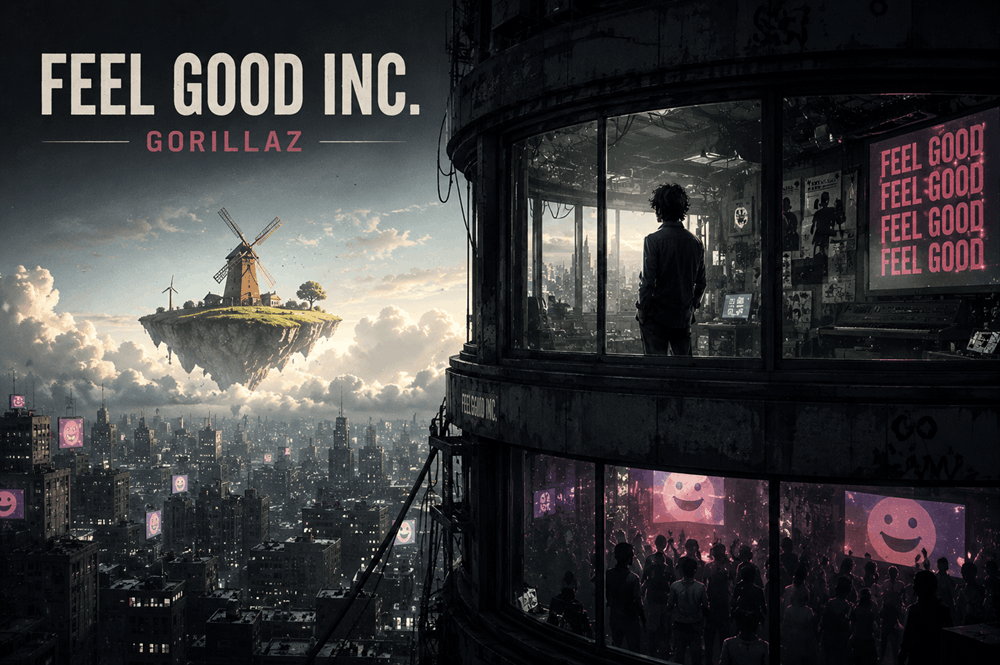
The tower offers immediate pleasure without freedom, while the distant windmill represents freedom that may be impossible to reach.
“Feel Good Inc.” is not simply arguing that entertainment is bad. Gorillaz themselves are an entertainment project. The song questions what happens when pleasure stops helping people live and starts preventing them from noticing how they are being controlled.
What is “Feel Good Inc.” about?
The song presents a city in decline.
Its residents continue filling the streets, but they do not appear capable of changing the conditions around them. Their supposed freedom exists within a system that keeps them distracted, exhausted and emotionally disconnected.
The phrase “feel good” becomes increasingly ironic.
At first, it resembles the language of a pop chorus or advertisement. Repeated often enough, it begins to sound like an instruction. People are not describing how they truly feel. They are being told what they should feel.
The song moves between two emotional worlds:
- A crowded city where happiness is manufactured
- An open landscape associated with wind, love and freedom
- A dark tower filled with noise and passive bodies
- A floating island that remains distant and vulnerable
- Forced laughter
- Genuine but fragile hope
The narrator can imagine escape, but imagination alone does not release him.
He remains inside the system while singing about the world beyond it.
Why is the title ironic?
“Feel Good Inc.” sounds like the name of a company selling happiness.
The title suggests that pleasure has been industrialized. A corporation does not need people to be deeply fulfilled. It needs them to remain satisfied enough to continue consuming, watching and participating.
The difference between happiness and feeling good is important.
Happiness may come from freedom, purpose, relationships or understanding. Feeling good can be temporary. It can be created through entertainment, shopping, attention, substances or constant stimulation.
Temporary pleasure is not necessarily harmful. The danger begins when it becomes a substitute for awareness.
In the song’s world, the company appears to offer exactly that substitution. It provides enough noise and excitement to stop people from asking whether they are free.
The title therefore contains both an invitation and a warning.
Come inside.
Enjoy yourself.
Do not examine who benefits from keeping you there.
The opening laugh does not sound joyful
The song begins with an exaggerated laugh performed by De La Soul’s Vincent Mason.
It is one of the recording’s most recognizable sounds, but it does not create a warm or welcoming atmosphere. The laugh is too large, repetitive and theatrical. It sounds less like spontaneous happiness than someone demonstrating what happiness is supposed to sound like.
This establishes the song’s irony before the first verse.
Laughter normally proves that a person is enjoying something. Here, it becomes suspicious. It may represent mockery, madness, corporate entertainment or a command to join the mood whether you feel it or not.
The laugh also returns throughout the recording like a supervisor checking that the illusion remains intact.
The listener is told to feel good.
The laughter supplies evidence that everyone else supposedly does.
A city collapsing under its own weight
The opening verse describes a city breaking down while people continue moving through it.
The image of a camel carrying too much weight suggests a system that has been overloaded. The city has accumulated pressure, consumption and population until one more burden could cause collapse.
Yet the residents do not appear to understand what is happening.
They fill the streets because movement gives the appearance of activity. Crowds make the city look alive even when its emotional and social structures are failing.
This distinction remains relevant far beyond the song’s fictional setting.
A society can be busy without progressing. People can work, travel, buy things and remain constantly entertained while feeling increasingly powerless.
The song does not present the citizens as entirely innocent. They participate in the system because its distractions are appealing.
But it also recognizes why resistance is difficult.
When daily life requires all of a person’s energy, there may be little attention left for questioning the structure producing that exhaustion.
The city keeps moving.
That does not mean it knows where it is going.
The new horizon is attractive but temporary
The narrator sees a new horizon, but describes its style as temporary.
A horizon usually represents possibility. It suggests that something exists beyond the limits of the present environment.
Calling it temporary changes the meaning.
The system can constantly offer new looks, trends, products and identities without allowing meaningful change. Every season introduces another version of the future, but each one disappears before people can build a life around it.
Novelty becomes another form of control.
People feel as though they are moving forward because the surface keeps changing. Underneath, the same power structure remains.
This helps explain why the city is melancholy even while it is full of entertainment. Its residents receive endless new stimulation but nothing stable enough to produce lasting satisfaction.
The horizon looks fresh.
It does not lead anywhere.
Why does no one smile in the melancholy town?
The town contains people, movement and presumably many opportunities to consume entertainment.
Still, genuine joy is absent.
This is the difference between the song’s two uses of feeling good.
The corporation can produce laughter, dancing and excitement. It cannot necessarily create the deeper emotional conditions that allow someone to smile without being instructed.
The town’s sadness may come from disconnection.
Its people occupy the same streets without truly knowing one another. They receive messages, images and products, but those forms of communication do not become intimacy.
The narrator’s longing for a message signal reinforces that loneliness. He is surrounded by noise while waiting for one meaningful connection.
The system has made communication constant.
It has not made people feel less alone.
The unanswered message is the song’s quietest pain
Among the song’s large images of collapsing cities and corporate control is a small personal detail: the narrator waits for a message.
This moment keeps “Feel Good Inc.” from becoming only an abstract political statement.
The narrator wants evidence that someone outside his immediate environment is thinking about him. He can imagine love and connection, but his reality contains sleeplessness and waiting.
Technology promises access to other people. A message notification can briefly create the feeling of being wanted, remembered or understood.
When it does not arrive, the silence becomes more noticeable.
The narrator’s dreams supply the affection missing from waking life. He imagines the person he wants because the system around him can stimulate his senses without satisfying his emotional need.
He has access to entertainment.
He does not have access to her.
The windmill represents a different kind of life
The chorus suddenly opens into a wider landscape.
The music becomes lighter, the language becomes pastoral and the windmill appears as an alternative to the enclosed city.
A windmill produces energy by responding to a natural force. It does not manufacture the wind or command it to move. It turns because it remains open to something larger than itself.
That makes it an effective symbol of freedom, continuity and cooperation with the natural world.
The narrator associates the windmill with land, shared movement and love without ownership. This is the opposite of Feel Good Inc., where pleasure is controlled, branded and distributed from above.
The windmill world is not built on forced happiness.
It offers space in which happiness might develop naturally.
The chorus is beautiful because the narrator can imagine that world clearly.
It is sad because he remains separated from it.
“Love is free” challenges the company’s entire model
Feel Good Inc. depends on turning emotional needs into things that can be sold.
If people feel lonely, the system offers entertainment. If they feel insecure, it offers status. If they feel trapped, it offers temporary escape.
The chorus introduces something the company cannot completely own: freely given love.
Love does not fit comfortably inside the corporation’s logic because its value depends on mutual choice rather than controlled consumption.
This does not mean love is effortless or free from consequences. In the song, freedom means that genuine connection cannot be produced through an order, slogan or advertisement.
The company can make people repeat that they feel good.
It cannot force them to care for one another.
The possibility of love therefore becomes quietly revolutionary.
Two people turning together may create a form of life that does not require institutional approval.
Why does the chorus still sound fragile?
The chorus offers freedom, but it does not sound completely secure.
The windmill turns above a world that appears to be falling. Time is running out, and the hopeful landscape may not survive the forces approaching it.
This keeps the song from presenting an easy choice between bad city and perfect countryside.
Freedom exists, but it is vulnerable.
The narrator cannot simply step outside and live happily forever. The company’s influence is large, its distractions are attractive and its surveillance may reach beyond the tower.
Hope survives as an image before it survives as a practical reality.
The song understands that imagining a better world is easier than protecting one.
De La Soul’s verse sounds like the system speaking
De La Soul’s rap section changes the song’s energy.
Where 2-D sounds weary and trapped, De La Soul enters with confidence, speed and authority. The voice is playful, commanding and difficult to resist.
The verse can be heard as an outside force pressuring people to remain inside the spectacle.
It celebrates movement, laughter and power while treating resistance as weakness. The energy is exciting enough that the listener can understand why people submit to it.
This is one of the song’s smartest choices.
Control does not arrive through a dull speech.
It arrives through the most charismatic part of the record.
The system succeeds because it is entertaining.
If Feel Good Inc. sounded obviously miserable, no one would enter. It must provide real pleasure, memorable rhythms and a sense of belonging.
The song criticizes manufactured entertainment while demonstrating how effective that entertainment can be.
The bassline creates a pleasurable trap
The famous bass riff is dark, repetitive and immediately physical.
It pulls the listener into the same enclosed cycle described by the lyrics. The pattern is enjoyable, but it does not seem to travel toward a new destination.
This makes the song’s structure part of its meaning.
The verse sections feel trapped inside repetition. The chorus briefly opens into acoustic guitar and wider melodic space. Then the bass returns, bringing the listener back into the company.
Freedom is heard.
The system resumes.
That musical movement repeats several times, recreating the experience of recognizing a problem but remaining inside it.
The song allows escape only for a few seconds at a time.
The tower and floating island make the conflict visible
The official music video places Gorillaz inside a dark tower while passive figures lie across the floor. Outside, Noodle sits on a floating island with a windmill, grass and open sky.
The tower represents concentrated power.
It is crowded but emotionally lifeless. Giant screens dominate the room, and De La Soul appears above the characters through mediated images rather than physical presence. Entertainment reaches everyone, but real contact does not.
The floating island represents the opposite:
- Nature instead of machinery
- Open air instead of confinement
- Individual creativity instead of passive consumption
- Movement without visible corporate direction
- Solitude that feels freer than the tower’s crowd
2-D can see Noodle’s island, which makes his imprisonment more painful. He knows another world is possible.
He simply cannot reach it.
Why is Noodle alone on the island?
Noodle’s solitude does not feel identical to the loneliness inside the tower.
The tower contains many bodies, but they appear disconnected and passive. Noodle is physically alone, yet she remains awake, creative and connected to her surroundings.
The contrast suggests that company and freedom are not the same thing.
A crowd can reinforce captivity if everyone is consuming the same illusion. Solitude can preserve individuality if it allows someone to think, create and observe independently.
Noodle’s guitar is also significant.
Music inside the tower is part of the spectacle. On the island, music appears personal and self-directed. She does not perform for a corporation or a passive crowd.
She plays because she is free to play.
The island is not necessarily a perfect society.
It is the last visible place where imagination has not been completely absorbed by the company.
The helicopters reveal that freedom is being watched
The floating island is pursued by military-looking helicopters.
Their presence turns escape into a threat against the system.
If Feel Good Inc. merely wanted people to be happy, it would have no reason to attack or monitor those who chose another way of living. The pursuit reveals that the company depends on controlling the available definition of happiness.
Noodle’s freedom exposes the tower’s false promise.
She demonstrates that life can exist outside its walls. That possibility is dangerous because other people may begin to want it.
The helicopters therefore represent surveillance and enforcement. They do not need to convince Noodle that the tower is better.
They can simply remove the alternative.
The later “El Mañana” video continues the floating-island storyline, making the fragile freedom seen in “Feel Good Inc.” even more precarious.
Gorillaz were criticizing the culture that created them
Gorillaz began partly as a response to the artificiality of music television and manufactured celebrity. Damon Albarn and Jamie Hewlett used fictional characters to expose how easily public images can be constructed, sold and mistaken for reality. A 2005 Wired profile described the project as a way of continually reinventing a band without being limited by conventional celebrity culture.
This makes “Feel Good Inc.” deliberately self-aware.
It is a highly commercial pop song criticizing commercial systems. It uses animation, branding and celebrity collaboration while warning listeners about passive media consumption.
That contradiction is not necessarily hypocrisy.
It is the point.
Gorillaz do not pretend they stand completely outside the entertainment industry. They use the machinery from within, showing how pleasure and criticism can exist in the same product.
The song is catchy enough to enter the system it questions.
Once inside, it asks listeners to notice the walls.
How the song fits Demon Days
“Feel Good Inc.” appears as track six on Gorillaz’s second album, Demon Days. The album’s official track list places it between “Dirty Harry” and “El Mañana,” linking its corporate tower directly to the wider record’s atmosphere of fear, violence and uncertain hope. (Gorillaz official store)
Albarn described Demon Days as a loose portrait of a world in a state of night. The album grew darker than Gorillaz’s debut, combining environmental anxiety, war, media saturation and social isolation with moments of beauty.
Within that setting, “Feel Good Inc.” becomes more than a standalone satire.
It explains how people continue functioning during a dark period.
They are encouraged to consume enough pleasure that the darkness becomes easier to ignore.
Why the collaboration with De La Soul works
“Feel Good Inc.” combines Albarn’s melancholy singing with a rap performance led by De La Soul’s David Jolicoeur, also known as Trugoy the Dove.
The collaboration creates opposing emotional forces within one recording.
2-D sounds tired, distant and aware that something is wrong. De La Soul sounds energetic, humorous and fully in command of the room.
Neither side would communicate the complete meaning alone.
Without 2-D, the song might sound like pure celebration.
Without De La Soul, it might become too obviously mournful to demonstrate the attraction of the system.
Together, they create a world where pleasure and anxiety cannot be separated.
The collaboration later won the Grammy for Best Pop Collaboration with Vocals and was nominated for Record of the Year and Best Music Video.
Why “Feel Good Inc.” became Gorillaz’s defining hit
Released as the lead single from Demon Days in 2005, “Feel Good Inc.” reached No. 2 on the UK Singles Chart.
Its longevity comes from how easily it works on two levels.
A listener can enjoy the bassline, hook, laugh and rap verse without analyzing the lyrics. The song succeeds as the kind of irresistible entertainment it appears to criticize.
A closer listener discovers a darker argument about consumerism, mass media and emotional control.
The two experiences do not cancel each other out.
They demonstrate the song’s message.
People can recognize manipulation and still enjoy what it gives them. Awareness does not automatically produce escape.
That is why the song has not become less relevant as entertainment has become more personalized and constant.
The company no longer needs one tower.
It can follow each person through a screen they carry everywhere.
Confirmed background versus interpretation
It is confirmed that “Feel Good Inc.” was released on Demon Days, features De La Soul and was produced by Gorillaz, Danger Mouse, Jason Cox and James Dring. The album became a major commercial and critical success, while the song earned Gorillaz and De La Soul a Grammy.
The official video clearly contrasts the dark Feel Good tower with Noodle’s floating windmill island. Gorillaz also released a commentary edition revisiting the visual.
The ideas that the company manufactures emotional compliance, that the missing message represents failed connection and that De La Soul can be heard as the seductive voice of the system are interpretations.
The song never gives one official line-by-line explanation.
Its strength comes from allowing the same sounds to represent pleasure, manipulation and resistance at once.
Final meaning
“Feel Good Inc.” is about a world that has learned how to imitate happiness.
The city is collapsing, its residents are disconnected and the narrator cannot sleep. Yet laughter continues, music plays and everyone is encouraged to repeat that they feel good.
The corporation does not need to create a meaningful life.
It only needs to make people comfortable enough that they stop searching for one.
Beyond the tower, the windmill offers another vision. It represents open land, freely given love, personal creativity and movement connected to something natural rather than commercially controlled.
But that freedom remains distant and threatened.
The narrator can see it.
He can sing about it.
He cannot yet reach it.
That is what makes “Feel Good Inc.” darker than its title suggests.
The song does not ask whether entertainment can make us feel good. Clearly, it can.
It asks whether feeling good is enough when the system producing that feeling also keeps us asleep.