Female Saints and Their Meanings: 35 Inspiring Women, Symbols, Stories, and Patronages
Female saints are associated with everything from courage, healing, motherhood, education, and impossible causes to music, mental health, travel, and protection. Some were martyrs, others were queens, teachers, doctors, nurses, mystics, mothers, or religious leaders. Their names also have meanings of their own: Cecilia is traditionally connected with “blind,” Lucy comes from a word for “light,” and Agnes is associated with purity.
Below are 35 well-known female saints, what their names mean, what they are remembered for, and what they commonly symbolize in Christian tradition.
Female Saints and Their Meanings at a Glance
| Saint | Name Meaning | Common Association |
|---|---|---|
| St. Anne | Grace or favor | Mothers, grandmothers, families |
| St. Monica | Meaning uncertain | Mothers, difficult family situations |
| St. Cecilia | Traditionally linked with “blind” | Music and musicians |
| St. Lucy | Light | Sight, light, courage |
| St. Agnes | Pure or chaste | Purity and young women |
| St. Agatha | Good | Protection, courage, breast illness |
| St. Catherine of Alexandria | Traditionally associated with pure | Students, philosophers, learning |
| St. Catherine of Siena | Traditionally associated with pure | Faith, courage, Europe |
| St. Teresa of Ávila | Meaning uncertain | Prayer and spiritual growth |
| St. Thérèse of Lisieux | Meaning uncertain | Love, simplicity, missionaries |
| St. Clare of Assisi | Bright or clear | Spiritual clarity and television |
| St. Joan of Arc | God is gracious | Courage, soldiers, France |
| St. Rita of Cascia | Pearl | Impossible causes |
| St. Dymphna | Meaning uncertain | Mental and emotional distress |
| St. Elizabeth of Hungary | God is my oath | Charity and the poor |
| St. Rose of Lima | Rose | Americas, spiritual devotion |
| St. Kateri Tekakwitha | Kateri is a form of Catherine | Indigenous Catholics, ecology |
| St. Bernadette | Brave as a bear | Illness and Lourdes |
| St. Faustina | Fortunate or lucky | Divine mercy |
| St. Josephine Bakhita | God will increase; Bakhita means fortunate | Human trafficking survivors |
| St. Gianna Beretta Molla | God is gracious | Mothers, physicians, families |
| St. Elizabeth Ann Seton | God is my oath | Education and Catholic schools |
| St. Frances Xavier Cabrini | Free one | Immigrants and migrants |
| St. Katharine Drexel | Pure, traditionally | Education and racial justice |
| St. Mary Magdalene | Mary of Magdala | Conversion and discipleship |
| St. Martha | Lady or mistress | Hospitality and service |
| St. Perpetua | Everlasting | Courage and martyrdom |
| St. Felicity | Happiness or good fortune | Courage and motherhood |
| St. Scholastica | Scholar or learned woman | Nuns and education |
| St. Hildegard of Bingen | Battle protection | Music, learning, nature |
| St. Brigid of Kildare | Exalted one | Ireland, hospitality, farming |
| St. Helena | Often associated with light | Archaeologists and Christian history |
| St. Margaret of Scotland | Pearl | Families, learning, charity |
| St. Barbara | Foreign woman | Dangerous occupations and protection |
| St. Edith Stein | Prosperity in war | Philosophy, Europe, persecution |
1. St. Anne — Mothers, Grandmothers, and Family
Name meaning: Grace or favor
St. Anne is traditionally regarded as the mother of the Virgin Mary and grandmother of Jesus.
She is especially associated with:
- Mothers
- Grandmothers
- Pregnancy
- Families
- Women hoping to have children
Her story has made her a symbol of patient motherhood and family devotion.
2. St. Monica — Patience in Difficult Family Situations
St. Monica is best known as the mother of St. Augustine.
Christian tradition remembers her for years of persistent prayer while Augustine lived a life she deeply worried about.
He eventually became one of Christianity’s most influential theologians.
Because of her story, Monica symbolizes:
- Patient motherhood
- Perseverance
- Hope for troubled family members
- Prayer during difficult relationships
3. St. Cecilia — Music and Musicians
St. Cecilia is one of the most recognizable female saints because of her association with music.
Art frequently shows her with:
- An organ
- Harp
- Other musical instruments
She is commonly regarded as the patron saint of musicians, singers, composers, and church music.
If you see St. Cecilia on a medal or icon, music is usually the central meaning.
4. St. Lucy — Light and Sight
Name meaning: Light
Lucy comes from the Latin word associated with light.
St. Lucy, also known as Santa Lucia, was an early Christian martyr and became strongly associated with vision and eyesight.
She represents:
- Light in darkness
- Spiritual vision
- Courage
- Protection of eyesight
Her feast is particularly famous in Scandinavian celebrations involving candles and white clothing.
5. St. Agnes — Innocence and Courage
Name meaning: Commonly associated with purity
St. Agnes was a young Christian martyr in ancient Rome.
Her name became connected with purity, innocence, and steadfast faith.
A lamb often appears beside her in religious art because the Latin word for lamb, agnus, resembles her name.
She commonly symbolizes young people who remain strong under pressure.
6. St. Agatha — Courage and Protection
Name meaning: Good
St. Agatha of Sicily was an early Christian martyr whose story includes severe persecution and injury to her breasts.
For that reason, she became associated with women experiencing breast disease and is often invoked by people affected by breast cancer.
She also became connected with protection from fire and volcanic eruptions, particularly in Sicily.
7. St. Catherine of Alexandria — Students and Philosophers
St. Catherine of Alexandria is traditionally described as exceptionally intelligent and skilled in argument.
Her legend says she defended Christianity against learned opponents.
She became associated with:
- Students
- Teachers
- Philosophers
- Scholars
- Libraries
Her most recognizable symbol is a spiked wheel, commonly called the Catherine wheel.
8. St. Catherine of Siena — Courage and Spiritual Leadership
St. Catherine of Siena was a medieval Italian mystic and influential religious writer.
She corresponded with political and religious leaders and became known for unusually direct spiritual advice.
She symbolizes:
- Courage
- Prayer
- Spiritual leadership
- Service
- Speaking honestly to powerful people
She is also recognized as a Doctor of the Church.
9. St. Teresa of Ávila — Prayer and Inner Growth
St. Teresa of Ávila was a Spanish Carmelite nun, reformer, and writer.
Her writings explore the interior spiritual life and different stages of prayer.
She represents:
- Deep prayer
- Self-knowledge
- Spiritual discipline
- Mysticism
- Personal transformation
She is another female Doctor of the Church.
10. St. Thérèse of Lisieux — Love in Small Things
St. Thérèse of Lisieux is famous for her “Little Way.”
Instead of seeking extraordinary achievements, she emphasized doing ordinary things with extraordinary love.
She is strongly associated with roses and is often shown holding them.
Thérèse symbolizes:
- Simplicity
- Love
- Humility
- Trust
- Finding meaning in everyday actions
11. St. Clare of Assisi — Simplicity and Spiritual Clarity
Name meaning: Bright, clear, or famous
St. Clare was a close follower of St. Francis of Assisi and founded the religious community later known as the Poor Clares.
Her life emphasized:
- Poverty
- Simplicity
- Prayer
- Devotion
An unusual modern tradition also regards her as a patron saint of television because of a story in which she reportedly experienced a distant church service while too sick to attend.
12. St. Joan of Arc — Courage and Determination
Name meaning: Joan ultimately means “God is gracious.”
St. Joan of Arc is one of history’s most famous female saints.
As a teenage girl, she became involved in the Hundred Years’ War and helped inspire French forces before being captured and executed.
Joan symbolizes:
- Courage
- Patriotism
- Determination
- Faith under pressure
- Standing by convictions
13. St. Rita of Cascia — Impossible Causes
St. Rita is one of the saints most commonly associated with seemingly impossible situations.
Her difficult life included an unhappy marriage, family conflict, widowhood, bereavement, and eventually religious life.
She is commonly invoked for:
- Impossible causes
- Difficult marriages
- Family problems
- Reconciliation
- Desperate situations
Roses are strongly associated with her.
14. St. Dymphna — Mental and Emotional Health
St. Dymphna is traditionally associated with people experiencing mental and emotional suffering.
She is commonly regarded as a patron saint of those dealing with:
- Anxiety
- Depression
- Mental illness
- Emotional distress
- Psychological difficulties
Her story made her one of the most frequently searched female saints for people looking for spiritual comfort during mental-health struggles.
15. St. Elizabeth of Hungary — Charity
Name meaning: God is my oath
St. Elizabeth of Hungary was a medieval princess known for giving extensive help to people in poverty.
She used her position and resources to care for those who were hungry and sick.
She symbolizes generosity, compassion, and the idea that wealth carries responsibilities toward other people.
16. St. Rose of Lima — Devotion and the Americas
Name meaning: Rose
St. Rose of Lima was born in Peru and became the first canonized saint born in the Americas.
She is strongly associated with:
- Peru
- Latin America
- Prayer
- Personal sacrifice
- Spiritual devotion
Roses naturally appear frequently in her imagery.
17. St. Kateri Tekakwitha — Indigenous Faith and Nature
St. Kateri Tekakwitha was a Mohawk woman who converted to Christianity in the seventeenth century.
She became the first Native American woman recognized as a saint by the Catholic Church.
Today she is associated with:
- Indigenous Catholics
- Ecology
- Nature
- Young people
- People facing ridicule for their beliefs
18. St. Bernadette Soubirous — Illness and Hope
St. Bernadette was a young French woman associated with the Marian apparitions at Lourdes.
Lourdes later became one of the world’s most famous Christian pilgrimage destinations, especially for people seeking healing.
Bernadette therefore symbolizes:
- Hope during illness
- Humility
- Prayer
- Perseverance
19. St. Faustina Kowalska — Mercy
Name meaning: Fortunate or lucky
St. Faustina was a Polish nun whose spiritual writings became central to modern Catholic devotion to Divine Mercy.
Her central message focused on trust, forgiveness, compassion, and God’s mercy.
She is therefore especially associated with:
- Mercy
- Forgiveness
- Trust
- Second chances
20. St. Josephine Bakhita — Freedom and Human Dignity
St. Josephine Bakhita was born in Sudan and kidnapped into slavery as a child.
After years of suffering, she eventually gained freedom and became a religious sister in Italy.
Her story makes her a powerful symbol of:
- Freedom
- Human dignity
- Survival
- Forgiveness
- Opposition to human trafficking
21. St. Gianna Beretta Molla — Mothers and Physicians
St. Gianna was an Italian physician, wife, and mother.
Because her story centers on medicine, pregnancy, motherhood, and family life, she is commonly associated with:
- Physicians
- Mothers
- Pregnant women
- Families
- Healthcare workers
She is unusual among famous modern saints because she lived much of her adult life as a working doctor and parent.
22. St. Elizabeth Ann Seton — Education
St. Elizabeth Ann Seton became the first person born in what is now the United States to be canonized by the Catholic Church.
She helped establish Catholic education in the United States and founded a religious community.
She is strongly associated with:
- Teachers
- Schools
- Education
- Widows
- Mothers
23. St. Frances Xavier Cabrini — Immigrants
St. Frances Xavier Cabrini, often called Mother Cabrini, worked extensively with Italian immigrants in the United States.
She established schools, hospitals, and charitable institutions.
She became known as a patron saint of immigrants.
Her story symbolizes hospitality toward newcomers and practical service to vulnerable communities.
24. St. Katharine Drexel — Education and Justice
St. Katharine Drexel was born into a wealthy American family but devoted her inheritance and life to religious work.
She supported education for Black and Native American communities and founded numerous schools.
She symbolizes:
- Education
- Generosity
- Service
- Racial justice
- Using wealth responsibly
25. St. Mary Magdalene — Conversion and Faithful Discipleship
Mary Magdalene is one of the most important women in the New Testament.
She followed Jesus and is described as being present around the crucifixion and the discovery of the empty tomb.
She symbolizes:
- Faithfulness
- Conversion
- Devotion
- Hope
- Witness
Despite later cultural portrayals, the Bible does not identify Mary Magdalene as a prostitute.
26. St. Martha — Hospitality and Service
Name meaning: Lady or mistress
St. Martha appears in the New Testament as the sister of Mary and Lazarus.
She is especially remembered for serving guests and caring for practical responsibilities.
She became associated with:
- Hospitality
- Cooking
- Housekeeping
- Service
- People who care for others
27. St. Perpetua — Courage Under Persecution
Name meaning: Everlasting or perpetual
Perpetua was a young mother and early Christian martyr.
An ancient account of her imprisonment and death is one of the most famous surviving stories of early Christian martyrdom.
She represents remarkable courage under intense pressure.
28. St. Felicity — Courage and Motherhood
Name meaning: Happiness, fortune, or good luck
St. Felicity was martyred alongside Perpetua.
She was pregnant while imprisoned and gave birth shortly before her execution.
Her story has made her a symbol of courage, motherhood, and endurance.
29. St. Scholastica — Learning and Religious Life
Name meaning: Scholar or learned woman
St. Scholastica was the sister of St. Benedict and is associated with early Benedictine women’s religious communities.
Her name itself makes her especially memorable for students.
She commonly symbolizes:
- Learning
- Prayer
- Nuns
- Religious community
30. St. Hildegard of Bingen — Music, Nature, and Learning
St. Hildegard of Bingen was one of the most remarkable women of medieval Europe.
She wrote about theology, music, medicine, nature, and spirituality and composed a substantial body of music.
She represents:
- Music
- Learning
- Creativity
- Nature
- Spiritual insight
She was eventually named a Doctor of the Church.
31. St. Brigid of Kildare — Ireland and Hospitality
Name meaning: Exalted one
St. Brigid is one of Ireland’s most important saints.
She became associated with:
- Ireland
- Hospitality
- Farming
- Dairy workers
- Charity
- Healing
St. Brigid’s cross, traditionally woven from rushes, remains one of the most recognizable Irish Christian symbols.
32. St. Helena — Christian History and Discovery
St. Helena was the mother of Roman Emperor Constantine.
Christian tradition strongly associates her with a pilgrimage to the Holy Land and the discovery of sites connected with the life and death of Jesus.
She is often associated with archaeologists and people seeking lost or hidden things.
33. St. Margaret of Scotland — Family and Charity
Name meaning: Pearl
St. Margaret was a medieval queen of Scotland known for charity, education, religious devotion, and family life.
She became associated with:
- Scotland
- Large families
- Mothers
- Education
- Charitable service
34. St. Barbara — Protection in Dangerous Work
Name meaning: Foreign woman
St. Barbara became associated with sudden danger, explosions, lightning, and occupations involving significant physical risk.
She has traditionally been regarded as a patron of people such as:
- Artillery soldiers
- Miners
- Engineers
- Firefighters
- Workers around explosives
A tower is one of her traditional symbols.
35. St. Edith Stein — Philosophy and Courage
St. Edith Stein, later known as Teresa Benedicta of the Cross, was a German Jewish philosopher who converted to Catholicism and became a Carmelite nun.
She was murdered at Auschwitz during the Holocaust.
Her life connects several powerful themes:
- Philosophy
- Education
- Faith
- Jewish-Christian history
- Persecution
- Human dignity
She is one of the patron saints of Europe.
Which Female Saint Represents Strength?
Several female saints can represent strength, depending on the kind of strength you mean.
St. Joan of Arc represents courage in conflict.
St. Catherine of Siena represents the courage to speak truthfully.
St. Perpetua and St. Felicity represent courage during persecution.
St. Josephine Bakhita represents resilience after extreme suffering.
St. Monica represents patient endurance over many years.
Which Female Saint Is for Impossible Causes?
St. Rita of Cascia is one of the female saints most closely associated with impossible and desperate causes.
People often turn to her when a situation feels beyond ordinary solutions.
St. Jude is another famous patron of desperate causes, but Rita provides the best-known female equivalent.
Which Female Saint Is Associated With Mental Health?
St. Dymphna is the female saint most commonly associated with mental and emotional health.
She is traditionally invoked by people experiencing anxiety, depression, emotional distress, and mental illness, as well as by those who care for them.
Which Female Saint Is for Mothers?
Several female saints have strong connections with motherhood.
- St. Anne — mothers and grandmothers
- St. Monica — mothers worried about their children
- St. Gianna Beretta Molla — mothers and pregnancy
- St. Felicity — motherhood and courage
- St. Margaret of Scotland — family life
Which Female Saint Represents Healing?
No single female saint represents every form of healing.
Different saints became associated with different needs.
St. Bernadette is strongly linked with Lourdes and prayers for healing.
St. Agatha is associated with breast illness.
St. Dymphna is associated with mental and emotional suffering.
St. Gianna is associated with medicine, physicians, and pregnancy.
Which Female Saint Represents Love?
St. Thérèse of Lisieux is particularly associated with love expressed through small everyday actions.
Her approach emphasized that ordinary acts can become meaningful when performed with genuine love.
St. Elizabeth of Hungary can also represent compassionate love expressed through charity.
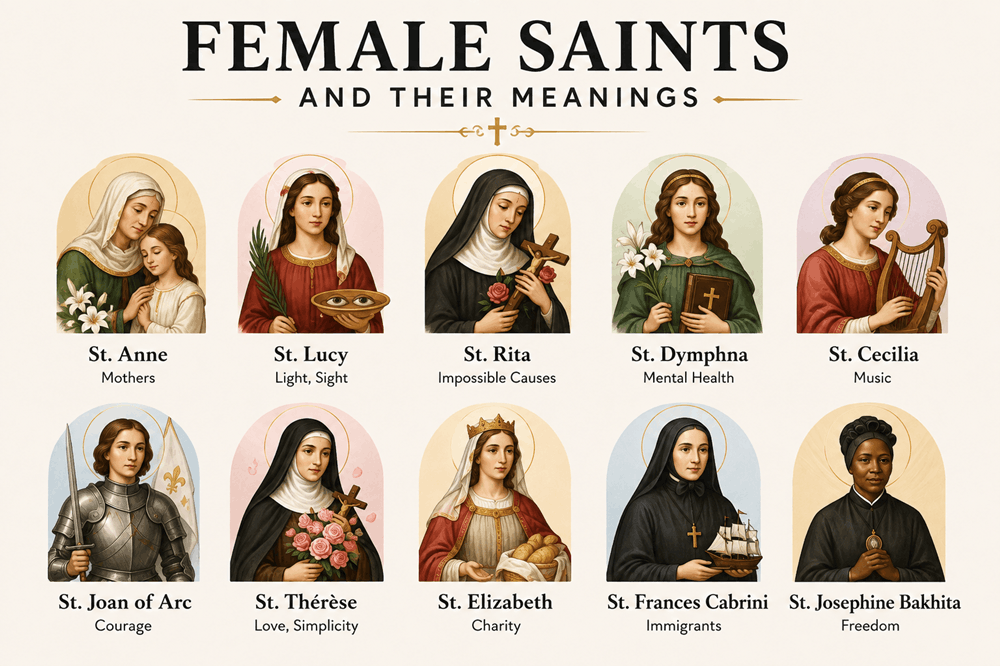
Why Do Saints Have Symbols?
Religious art developed visual symbols so viewers could recognize saints even when they could not read their names.
For example:
- St. Cecilia often appears with a musical instrument.
- St. Lucy may appear with eyes or a lamp.
- St. Catherine of Alexandria appears with a wheel.
- St. Joan of Arc appears in armor.
- St. Thérèse appears with roses.
- St. Clare may hold a monstrance.
- St. Barbara appears with a tower.
Once you learn these objects, paintings and statues of female saints become much easier to identify.
What Does It Mean for a Saint to Be a Patron Saint?
A patron saint is a saint who has traditionally become associated with a particular group, occupation, place, illness, activity, or situation.
For example:
St. Cecilia is associated with musicians.
St. Dymphna is associated with mental-health concerns.
St. Frances Cabrini is associated with immigrants.
These associations often developed because of something in the saint’s life, death, occupation, name, or later tradition.
They do not mean Christians believe the saint controls that area of life. In traditions that ask saints for intercession, the saint is understood as praying with or for the person seeking help.
The Bottom Line
Female saints represent an enormous range of experiences and qualities.
St. Joan of Arc represents courage.
St. Cecilia represents music.
St. Lucy represents light and sight.
St. Rita is associated with impossible causes.
St. Dymphna is associated with mental and emotional suffering.
St. Monica represents patient motherhood.
St. Thérèse represents love expressed through small things.
St. Elizabeth of Hungary represents charity.
St. Josephine Bakhita represents freedom and resilience.
St. Hildegard of Bingen represents creativity, music, learning, and nature.
The stories of these women are remarkably different. Some lived in ancient Rome, some in medieval Europe, and others survived into the modern era.
What connects them is not one personality or one kind of life.
It is the idea that courage, compassion, intelligence, faith, service, perseverance, creativity, and love can take many different forms.