Hamilton Songs in Order: The Complete Act One and Act Two Track List
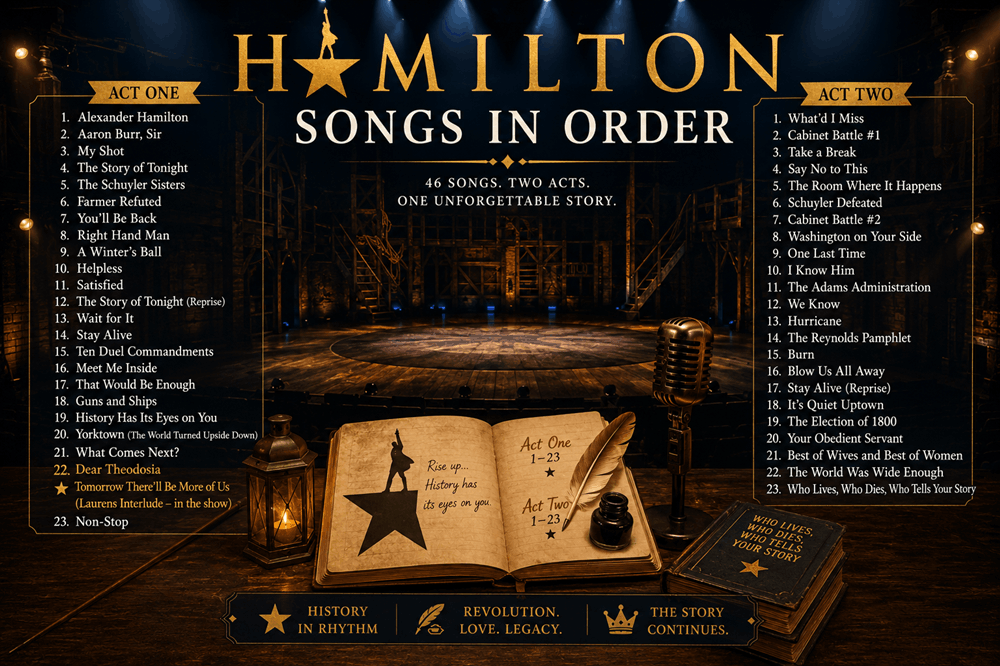
The original Broadway cast recording of Hamilton contains 46 songs, divided evenly between Act One and Act Two.
The songs are meant to be heard in sequence. Together, they tell Alexander Hamilton’s story from his arrival in New York and participation in the American Revolution to his political rise, personal scandals, family tragedies and fatal conflict with Aaron Burr.
Lin-Manuel Miranda wrote the musical’s book, music and lyrics, drawing from Ron Chernow’s biography of Hamilton and combining hip-hop, R&B, jazz, soul and traditional musical theater. (Lin-Manuel Miranda’s official Hamilton page)
The original Broadway cast recording was released on September 25, 2015. Its two discs correspond closely with the show’s two acts, although one brief stage scene was intentionally omitted from the album. (Atlantic Records’ official Hamilton page)
Hamilton Act One songs in order
1. “Alexander Hamilton”
The opening number introduces Hamilton’s childhood, migration to New York and relentless ambition.
Nearly every major character participates, but their descriptions carry different meanings. Some admire him, some love him and some already know how his life will end.
2. “Aaron Burr, Sir”
Hamilton arrives in New York and approaches Aaron Burr for advice.
Burr recommends caution and emotional restraint. Hamilton immediately begins moving in the opposite direction, joining John Laurens, Hercules Mulligan and the Marquis de Lafayette.
3. “My Shot”
Hamilton and his new friends describe their revolutionary ambitions.
The song establishes Hamilton’s defining belief that life must be used aggressively. He sees every opportunity as something that may disappear unless he acts immediately.
4. “The Story of Tonight”
Hamilton, Laurens, Lafayette and Mulligan imagine future generations remembering their struggle for independence.
Compared with “My Shot,” the arrangement is quieter and more intimate. The revolution briefly feels like a shared promise among friends.
5. “The Schuyler Sisters”
Angelica, Eliza and Peggy Schuyler explore New York as political unrest spreads through the colonies.
Angelica connects the language of revolution with women’s exclusion from political power, while Eliza becomes excited by the personal possibilities of the changing city.
6. “Farmer Refuted”
Hamilton publicly debates Loyalist Samuel Seabury.
Their overlapping arguments demonstrate how differently they use language. Seabury depends on order and repetition, while Hamilton interrupts, accelerates and overwhelms him.
7. “You’ll Be Back”
King George III addresses the colonies as though they are an ungrateful romantic partner.
The cheerful British-pop style makes his threats sound even more unsettling. He cannot imagine independence as a legitimate political demand.
8. “Right Hand Man”
George Washington takes command of a struggling Continental Army and searches for an aide capable of managing the growing crisis.
Hamilton wants battlefield glory, but Washington recognizes that his writing and organizational skills may be more valuable.
9. “A Winter’s Ball”
Burr and Hamilton briefly turn their attention from revolution toward romance.
The song introduces the social environment in which Hamilton meets Eliza Schuyler.
10. “Helpless”
Eliza recounts meeting Hamilton, falling in love and marrying him.
The song presents the romance through her perspective, using an upbeat R&B structure to capture the speed and excitement of their relationship.
11. “Satisfied”
Angelica rewinds the wedding celebration and reveals her own feelings for Hamilton.
She recognizes their intellectual connection but sacrifices the relationship, partly for Eliza’s happiness and partly because she believes Hamilton’s ambitions make him an unsuitable choice.
12. “The Story of Tonight (Reprise)”
Hamilton’s friends tease him after the wedding.
Burr reveals that he is involved with Theodosia, a woman married to a British officer. Hamilton challenges Burr’s tendency to hide his strongest feelings.
13. “Wait for It”
Burr explains the philosophy governing his life.
Unlike Hamilton, he does not believe that hesitation equals failure. He sees patience as strength, although the song also reveals how deeply he fears making an irreversible choice.
14. “Stay Alive”
The Revolutionary War becomes increasingly difficult.
Hamilton remains frustrated by Washington’s refusal to give him a military command, while General Charles Lee’s failures create conflict within the Continental Army.
15. “Ten Duel Commandments”
Laurens challenges Lee to a duel after Lee publicly attacks Washington.
The song explains the ritual of dueling through ten steps. Its structure later returns when Hamilton and Burr prepare for their own confrontation.
16. “Meet Me Inside”
Washington angrily confronts Hamilton after the duel.
Hamilton resents being treated like a son or subordinate, while Washington believes Hamilton’s impatience is threatening both his life and the revolutionary cause.
17. “That Would Be Enough”
Eliza tells Hamilton that she is pregnant and asks him to recognize that family life can be meaningful without wealth or historical fame.
Hamilton struggles to accept her definition of enough because he still believes his value depends on achievement.
18. “Guns and Ships”
Lafayette persuades Washington that Hamilton should receive a military command.
The song also demonstrates Lafayette’s growing importance to the revolution and the French support that helps change the direction of the war.
19. “History Has Its Eyes on You”
Washington warns Hamilton that leadership creates consequences extending far beyond the present moment.
Washington knows that future generations will judge their choices, even when those generations do not understand the pressure under which the choices were made.
20. “Yorktown (The World Turned Upside Down)”
Hamilton, Lafayette and the Continental forces prepare for and win the decisive Battle of Yorktown.
The number gives Hamilton the military achievement he has spent much of the act pursuing.
21. “What Comes Next?”
King George responds to the American victory with amused skepticism.
He argues that winning independence may prove easier than governing a divided nation.
22. “Dear Theodosia”
Hamilton and Burr sing separately to their newborn children.
For a brief moment, political competition disappears. Both men hope to create a safer and more promising country for the next generation.
23. “Non-Stop”
After the war, Hamilton becomes a lawyer, participates in the Constitutional Convention and helps write the Federalist Papers.
Washington asks him to become the first secretary of the Treasury. Eliza and Angelica worry that Hamilton’s work is consuming him, while Burr watches his rival advance.
The complete official cast-album sequence places 23 tracks in Act One, beginning with “Alexander Hamilton” and ending with “Non-Stop.” (Complete Hamilton cast-album list)
Is a song missing from Act One?
Yes. The stage production includes a short scene commonly called “Tomorrow There’ll Be More of Us” or the Laurens Interlude between “Dear Theodosia” and “Non-Stop.”
In the scene, Eliza tells Hamilton that John Laurens has died. Laurens briefly appears and reprises musical material from “The Story of Tonight.”
Lin-Manuel Miranda intentionally left the scene off the original cast album. Therefore, the album has 46 tracks, while the complete stage performance contains this additional musical interlude.
For the full dramatic order near the end of Act One, the sequence is:
- “Dear Theodosia”
- “Tomorrow There’ll Be More of Us”
- “Non-Stop”
Hamilton Act Two songs in order
1. “What’d I Miss”
Thomas Jefferson returns from France and enters the newly formed American government.
His relaxed, jazz-influenced entrance contrasts with the intense wartime music of Act One. He arrives prepared to become Hamilton’s political rival.
2. “Cabinet Battle #1”
Hamilton and Jefferson debate Hamilton’s proposal for the federal government to assume state debts and establish greater financial authority.
Washington turns the disagreement into a staged rap battle, translating an economic dispute into personal and ideological conflict.
3. “Take a Break”
Angelica visits the Hamilton family while Eliza asks her husband to join them on a summer trip.
Hamilton refuses because he is determined to complete his financial plan. His inability to step away from work leaves him emotionally and physically isolated.
4. “Say No to This”
Maria Reynolds approaches Hamilton and asks for help.
Their encounter develops into an affair, after which Maria’s husband uses the relationship to blackmail Hamilton. The song marks the moment Hamilton begins actively damaging the legacy he has worked to create.
5. “The Room Where It Happens”
Burr learns that Hamilton, Jefferson and James Madison reached a private political agreement.
Hamilton obtains support for his financial plan, while the national capital is placed along the Potomac. Burr becomes increasingly frustrated by his exclusion from important decisions.
6. “Schuyler Defeated”
Burr defeats Eliza’s father, Philip Schuyler, in a Senate election.
Hamilton interprets Burr’s changing political position as proof that Burr values advancement more than principle.
7. “Cabinet Battle #2”
Hamilton and Jefferson debate whether the United States should support France in its war against Britain.
Hamilton argues for neutrality, while Jefferson appeals to the assistance France provided during the American Revolution.
8. “Washington on Your Side”
Jefferson, Madison and Burr unite against Hamilton.
They resent his influence over Washington and begin searching for evidence they can use to weaken him.
9. “One Last Time”
Washington tells Hamilton that he intends to leave office.
Hamilton helps prepare Washington’s farewell address, while Washington argues that peacefully surrendering power will create a vital precedent for future presidents.
10. “I Know Him”
King George hears that Washington is stepping down and reacts with disbelief.
He becomes particularly amused when he learns that John Adams will become president.
11. “The Adams Administration”
Hamilton’s relationship with President Adams deteriorates.
Hamilton publishes an attack on Adams, further dividing his own political party and reducing his influence.
12. “We Know”
Jefferson, Madison and Burr confront Hamilton with evidence of payments made to James Reynolds.
They suspect government corruption. Hamilton reveals the affair and blackmail to prove that the payments involved personal misconduct rather than misuse of public funds.
13. “Hurricane”
Hamilton remembers surviving a Caribbean hurricane and writing his way out of poverty.
He decides that another written explanation can protect him from the Reynolds accusations, failing to recognize that public confession will create a much larger disaster.
14. “The Reynolds Pamphlet”
Hamilton publishes the details of his affair.
Although the pamphlet may protect him from accusations of financial corruption, it destroys his family’s privacy and severely damages his political future.
15. “Burn”
Eliza responds to Hamilton’s confession.
She rejects his attempt to control the historical account and removes herself from the narrative he has published for the world to read.
16. “Blow Us All Away”
Hamilton’s son Philip has grown into a confident young man.
After George Eacker publicly attacks Hamilton’s reputation, Philip challenges him to a duel.
17. “Stay Alive (Reprise)”
Philip is fatally wounded.
Hamilton and Eliza rush to him, but he dies with his parents beside him. Musical ideas from the earlier war scenes return in a devastating family context.
18. “It’s Quiet Uptown”
Hamilton and Eliza grieve after Philip’s death.
Hamilton withdraws from public life and seeks forgiveness. The song avoids offering an easy resolution, presenting reconciliation as something fragile and almost beyond language.
19. “The Election of 1800”
Jefferson and Burr compete for the presidency after receiving the same number of electoral votes.
Hamilton dislikes both candidates but supports Jefferson because he believes Jefferson possesses clearer principles.
20. “Your Obedient Servant”
Burr blames Hamilton for repeatedly damaging his political career.
Their exchange of increasingly hostile letters ends with Burr challenging Hamilton to a duel.
21. “Best of Wives and Best of Women”
Hamilton says goodbye to Eliza early in the morning.
He does not tell her that he is leaving to meet Burr, turning an ordinary marital exchange into their final conversation.
22. “The World Was Wide Enough”
Hamilton and Burr meet in Weehawken, New Jersey.
The song revisits the structure of “Ten Duel Commandments” but slows the decisive moment, allowing both men’s thoughts and choices to become clear before Burr fires.
23. “Who Lives, Who Dies, Who Tells Your Story”
The finale shifts attention from Hamilton’s achievements to the people who preserve, interpret and expand his legacy.
Eliza becomes the central figure. She spends decades protecting Hamilton’s writings, telling the stories of his fellow soldiers and creating a legacy of her own.
Act Two also contains 23 album tracks, beginning with “What’d I Miss” and ending with “Who Lives, Who Dies, Who Tells Your Story.”
The complete Hamilton track list without explanations
Act One
- “Alexander Hamilton”
- “Aaron Burr, Sir”
- “My Shot”
- “The Story of Tonight”
- “The Schuyler Sisters”
- “Farmer Refuted”
- “You’ll Be Back”
- “Right Hand Man”
- “A Winter’s Ball”
- “Helpless”
- “Satisfied”
- “The Story of Tonight (Reprise)”
- “Wait for It”
- “Stay Alive”
- “Ten Duel Commandments”
- “Meet Me Inside”
- “That Would Be Enough”
- “Guns and Ships”
- “History Has Its Eyes on You”
- “Yorktown (The World Turned Upside Down)”
- “What Comes Next?”
- “Dear Theodosia”
- “Non-Stop”
Act Two
- “What’d I Miss”
- “Cabinet Battle #1”
- “Take a Break”
- “Say No to This”
- “The Room Where It Happens”
- “Schuyler Defeated”
- “Cabinet Battle #2”
- “Washington on Your Side”
- “One Last Time”
- “I Know Him”
- “The Adams Administration”
- “We Know”
- “Hurricane”
- “The Reynolds Pamphlet”
- “Burn”
- “Blow Us All Away”
- “Stay Alive (Reprise)”
- “It’s Quiet Uptown”
- “The Election of 1800”
- “Your Obedient Servant”
- “Best of Wives and Best of Women”
- “The World Was Wide Enough”
- “Who Lives, Who Dies, Who Tells Your Story”
The complete cast album can be streamed through the official links to Apple Music and the other platforms listed by Atlantic Records.
Why should the songs be played in order?
Unlike an album made from mostly independent singles, Hamilton is almost entirely sung and rapped.
Important conversations, political developments and character decisions happen inside the musical numbers. Skipping a song may mean missing the reason a relationship changes or a later melody returns.
The sequence also creates deliberate parallels:
- “Helpless” and “Satisfied” present the same event from different perspectives.
- “Ten Duel Commandments” establishes the structure later used in “The World Was Wide Enough.”
- “Stay Alive” describes danger during war, while its reprise brings that danger into Hamilton’s family.
- “The Story of Tonight” celebrates youthful hopes, while the Laurens Interlude reveals what those hopes cost.
- “Burn” rejects Hamilton’s attempt to control the story, while the finale asks who ultimately preserves it.
The music therefore operates as memory. Earlier melodies return with altered meanings because the characters and circumstances have changed.
What happens in each act?
Act One is about Hamilton’s rise.
He arrives with almost nothing, joins the revolution, becomes Washington’s aide, marries Eliza, earns a military command and enters the new government.
The act ends with several people warning that he is working as though time is running out.
Act Two is about what that ambition costs.
Hamilton gains political influence but alienates rivals, neglects his family, begins an affair and publishes a confession that damages both his marriage and career. Philip’s death deepens the family tragedy, while Hamilton’s conflict with Burr leads to the final duel.
The musical’s last song then reframes the entire story through Eliza, asking whether legacy belongs to the person who acts or to the people who decide what should be remembered.
Final answer
The Hamilton original Broadway cast recording contains 46 tracks in total: 23 songs in Act One and 23 in Act Two.
Act One begins with “Alexander Hamilton” and ends with “Non-Stop.” Act Two begins with “What’d I Miss” and ends with “Who Lives, Who Dies, Who Tells Your Story.”
The stage production also includes the Laurens Interlude, “Tomorrow There’ll Be More of Us,” between “Dear Theodosia” and “Non-Stop,” but that scene was left off the original cast album.
Listening in order matters because the songs do not merely accompany the plot.
They are the plot.
Each repeated melody, changing rhythm and returning phrase shows how ambition, love, grief and memory transform the characters over time.