Free Music Streaming With No Ads: The Best Legal Options in 2026
Free music streaming without ads does exist, but the best options usually come with one limitation.
You may need a public-library card. You may have to listen to radio-style stations rather than choosing every song. The catalog may focus on classical or independent music. Some services allow only a few free plays before asking you to support the artist.
The main reality is:
No major mainstream service currently provides unlimited, permanent, on-demand access to nearly every popular song without either charging a subscription or playing advertisements.
Spotify Free and YouTube Music’s unpaid tier include ads. Amazon describes its free music tier as ad-supported. Apple Music is ad-free, but continued access requires a paid subscription after any introductory offer ends.
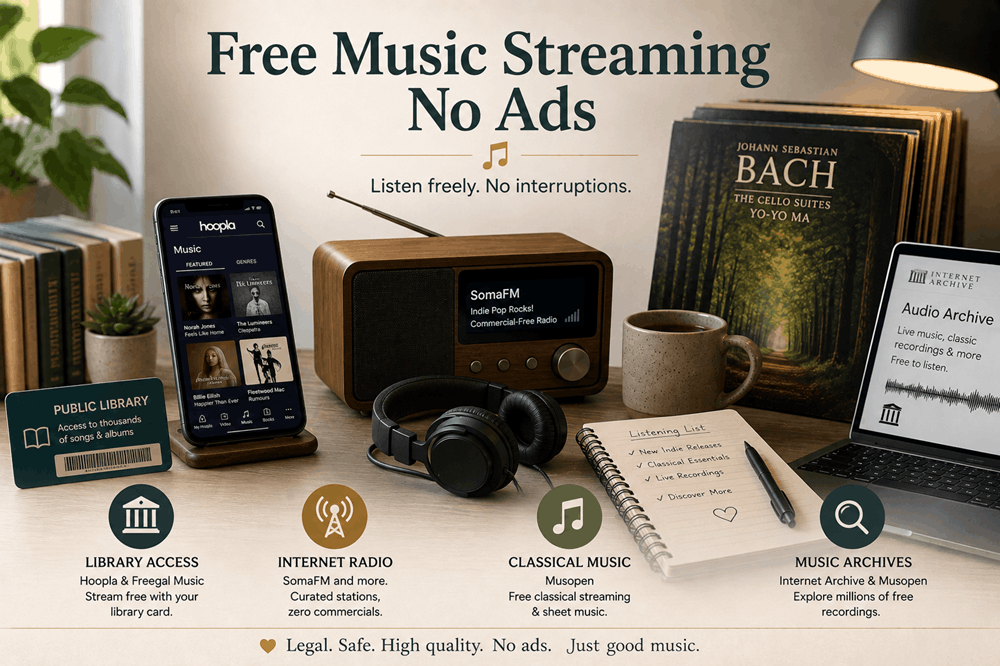
The strongest legal alternatives are library-supported services such as Hoopla and Freegal, listener-funded radio such as SomaFM, and specialist platforms such as Musopen and Bandcamp.
Best free ad-free music services at a glance
| Service | Best for | Can you choose songs? | Main limitation |
|---|---|---|---|
| Hoopla | Popular albums through a library | Yes | Library participation and borrowing limits |
| Freegal Music | Mainstream and catalog music | Yes | Requires a participating library |
| SomaFM | Continuous curated radio | No | Radio format; underground-focused catalog |
| Musopen | Classical music | Partly | Mainly public-domain classical recordings |
| Bandcamp | Independent music discovery | Yes | Free plays may be limited before purchase |
| Internet Archive | Live recordings and historical audio | Yes | Less polished search and uneven catalog |
1. Hoopla: the best place to check first
Hoopla is one of the strongest answers for listeners who want recognizable artists without commercials or a personal subscription fee.
The service works through participating public libraries. You create an account, connect a valid library card and borrow albums in much the same way you would borrow an ebook or audiobook.
Hoopla explicitly promotes its music service as free and ad-free. Its catalog covers pop, rock, hip-hop, country, classical, soundtracks and other major genres. Available albums can be streamed through its website and mobile apps.
The main limitation is that Hoopla access is controlled by your local library.
Libraries determine how many titles a patron can borrow each month, and some systems also use collective daily limits to control costs. Album availability can differ among libraries.
How to use Hoopla
- Visit your public library’s website.
- Search its digital resources for Hoopla.
- Register with your library card number and PIN.
- Browse the Music section.
- Borrow an album and begin streaming.
Hoopla is not identical to Spotify. You generally borrow albums rather than building an unlimited collection of individual tracks from the entire global catalog.
For people whose libraries offer a generous borrowing allowance, however, it may be the closest legal option to a free, mainstream and ad-free music service.
Best for: Complete albums from familiar artists.
2. Freegal Music: free streaming through participating libraries
Freegal Music is another library-funded service.
Its official site says it provides access to more than 15 million songs across over 200 genres. Users can stream music on compatible devices, create playlists and, where supported by the library, download a limited number of DRM-free tracks.
Some library systems explicitly describe Freegal as offering unlimited, ad-free streaming. For example, LA County Library promotes ad-free access through its Freegal service, while Los Angeles Public Library also offers unlimited streaming and weekly downloads to cardholders.
The exact experience depends on your library’s agreement.
Some libraries may enable streaming and downloads, while others may apply different weekly or monthly allowances. Freegal’s own FAQ recognizes that streaming availability can depend on the participating institution.
Freegal can be particularly valuable when its catalog complements Hoopla. One service may carry an album or artist that the other does not.
Best for: Library users who want playlists, individual songs and selected downloads.
3. SomaFM: genuinely commercial-free internet radio
SomaFM is a listener-supported internet-radio network offering more than 30 commercial-free channels.
Unlike Spotify, it does not allow you to select any song from a massive on-demand library. You choose a station and listen to the sequence curated by its programmers.
Its channels cover styles such as:
- Ambient and downtempo
- Indie pop and alternative music
- Electronic and experimental music
- Folk and Americana
- Reggae and ska
- Vintage lounge music
- Groove-oriented instrumental music
- Seasonal and specialty programming
SomaFM states directly that it does not run advertisements or commercial interruptions. It remains independent by relying on voluntary listener donations rather than corporate sponsors.
This makes SomaFM one of the clearest truly free, no-ad choices.
The compromise is control. You cannot usually search for one specific mainstream single and play it immediately. The service is designed for discovery and continuous background listening.
It works especially well when you want music for studying, working, reading, entertaining or relaxing without repeatedly choosing tracks.
Best for: Commercial-free radio and discovering music outside mainstream playlists.
4. Musopen: free classical music streaming
Musopen is a nonprofit organization focused on increasing access to classical music, sheet music and educational resources.
Its free radio service streams classical recordings through a browser and mobile app. Its broader player also allows users to explore public-domain recordings by composer, instrument, period and musical form.
Musopen is especially useful for listeners interested in composers such as:
- Johann Sebastian Bach
- Ludwig van Beethoven
- Frédéric Chopin
- Wolfgang Amadeus Mozart
- Pyotr Ilyich Tchaikovsky
- Antonio Vivaldi
- Claude Debussy
Because many compositions are in the public domain, Musopen can legally provide recordings and downloads under terms that differ from those of mainstream pop catalogs.
Its selection is not intended to replace Spotify or Apple Music for current chart releases. You may also find multiple performances of the same composition rather than one definitive commercial recording.
For classical listening, studying and peaceful background music, it remains one of the most useful free resources.
Best for: Classical music, studying and public-domain recordings.
5. Bandcamp: free independent-music discovery with limits
Bandcamp allows independent musicians and labels to publish music and sell it directly to listeners.
Most public releases can be played in full before purchase. There are no conventional audio-commercial breaks interrupting each album, and listeners can browse by genre, location, format and community recommendations.
Bandcamp should not be described as unlimited free streaming, however.
Its current policy allows artists to limit how many times an unpaid visitor can play a release. The default minimum is three full plays before Bandcamp displays a purchase prompt, although artists can raise or disable that limit. Once a release is purchased, the listener receives unlimited streaming through the free Bandcamp app.
This creates a different relationship from conventional streaming.
Bandcamp is designed for discovery first and artist support second. You can explore large amounts of music without a subscription, but repeated long-term listening may require purchasing the album.
Some artists also set releases to “name your price,” allowing listeners to download them free or contribute an amount they choose.
Best for: Indie, experimental and niche music—and directly supporting musicians you discover.
6. Internet Archive: free concerts and historical recordings
The Internet Archive Audio Archive contains an enormous collection of free audio.
Its holdings include:
- Live concerts
- Independent and Creative Commons music
- Netlabel releases
- Historical records
- 78 rpm recordings
- Radio broadcasts
- Spoken-word material
- Old-time radio
- Artist-authorized concert archives
The Archive states that many recordings can be streamed or downloaded free. Its music collections include thousands of live performances and extensive historical-audio projects.
The experience is closer to exploring a digital archive than using a polished commercial streaming app.
Metadata may be inconsistent. Some collections are easy to navigate, while others require patience. The catalog also does not provide comprehensive access to current commercial releases.
Users should check the usage and licensing information listed on each item. Material may be public domain, licensed by its creator or uploaded under specific preservation and sharing conditions.
Best for: Live music, archival recordings and unusual historical material.
Why Spotify Free is not ad-free
Spotify offers free access without requiring a credit card, but its free accounts include advertising.
Spotify’s own signup language describes the experience as songs and podcasts with occasional ads, and Spotify operates an advertising platform specifically designed to reach users during listening sessions.
The free plan may still be useful when you want:
- A large mainstream catalog
- Personalized playlists
- Cross-device support
- Music discovery
- Social sharing
It does not satisfy the requirement of uninterrupted, ad-free music.
Avoid browser extensions or modified applications claiming to remove Spotify ads without payment. Such tools may violate the service’s rules, expose login information or contain malware.
Is YouTube Music free without ads?
No. YouTube Music offers an unpaid version, but Google labels it “YouTube Music with ads.”
Ad-free music and music-video playback are benefits of YouTube Music Premium. Google also notes that Premium members may still encounter advertisements within some podcasts.
YouTube remains valuable for rare performances, unofficial remixes, live recordings and songs that may not appear on traditional streaming services.
But the standard free experience is not ad-free.
Is Amazon Music free without ads?
Amazon operates an ad-supported music tier.
Amazon’s advertising documentation explicitly describes its free first-party music tier as ad-supported. Amazon Music Unlimited provides broader subscription access, but it is a paid service rather than a permanent free alternative.
Prime membership may include certain music benefits, but Prime itself is not free. It should therefore not be included in a list of genuinely free services.
Is Apple Music free without ads?
Apple Music is ad-free, but it is not permanently free.
Apple may offer introductory access to eligible new subscribers, devices or promotions. Once that offer ends, continued use requires a paid Apple Music subscription. Apple describes its regular service as always ad-free.
A free trial can be useful when you need temporary ad-free access, but it is not a long-term solution unless you plan to pay or cancel before billing starts.
Always check the renewal date when activating a trial.
What “no ads” can still include
A service may be described as ad-free while still including noncommercial interruptions.
You might hear or see:
- Station identifications
- Requests for donations
- Messages encouraging you to support an artist
- Purchase prompts
- App announcements
- Public-radio fundraising messages
- Spoken introductions from DJs
These are different from paid third-party advertising, but they may still interrupt completely continuous playback.
SomaFM, for example, is commercial-free but relies on donation requests. Bandcamp does not behave like an advertising-funded radio platform, but it may ask you to buy an album after several plays.
Which option is best?
The best service depends on the music you want and how much control you need.
Choose Hoopla when:
- Your library participates
- You want recognizable albums
- You are comfortable with borrowing limits
- You want mobile and web access
Choose Freegal when:
- Your library offers it
- You prefer individual tracks and playlists
- You want occasional permanent downloads
- You need a more conventional music-library interface
Choose SomaFM when:
- You want music playing continuously
- You enjoy human-curated stations
- You do not need to select every song
- You like ambient, indie or alternative genres
Choose Musopen when:
- You mainly listen to classical music
- You want public-domain recordings
- You need peaceful study music
- You want to browse by composer or instrument
Choose Bandcamp when:
- You want to discover independent artists
- You are willing to purchase favorite releases
- You prefer album-focused listening
- You want your money to support musicians more directly
Choose Internet Archive when:
- You enjoy live recordings
- You want historical or unusual audio
- You do not mind searching through an archive
- You want downloadable collections
How to find library-based music services
Start with your local library’s website.
Search for sections labeled:
- Digital Library
- Online Resources
- Music
- Streaming Media
- Freegal
- Hoopla
- Naxos Music Library
Your library may offer services that are not prominently displayed on its homepage. Contact a librarian when you cannot locate them.
Some library systems allow residents to apply for a digital card online. Eligibility rules vary and may require local residency, identification or an in-person visit.
Library access is not technically “free” in the sense that no one pays for it. The service is financed through the library’s budget, allowing eligible patrons to use it without an individual subscription.
Avoid illegal “free premium” websites
Websites offering free access to premium streaming accounts, modified applications or copyrighted music without authorization can create several risks.
They may:
- Steal account credentials
- Install malicious software
- Display deceptive download buttons
- Collect payment information
- Redirect visitors to scam pages
- Disappear without warning
- Distribute unauthorized recordings
- Violate streaming-service terms
A legitimate free service should clearly identify who operates it and why the music is available without a subscription.
The safest models are transparent:
- A public library pays for patron access.
- Listeners voluntarily support a radio station.
- Artists permit previews or free downloads.
- A nonprofit provides public-domain recordings.
- An archive hosts material under stated permissions.
“Free” should have an understandable business or legal explanation.
Final answer
The best completely free, ad-free music option is usually a service supplied by your public library.
Hoopla is the strongest first choice for complete popular albums, while Freegal Music offers a large catalog, playlists and—through some libraries—weekly downloads.
For uninterrupted radio, SomaFM is one of the clearest genuinely commercial-free options. Musopen is best for classical music, while Bandcamp offers limited free listening to independent artists before encouraging a purchase. The Internet Archive is valuable for live and historical recordings.
Spotify Free, YouTube Music’s unpaid tier and Amazon Music’s free tier all rely on advertising. Apple Music removes ads but eventually requires payment.
Free, legal and ad-free listening is therefore possible.
You simply have to choose which compromise works best:
A library card.
A radio-style format.
A specialist catalog.
Or a platform that asks you to support the artists you continue enjoying.