Where Was The Sound of Music Filmed? The Real Locations Behind the Movie
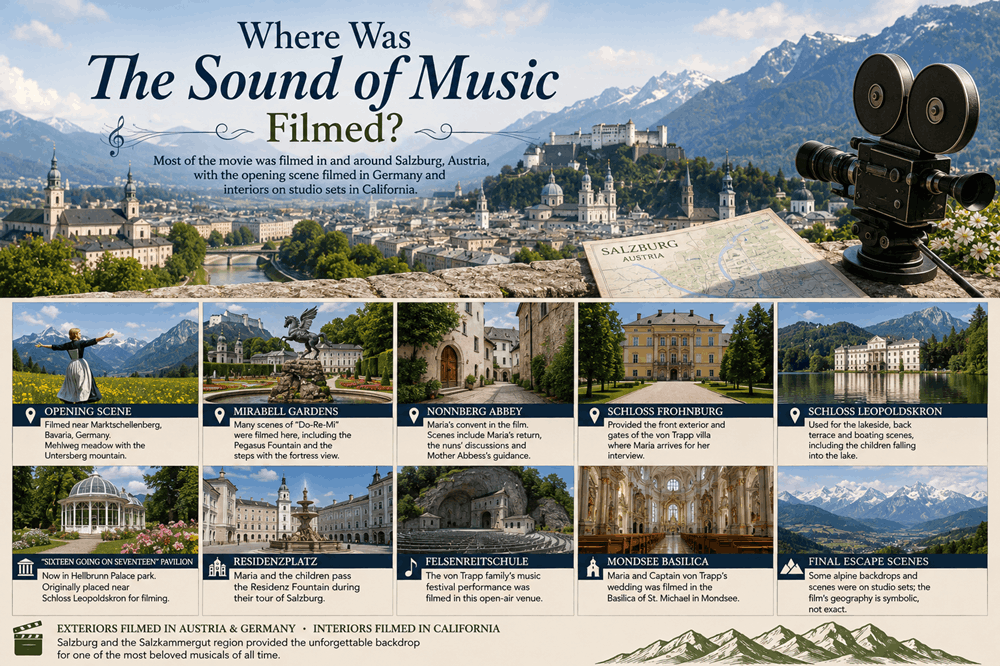
The Sound of Music was filmed primarily in Salzburg and the surrounding Austrian countryside, with additional mountain scenes shot just across the German border and most interior scenes created at the former 20th Century Fox studios in Los Angeles.
The film’s unforgettable landscape is therefore a careful combination of real places and Hollywood sets.
Salzburg provided the gardens, streets, abbey, palaces and performance venue. The nearby Salzkammergut lake district supplied the panoramic water-and-mountain views. Mondsee provided Maria and Captain von Trapp’s wedding church. A Bavarian meadow near Marktschellenberg became the hill on which Julie Andrews sang the title song.
The main answer is:
Most of the famous outdoor scenes were filmed in and around Salzburg, Austria, but the opening hill was in Germany and many interiors were filmed in California.
Salzburg’s official tourism board maintains a detailed guide to the movie’s original shooting locations. (Salzburg)
Was The Sound of Music really filmed in Austria?
Yes. Many of the film’s most recognizable scenes were photographed at real Austrian locations during the spring and summer of 1964.
Salzburg was not merely a distant background. Its gardens, fountains, churches, streets and historic architecture became essential parts of the story. Mirabell Gardens, Nonnberg Abbey, Schloss Leopoldskron, Schloss Frohnburg and the Felsenreitschule all appear on screen.
The production also traveled beyond Salzburg to the Salzkammergut lake district and the town of Mondsee. However, the finished movie blends those locations so smoothly that places separated by considerable distances can appear to belong to one continuous neighborhood. (Salzburg)
Where was the opening scene filmed?
The famous opening scene, in which Maria turns across a meadow and sings the title song, was filmed near Marktschellenberg in Bavaria, Germany.
The meadow lies along the Mehlweg, near the Untersberg mountain and only a short distance from the Austrian border. Marktschellenberg’s municipal tourism site confirms that Julie Andrews performed the scene there with the Untersberg behind her. (Marktschellenberg)
This surprises many viewers because the scene is meant to represent the Austrian Alps. The landscape does not look noticeably different from the countryside surrounding Salzburg, allowing the German meadow to fit naturally into the movie.
The exact site is private agricultural land rather than a public film attraction. Visitors should not attempt to enter the field without permission. Its isolation is part of why the scene still feels so open and untouched.
Mirabell Gardens: the heart of “Do-Re-Mi”
Many of the liveliest sections of “Do-Re-Mi” were filmed in Mirabell Gardens, beside Mirabell Palace in central Salzburg.
Maria and the children move through several recognizable parts of the formal Baroque gardens, including the Pegasus Fountain, the hedge-lined paths, the vine tunnel and the steps leading toward the garden’s elevated terrace.
The children circle the Pegasus Fountain, imitate the poses of statues and finish the musical sequence on the steps with Salzburg’s fortress visible behind them. Salzburg’s official film-location archive specifically identifies the fountain as the place where Maria and the children danced during “Do-Re-Mi.” (Salzburg)
Mirabell Gardens remains one of the easiest locations for visitors to recognize because the basic layout, fountains and sculptural details have been preserved.
Unlike some of the film’s palace locations, it lies within the city center and can be incorporated into an ordinary walk through Salzburg.
Nonnberg Abbey: Maria’s convent
Nonnberg Abbey, positioned above Salzburg’s historic center, provided the exterior setting for the convent where Maria begins the story.
The abbey appears when Maria returns late, when the nuns discuss what to do with her and during later scenes connected with her decision to leave convent life. Salzburg’s official location guide describes Nonnberg as the place where the film’s story begins, while its anniversary archive identifies it with the nuns’ “Maria” sequence and the Mother Abbess’s guidance. (Salzburg)
Nonnberg is not a fictional movie building. It is a functioning Benedictine abbey with a history reaching back many centuries.
The production used recognizable exterior areas, including the entrance and surrounding streets. Some interior convent scenes, however, were recreated on studio sets in Los Angeles rather than filmed inside the working abbey. (The Studio Tour)
The real Maria Kutschera also had a connection with Nonnberg Abbey, although the movie changes many details of her life and relationship with the von Trapp family.
Where was the von Trapp house filmed?
The movie’s von Trapp villa was not one complete house.
Its exterior identity was assembled from Schloss Frohnburg, Schloss Leopoldskron and studio sets constructed in California.
Schloss Frohnburg provided the front entrance
Schloss Frohnburg, located along Salzburg’s tree-lined Hellbrunner Allee, supplied the villa’s imposing front façade, gates and approach.
Maria passes Frohnburg near the end of “I Have Confidence” before nervously arriving to meet Captain von Trapp and his children. Salzburg’s official archive identifies the palace as the villa Maria sees when she approaches her new position. (Salzburg)
The symmetrical yellow building and long avenue created the formal, slightly intimidating impression needed for Captain von Trapp’s household.
Frohnburg did not provide every view of the family home. When characters move toward the lake or gather on the rear terrace, the movie shifts to another property.
Schloss Leopoldskron provided the lakeside
The lakeside terrace and garden scenes were filmed at Schloss Leopoldskron, a Rococo palace beside the Leopoldskroner Weiher in Salzburg.
The palace grounds appear in scenes involving the rear of the villa, the terrace and the lake. The memorable sequence in which the children fall from a boat into the water was filmed there. Schloss Leopoldskron’s official site describes its gardens and lake as major parts of the movie’s visual history. (Schloss Leopoldskron)
The building seen across the water became closely associated with the von Trapp home, but audiences never receive a geographically accurate tour of one real property.
The front belongs to Frohnburg. The lakeside belongs to Leopoldskron. The rooms inside belong largely to Hollywood.
The villa interiors were built in Los Angeles
The grand staircase, ballroom, bedrooms and much of the family’s interior living space were created on soundstages at the 20th Century Fox studio complex in Century City, Los Angeles.
Production began on a studio set before the cast traveled to Austria, and historical studio records indicate that most interiors were completed in California. (IMDb)
The designers copied and adapted details from Austrian palaces to make the sets feel connected to the Salzburg exteriors. The transition works so well that viewers may assume the camera simply moved through a door into the real palace.
In reality, the movie’s von Trapp villa is one of its most effective illusions: three separate environments joined through editing and design. (Architectural Digest)
Where is the “Sixteen Going on Seventeen” gazebo?
The glass pavilion associated with “Sixteen Going on Seventeen” can now be found in the park at Hellbrunn Palace in Salzburg.
The structure was originally positioned near Schloss Leopoldskron for exterior filming. It was later moved to Hellbrunn, where it became a popular attraction for visitors. Hellbrunn’s official site identifies the pavilion with the Liesl and Rolf duet. (Hellbrunn Palace)
The actors did not perform the entire dance inside that small outdoor structure.
The exterior pavilion appears in the film, but its interior was recreated on a larger soundstage so the performers and cameras would have enough room for the choreography. The reprise of “Something Good” is also associated with the pavilion. (People.com)
The gazebo demonstrates how the production combined a real exterior prop with an enlarged studio interior while presenting both as the same space.
Residenzplatz and Salzburg’s Old Town
Several city scenes were filmed around Salzburg’s historic center.
One of the most recognizable locations is Residenzplatz, the large square dominated by the Residenz Fountain. Maria crosses the square, and she and the children later pass the fountain while exploring Salzburg.
Salzburg’s official description of Residenzplatz notes its appearance during Maria and the children’s musical tour through the city. (Salzburg.info)
Other portions of “Do-Re-Mi” and the city montages use streets, squares, bridges and viewpoints around central Salzburg.
These sequences allow the film to present the city almost as another character. Salzburg changes from an unfamiliar place Maria must enter into a landscape she and the children learn to experience playfully.
Where was the music festival filmed?
The von Trapp family’s final public performance was filmed at the Felsenreitschule, also known as the Summer Riding School.
This open-air Salzburg performance venue was carved into the Mönchsberg rock and contains distinctive rows of arched openings behind the stage. In the movie, the family performs at the festival before using its farewell song as part of its escape.
Salzburg’s location guide identifies the Felsenreitschule as the stage where Maria, Captain von Trapp and the children compete and perform their folk songs. (Salzburg Blog)
The venue remains active and is associated with the Salzburg Festival. Its real theatrical scale gives the sequence a quality that would have been difficult to reproduce completely on a studio stage.
Where was the wedding scene filmed?
Maria and Captain von Trapp’s wedding was filmed inside the Basilica of St. Michael in Mondsee, approximately 30 kilometers east of Salzburg.
The church’s long central aisle, ornate altar and pale interior create the dramatic procession seen as Maria walks toward the captain. Mondsee’s official tourism site confirms that the basilica was used for the wedding scene. (Mondsee)
In the story, the audience may assume the wedding takes place close to the abbey and family home. Mondsee is actually a separate town in the Salzkammergut region.
The movie does not emphasize that geographical change. It simply selects the church that gives the scene the strongest visual and emotional scale.
The real Maria and Georg von Trapp did not marry in the Mondsee basilica. Their actual wedding took place at Nonnberg Abbey.
The Salzkammergut lakes and mountain scenery
The expansive aerial views at the beginning of the movie were filmed across the Salzkammergut, Austria’s lake district east of Salzburg.
The area contains mountain villages, alpine lakes and sweeping elevated viewpoints that helped establish the almost storybook landscape surrounding the film.
St. Gilgen and Wolfgangsee appear in aerial footage, while the scenery around the lake region is used during Maria and the children’s outings. Salzburg’s official image archive identifies St. Gilgen as one of the villages seen from above during the title sequence and associates the Schafberg Railway with their mountain excursion. (Salzburg)
These shots are one reason the movie’s geography can feel much larger than Salzburg itself.
The film combines the compact streets of the city with lakes and peaks spread across the surrounding region, creating an idealized version of Austria rather than a literal map of Maria’s daily movements.
Were the escape scenes filmed in Switzerland?
No. The final mountain escape was not filmed in Switzerland.
The characters are shown climbing toward supposed safety after leaving Salzburg, but the film’s geography is symbolic rather than accurate. In reality, Switzerland lies west of Salzburg, and walking across the mountains shown in the movie would not have taken the family directly there.
Some of the alpine backgrounds and escape imagery were also recreated or enhanced on studio sets using painted scenery. Production accounts describe hand-painted backdrops used for the final mountain view and other sequences that appear to have been photographed entirely outdoors. (Architectural Digest)
The real von Trapp family did not secretly climb over the Alps on foot. They left Austria by train and traveled openly before eventually emigrating to the United States.
Why were so many different locations combined?
Director Robert Wise and production designer Boris Leven were not attempting to create a documentary map of Salzburg.
They selected each location for the emotional quality it contributed.
Frohnburg made the von Trapp home look imposing from the front. Leopoldskron supplied romantic water views. Mondsee provided a more visually dramatic wedding church. Mirabell Gardens gave “Do-Re-Mi” movement and color, while the Felsenreitschule gave the final performance real architectural scale.
Studio sets then allowed the filmmakers to control lighting, sound, choreography and camera movement.
The result is not geographically precise, but it is visually coherent. Viewers accept several palaces, towns and studio interiors as one continuous world because the film maintains a consistent architectural and emotional atmosphere.
Can you visit the filming locations?
Many of the most famous sites can still be visited.
Mirabell Gardens, Residenzplatz, Nonnberg Abbey’s public church area, the Felsenreitschule, Hellbrunn Palace park and the Basilica of St. Michael are established visitor destinations.
Schloss Leopoldskron operates as a hotel and institutional venue, so access differs from that of a public city park. Its lakeside can also be viewed from paths across the water. Frohnburg is not presented as a conventional movie attraction, although its exterior can be seen along Hellbrunner Allee. (Salzburg)
Visitors should remember that some locations remain religious institutions, educational properties, hotels or private land.
The easiest self-guided route concentrates on Mirabell Gardens, Salzburg Old Town and Nonnberg Abbey. Leopoldskron, Hellbrunn and Mondsee generally require additional travel.
Final answer
The Sound of Music was filmed mainly in Salzburg, Austria, and the nearby Salzkammergut lake district.
Mirabell Gardens became the setting for much of “Do-Re-Mi.” Nonnberg Abbey represented Maria’s convent. Schloss Frohnburg supplied the front of the von Trapp villa, while Schloss Leopoldskron supplied its lake and terrace. The Felsenreitschule hosted the family’s festival performance, and the Basilica of St. Michael in Mondsee became the wedding church.
The opening meadow was filmed near Marktschellenberg in Germany, and most of the movie’s interiors were constructed on soundstages in Los Angeles.
The film’s Austria is therefore both real and invented.
Its mountains, gardens and city squares genuinely exist, but the filmmakers rearranged them into an ideal landscape where a German meadow, two Salzburg palaces, an Austrian lakeside church and a California studio could all appear to belong to the same journey.