“Thriller” Lyrics Meaning: Why Michael Jackson Makes Fear Feel Irresistible
“Thriller” by Michael Jackson is about being trapped inside a horror story where darkness, monsters and death appear to close in from every direction.
But the song is not designed to make fear purely unpleasant.
Its narrator describes terrifying danger while turning that danger into entertainment, attraction and physical excitement. The beat encourages movement, the chorus invites participation and the person supposedly offering protection may be connected to the threat.
That creates the song’s central contradiction:
The listener is warned to fear the night while being encouraged to enjoy every second of it.
“Thriller” succeeds because it understands why people watch horror films. We do not always want to feel safe. Sometimes we want to approach danger from a protected distance, experience the rush and then return to ordinary life.
The song turns that desire into music.
What is “Thriller” about?
“Thriller” follows a person who appears to be walking through the night with a companion as the surrounding world becomes increasingly threatening.
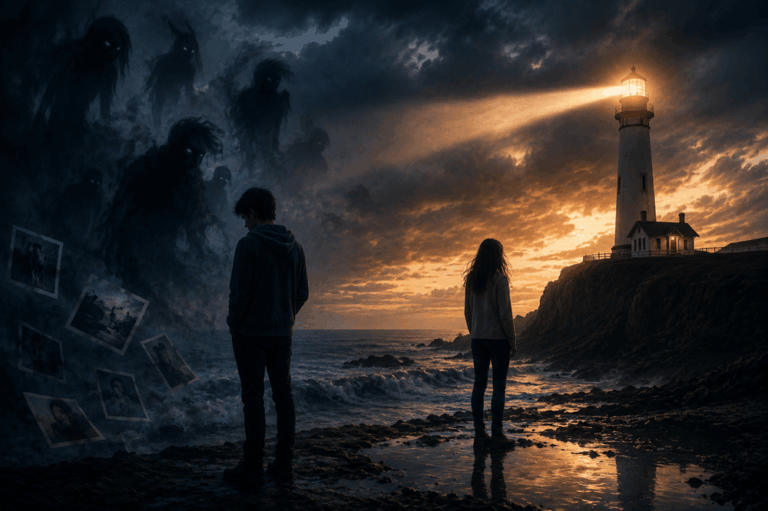
Something moves in the darkness. The victim freezes, loses the ability to call for help and realizes that escape may be impossible. Creatures gather, the dead return and the night begins to resemble a horror movie.
The narrator seems to understand exactly what is happening.
At first, he appears to be warning his companion. He describes the danger, recognizes her fear and offers physical closeness.
Yet he never sounds frightened himself.
That calmness makes his role uncertain. He may be a guide who knows how to survive the night. He may be enjoying the other person’s terror. He may even be one of the creatures she should fear.
The lyrics leave that ambiguity unresolved.
The narrator stands close enough to offer safety and close enough to become the threat.
The song behaves like a horror-film trailer
“Thriller” does not tell a complete story with clearly developed characters.
Instead, it moves through familiar horror images:
- Midnight
- Moonlight
- A sudden presence in the darkness
- Paralysis
- Creatures approaching
- The dead rising
- An inescapable final attack
These images work like scenes in a movie trailer. Each one increases the danger without pausing to explain the world logically.
We do not learn where the narrator and his companion are going or why the creatures have appeared. The lack of explanation makes the night feel more dreamlike.
The song is interested in the sensation of horror rather than the rules of one particular monster story.
The danger can therefore keep changing. It begins as something hidden nearby, becomes a beast preparing to strike and expands into an entire landscape filled with supernatural creatures.
There is no single enemy to defeat.
The night itself has become hostile.
Midnight represents the loss of ordinary rules
Midnight is more than a time on a clock.
It marks the boundary between an ordinary evening and a world where familiar protections no longer seem reliable.
During the day, streets, houses and people can be understood clearly. At midnight, visibility weakens and imagination becomes more powerful. An indistinct shape can become a monster because the mind supplies details the eyes cannot confirm.
That uncertainty is essential to “Thriller.”
The victim does not know exactly what is approaching. Fear begins before the threat is fully visible.
This is how anticipation works in horror. What might happen often creates more anxiety than what has already happened.
The song stretches that moment.
It keeps the listener waiting for the creature to emerge while the rhythm steadily moves forward.
Why is the victim unable to scream or move?
The lyrics repeatedly describe physical paralysis.
The person wants to call for help but cannot produce a sound. The body becomes cold, movement stops and fear takes control before any attack has actually occurred.
This reflects a recognizable response to danger.
People often imagine fear as immediate running or fighting. In reality, the body may freeze when it cannot quickly determine what to do.
Within the song, paralysis also creates helplessness.
The victim cannot escape through strength, speed or intelligence. The approaching creature has already gained control simply by being seen.
The inability to scream is particularly important because screaming is one of horror cinema’s most familiar reactions. Taking that ability away makes the fear feel private.
No one else can hear what is happening.
The victim experiences terror while the surrounding world remains silent.
The chorus turns survival into entertainment
The verses describe a person fighting for survival.
The chorus turns that struggle into a named attraction: a “thriller night.”
That phrase sounds like the title of an event someone might choose to attend. The terror becomes a spectacle with its own atmosphere and excitement.
This is where the song stops behaving like a realistic warning.
If the narrator truly wanted his companion to avoid danger, he would help her leave. Instead, he repeatedly describes how exciting and unavoidable the night has become.
The chorus operates like a carnival host announcing the main attraction.
Come closer.
The frightening part is about to begin.
This is why the song feels playful even when its images are violent. The fear is theatrical. Listeners are invited to imagine themselves inside the nightmare while remaining protected by the music.
The narrator offers comfort but may not be trustworthy
The narrator suggests that his companion should move closer to him.
On one level, this is reassuring. When someone is frightened, physical closeness can provide comfort and protection.
On another level, he may be using fear to create intimacy.
He emphasizes that no one else will save her, making himself appear to be the only available source of safety. The more dangerous the night becomes, the more she may depend on him.
That makes the relationship slightly unsettling.
A trustworthy protector tries to reduce fear.
The narrator appears to increase it.
He describes each threat in detail and seems almost entertained by the other person’s reaction. He knows too much about what is approaching and remains too calm while she becomes paralyzed.
The song never confirms that he created the danger. It leaves enough doubt to make the listener suspicious.
Perhaps she is not standing beside the hero.
Perhaps she is already standing beside the monster.
Fear and attraction become difficult to separate
“Thriller” uses horror as a form of seduction.
The narrator and his companion are brought physically closer by the danger around them. Her fear gives him an opportunity to hold her, while his confidence makes him seem powerful.
This does not turn the song into a conventional love story.
The connection depends on uncertainty. She may be drawn toward him because he appears to understand the night, but that same knowledge makes him potentially dangerous.
Horror often creates this mixture of attraction and fear.
Monsters are threatening because they break ordinary boundaries, but that freedom can also make them fascinating. They act without following the rules that control everyone else.
The narrator carries some of that appeal.
He does not seem trapped by the nightmare.
He appears to belong inside it.
Vincent Price makes the ending feel unavoidable
The final spoken section is performed by horror-film actor Vincent Price, whose voice changes the song from a personal encounter into a grand supernatural announcement.
Price does not sound like another frightened character.
He sounds like an authority explaining that darkness has taken control. His formal delivery gives the creatures a sense of ancient ceremony, as though what is happening is part of a ritual that has occurred many times before.
Rod Temperton wrote both the song and Price’s spoken material. Quincy Jones later recalled that Temperton composed the Price section while traveling to the studio, and the official Michael Jackson site credits Price’s performance within the track.
The narration expands the scale of the danger.
The earlier verses focus on one frightened person. Price describes a world in which darkness spreads across the land and supernatural forces move through entire neighborhoods.
The victim is no longer dealing with an isolated creature.
The normal world has been overtaken.
Price’s laugh then provides the final sound of the song. It does not offer resolution or confirm that anyone escaped.
The nightmare appears to continue after the music ends.
How the production makes horror danceable
“Thriller” was written by Rod Temperton and produced by Quincy Jones. It appears as the fourth track on Jackson’s 1982 album of the same name.
The recording combines horror-film sound effects with a tightly controlled dance groove.
Creaking, footsteps, animal sounds and wind-like textures suggest that something is approaching. Beneath them, the bass and drums remain steady enough for the listener to move confidently.
That contrast is the song’s musical secret.
The sound effects say that the environment is unsafe.
The rhythm says that the listener is in control.
Instead of making the audience retreat from the fear, the production gives fear a beat. Each frightening sound becomes part of the entertainment rather than an interruption to it.
Jackson’s vocal moves between warning, excitement and playful menace. He sounds dramatic without sounding genuinely overwhelmed.
The performance keeps one foot inside the nightmare and one foot outside it.
He is acting frightened enough to tell the story.
He is enjoying himself too much to seem like a victim.
“Thriller” began as a very different song
Temperton’s original version was called “Starlight.”
After Jones asked him to reconsider the title, Temperton reportedly generated hundreds of alternatives before arriving at “Thriller.” He later explained that the word immediately felt visually powerful and commercially memorable.
The title change transformed the song.
“Starlight” suggests beauty, distance and romance. “Thriller” suggests movement, suspense and a complete entertainment genre.
The new title also allowed the song to become larger than its lyrics.
It could name the track, the album, a visual project and eventually an entire cultural event. The Library of Congress notes that the title track was one of three Temperton compositions selected for the nine-song album, alongside “Baby Be Mine” and “The Lady in My Life.”
The word does not identify one specific monster.
It promises a particular experience.
Something exciting and frightening is about to happen.
What the short film adds
The official “Thriller” short film was directed by John Landis and expands the song into a story about movies, transformation and the uncertainty of what is real.
Jackson and his date, played by Ola Ray, first appear inside a 1950s-style horror scene. Jackson transforms into a creature and attacks her, but the sequence is revealed to be a film they are watching in a theater.
They leave the theater, apparently returning to reality.
Then the dead rise from a graveyard, Jackson becomes part of the zombie group and the famous dance sequence begins.
The story repeatedly offers safety and then removes it.
First, the monster attack is only a movie.
Then the world outside the movie becomes supernatural.
Finally, Jackson appears normal again before looking toward the audience with monstrous eyes.
The ending prevents viewers from placing the horror safely inside fiction.
Perhaps everything was a performance.
Perhaps the monster was present all along.
The nearly 14-minute production helped redefine the scale of music video, and the Library of Congress selected it for the National Film Registry in 2009 because of its cultural, historical and aesthetic importance.
The dance sequence changes the meaning of the zombies
Zombies traditionally represent bodies that have lost individuality.
They move without independent thought and belong to a crowd controlled by death.
In the short film, however, choreography gives the group precision, personality and visual pleasure.
The zombies remain frightening, but they are also impressive.
This reversal reflects the song’s larger method. Horror is not removed. It is reorganized into entertainment.
The dance also makes Jackson’s transformation more important.
He does not simply run from the creatures or defeat them. He joins them and becomes their leader.
The person who appeared to be protecting his date now controls the nightmare surrounding her.
That moment confirms what the lyrics only suggest:
The narrator understands the monsters because he may be one of them.
The viewer becomes part of the trap
The short film includes people watching a horror movie before becoming trapped in a horror story themselves.
That structure makes spectatorship part of the subject.
Ola Ray’s character initially watches fear from a theater seat, where she knows she is physically safe. Once she leaves, the boundary between audience and victim disappears.
The real viewer experiences a similar trick.
We watch Jackson and Ray watching a movie, then follow them outside and accept that the second world is more real. The final glance toward the camera breaks that confidence again.
The monster does not only look at the woman beside him.
He looks at us.
“Thriller” therefore asks why we enjoy watching danger and then reminds us that horror becomes less comfortable when it seems capable of watching back.
Why “Thriller” became inseparable from Halloween
The song does not mention Halloween directly.
Its midnight setting, supernatural creatures, theatrical laughter and danceable darkness nevertheless made it ideal for the holiday.
Halloween allows people to temporarily adopt frightening identities without becoming genuinely dangerous. Costumes, decorations and horror films turn fear into a controlled social experience.
“Thriller” does the same thing musically.
It gives listeners monsters without requiring real danger. It provides screams, suspense and death imagery inside a polished pop structure.
The short film strengthened that association by giving the song instantly recognizable visual symbols: the red jacket, the graveyard, the transformation and the zombie dance.
The song became the seventh and final single released from Thriller, while the short film helped establish music video as a format capable of carrying cinematic storytelling on an unprecedented scale.
Its lasting success comes from repetition without exhaustion.
Every Halloween, the same creatures rise again.
That predictability is part of the pleasure.
Confirmed background versus interpretation
It is confirmed that Rod Temperton wrote “Thriller,” Quincy Jones produced it and Vincent Price performed its spoken horror narration. The track appears on Jackson’s 1982 album Thriller, which was added to the National Recording Registry in 2007.
It is also confirmed that John Landis directed the short film and that the Library of Congress selected it for preservation in the National Film Registry in 2009.
The ideas that the narrator uses fear to create intimacy, that he may secretly be one of the creatures and that the chorus behaves like an advertisement for danger are interpretations.
The lyrics do not identify the narrator’s true nature.
The short film deliberately keeps that question open.
Final meaning
“Thriller” is about the pleasure of entering a nightmare when the nightmare has been transformed into entertainment.
The song surrounds its victim with darkness, creatures and the possibility of death. Escape appears impossible, and even the narrator offering protection cannot be completely trusted.
Yet the music never allows fear to become purely miserable.
The rhythm keeps moving. The chorus makes the danger memorable. Vincent Price turns death into theater, while Michael Jackson performs the story with enough excitement to make the listener want to remain inside it.
That is the meaning of “Thriller.”
It is not simply a song about monsters attacking at midnight.
It is a song about why people willingly approach monsters in stories, music and film. Fear makes the body react. Distance makes the reaction enjoyable.
For a few minutes, listeners can enter the darkness, dance beside the dead and imagine that danger is close enough to feel but controlled enough to survive.
The night is frightening.
That is exactly why no one wants it to end.