
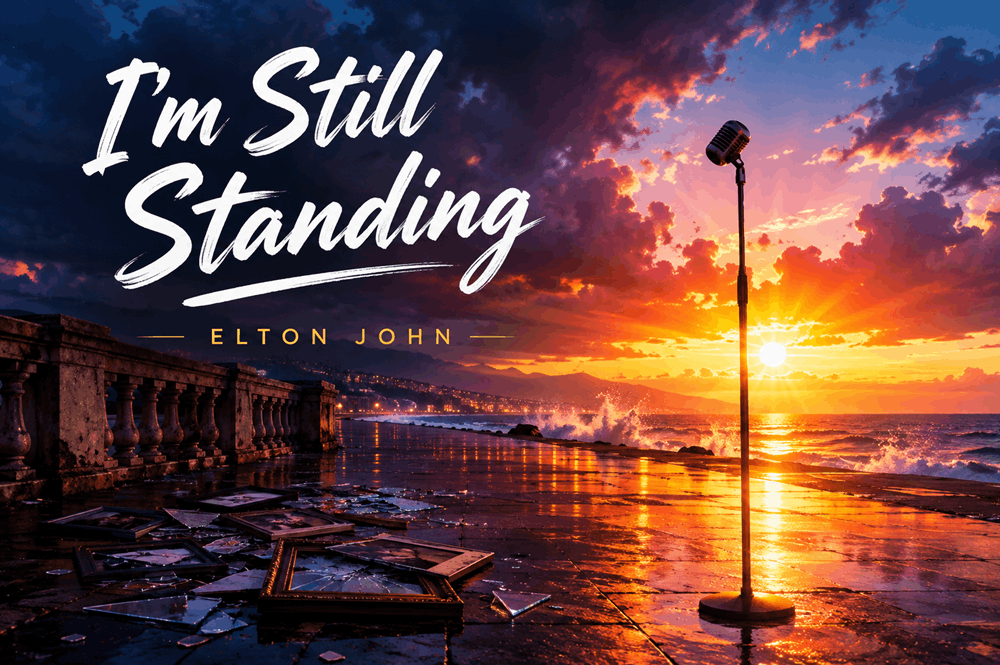
“I’m Still Standing” Lyrics Meaning: Elton John’s Victory Begins After the Breakup
“I’m Still Standing” by Elton John is about emerging from a damaging relationship with confidence, independence and the satisfaction of proving that another person failed to destroy you.
The narrator addresses a former lover who expected him to remain heartbroken. Instead, he announces that he has rebuilt his life and no longer depends on that person’s approval.
The song’s central message is simple:
Survival becomes a victory when the person who hurt you expected you never to recover.
Today, “I’m Still Standing” is widely heard as an anthem of resilience. It can apply to illness, career setbacks, addiction, rejection or any experience that tests someone’s ability to continue.
Its original meaning was more specific. Lyricist Bernie Taupin has described it as a dismissive message to a former girlfriend—a way of saying that the breakup had not left him secretly longing for her. Elton John’s official site notes that listeners later turned it into something broader: an anthem closely associated with John’s own survival and longevity. (Elton John)
That broader interpretation works because the song does more than claim that the narrator survived.
It makes survival sound joyful.
What is “I’m Still Standing” about?
The song follows someone confronting a former partner who was emotionally cold, manipulative or convinced of their own superiority.
During the relationship, that person seems to have held the power. They could withdraw affection, create pain and assume the narrator would remain trapped by what had happened.
The narrator now speaks from the other side of the breakup.
He has recognized the former partner’s behavior, recovered his confidence and discovered that life without them is not the disaster they may have imagined.
His message contains several emotions at once:
- Relief that the relationship is over
- Anger over how he was treated
- Pride in his recovery
- Amusement at the former partner’s failure
- A desire to be seen thriving
- Freedom from the old emotional balance
The song is not a quiet statement of healing.
It is a public victory lap.
Why does the narrator need the former lover to know he survived?
Someone who has completely forgotten an ex may not need to address them at all.
The narrator’s confidence is real, but it still contains an audience. He wants the person who hurt him to witness the outcome.
That desire does not necessarily mean he wants reconciliation.
It means recovery feels especially satisfying when it disproves someone else’s expectations.
The former partner may have behaved as though the narrator would remain emotionally dependent. Perhaps they believed they were irreplaceable. Perhaps they expected him to keep returning, regretting the breakup or measuring every future relationship against them.
By announcing that he is still standing, the narrator overturns that story.
He is not only saying, “I survived.”
He is saying, “You were wrong about how much power you had.”
Standing represents more than physical survival
To remain standing means refusing to collapse.
The image suggests that the narrator has been attacked, exhausted or emotionally knocked down but has not remained on the ground.
Standing also implies readiness.
He is not merely alive. He is upright, alert and prepared to continue. The breakup has not reduced him to someone permanently defined by what happened.
The word still is equally important.
It acknowledges that survival required time. The narrator has faced repeated pressure and perhaps periods when recovery seemed uncertain.
Yet after everything, he remains.
The chorus therefore carries both defiance and continuity. Other parts of life may have changed, but his essential ability to move forward has survived.
The former lover appears emotionally frozen
The opening presents the person being addressed as someone concealed behind a cold exterior.
Coldness can represent emotional distance, cruelty or the refusal to admit vulnerability. The former lover may protect themselves by acting untouched, superior or incapable of needing anyone.
The narrator now sees that image as a performance.
A mask of coldness can create power in a relationship because the person who appears to care less often controls the emotional temperature. The more one partner seeks warmth or reassurance, the more the distant partner can determine when affection is given.
The song breaks that pattern.
The narrator no longer waits for warmth from someone who used coldness as control. He can identify the mask without trying to remove it.
That recognition is part of his recovery.
He has stopped believing that better behavior on his part would transform the other person.
The blood imagery describes inherited arrogance
The song associates the former lover with a superior background and a cold emotional nature.
This suggests someone who considers status, family or social position evidence that they deserve control over other people.
Their sense of importance may not come from genuine strength. It may come from an identity inherited and protected rather than earned.
The narrator attacks that superiority by emphasizing his own ability to recover.
Status did not make the former lover emotionally wise.
Elegance did not make them kind.
Their power worked only while the narrator believed he needed what they offered.
Once he leaves, the hierarchy loses its force.
The person who once appeared untouchable becomes simply another ex whose predictions were wrong.
Why does the song describe love as a circus?
The former relationship is compared to a circus or performance.
A circus can be exciting, colorful and entertaining. It can also involve illusion, exaggeration and carefully controlled appearances.
That image suggests that the relationship may have been dramatic without being emotionally secure.
There may have been intense attraction, arguments, reconciliations and public displays that made the connection feel important. But intensity is not the same as stability.
The former lover may also have enjoyed turning the narrator’s emotions into a spectacle.
If every conflict becomes another performance, the relationship stops being a place where two people can communicate honestly. One person becomes the entertainer or manipulator, while the other becomes the audience expected to keep reacting.
The narrator’s recovery begins when he leaves the show.
He no longer needs to play the role assigned to him.
Picking up the pieces is the real work of survival
The chorus sounds effortless, but one image acknowledges that healing required labor.
After the relationship ended, the narrator had to gather the scattered parts of his life and place them back together.
Those pieces may include:
- Self-respect weakened by criticism
- Plans that depended on the relationship
- Friendships neglected during it
- Confidence damaged by rejection
- Habits built around the other person
- A future that suddenly no longer existed
Recovery is therefore not presented as forgetting everything overnight.
The narrator has rebuilt himself from damage.
This makes the triumph more believable. He is not strong because the relationship never affected him. He is strong because it affected him deeply and did not become the final definition of his life.
Why does he say he feels like a child again?
The breakup restores a younger, lighter version of the narrator.
Feeling like a child does not mean becoming immature. It suggests rediscovering openness, energy and the ability to imagine a future that is not shaped by the former partner.
Unhealthy relationships can make people constantly monitor themselves.
They may worry about saying the wrong thing, causing another withdrawal or failing to meet expectations that keep changing. Over time, spontaneity disappears.
Once the relationship ends, even ordinary independence can feel new.
The narrator can make decisions without anticipating punishment. He can experience pleasure without wondering how the other person will respond.
His childlike feeling is the return of possibility.
The relationship made life smaller.
Leaving allows the world to expand again.
The song turns revenge into happiness
Many breakup songs imagine revenge through humiliation, exposure or the hope that the former partner will suffer.
“I’m Still Standing” offers a more effective form of revenge:
The narrator becomes happy without them.
This matters because continued obsession can preserve the ex’s power. Even hatred may keep someone emotionally connected to the person they claim to have escaped.
The narrator’s victory is that his life has restarted.
He may enjoy knowing that the former lover was wrong, but his recovery no longer depends on receiving an apology. He does not need them to understand what they did before he can move forward.
His happiness becomes evidence.
The former lover expected devastation.
Instead, they receive a chorus.
Is the narrator completely over the relationship?
Probably not in the sense of feeling nothing.
The song contains too much energy, accusation and pleasure in being witnessed to represent total indifference.
But emotional recovery does not require indifference.
A person can remain angry about mistreatment while no longer wanting the relationship back. They can remember the damage clearly without allowing it to control their future.
The narrator has moved beyond dependence even if some emotional charge remains.
That distinction is important.
Healing is not the erasure of every reaction.
It is reaching the point where those reactions no longer determine your choices.
The former partner may still occupy the song.
They no longer occupy the narrator’s life.
Bernie Taupin originally wrote it as a breakup dismissal
Although the song became closely associated with Elton John’s public resilience, Taupin’s starting point was personal.
In an interview connected to his memoir, the Associated Press reported that “I’m Still Standing” was based on a breakup Taupin had experienced. (Associated Press)
Taupin has also explained that the lyric was essentially a kiss-off to an old girlfriend. Unlike a narrator who pretends not to care while secretly longing for the relationship, he said the point was that he genuinely believed he would be fine.
That background clarifies the song’s confidence.
The narrator is not attempting to lure the former lover back through jealousy. His message is final.
You believed I would remain broken.
I did not.
Why the song feels autobiographical for Elton John anyway
Even though the lyric began with Taupin’s breakup, Elton John’s performance caused listeners to connect it with his own career.
By 1983, John had already experienced enormous success, shifting musical trends, personal turmoil and periods when critics questioned whether his greatest years were behind him.
The title therefore sounded like a statement from the performer himself.
He was still recording.
Still reaching the charts.
Still unmistakably Elton John.
His official website now describes the phrase as a catchphrase for his career, demonstrating how fully the audience’s interpretation became attached to his public identity.
This is a common transformation in songwriting.
A lyric may begin with one specific person, but the performer’s life changes how the audience hears it. Over time, the original ex becomes less important than the larger image of someone surviving decade after decade.
Taupin wrote the personal challenge.
John turned it into a public anthem.
How the music makes survival sound exhilarating
The arrangement moves with urgency from the beginning.
Bright synthesizers, piano, guitar and driving drums give the song the energy of someone who has already left the painful period behind. The music does not sound as though the narrator is struggling to get up.
It sounds as though he is running forward.
That choice changes the emotional meaning.
A slower arrangement might emphasize the wounds left by the relationship. This production emphasizes momentum. The listener experiences recovery not as quiet reflection but as physical release.
The chorus rises quickly and invites participation.
By singing along, listeners can temporarily apply the statement to their own lives. The ex in the verses becomes any force that expected them to fail.
The song’s speed also prevents the former partner from controlling the emotional atmosphere.
There is no extended pause for regret.
The narrator has somewhere else to go.
Too Low for Zero made the title feel even more appropriate
“I’m Still Standing” appeared on Elton John’s 1983 album Too Low for Zero. John’s official discography identifies it as his 17th studio album and lists the song as its second track. The album also reunited John with major members of his classic 1970s band, including Davey Johnstone, Dee Murray and Nigel Olsson. (Elton John’s official discography)
That reunion contributed to the recording’s sense of renewed energy.
The song was not only about an individual recovering from a breakup. It arrived during a period when John was reaffirming his place in contemporary pop.
The single reached No. 4 in the United Kingdom and No. 12 on the Billboard Hot 100. It also topped the charts in Canada and Switzerland.
The Official Charts archive records an 11-week UK chart run in 1983.
The commercial success made the title sound almost prophetic.
John said he was still standing.
The audience confirmed it.
What the music video adds
The official music video was directed by Russell Mulcahy and filmed in Cannes and Nice, France.
Its bright Riviera setting transforms emotional survival into a celebration.
John performs in colorful clothing while dancers move through beaches, streets and hotel spaces. Instead of visualizing the failed relationship, the video presents a world overflowing with motion, sunlight and theatrical confidence.
This is exactly what the former lover is meant to witness:
Life did not become gray after their departure.
It became louder.
The production itself nearly experienced a setback. John later recalled that footage was lost when Mulcahy fell from a pier with the camera, forcing the team to complete much of the work under intense time pressure.
That story adds an unintended layer to the title.
Even the video had to recover and continue.
Why the song became larger than a breakup
The phrase “I’m still standing” is simple enough to belong to anyone.
It does not specify what knocked the speaker down. That openness allows the chorus to apply to many forms of survival:
A painful relationship.
A personal loss.
A health crisis.
Addiction recovery.
Public rejection.
A career others assumed had ended.
The verses preserve the song’s specific romantic anger, but the chorus releases that anger into something broader.
Listeners do not need to have experienced Taupin’s exact breakup or John’s career pressures. They only need to know what it feels like to be underestimated.
The song gives them a sentence that does not minimize the struggle.
“Still” acknowledges that something happened.
“Standing” refuses to let that event have the final word.
Confirmed background versus interpretation
It is confirmed that Elton John and Bernie Taupin wrote “I’m Still Standing,” with Taupin supplying the lyrics and John composing the music. The song appeared on Too Low for Zero, was produced by Chris Thomas and became an international hit in 1983.
Taupin has confirmed that its original inspiration was a breakup rather than a deliberate summary of John’s life. The public later interpreted it as an anthem of John’s resilience, an interpretation Taupin has welcomed.
The ideas that the cold exterior represents emotional control, that the circus represents a performative relationship and that feeling like a child represents restored possibility are interpretations based on the song’s imagery.
The song does not explain every detail of the relationship.
It does not need to.
Its emotional movement is clear: someone believed they had broken the narrator, and the narrator has returned to prove otherwise.
Final meaning
“I’m Still Standing” is about discovering that the person who once seemed powerful was never powerful enough to determine your future.
The narrator has been hurt, dismissed and expected to fail. He does not deny the damage or pretend that rebuilding was effortless.
He gathers the pieces.
He rediscovers his confidence.
He realizes that the relationship’s end has restored more than it removed.
The former lover remains frozen behind the same emotional mask. The narrator is the one who has changed.
That is why the song feels triumphant rather than merely angry.
His victory is not that he defeated the other person in an argument.
His victory is that he no longer needs the argument to continue.
He is alive, independent and moving forward.
After everything intended to keep him down, he is still standing.