
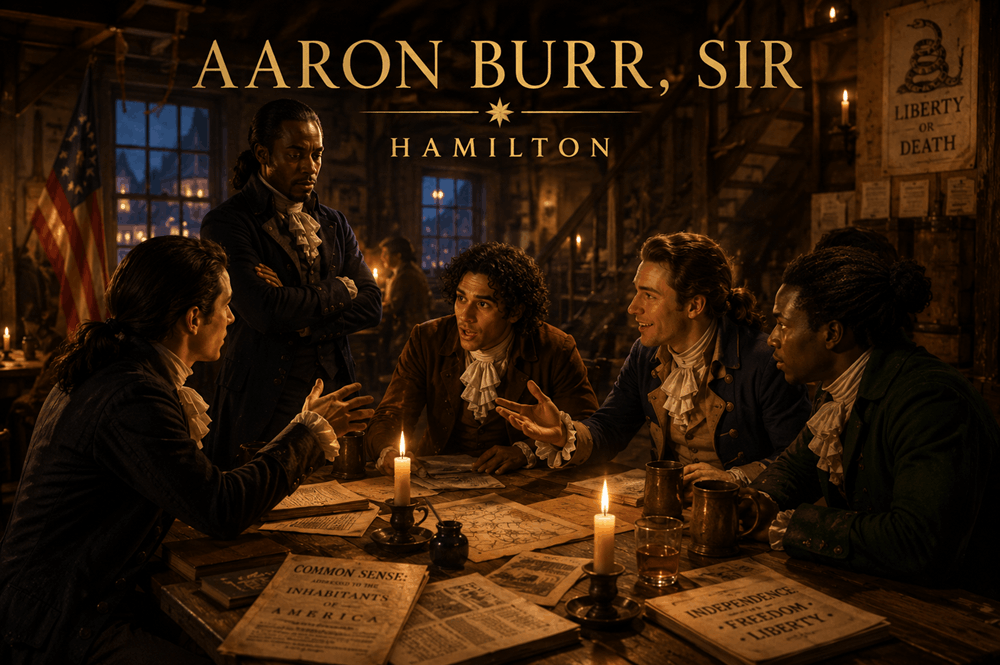
“Aaron Burr, Sir” Lyrics Meaning: Hamilton Meets the Man Who Will Teach Him to Hide
“Aaron Burr, Sir” from Hamilton is about Alexander Hamilton searching for guidance and immediately discovering that Aaron Burr’s approach to ambition is the opposite of his own.
Hamilton arrives in New York eager to prove himself. He wants action, recognition and a place in the revolution. Burr has already achieved some of what Hamilton wants, so Hamilton approaches him with admiration and asks how to get ahead.
Burr’s advice is simple: speak less, appear agreeable and avoid revealing exactly what you believe.
Hamilton cannot accept that philosophy.
That creates the song’s central conflict:
Burr believes survival depends on controlling what other people know about you, while Hamilton believes success depends on making sure no one can ignore you.
Their first meeting appears friendly, but the qualities that will eventually turn them into rivals are already visible. Burr sees Hamilton as reckless. Hamilton sees Burr as cautious to the point of emptiness.
Neither man understands how much the other will shape his life.
What is “Aaron Burr, Sir” about?
The song takes place in New York in 1776, shortly before the American Revolution transforms the characters’ ambitions into military and political careers.
Hamilton approaches Burr because he has heard that Burr completed his education unusually quickly. Hamilton hopes Burr can offer practical advice about advancement.
The conversation begins respectfully. Hamilton repeatedly addresses him as “sir,” treating Burr as an experienced figure whose success deserves admiration.
That respect begins to weaken when Burr explains his method.
Instead of encouraging Hamilton to display his intelligence, Burr advises him to remain quiet, smile and avoid taking positions too openly. Burr believes that revealing less gives a person more control.
Hamilton has spent his entire life trying to escape obscurity. The idea of hiding his beliefs feels almost impossible.
Their conversation is then interrupted by John Laurens, the Marquis de Lafayette and Hercules Mulligan, three young revolutionaries who are far more comfortable with Hamilton’s intensity. They speak openly about rebellion, war and their desire to build reputations through action.
By the end of the song, Hamilton has found his immediate friends.
He has also met the man whose philosophy will oppose his for the rest of the musical.
Why does Hamilton seek out Burr?
Hamilton recognizes Burr as an example of rapid advancement.
Both men are intelligent, ambitious and determined to rise beyond the circumstances surrounding them. Burr appears to possess knowledge Hamilton needs: how to enter elite institutions, build influence and move through a world controlled by powerful families.
Hamilton’s admiration is genuine.
He does not initially approach Burr as a rival. He approaches him as a possible mentor.
This makes Burr’s response important. Burr could welcome Hamilton’s energy, dismiss him completely or offer detailed guidance. Instead, he gives advice based on concealment.
Hamilton wants to know what he should do.
Burr tells him what he should avoid revealing.
The difference shows that they define power differently from their first conversation.
To Hamilton, power comes from demonstrating ability.
To Burr, power comes from protecting your options.
The Princeton story reveals Hamilton’s entire personality
Hamilton explains that he attempted to complete college on an accelerated schedule but was rejected after confronting the school’s leadership.
The story is humorous, but it establishes several important traits.
Hamilton is impatient with systems that move more slowly than he does. He believes talent should allow him to bypass ordinary restrictions. When authority refuses, he does not quietly accept the answer.
He pushes.
That confidence is part of what makes him extraordinary. It is also one of the qualities that repeatedly creates enemies.
Hamilton interprets obstacles as challenges to overcome through greater effort and stronger argument. He rarely considers that restraint might preserve relationships or create a more effective path forward.
Burr hears the story and recognizes danger.
Hamilton hears himself telling it and remains proud.
What does “talk less, smile more” mean?
Burr’s most important advice is to reveal as little as possible while maintaining a pleasant public image.
Speaking less prevents other people from using your words against you. Smiling makes you appear cooperative without requiring you to commit yourself to a position.
The strategy allows Burr to remain welcome in multiple groups.
If no one knows exactly what he opposes or supports, fewer people have a clear reason to treat him as an enemy. He can observe changing circumstances and choose a side only when the risk is lower.
This is not simply shyness.
It is a deliberate political method.
Burr believes that opinions create vulnerability. Every strong statement closes one possible alliance and gives opponents material they can later attack.
Hamilton believes the opposite.
He sees speech as the main instrument available to a person without inherited wealth or established power. If he remains silent, people may never recognize what he can do.
Burr protects himself by withholding his identity.
Hamilton creates his identity by announcing it.
Is Burr’s advice cowardly or intelligent?
The musical does not present an entirely simple answer.
Burr’s caution is frustrating because it allows him to avoid moral commitment. He often waits until he knows which position will benefit him before openly choosing it.
However, his strategy is not irrational.
Political and military environments can punish people who speak impulsively. Hamilton’s later life repeatedly proves that words can create lasting enemies. He publishes attacks, exposes private conflicts and refuses to let insults pass unanswered.
Burr understands something Hamilton does not:
Being correct does not guarantee survival.
Hamilton understands something Burr struggles to accept:
Waiting safely does not guarantee that opportunity will eventually choose you.
Their tragedy develops because each man possesses part of the truth and pushes it too far.
Hamilton speaks until his words damage him.
Burr waits until patience becomes resentment.
“Fools who run their mouths off wind up dead” foreshadows the ending
Burr’s warning sounds like practical advice for a dangerous revolutionary period.
It also predicts the musical’s conclusion.
Hamilton’s words help create the conflict that ends in the duel with Burr. He repeatedly expresses judgments publicly, including opinions about Burr’s character and fitness for leadership.
Burr, meanwhile, spends much of the story controlling his emotions. When he finally decides to act directly, that action becomes irreversible.
The warning is therefore deeply ironic.
Burr tells Hamilton that outspoken fools die.
Burr eventually becomes the person who kills him.
The line also shows that Burr understands how dangerous Hamilton’s personality is before Hamilton’s closest friends do. Laurens, Lafayette and Mulligan are energized by his confidence.
Burr immediately sees the possible cost.
Why does Hamilton reject Burr’s philosophy?
Hamilton’s background makes silence feel especially threatening.
He arrives without the secure social position Burr possesses. Hamilton believes he must create importance through work, writing and visible achievement. No powerful family name will automatically guarantee that others make room for him.
He cannot afford to wait quietly for recognition.
His urgency is also connected to mortality. Throughout Hamilton, he behaves as though time is already running out. Every delay feels like a threat that history will move forward without him.
Burr’s strategy requires patience.
Hamilton experiences patience as disappearance.
This is why the two men can understand each other intellectually while remaining emotionally incompatible. Hamilton knows caution can be useful. He cannot tolerate what caution makes him feel.
Burr knows action can create opportunity. He cannot tolerate the loss of control it requires.
Why are Laurens, Lafayette and Mulligan introduced together?
The arrival of John Laurens, Lafayette and Hercules Mulligan changes the atmosphere.
Burr’s conversation with Hamilton is controlled and private. The three revolutionaries enter with noise, humor and open political enthusiasm.
They give Hamilton the community he was seeking.
Each man also represents a different reason for joining the revolutionary cause.
John Laurens wants freedom to include abolition
The musical presents Laurens as an idealistic opponent of slavery who wants the Revolution’s promise of liberty to extend beyond white colonists.
The historical Laurens came from a wealthy South Carolina slaveholding family but developed strong antislavery views. He later proposed recruiting enslaved men into the Continental Army in exchange for freedom, although his plan encountered resistance. The National Park Service’s biography of John Laurens describes his education, military service and return to America to participate in the Revolution.
Inside “Aaron Burr, Sir,” Laurens brings moral urgency.
He does not merely want a career.
He wants the new country to become more consistent with its own language of liberty.
Lafayette represents international revolutionary energy
Lafayette arrives as a young French aristocrat eager to fight for American independence.
His presence reminds the audience that the Revolution was connected to international politics and to wider debates about monarchy, liberty and citizenship.
Historically, Lafayette traveled to America as a young man and became a major general in the Continental Army, developing a particularly close relationship with George Washington. The Mount Vernon account of Lafayette details his role in the Revolution and his bond with Washington.
In the song, his rapid, accented delivery makes him appear ambitious, energetic and eager to transform imperfect English into revolutionary action.
Like Hamilton, he is an outsider determined to help create the country in which he hopes to belong.
Hercules Mulligan connects rebellion with practical action
Mulligan enters with the confidence of someone prepared to turn talk into physical participation.
He works in a trade rather than arriving through the same elite educational route associated with Burr. His presence expands the revolutionary circle beyond lawyers and aristocrats.
Historically, Mulligan was a New York tailor who later gathered intelligence from British officers and passed information to the revolutionary cause. Mount Vernon’s overview of George Washington’s intelligence network identifies Mulligan as one of Washington’s agents.
The song introduces him mainly through personality, but his boldness foreshadows the active role he will later claim.
The tavern scene creates Hamilton’s first chosen family
Hamilton begins the song looking upward toward Burr.
He ends it standing beside young men whose energy resembles his own.
That movement matters.
Burr offers guidance but not belonging. Laurens, Lafayette and Mulligan immediately treat Hamilton as someone who may share their ambitions.
They are loud, competitive and somewhat chaotic, but their openness allows Hamilton to participate fully. He does not have to hide his hunger for achievement or pretend to feel less intensely.
The group gives him a social identity:
He is no longer simply an unknown immigrant asking how to rise.
He is one of the young revolutionaries preparing to act.
The friendship is based partly on shared ideals and partly on shared impatience. They want history to begin immediately, and they want important roles inside it.
Why does Burr remain separate from the group?
Burr is physically present, but the song places him outside the emotional unity forming around Hamilton.
He does not share the others’ enthusiasm openly. He observes, questions and warns.
This separation foreshadows his position throughout the musical.
Burr frequently stands close enough to witness Hamilton’s rise while remaining unable to join it completely. Hamilton’s willingness to declare himself attracts allies, mentors and opportunities. Burr’s caution keeps him safe but makes others uncertain about what he represents.
The group’s reaction also reveals that caution can look like a lack of conviction.
Burr may believe he is being strategic.
The others see someone unwilling to commit.
That difference gradually becomes personal. Hamilton does not simply disagree with Burr’s tactics. He begins to treat Burr’s uncertainty as evidence of weak character.
Burr, in turn, sees Hamilton receiving rewards for precisely the behavior he was taught to avoid.
Why is Hamilton fascinated by revolution?
Hamilton sees war as both a political cause and a personal opening.
In ordinary circumstances, established families and institutions control advancement. Revolution disrupts those structures. A talented outsider may rise quickly if he can prove himself useful.
This does not mean Hamilton’s patriotism is entirely insincere.
He believes in independence and wants to help shape the new nation. At the same time, he recognizes that the conflict may give him the reputation he has been unable to inherit.
The song makes both motives visible.
Hamilton wants freedom.
He also wants glory.
For him, the two desires strengthen each other. If the Revolution succeeds, he can help create a country while creating himself.
Burr is more careful about attaching his future to one cause.
Hamilton believes the danger is exactly what makes the opportunity valuable.
The title’s politeness hides a growing challenge
The repeated “sir” makes Hamilton sound respectful, especially at the beginning.
As the exchange continues, the politeness becomes more complicated.
Hamilton still admires Burr, but he is also testing him. He asks questions rapidly, pushes against the advice he receives and refuses to hide his disbelief.
The title therefore captures their entire future relationship in miniature.
Hamilton recognizes Burr’s intelligence and status.
He does not trust Burr’s method.
Burr appreciates Hamilton’s ability.
He does not trust Hamilton’s judgment.
Respect and irritation exist together from the first meeting.
How the music distinguishes Hamilton from Burr
“Aaron Burr, Sir” is the second track on the 2015 original Broadway cast recording of Hamilton. The production credits Lin-Manuel Miranda with the musical’s book, music and lyrics, with Alex Lacamoire serving as orchestrator and co-arranger. The official Hamilton site identifies Miranda, director Thomas Kail, choreographer Andy Blankenbuehler and Lacamoire among the principal creative team.
The song is structured more like a fast-moving conversation than a conventional show tune.
Hamilton’s delivery is crowded with information. He explains his history, asks questions and interrupts the pace with new thoughts. His language is always trying to move faster.
Burr’s delivery is smoother and more economical.
He uses fewer words because his entire philosophy values restraint. When he speaks, he wants each line to preserve control rather than reveal excitement.
The entrance of Laurens, Lafayette and Mulligan makes the arrangement more crowded and rhythmic. Their overlapping personalities create the sense that Hamilton has stepped from a private lesson into a living revolutionary movement.
The music does not merely introduce the characters.
It demonstrates their different relationships with speech.
The song introduces Burr as more than a future villain
The audience already knows from the opening number that Burr will eventually shoot Hamilton.
“Aaron Burr, Sir” could therefore present him as obviously threatening.
Instead, he appears intelligent, controlled and even helpful.
This choice makes the story more tragic. Burr is not introduced as a monster waiting to attack Hamilton. He is introduced as a possible mentor whose worldview gradually becomes incompatible with Hamilton’s.
Lin-Manuel Miranda told the Library of Congress that the historical Burr was difficult to define because different biographies present dramatically different versions of him. Miranda therefore had to choose the Burr the musical would dramatize.
The resulting character is not simply cautious because he lacks courage.
He has built caution into a complete philosophy of survival.
The tragedy is that the philosophy eventually fails him.
How the song establishes the musical’s larger argument
Much of Hamilton asks how people become part of history.
Hamilton believes history notices those who speak, write and act.
Burr believes influence belongs to those who wait until the correct opening appears.
“Aaron Burr, Sir” establishes that debate before either man has gained real power.
Every later conflict grows from it:
- Hamilton publishes while Burr withholds.
- Hamilton commits while Burr calculates.
- Hamilton creates enemies through certainty.
- Burr loses opportunities through hesitation.
- Hamilton treats being known as survival.
- Burr treats being unreadable as protection.
Their final confrontation does not emerge suddenly.
It begins in the first advice Burr gives him.
Confirmed background versus interpretation
It is confirmed that “Aaron Burr, Sir” appears near the beginning of Hamilton and introduces Burr’s cautious philosophy alongside the revolutionary enthusiasm of Hamilton, Laurens, Lafayette and Mulligan. The original cast recording was released by Atlantic Records and was added to the Library of Congress National Recording Registry in 2025 because of its cultural and historical significance.
The historical figures were real participants in the revolutionary era, but the tavern meeting should be understood as theatrical compression rather than a complete documentary reconstruction of how and when every relationship began.
The ideas that Hamilton approaches Burr as a potential mentor, that the tavern group becomes a chosen family and that the word “sir” gradually changes from admiration into challenge are interpretations of the song’s dramatic structure.
Final meaning
“Aaron Burr, Sir” is about two ambitious men discovering that they have opposite ideas about how ambition should work.
Hamilton asks Burr how to rise.
Burr tells him to hide.
Hamilton believes silence will make him invisible. Burr believes open conviction will make him vulnerable.
Their disagreement initially appears almost comic. Hamilton talks too much, Burr says too little and three enthusiastic revolutionaries interrupt before either man can persuade the other.
But the song contains the entire tragedy of Hamilton in miniature.
Hamilton’s openness will create friendships, achievements and enemies.
Burr’s caution will preserve him until waiting begins to feel unbearable.
The young Hamilton enters the song hoping Burr can show him the path forward.
Instead, Burr gives him a warning he will never learn to follow.
The men begin as possible allies.
Their first conversation already explains why they cannot remain that way.