
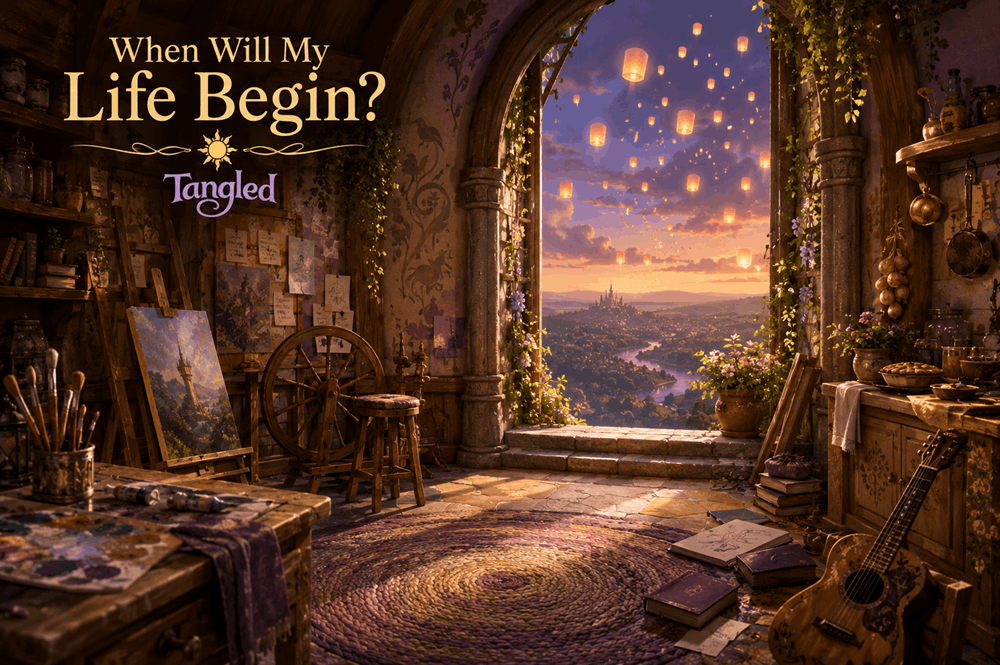
“When Will My Life Begin?” Lyrics Meaning: Rapunzel Is Busy Every Day but Still Waiting to Live
“When Will My Life Begin?” from Tangled is about the difference between filling your time and having control over your life.
Rapunzel’s days are packed with chores, hobbies and creative projects. She reads, paints, cooks, cleans, plays music and invents new ways to entertain herself. From the outside, she appears cheerful and productive.
But none of those activities answers the question beneath the song:
If every day follows a routine chosen by someone else, does being busy really count as living?
Rapunzel is not simply bored. She is beginning to understand that the tower has kept her physically safe by preventing her from making her own choices. Her long list of activities shows imagination and resilience, but it also reveals how much effort she must spend making captivity feel like a normal life.
The song begins with a schedule.
It ends with a desire for freedom.
What is “When Will My Life Begin?” about?
The song introduces Rapunzel as an energetic young woman who has spent her entire remembered life inside a hidden tower.
She follows nearly the same routine every day. She completes household tasks, develops artistic skills and finds ways to occupy every hour until evening. Then she looks toward the floating lanterns that appear in the distance once each year.
Those lights represent the one mystery her tower cannot contain.
Rapunzel does not know that the lanterns are connected to her true identity as the kingdom’s missing princess. She only knows that they appear on her birthday and seem to call her toward a world she has never been allowed to explore.
Disney’s official description of Tangled presents Rapunzel as a tower-bound teenager who longs to see the world, while the official Disney Princess profile emphasizes her creativity, curiosity and willingness to move beyond her comfort zone.
The song captures the moment before she acts on that curiosity.
She has not escaped yet.
She has begun to recognize why she needs to.
Rapunzel’s routine shows both talent and confinement
The opening moves quickly through an impressive number of activities.
Rapunzel is not passive. She has taught herself practical skills, artistic techniques and forms of entertainment that many people would struggle to master even with access to teachers and the outside world.
Her routine shows several strengths:
- She is disciplined.
- She is creative.
- She learns quickly.
- She can generate joy from limited resources.
- She refuses to let isolation completely destroy her curiosity.
Yet the list becomes increasingly uncomfortable because she has enough time to do everything repeatedly.
The activities do not mark progress toward a different future. They reset each morning.
She cleans what will become dirty again, reads familiar books and returns to creative projects because the tower offers nowhere else for her energy to go.
Her talents expand.
Her world does not.
That contrast prevents the montage from being merely cheerful. Rapunzel is capable of an enormous life, but all of that ability has been compressed into one room.
Being productive is not the same as being free
Rapunzel’s schedule initially resembles an idealized productive day.
She wakes early, completes chores, exercises, creates art and avoids wasting time. In another context, those habits might represent independence and self-development.
Inside the tower, they function differently.
Rapunzel can choose which painting to make, but she cannot choose where to go. She can decide what to bake, but she cannot decide whom to meet. She can improve herself endlessly without gaining authority over the direction of her life.
The song therefore challenges the idea that constant productivity automatically creates fulfillment.
A person can complete many tasks while still feeling that life has not begun. Busyness may provide structure, distraction and even genuine pleasure without answering deeper questions about freedom, purpose and connection.
Rapunzel is not ungrateful for her hobbies.
She is recognizing their limit.
The tower gives her activities.
It does not give her a future she selected for herself.
Why does the song sound so cheerful?
The bright melody reflects Rapunzel’s personality.
She has survived isolation by remaining hopeful, curious and playful. A darker arrangement would make her sound defeated, but Rapunzel has not yet accepted the tower as the final boundary of her life.
The music moves rapidly because her mind moves rapidly. She jumps from one task to another, turning confinement into a private world filled with movement and color.
That energy also prevents her from sitting too long with the emptiness underneath the routine.
As long as she is cleaning, painting or reading, the day appears full. When evening arrives and the activities stop, the unanswered question becomes harder to avoid.
Composer Alan Menken has written that Tangled went through a long creative process in which the filmmakers initially wanted to avoid traditional Disney musical conventions before gradually returning to classic song-driven storytelling. The finished soundtrack, created by Menken with lyricist Glenn Slater, combines that theatrical structure with a lighter contemporary sound.
“When Will My Life Begin?” consequently works as a classic character-introduction song without making Rapunzel sound formal or distant.
She sounds like a modern young woman thinking aloud.
The title reveals that Rapunzel does not consider the tower a complete life
Rapunzel is already alive when she asks when her life will begin.
The question is therefore symbolic.
For her, life means more than biological existence or the successful completion of another day. It means experience, choice, relationships and movement into the unknown.
The tower has given her survival without participation.
She can watch light change through the window, but she cannot walk beneath the open sky. She can read about other people’s adventures, but she cannot create memories with anyone beyond Mother Gothel and Pascal.
Her question also reveals a growing separation between the identity Gothel has assigned her and the person she senses she could become.
Gothel treats the tower as home and the outside world as a threat. Rapunzel has started to experience the same tower as a place where her real self is being delayed.
She does not yet know who she truly is.
She knows she cannot discover it by repeating yesterday forever.
The floating lanterns represent more than a birthday wish
The lanterns are the first sign that Rapunzel’s life may be connected to something outside the tower.
They appear at the same time each year, creating a pattern she cannot explain. Because she has so little access to the outside world, the lights become emotionally enormous.
They represent:
- A mystery she wants to solve
- A place beyond Gothel’s control
- Evidence that the outside world contains beauty
- A connection to the family she does not remember
- The possibility that her birthday has meaning beyond the tower
- A future she can imagine without yet understanding
The lanterns are especially powerful because they are distant.
Rapunzel cannot touch them, ask anyone in the kingdom about them or determine where they come from. She can only look through the window and wonder.
Her desire to see them up close is not a random travel wish. It is the first concrete goal that belongs entirely to her.
Gothel has planned Rapunzel’s home, rules and understanding of the world.
The lantern dream comes from Rapunzel herself.
Mother Gothel’s control is hidden inside an apparently comfortable life
The song does not begin with visible chains or a locked cell.
Rapunzel has food, books, art supplies, a comfortable bedroom and enough material to fill her days. That comfort helps conceal the reality of her situation.
Gothel does not need Rapunzel to feel miserable every hour. She needs Rapunzel to remain dependent.
Providing entertainment supports that goal. If Rapunzel can stay occupied, she may be less likely to examine why she has no friends, no freedom of movement and no knowledge of the world outside.
This makes the song’s cheerful domestic setting important.
Control is not always maintained through constant punishment. It can also operate through fear, selective affection and the creation of a life that seems pleasant enough to discourage resistance.
Rapunzel has been taught that leaving would be dangerous and disobedient. As a result, she begins the film believing that wanting freedom may itself be wrong.
Her question is the first crack in that belief.
Why does she ask for permission instead of simply leaving?
Rapunzel has been raised to treat Gothel’s authority as unquestionable.
Although she is nearly an adult, she does not initially imagine that she has the right to leave without approval. She prepares to ask Gothel to take her to see the lanterns rather than recognizing that the choice should belong to her.
This shows how deeply control has shaped her thinking.
The tower’s physical height matters, but the larger barrier is psychological. Rapunzel has internalized Gothel’s warnings and expects guilt to follow any act of independence.
She wants the outside world.
She also wants to remain a good daughter.
Those desires appear incompatible because Gothel has designed the relationship that way. Obedience is treated as evidence of love, while independence is framed as rejection.
Rapunzel’s later escape is consequently more than a physical adventure.
She must learn that making a choice for herself is not the same as betraying someone.
The reprise changes the question into movement
The original song is performed before Rapunzel leaves the tower. Its energy is active, but she remains physically confined.
The later reprise occurs once she finally steps onto the ground outside.
At that point, the question has begun to answer itself.
Life starts not because every fear disappears, but because Rapunzel makes a decision and accepts the uncertainty attached to it. Her first moments of freedom bring excitement, guilt, panic and joy rather than one simple emotion.
That emotional confusion is realistic.
Someone who has lived under controlling rules may long for independence and still feel terrified after taking it. Freedom can initially feel wrong when obedience has been presented as safety.
The official Tangled soundtrack includes the main song and two reprises, showing how the central idea evolves as Rapunzel moves from waiting toward action. The collection credits Mandy Moore as the performer and Alan Menken and Glenn Slater as the principal songwriters.
The reprise does not erase the tower immediately.
It reveals how much of the tower Rapunzel still carries inside her.
Why the song is relatable beyond Rapunzel’s story
Most listeners have not spent their lives inside a magical tower.
Many understand the feeling of waiting for life to begin.
A person may feel trapped by school, family expectations, financial limits, an unhealthy relationship or a routine that leaves little room for personal choice. Their days can be full while still feeling disconnected from the future they want.
The song speaks to the belief that real life will begin after one major change:
After graduation.
After leaving home.
After finding love.
After earning enough money.
After receiving permission.
Rapunzel’s story offers a useful correction. Her life does not begin because the world suddenly becomes safe or because someone else officially declares her ready.
It begins when she moves toward something meaningful despite not knowing exactly what will happen.
The lanterns give her direction.
Courage turns direction into experience.
Mandy Moore’s performance keeps Rapunzel hopeful rather than naïve
Mandy Moore performs the song with excitement, humor and a growing sense of longing.
Her delivery makes Rapunzel sound inexperienced without making her unintelligent. She understands that something is missing even though she lacks the language and experience to describe it fully.
Moore later said that recording original songs by Menken and Slater for Tangled carried special meaning because she had grown up inspired by Menken’s Disney music.
The performance also changes subtly as the song progresses.
The early sections rush through Rapunzel’s activities with playful confidence. When she looks toward the evening lights, the vocal becomes more open and reflective.
Her routine belongs to the life she knows.
The lanterns belong to the life she wants.
Confirmed background versus interpretation
It is confirmed that “When Will My Life Begin?” was written for Disney’s 2010 animated film Tangled, with music by Alan Menken, lyrics by Glenn Slater and vocals performed by Mandy Moore as Rapunzel. Disney’s official video presents the song as Rapunzel’s account of her daily routine and her desire to leave the tower and see the world.
The ideas that her hobbies function partly as distraction, that productivity hides her lack of agency and that the lanterns represent a desire created outside Gothel’s control are interpretations based on the song and film.
The lyrics do not present Rapunzel as consciously analyzing emotional manipulation.
She is only beginning to sense that the life she has been given is not the same as a life she has chosen.
Final meaning
“When Will My Life Begin?” is about a young woman realizing that a full schedule cannot replace freedom.
Rapunzel has built a colorful, creative existence from the limited world available to her. Her routine proves that she is resourceful and hopeful.
It also proves that she has outgrown the tower.
She can learn another skill, paint another wall and read the same books again. None of those activities will answer the mystery in the sky or show her who she might become beyond Gothel’s rules.
The floating lanterns awaken a desire that routine can no longer silence.
Rapunzel does not yet understand that they were released for her.
She only understands that she must move closer to them.
That is when her life begins—not when every question is answered, but when she stops waiting for someone else to give her permission to ask them.