
“Brain Stew” Lyrics Meaning: Green Day’s Song About Insomnia, Anxiety and a Mind Stuck on Overdrive
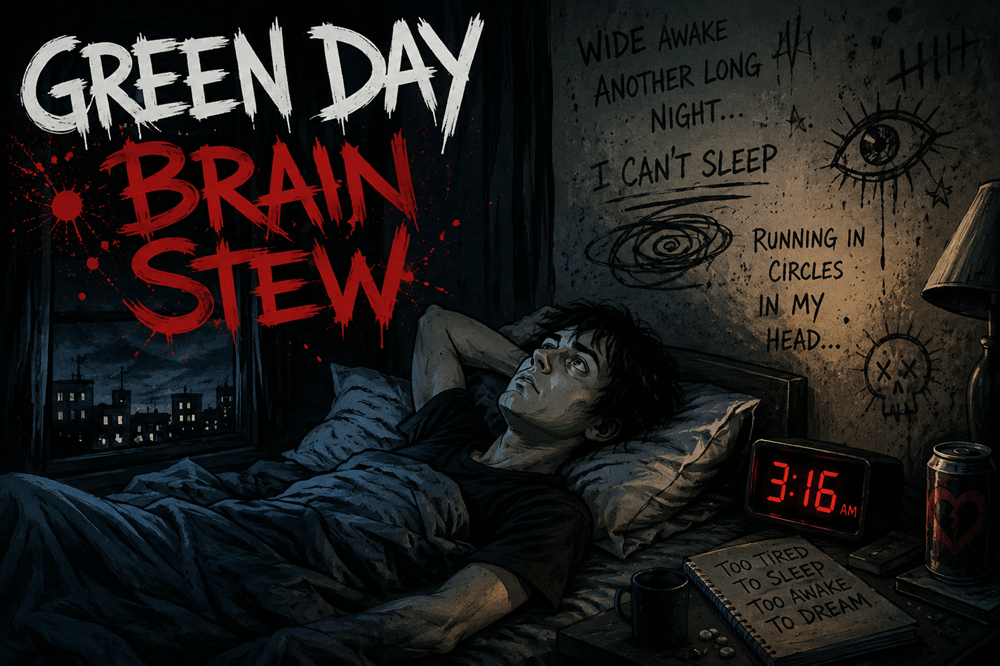
Green Day’s “Brain Stew” is about lying awake through a sleepless night while exhaustion, anxiety and racing thoughts gradually distort the narrator’s sense of reality.
He tries to rest, but his mind refuses to slow down. The passing hours make him increasingly frustrated, physically uncomfortable and detached from his surroundings. By the end, he seems caught between extreme tiredness and an agitated state that will not allow him to sleep.
The song’s central meaning is:
Insomnia does not feel like peaceful wakefulness. It can feel like being imprisoned inside an exhausted body while the mind continues running without direction.
The title describes the narrator’s mental condition. His thoughts have been heated, mixed and reduced into an indistinguishable “stew.” He can no longer separate ordinary worries from irrational fears, physical discomfort or chemically intensified restlessness.
Billie Joe Armstrong has described the track as a song about staying awake all night. He said its central riff appeared while he was testing new recording equipment, after which the melody and sleepless-night narrative came together naturally. (americansongwriter.com)
Listeners can watch Green Day’s official “Brain Stew/Jaded” music video or hear the album recording through Apple Music.
What is “Brain Stew” about?
“Brain Stew” follows a narrator experiencing a severe night of insomnia.
He begins by trying familiar methods of falling asleep, but none of them work. As the hours pass, his frustration becomes more physical and more disturbing.
He experiences:
- Racing thoughts
- Awareness of every passing second
- Dryness and physical discomfort
- Exhausted, strained eyes
- Numbness
- Mental overstimulation
- Isolation
- A growing sense of delirium
The song does not move toward peaceful rest.
Instead, every verse brings the narrator deeper into the night. His body becomes more exhausted while his brain appears to become more active.
This creates the central contradiction of insomnia:
The more desperately someone tries to sleep, the more awake they may feel.
The narrator is tired enough to feel physically damaged, yet still unable to switch off the thoughts preventing rest.
What does “brain stew” mean?
“Brain stew” is a metaphor for mental confusion caused by exhaustion and overstimulation.
A stew is created when separate ingredients are mixed and cooked together until they become part of one dense substance. The narrator’s thoughts have undergone a similar process.
Worry, time, frustration and physical discomfort have blended together.
He can no longer clearly distinguish:
- What is genuinely important
- What only feels urgent because it is late
- What comes from anxiety
- What comes from exhaustion
- What may be intensified by stimulants
- What is real and what is becoming delirious
The phrase is darkly humorous.
The narrator’s brain is not simply busy. It feels overheated, overworked and reduced to something shapeless.
The title also suggests that insomnia has changed the quality of his thinking. He may still be conscious, but consciousness is no longer useful. His thoughts repeat without leading to decisions or solutions.
Is the song literally about insomnia?
Yes.
Armstrong has repeatedly described “Brain Stew” as a song about being unable to sleep. The title originally connected closely enough with insomnia that “Insomniac” was reportedly considered as an early working title for the track before becoming the name of Green Day’s 1995 album. Armstrong was also dealing with interrupted sleep during the period surrounding the birth of his first child. (americansongwriter.com)
The lyrics reproduce the progression of a sleepless night rather than merely mentioning that sleep is difficult.
At first, the narrator still tries to solve the problem.
Later, he stops sounding hopeful and begins documenting the effects of failure.
That progression moves through several stages:
- He tries to fall asleep.
- He becomes aware of time passing.
- His thoughts accelerate.
- His body begins feeling damaged.
- His senses become unreliable.
- The night turns into delirium.
The song’s structure therefore resembles an insomnia spiral.
There is no dramatic outside event. The conflict takes place between the narrator, his body and the clock.
Why does counting sheep fail?
Counting sheep is a familiar method associated with distracting the mind until sleep arrives.
In the song, even this simple technique becomes impossible to sustain.
The narrator metaphorically runs out of sheep, suggesting that he has been awake so long that the traditional solution has become useless. His imagination cannot produce enough repetition to outlast the insomnia.
The image is funny, but it also communicates desperation.
He has reached the point where:
- Relaxation techniques feel irritating.
- Repetition increases awareness of being awake.
- Every failed attempt becomes additional evidence that sleep is not coming.
- Trying harder makes the problem worse.
The sheep also show how ordinary the night was supposed to be.
Nothing supernatural entered the room. The narrator simply went to bed and discovered that his own mind had become an opponent.
Why does the clock feel hostile?
During insomnia, a clock does more than display time.
It measures failure.
Every passing minute reminds the narrator that he is still awake and that the remaining opportunity for sleep is becoming shorter. Instead of helping him organize the night, the clock appears to mock him.
This feeling is familiar to many people who have watched the hours move toward morning while calculating how little sleep remains possible.
The clock represents:
- Time that cannot be recovered
- Pressure to fall asleep immediately
- Anxiety about the following day
- Proof that relaxation is failing
- The approach of responsibilities that will arrive regardless of exhaustion
The narrator gives the clock a personality because insomnia can make neutral objects feel antagonistic.
The clock is not actually laughing.
His exhausted mind interprets it that way because every movement of its hands increases his frustration.
What do the physical descriptions mean?
“Brain Stew” describes insomnia as a bodily experience rather than only a collection of thoughts.
The narrator’s eyes feel strained, his mouth is dry and his face becomes numb. These exaggerated images communicate the sensation of remaining awake after the body has begun demanding rest.
The physical details make the song uncomfortable because they remove any romantic idea of staying up all night.
This is not a productive artist working until sunrise or friends enjoying an unforgettable night together.
The narrator is alone and deteriorating.
His symptoms represent:
- Eye strain
- Dehydration
- Muscle tension
- Sensory dullness
- Exhaustion
- Possible stimulant use
- The feeling of being disconnected from one’s own body
The descriptions are not presented as a clinical checklist. They are the narrator’s distorted account of what sleeplessness feels like from inside his room.
What does “cross-tops” mean?
The unusual term is generally understood as a reference to stimulant pills.
That interpretation introduces the possibility that the narrator’s sleeplessness is not caused only by ordinary anxiety. He may have taken something that is forcing his mind and body to remain active.
This fits the physical condition described later:
- Extreme dryness
- Numbness
- Overstimulation
- An inability to stop moving mentally
- A state approaching delirium
However, the song does not provide enough information to determine exactly what the narrator consumed or whether every image should be read literally.
The stimulant reference broadens the meaning.
“Brain Stew” may describe insomnia caused by several pressures operating together:
- New responsibility
- Anxiety
- Sudden fame
- Substance use
- Physical exhaustion
- A lifestyle with little stability
The mind is stuck on overdrive because there is no single switch capable of slowing it down.
Is the song about drug use?
Drug imagery is present, but insomnia remains the primary subject.
The narrator sounds chemically overstimulated, and Insomniac contains other songs concerned with intoxication and self-destructive behavior. Yet “Brain Stew” does not unfold as a detailed story about addiction.
Instead, stimulant language intensifies the sleeplessness.
The song shows a person whose body needs rest while something—chemical, emotional or both—keeps the brain moving.
That combination matters because it makes the narrator partly responsible and partly powerless.
He may have contributed to his condition, but once the night is underway, he cannot easily reverse it.
The track is not delivering a moral lesson about substances.
It is recreating the claustrophobic consequences of being exhausted, stimulated and alone.
Why does the narrator keep emphasizing that he is alone?
The repeated isolation is one of the song’s most important emotional details.
Insomnia often feels uniquely private.
The rest of the world appears to be sleeping while one person remains awake, aware of every sound and unable to participate in the night’s stillness.
The narrator has nobody present to:
- Distract him
- Reassure him
- Interrupt the thought cycle
- Confirm that his distorted perceptions are not accurate
- Share the burden of waiting for morning
His room becomes an enclosed mental space.
Nothing changes outside it, but his internal condition becomes increasingly extreme.
The repeated sense of being on his own may also reflect a larger form of alienation. Armstrong was adjusting to fatherhood and Green Day’s sudden mainstream success during the period surrounding Insomniac. The album’s darker atmosphere repeatedly returns to anxiety, resentment and the discomfort of no longer belonging comfortably to either the underground scene or mainstream celebrity culture.
The sleepless room can therefore represent more than one night.
It can represent feeling trapped inside a life other people assume should be exciting.
Is “Brain Stew” about anxiety?
Insomnia is the visible problem, but anxiety appears to be one of the forces sustaining it.
The narrator does not describe one specific worry. His mind is overloaded more generally.
This is realistic because anxious sleeplessness does not always revolve around one solvable question. The brain may move rapidly between unrelated concerns, creating intense activity without useful progress.
The narrator’s experience includes:
- Repetitive thinking
- Hyperawareness of time
- Physical tension
- Catastrophic imagery
- Irritation
- Inability to settle
- Fear that the condition is getting worse
The song never separates anxiety from exhaustion.
Each one feeds the other.
Anxiety prevents sleep.
The lack of sleep weakens the narrator’s ability to regulate anxiety.
The result is the “stew”: an indistinguishable mixture in which causes and symptoms repeatedly intensify one another.
Why does the guitar riff move so slowly?
The central guitar riff is heavy, repetitive and separated by large spaces.
That pacing recreates the experience of watching time pass during a sleepless night.
Each chord arrives with weight, followed by enough silence for the listener to anticipate the next one. The riff seems simple, but its repetition becomes oppressive.
It can resemble:
- A clock
- Heavy footsteps
- A tired heartbeat
- A machine restarting
- A thought returning against the narrator’s will
Armstrong has said he discovered the riff while experimenting with recording equipment. He then placed a more floating vocal melody above it, creating a contrast between the blunt guitar and the narrator’s exhausted voice. (americansongwriter.com)
The riff does not rush even though the narrator’s thoughts do.
That contrast makes the song more effective.
His mind races, but the night itself moves painfully slowly.
Why does the arrangement become heavier?
The recording gradually adds more guitar weight and distortion.
This growth mirrors the narrator’s increasing loss of control.
At the beginning, the sleeplessness is frustrating but still manageable. As the song continues, the instrumental sound becomes denser, making the room feel smaller and the pressure more difficult to escape.
The band does not suddenly change tempo or introduce a traditional emotional release.
Instead, the same basic idea becomes heavier.
That is how insomnia often works.
The problem does not need to change in order to become unbearable. Remaining inside the same condition for another hour can make it feel significantly worse.
The arrangement therefore turns repetition into escalation.
Why does the song have no conventional chorus?
“Brain Stew” does not rely on a large melodic chorus that provides relief from the verses.
Instead, it returns to a short statement of isolation before beginning another description of deterioration.
This structure reinforces the feeling of being trapped.
A conventional chorus might create emotional release or summarize the experience from a clearer perspective. “Brain Stew” offers neither.
The narrator remains inside the night.
Each section leads back to the same position:
- Still awake
- Still alone
- Still inside the room
- Still unable to quiet the mind
The guitar riff effectively becomes the hook.
Listeners recognize the song through the repeated instrumental pattern rather than a polished pop refrain.
Why does “Brain Stew” transition into “Jaded”?
On Insomniac, “Brain Stew” leads directly into “Jaded.”
The two songs were also paired in the official music video and released together as “Brain Stew/Jaded.” The joint single reached No. 28 on the UK Official Singles Chart and No. 2 on the Official Rock & Metal Singles Chart. (officialcharts.com)
The transition changes the physical energy immediately.
“Brain Stew” is slow, heavy and exhausted.
“Jaded” is fast, frantic and unstable.
Together, they resemble two stages of the same sleepless condition.
“Brain Stew” represents paralysis
The narrator lies awake, overwhelmed by time and unable to move forward.
“Jaded” represents collapse into agitation
The pressure breaks into speed, confusion and reckless momentum.
The transition can feel like a person reaching morning without receiving rest. The body is exhausted, but responsibilities and nervous energy force movement anyway.
There is no peaceful resolution between the songs.
The slow nightmare simply becomes a fast one.
What does the music video add?
The official video combines “Brain Stew” and “Jaded,” preserving the transition between the two tracks.
Its imagery is fragmented, dirty and deliberately uncomfortable. The band appears surrounded by unusual objects, mechanical movement and scenes that feel disconnected from ordinary logic.
The visual style resembles the narrator’s mental state:
- Familiar things look strange.
- Actions repeat without clear purpose.
- Bodies and objects seem slightly distorted.
- The environment feels artificial and unstable.
- Nothing offers genuine comfort.
The video does not literally show Armstrong lying in bed throughout the night.
Instead, it visualizes the disorientation produced by exhaustion.
The world has begun looking like the inside of a sleepless mind.
Who wrote and produced “Brain Stew”?
Apple Music credits Billie Joe Armstrong with the composition and lyrics, while Mike Dirnt and Tré Cool also receive composition credits.
Armstrong performs lead vocals and electric guitar, Dirnt plays bass and contributes backing vocals, and Cool plays drums.
Green Day and Rob Cavallo produced the recording. Jerry Finn mixed it, with Kevin Army credited as recording engineer. The album version runs slightly over three minutes. (music.apple.com)
The relatively small number of musical elements helps the track feel direct.
There is nowhere for the narrator to hide inside an elaborate arrangement.
Voice, guitar, bass and drums repeatedly return to the same oppressive pattern.
Which album includes “Brain Stew”?
“Brain Stew” appears as the tenth track on Green Day’s fourth studio album, Insomniac, released on October 10, 1995.
The album followed the enormous success of Dookie and used a darker, more abrasive sound. Its songs frequently address alienation, anxiety, boredom, intoxication and the pressures surrounding sudden fame. (music.apple.com)
The album title fits “Brain Stew” especially closely.
The entire record feels restless.
Even its faster songs rarely sound joyful. The performances are energetic, but the emotional world is irritated, suspicious and exhausted.
“Brain Stew” slows that unrest down enough for listeners to feel each passing second.
Why did Green Day sound darker after Dookie?
Dookie transformed Green Day from a successful punk band into international stars.
That success brought larger audiences, greater expectations and criticism from people who believed the group had abandoned its underground origins.
Insomniac did not attempt to recreate the lighter, more immediately inviting parts of its predecessor. It responded with a heavier and more confrontational sound. The album still achieved major commercial success, reaching No. 2 on the Billboard 200, but its emotional atmosphere was deliberately less welcoming.
“Brain Stew” fits that moment perfectly.
The narrator has supposedly reached a stage of life that should feel rewarding. Instead, he is isolated in a room, unable to sleep and unable to enjoy anything his success might have provided.
The song reveals the physical exhaustion beneath the public momentum.
Is “Brain Stew” a depressing song?
It is bleak, but its directness can also feel validating.
The narrator does not offer a solution, and the song never reaches restful acceptance. Its humor is dark, its physical imagery is unpleasant and its musical pattern feels intentionally oppressive.
Yet listeners may find relief in hearing an experience they recognize described so accurately.
The song communicates:
- You are not the only person who has watched the clock all night.
- Exhaustion can make ordinary thoughts feel frightening.
- A quiet room can become mentally overwhelming.
- Being tired does not automatically mean being able to sleep.
- Frustration with insomnia can become almost absurd.
“Brain Stew” does not comfort by promising that everything will improve immediately.
It comforts through recognition.
Why does the song still resonate?
The song turns a familiar experience into something physical and dramatic.
Many people understand the basic situation:
They are exhausted.
They need to sleep.
They cannot.
The harder they try, the more alert and frustrated they become.
“Brain Stew” intensifies that experience without making it unrecognizable. Its details are exaggerated, but the emotional progression remains familiar.
The track also avoids tying the narrator’s sleeplessness to one decade-specific problem. The pressure could come from:
- Parenting
- Work
- School
- Anxiety
- Fame
- Substance use
- Relationship problems
- An irregular schedule
- No clearly identifiable reason at all
Because the source remains partly undefined, listeners can place their own sleepless night inside the song.
What is the deeper meaning of “Brain Stew”?
The deeper meaning concerns losing control over a process that should happen naturally.
Sleep normally requires no deliberate skill. The body becomes tired, the mind slows down and consciousness fades.
The narrator’s distress comes partly from discovering that he cannot command this basic process.
He can lie down.
He can close his eyes.
He can count.
He can wait.
None of those actions guarantees sleep.
That powerlessness becomes symbolic of other experiences.
A person cannot always force themselves to:
- Stop worrying
- Feel calm
- Adjust immediately to responsibility
- Enjoy success
- Recover on a schedule
- Silence every intrusive thought
The mind is part of the self, yet it does not always obey the self.
“Brain Stew” captures the frightening moment when that contradiction becomes impossible to ignore.
Final meaning
Green Day’s “Brain Stew” is about a narrator trapped inside a night of insomnia while his thoughts, senses and physical condition gradually deteriorate.
He tries to sleep, but every attempt makes him more aware of being awake. Time becomes an enemy, his room becomes a cage and his exhausted body begins feeling unfamiliar.
The title describes a mind whose contents have been mixed beyond recognition.
Anxiety, responsibility, exhaustion and possible stimulant use combine until the narrator cannot separate cause from effect. He is tired because his mind will not stop, and his mind becomes less stable because he is tired.
The slow, crushing guitar riff makes the experience physical. Each repeated chord resembles another movement of the clock, while the increasing distortion reflects pressure accumulating without release.
When the track moves into “Jaded,” the sleepless paralysis becomes frantic motion.
Neither state provides rest.
“Brain Stew” endures because it understands that insomnia is not merely the absence of sleep.
It is the experience of watching the night disappear while remaining completely awake—alone with a mind that has forgotten how to become quiet.