4 Horsemen of the Apocalypse Names and Meanings Explained
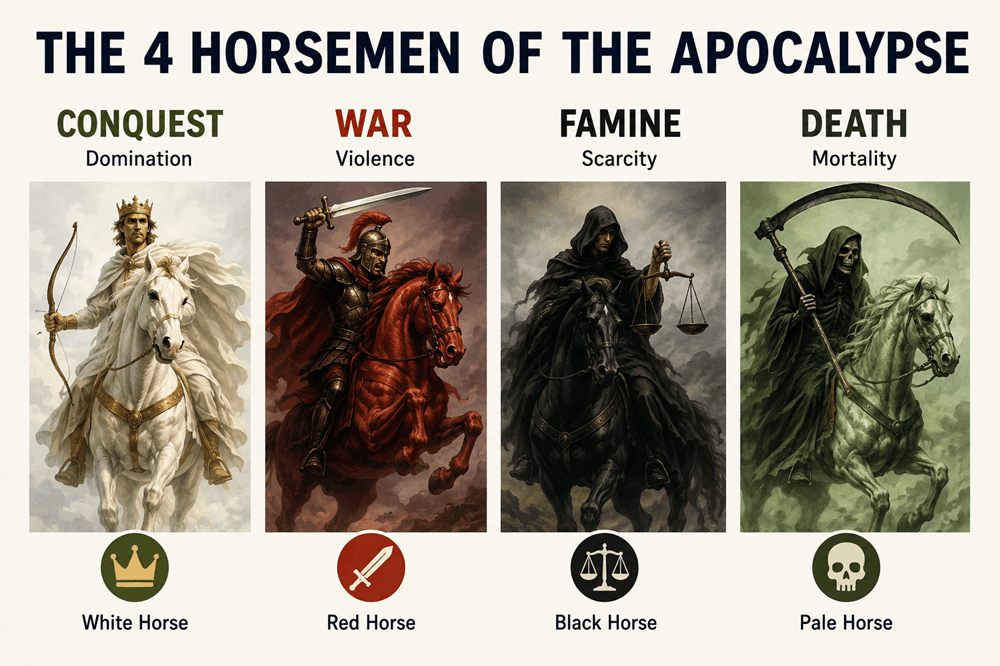
The Four Horsemen of the Apocalypse are usually called Conquest, War, Famine, and Death. They appear in Revelation 6:1–8, where four riders emerge as the first four seals of a mysterious scroll are opened. Each rider travels on a different-colored horse and represents a form of catastrophe or judgment.
There is one important detail, however: the Bible explicitly names only the fourth rider, Death. The identities of the other three come from centuries of interpretation based on their horses, weapons, actions, and surrounding imagery.
The Four Horsemen at a Glance
| Horseman | Horse Color | Main Symbol | Common Meaning |
|---|---|---|---|
| Conquest | White | Bow and crown | Conquest, domination, sometimes pestilence |
| War | Red | Large sword | Warfare, violence, bloodshed |
| Famine | Black | Scales | Hunger, scarcity, economic hardship |
| Death | Pale/greenish | Death itself | Mass death, mortality, destruction |
Together, the Horsemen symbolize escalating disaster.
The first conquers.
The second destroys peace.
The third brings scarcity.
The fourth brings death.
Where Do the Four Horsemen Appear in the Bible?
The Four Horsemen appear in the Book of Revelation, the final book of the New Testament.
Revelation contains a vision involving a scroll sealed with seven seals. As the Lamb opens the first four seals, four riders appear one after another.
Each is summoned by one of four living creatures with the command to come forward.
The imagery is dramatic and deliberately symbolic.
Rather than simply describing four literal riders traveling across the earth, the passage presents forces that bring conquest, violence, hunger, and death.
That is why the Four Horsemen have remained such powerful symbols far beyond religious interpretation.
1. The White Horseman — Conquest
The first rider appears on a white horse.
He carries a bow and is given a crown. He then rides out conquering and determined to continue conquering.
Because of this, the most common name for the first Horseman is:
Conquest
His main symbols are:
- White horse
- Bow
- Crown
- Victory
- Expansion
- Domination
The image suggests someone with authority who moves outward successfully, taking control.
Unlike the second Horseman, who represents open warfare and bloodshed, Conquest can represent the broader process of one power overcoming another.
Is the First Horseman Conquest or Pestilence?
This is one of the biggest questions surrounding the Four Horsemen.
Many modern lists call the first rider Pestilence rather than Conquest.
That interpretation has become extremely common in movies, games, novels, and popular culture.
However, Revelation itself does not say that the white rider represents disease.
The text describes him as carrying a bow, receiving a crown, and riding out to conquer.
For that reason, Conquest is usually the more direct interpretation of the biblical imagery.
Pestilence became associated with the Horsemen partly because disease fits naturally alongside war, famine, and death as one of civilization’s great catastrophes.
So if you encounter the names:
Pestilence, War, Famine, and Death
you are seeing a popular later version of the Four Horsemen.
If you encounter:
Conquest, War, Famine, and Death
you are seeing a reading that follows the first rider’s actions more closely.
Why Is Conquest Riding a White Horse?
White can represent victory, triumph, authority, or purity.
That creates some ambiguity.
A white horse initially sounds positive.
The rider even receives a crown.
But his purpose is conquest.
This contrast has led to several competing interpretations.
Some readers see the rider as political or military imperialism.
Others have interpreted him as a false messiah or deceptive power because his appearance seems victorious while his arrival begins a sequence of catastrophe.
Still others have interpreted the rider positively.
The passage leaves enough ambiguity that the first Horseman remains the most debated of the four.
2. The Red Horseman — War
The second rider appears on a red horse.
He is given a large sword and the power to take peace away from the earth so that people kill one another.
For that reason, his traditional name is:
War
His symbolism is much less ambiguous than the first rider’s.
Red naturally evokes:
- Blood
- Violence
- Fire
- Anger
- Conflict
The sword reinforces the meaning.
This Horseman represents organized violence and the collapse of peace.
What Does the War Horseman Represent?
War represents more than a single battle.
The image suggests a world in which peace itself has been removed.
Once that happens, violence spreads.
Nations can fight nations.
Communities can turn against one another.
Individuals can kill one another.
The Horseman therefore symbolizes both warfare and the larger human tendency toward violent conflict.
In interpretations of Revelation, War frequently follows Conquest naturally.
One power attempts to dominate.
Resistance follows.
Peace collapses.
Violence spreads.
The sequence feels almost historically familiar.
Why Does War Carry a Sword?
The sword was an obvious symbol of military violence in the ancient world.
A large sword makes the rider’s meaning unmistakable.
He does not arrive carrying scales, food, or a crown.
He carries a weapon.
The important part of his description, however, is not simply the sword.
He is given authority to remove peace.
That turns War from a person with a weapon into a symbol of an entire condition.
Where War rides, peaceful order disappears.
3. The Black Horseman — Famine
The third Horseman rides a black horse and carries a pair of scales.
He is traditionally called:
Famine
The scales are the key to understanding him.
A voice announces extremely high prices for basic foods while also mentioning that oil and wine should not be harmed.
The image suggests scarcity severe enough that basic necessities become extraordinarily expensive.
His symbols include:
- Black horse
- Scales
- Expensive food
- Scarcity
- Hunger
- Economic inequality
Why Does Famine Carry Scales?
Scales were used to weigh goods.
In the context of the Horseman, they suggest food being measured carefully because there is not enough to go around.
When food is abundant, people do not need to obsess over every tiny amount.
During famine, every portion matters.
The scales therefore symbolize rationing and scarcity.
They can also suggest economic imbalance.
Food still exists.
But ordinary people may struggle to afford it.
This makes the Horseman relevant not only to literal starvation but also to broader ideas of inflation, shortages, and economic crisis.
Why Is Famine’s Horse Black?
Black is traditionally associated with mourning, deprivation, darkness, and death.
Those associations make it appropriate for famine.
Starvation is slow compared with the sudden violence of war.
The black horse suggests a darker, more prolonged form of suffering.
It also creates a visual progression.
White.
Red.
Black.
Pale.
Each horse seems to move the vision further into catastrophe.
What Do the Food Prices Mean?
The announcement accompanying the third Horseman describes basic grain being sold at extraordinarily high prices.
The implication is that a person’s entire daily wage may barely purchase enough basic food to survive.
That is economic disaster.
The unusual instruction not to harm the oil and wine has produced many interpretations.
One common reading sees it as a picture of inequality.
Basic food becomes unaffordable for ordinary people while goods associated with greater comfort remain available.
Whether or not that is the only intended meaning, the scene clearly depicts a society in which food security has collapsed.
4. The Pale Horseman — Death
The fourth Horseman is the only one actually named in the biblical passage.
He rides a pale horse, and his name is:
Death
Hades follows behind him.
Death is given authority over part of the earth to kill through several forms of catastrophe, including violence, famine, disease, and wild animals.
This Horseman effectively gathers the consequences of the previous riders together.
His symbols include:
- Pale horse
- Death
- Hades
- Mortality
- Disease
- Widespread destruction
What Color Is Death’s Horse?
Many English translations call it a pale horse.
The underlying Greek word is related to a pale green or yellow-green color.
That is significant because it can resemble the unhealthy color of sickness, decay, or a corpse.
So Death’s horse is not necessarily pale white.
It is closer to a sickly greenish shade.
That makes the image considerably more unsettling.
The horse looks like death before the rider’s name is even revealed.
Why Does Hades Follow Death?
In Revelation, Death is followed by Hades.
The two concepts are closely related but not identical.
Death takes life.
Hades represents the realm of the dead.
The pairing therefore creates a powerful sequence:
Death kills.
The grave follows.
It reinforces the idea that this final Horseman represents mortality on an enormous scale rather than one particular way of dying.
Why Doesn’t Death Carry a Scythe in Revelation?
Modern images often show Death as a hooded skeleton holding a scythe.
That image comes from later artistic traditions surrounding the Grim Reaper.
Revelation does not actually describe the fourth Horseman carrying a scythe.
The connection is understandable because both figures represent death.
Over time, artists blended apocalyptic imagery with the visual traditions of the Grim Reaper.
That is why modern paintings, games, tattoos, and movies may show the pale rider with:
- A skull
- Black robes
- A scythe
- Skeletal features
Those details are culturally familiar, but they are not all stated in the biblical passage.
What Order Do the Four Horsemen Appear In?
The traditional order is:
- Conquest — White horse
- War — Red horse
- Famine — Black horse
- Death — Pale horse
The order matters because the disasters can be interpreted as connected.
Conquest leads to conflict.
Conflict leads to destruction and disrupted food supplies.
Scarcity leads to famine.
War and famine ultimately produce death.
The Horsemen therefore form an escalating chain rather than four completely unrelated disasters.
Are the Four Horsemen Actual People?
Revelation does not provide ordinary personal names or biographies for the riders.
They function primarily as symbolic figures.
For that reason, they are better understood as embodiments of forces rather than four normal human characters.
War is not simply a soldier.
He is war itself.
Famine is not merely a hungry person.
He represents scarcity spreading across society.
Death is explicitly personified as Death.
That personification makes enormous abstract disasters easier to visualize.
Instead of being told that catastrophe is coming, the reader sees catastrophe riding toward humanity.
What Do the Four Horsemen Represent Together?
Together, the Four Horsemen represent the fragility of human civilization.
A society may appear stable.
Then conquest begins.
Peace disappears.
Food becomes scarce.
People die.
Their power comes partly from the fact that these disasters are connected in real history.
War can destroy farms.
Destroyed farms create food shortages.
Food shortages lead to hunger and disease.
Disease and conflict increase mortality.
The imagery therefore works both symbolically and practically.
Each Horseman strengthens the next.
Why Are They Called Horsemen of the Apocalypse?
The word “apocalypse” comes from a Greek word meaning something closer to revelation or unveiling.
Today, “apocalypse” usually means catastrophic destruction or the end of the world.
That modern meaning developed partly because Revelation contains dramatic visions of judgment and cosmic upheaval.
The riders became known as the Four Horsemen of the Apocalypse because they appear in this apocalyptic vision.
They have since become universal symbols of catastrophe.
Someone may jokingly refer to four unpleasant things as “the Four Horsemen of the Apocalypse” even when religion has nothing to do with the conversation.
Are the Four Horsemen Signs of the End of the World?
Many Christian traditions interpret the Horsemen in relation to divine judgment and end-times events.
But interpretations differ considerably.
Some readers believe Revelation describes future events.
Others understand much of the book as symbolic language connected with conditions facing early Christians and the Roman world.
Some see repeating patterns of conquest, warfare, famine, and death throughout human history.
Because Revelation is highly symbolic, different Christian traditions have developed very different timelines and explanations.
The basic imagery of the Horsemen is much more widely agreed upon than exactly when or how it should be fulfilled.
Why Is Pestilence So Often Listed as One of the Four Horsemen?
Pestilence means widespread deadly disease.
It fits so naturally beside War, Famine, and Death that it has become deeply embedded in popular culture.
Historically, the connection also makes sense.
War often produces famine.
Famine weakens populations.
Disease spreads.
Death follows.
This cycle occurred repeatedly throughout history.
As a result, many modern stories replace Conquest with Pestilence to create four immediately recognizable disasters:
Pestilence
War
Famine
Death
That version is culturally powerful even though Revelation does not explicitly identify the first white rider as Pestilence.
What Are the Four Horsemen’s Names in Popular Culture?
Popular culture usually uses one of two sets.
Biblical-style interpretation
- Conquest
- War
- Famine
- Death
Popular modern interpretation
- Pestilence
- War
- Famine
- Death
Games, television shows, comic books, anime, novels, and movies frequently modify the list further.
Sometimes Conquest and Pestilence exist as separate characters.
Sometimes one Horseman is replaced entirely.
Writers also give them personalities, weapons, backstories, and relationships that do not come from Revelation.
What Do the Four Horsemen Mean as Tattoos?
Four Horsemen tattoos often symbolize:
- Mortality
- Chaos
- Destruction
- Judgment
- Human conflict
- Survival
- Fate
- The end of an era
- Religious belief
- The darker side of humanity
A single Horseman can also carry a more specific meaning.
War may represent conflict.
Famine may represent deprivation.
Death may symbolize mortality or acceptance of death.
Conquest may represent ambition, domination, or victory.
The meaning depends heavily on the person wearing the tattoo.
Are the Four Horsemen Evil?
The passage does not describe them in the same way a simple story would describe four villains.
They appear as part of the opening of the seals and operate within a larger vision of judgment.
They represent terrible forces, but their role is more symbolic and theological than simply “four evil characters.”
This distinction becomes important because modern entertainment often turns them into supernatural villains with individual personalities.
That can be entertaining, but it is a creative adaptation rather than a direct description from Revelation.
Why Are the Four Horsemen Still So Famous?
Few symbols communicate catastrophe as quickly.
Four riders approaching on differently colored horses create a simple image that can carry enormous meaning.
You do not need a long explanation to understand what War represents.
Famine is immediately threatening.
Death is universal.
Even the uncertain first rider communicates power and conquest.
The Horsemen also represent disasters humanity has repeatedly experienced.
Empires conquer.
Wars begin.
Food becomes scarce.
People die.
That makes the imagery feel timeless rather than tied entirely to one ancient text.
The Bottom Line
The Four Horsemen of the Apocalypse are traditionally known as Conquest, War, Famine, and Death.
The first rides a white horse, carries a bow, receives a crown, and goes out conquering.
The second rides a red horse, carries a sword, and removes peace from the earth.
The third rides a black horse, carries scales, and represents famine, scarcity, and extreme food prices.
The fourth rides a pale greenish horse and is explicitly named Death, with Hades following behind him.
Only Death is actually named in Revelation. “War,” “Famine,” and especially “Conquest” are descriptive names based on what the riders do.
The popular name Pestilence for the first Horseman developed later and remains common in modern entertainment and everyday culture.
Whichever version you encounter, the central idea remains the same.
The Four Horsemen represent catastrophe arriving in stages: power conquers, peace collapses, resources disappear, and death follows.