What Artist Cut Off His Ear? The Truth Behind Van Gogh’s Story
The famous artist who cut off his ear was Vincent van Gogh, the Dutch painter known for works such as The Starry Night, Sunflowers, and The Bedroom. The incident happened in Arles, France, in December 1888, when Van Gogh was 35 years old. Historical accounts identify his left ear as the one he injured.
It has become one of the most famous stories in art history, but the popular version often gets simplified into a dramatic sentence: “Van Gogh cut off his ear.”
The real story is more complicated.
The incident happened during an emotionally unstable period, shortly after tensions with fellow artist Paul Gauguin reached a breaking point. Van Gogh was hospitalized afterward, continued painting, and eventually entered a psychiatric hospital voluntarily.
The ear did not end his career. In fact, some of his most famous paintings still lay ahead.
Which Artist Cut Off His Ear?
Vincent van Gogh cut off his left ear in December 1888.
At the time, he was living in the Yellow House in Arles in southern France. Van Gogh hoped the house could become the center of an artists’ community where painters would live and work together.
Paul Gauguin joined him there in October 1888.
For a while, Van Gogh’s plan appeared to be working. The two artists painted, discussed art, and lived under the same roof.
But they also had very different personalities and artistic ideas.
Their relationship became increasingly tense.
According to the Van Gogh Museum, the situation deteriorated until Gauguin decided to leave. In a state of severe confusion, Van Gogh then cut off his left ear.
That sequence—Van Gogh’s emotional crisis, Gauguin’s planned departure, and the ear incident—has made the night one of the most discussed episodes in the history of Western art.
Did Van Gogh Cut Off His Whole Ear?
This is one of the details that has been debated.
For years, the story was often softened into the claim that Van Gogh removed only his earlobe or a small portion of his ear.
Other historical research has argued that the injury was considerably more extensive.
The Van Gogh Museum now states simply that he cut off his left ear, while historical discussion continues over exactly how much tissue was removed. A drawing associated with Dr. Félix Rey, the physician who treated Van Gogh, has been used as evidence that most or all of the external ear was severed.
So the safest answer is not that Van Gogh casually nicked his earlobe.
It was a serious injury requiring medical treatment.
Why Did Van Gogh Cut Off His Ear?
There is no single completely proven explanation.
That is important because popular culture often presents the incident as though historians know exactly what Van Gogh was thinking.
They do not.
What is known is that the incident occurred during a period of severe emotional distress and immediately around the collapse of his living and working arrangement with Paul Gauguin.
Van Gogh had dreamed of creating a community of artists in Arles. Gauguin’s arrival had been extremely important to him, so the breakdown of their relationship represented more than an argument with a roommate.
It threatened an entire vision of the life Van Gogh hoped to build.
The two men reportedly argued frequently, and Gauguin ultimately intended to leave Arles.
Shortly afterward came Van Gogh’s crisis.
It is tempting to reduce the story to:
Gauguin left, so Van Gogh cut off his ear.
But that suggests a simple cause-and-effect relationship that the historical evidence cannot fully establish.
Van Gogh experienced repeated periods of serious illness afterward, and even the doctors treating him could not provide the kind of definitive modern diagnosis people sometimes attach to him today. The Van Gogh Museum emphasizes that the exact nature of his illness remains uncertain.
What Did Van Gogh Do With His Ear?
This is the part of the story that sounds almost invented.
After cutting his ear, Van Gogh reportedly wrapped it in paper and took it to a woman at a brothel in Arles.
The Van Gogh Museum records that the woman fainted, causing considerable commotion. Police later found Van Gogh at his home, and he was taken to the hospital.
The woman’s identity and the exact nature of her relationship with Van Gogh have been subjects of historical investigation, but the broad story of him delivering the severed ear is supported by contemporary accounts.
It is one reason the incident became so difficult to separate from the mythology surrounding Van Gogh.
Even without embellishment, the documented events are extraordinary.
Did Paul Gauguin Cut Off Van Gogh’s Ear?
An alternative theory occasionally appears claiming that Paul Gauguin actually injured Van Gogh during a confrontation and that the two artists concealed what happened.
It is an intriguing story, particularly because Gauguin was an experienced fencer.
But it is not the generally accepted account.
The Van Gogh Museum continues to describe Van Gogh as having cut off his own ear during a period of confusion after his conflict with Gauguin.
The Gauguin theory remains useful mainly because it shows how much speculation has grown around a night for which no complete eyewitness account survives.
When a famous historical event has unanswered questions, those gaps tend to attract alternative explanations.
That does not make every alternative equally likely.
Which Ear Did Van Gogh Cut Off?
Van Gogh injured his left ear.
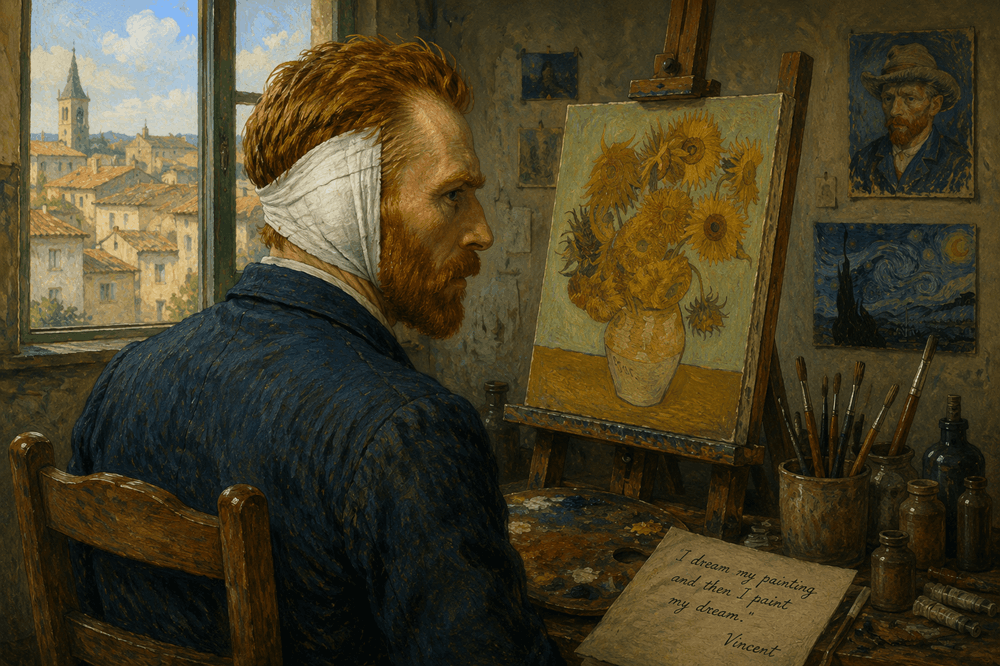
Confusion sometimes comes from his famous Self-Portrait with Bandaged Ear.
In the painting, the bandage can appear to be on the opposite side because Van Gogh painted himself using a mirror.
A self-portrait made from a mirror reverses what the artist sees.
So the painting should not be treated like a photograph documenting which ear was injured.
The historical record identifies the left ear.
What Happened to Van Gogh After He Cut Off His Ear?
Van Gogh was hospitalized in Arles.
His brother Theo hurried from Paris to see him, and Van Gogh was treated by Dr. Félix Rey. Friends including postman Joseph Roulin also supported him during this difficult period.
Van Gogh eventually returned to painting, but his health remained unstable.
He experienced further crises and periods of hospitalization.
By May 1889, Van Gogh realized that living alone in Arles was no longer working. He voluntarily entered the Saint-Paul-de-Mausole psychiatric hospital at Saint-Rémy-de-Provence.
What happened next is one of the strangest contrasts in his life.
While struggling with serious illness, Van Gogh continued producing extraordinary art.
His time at Saint-Rémy included paintings of the surrounding gardens, olive trees, cypresses, fields, and night skies.
Among the works associated with this period is The Starry Night, now one of the most recognizable paintings in the world.
The ear incident therefore did not mark the end of Van Gogh’s artistic development.
Some of the work that made him immortal came afterward.
Did Van Gogh Paint Himself With the Bandaged Ear?
Yes.
Van Gogh created self-portraits showing himself after the injury, including the famous Self-Portrait with Bandaged Ear.
These paintings have become inseparable from the story.
But they are interesting for another reason.
Van Gogh does not portray the incident itself.
There is no dramatic scene of violence.
Instead, the viewer encounters the aftermath: an artist standing or sitting calmly enough to paint himself while a heavy bandage covers the side of his head.
That contrast makes the image unusually powerful.
The event that preceded the painting was chaotic.
The painting itself is controlled.
Van Gogh returned to the activity he understood best: making art.
Did Van Gogh Cut Off His Ear for a Woman?
This is another common version of the story, but there is no good reason to reduce the incident to romantic rejection.
The fact that Van Gogh delivered the severed ear to a woman helped create later stories connecting the act directly to romance.
But giving someone the ear afterward does not prove that the woman caused him to injure himself.
The better-supported historical context centers on Van Gogh’s severe crisis and the deterioration of his relationship with Gauguin.
The desire for a dramatic romantic explanation probably says as much about later storytelling as it does about Van Gogh.
“Artist loses his love and cuts off his ear” is memorable.
Reality is less tidy.
Why Is Van Gogh’s Ear So Famous?
Van Gogh’s ear became famous partly because his entire life was transformed into a legend after his death.
Today, Van Gogh represents the popular image of the brilliant artist who suffers for his work.
The ear fits perfectly into that story.
But the mythology can distort the actual person.
Van Gogh was not important because he cut off his ear.
He was an ambitious, intensely hardworking painter who spent years studying color, perspective, landscape, portraiture, Japanese prints, rural life, and the work of other artists.
His surviving correspondence also shows someone who thought deeply about painting and constantly evaluated his own progress.
The ear incident occupied one terrible night.
His artistic career involved years of work.
Treating the injury as the defining fact about Van Gogh risks turning a complicated artist into a strange piece of trivia.
Was Van Gogh Famous When He Cut Off His Ear?
Not in the way he is famous today.
Van Gogh struggled commercially during his lifetime and depended heavily on financial support from his younger brother Theo.
He was connected to the art world, knew other artists, and exhibited work, but he never experienced anything resembling his later global fame.
That creates one of the great ironies surrounding his story.
Today, crowds travel across the world to see paintings by a man who struggled to find widespread recognition while he was alive.
The dramatic ear story may attract attention, but the paintings are why the attention endured.
The Bottom Line
The artist who cut off his ear was Vincent van Gogh.
The incident occurred in Arles, France, in December 1888, during an intense period of personal instability and conflict with fellow painter Paul Gauguin. Van Gogh injured his left ear, delivered the severed tissue to a woman, and was hospitalized afterward.
Exactly why he did it cannot be reduced to one proven explanation.
His illness remains historically difficult to diagnose, and some details surrounding the event are still debated.
What is clearer is what happened afterward.
Van Gogh kept painting.
He created self-portraits showing his bandaged ear, endured additional health crises, voluntarily entered a psychiatric hospital, and continued producing work that would eventually make him one of the most recognizable artists in history.
That may be the more revealing part of the story.
The ear incident is the detail people remember because it is shocking.
Van Gogh’s paintings are the reason people are still asking about it more than a century later.