
John Legend’s “All of Me” Meaning: Wholehearted Love
John Legend’s “All of Me” is often summarized as a song about loving someone despite their flaws. Its message is more meaningful than that description suggests.
The narrator sees his partner as fascinating, unpredictable, reassuring, and difficult to understand. He does not ignore those contradictions or pretend the relationship is always easy. Instead, he chooses to love her as a complete person.
The song’s promise is also reciprocal. He offers his whole self while asking his partner to take the same emotional risk. “All of Me” is therefore not only about accepting another person—it is about two people allowing themselves to be fully known.
Listen to “All of Me” and read the full lyrics
We do not reproduce the complete copyrighted lyrics here, but you can follow the song through authorized sources:
- Read the full “All of Me” lyrics on Apple Music — sign in and select View Full Lyrics
- Watch John Legend’s official “All of Me” music video
- Explore Love in the Future through John Legend’s official store
Apple Music provides the original recording, official credits, and access to the complete lyrics where available.
“All of Me” at a glance
- Artist: John Legend
- Album: Love in the Future
- Released as a single: August 2013
- Album position: Track six
- Songwriters: John Legend (John Stephens) and Toby Gad
- Producers: John Legend and Dave Tozer
- Duration: 4 minutes, 29 seconds
- Inspiration: Chrissy Teigen
- Music-video director: Nabil Elderkin
Legend wrote the song about his then-fiancée, Chrissy Teigen. Although it began with one real relationship, its language is broad enough to reflect the experiences of many couples.
What is “All of Me” about?
“All of Me” is about loving someone as a whole person rather than loving only the qualities that are convenient, attractive, or easy to understand.
The narrator is captivated by his partner, but he is also unsettled by her. She can draw him closer while leaving him confused. She can challenge him, distract him, and affect his emotions in ways he cannot fully control.
Instead of treating those experiences as proof that the relationship is wrong, he accepts them as part of loving someone deeply.
His commitment does not come from believing that his partner is flawless. It comes from recognizing that her appealing and difficult qualities belong to the same person.
The song also avoids presenting the narrator as completely calm or self-assured. He is vulnerable too. His devotion gives his partner the power to affect him, disappoint him, and expose parts of himself he might otherwise protect.
That shared vulnerability is the foundation of the song.
The meaning of “perfect imperfections”
“Perfect imperfections” is the song’s most recognizable paradox.
An imperfection is something that falls short of an ideal. Calling imperfections perfect appears contradictory, but that contradiction expresses the song’s main idea.
The narrator is not waiting for his partner to become a smoother, simpler, or more polished version of herself. He loves the person who actually exists, including the insecurities, difficult moods, unusual habits, and sharp edges that make her individual.
The phrase does not mean that every action becomes harmless or admirable simply because it comes from someone we love. Instead, it rejects the idea that a person must appear flawless to deserve affection.
Love, in this song, is not the discovery of perfection. It is the decision to value a person whose humanity includes inconsistency.
That is why the physical imagery surrounding the phrase includes both softness and edges. The beloved is attractive, but she is not presented as passive or designed only to please the narrator. She remains someone who can resist, challenge, and surprise him.
Why the song is built from contradictions
“All of Me” repeatedly joins opposing ideas:
- Losing and winning
- Endings and beginnings
- Feeling overwhelmed while continuing to breathe
- Being distracted and inspired by the same person
- Experiencing confusion while remaining certain about love
These paradoxes show how intimate relationships can create several emotions at once.
Love can make someone feel secure while also making them more vulnerable. The person who provides comfort may become the person whose absence is most frightening. Surrendering emotional control may feel like a loss, yet that surrender can create a deeper connection.
The narrator cannot explain his relationship through simple categories. It is not purely peaceful or chaotic, easy or difficult, safe or risky.
It contains all of those experiences.
That emotional complexity makes the song more convincing than a declaration built entirely from compliments. Legend is not saying that love removes every contradiction. He is saying that commitment can exist within them.
Why losing can feel like winning
Love requires giving up certain forms of control.
The narrator can no longer remain emotionally detached. He cannot guarantee that he will never be hurt, misunderstood, or disappointed. By loving someone completely, he gives that person the ability to affect him deeply.
That can feel like losing independence or protection.
Yet the same surrender creates intimacy. What he loses in emotional distance, he gains in connection.
The phrase can also suggest that relationships should not always be treated as contests. Winning an argument, preserving pride, or refusing to compromise may matter less than maintaining trust.
The song presents surrender as voluntary vulnerability, not as the disappearance of personal boundaries.
The beloved as both an ending and a beginning
Calling someone both an ending and a beginning communicates the scale of the relationship.
It may represent the end of a more isolated or self-contained life and the beginning of a shared future. The narrator’s identity has not disappeared, but the relationship has changed how he imagines the rest of his life.
It can also describe emotional transformation. Loving this person has ended one way of understanding himself and begun another—one in which he must become more open and accept greater emotional risk.
The phrase is romantic exaggeration rather than a literal claim that the narrator has no existence outside the relationship.
Its purpose is to divide his life into a before and an after.
“All of me” and “all of you” make the promise mutual
The title initially sounds like a one-sided declaration: the narrator will give everything he has.
The chorus makes the exchange reciprocal. He offers his whole self and asks for the whole of his partner in return.
That distinction is essential.
The relationship is not presented as one person sacrificing endlessly while the other remains protected. Both partners must reveal themselves.
The repeated exchange suggests that:
- Both people must be emotionally honest.
- Neither can remain completely hidden.
- Each accepts the possibility of rejection.
- Commitment involves receiving vulnerability as well as offering it.
- Intimacy is created through mutual trust.
The narrator is not only praising his partner. He is proposing an emotional agreement.
He will accept the parts of her that are difficult to reveal, but she must also accept his complete self. The love works because both people participate.
Cards on the table and the risk of honesty
The song later uses the language of a card game to describe emotional openness.
Card players normally protect their hands. Revealing every card removes strategic safety and allows the other person to see exactly where they stand.
Emotional honesty carries a similar risk.
Someone who hides their fears may avoid immediate rejection, but they also prevent the relationship from becoming fully intimate. Being known requires surrendering control over how another person will respond.
The song emphasizes that both people reveal themselves. One partner cannot create mutual vulnerability alone.
This marks the movement from attraction toward commitment. The couple is no longer simply fascinated by each other. They are deciding whether to remove their defenses and accept the uncertainty that follows.
The card imagery is therefore one of the song’s clearest statements about what complete love demands: not perfection, but honesty.
Loving someone during difficult moments
The second verse expands the declaration beyond attraction.
The narrator promises to remain present when his partner is overwhelmed, discouraged, or no longer appearing confident and composed. His affection does not depend on her performing happiness.
That gives the song an element of companionship.
He is not only interested in the public or polished version of the person he loves. He wants to stay close when she is emotionally struggling and when the outside world has damaged her confidence.
The song does not suggest that sadness itself is beautiful or desirable. Its point is that difficult moments do not remove someone’s worth.
This promise helps explain why “All of Me” became closely associated with weddings. The song’s commitment reaches beyond celebration toward the less predictable periods of a shared life.
Its romantic language should not be interpreted as a demand to tolerate cruelty or genuinely harmful behavior. The song celebrates acceptance of human imperfection, not the abandonment of reasonable boundaries.
How the piano and vocal make the promise personal
The recording is built around Legend’s voice and piano, with restrained supporting production.
That simplicity makes the song feel like a direct conversation. Instead of beginning as a large public anthem, it sounds like one person addressing another in a private room.
The sparse arrangement serves several purposes:
- The lyrics remain clear.
- Small changes in Legend’s voice become noticeable.
- The piano creates intimacy.
- The chorus can grow without heavy percussion.
- The performance remains easy to adapt for weddings and acoustic covers.
The music does not compete with the promise. It leaves enough space for the vocal to carry most of the emotional weight.
Legend begins with a relatively conversational delivery. That suits the uncertainty of the opening verse, where the narrator is still attempting to understand his partner and the effect she has on him.
When the chorus arrives, his voice becomes fuller and more assured.
The musical growth makes the declaration feel like an answer to the confusion established earlier. He may not understand every contradiction within the relationship, but he is certain about his willingness to commit.
Later repetitions reinforce that certainty rather than introducing new ideas. The narrator keeps returning to the promise because it is the emotional conclusion he trusts most.
How John Legend and Toby Gad wrote “All of Me”
Legend co-wrote “All of Me” with songwriter Toby Gad.
Gad has recalled that Legend entered the session with the title, the central chorus idea, and his relationship with Teigen already in mind. They developed the song at the piano within a relatively short writing session.
Its concentrated writing process fits the finished result.
The song does not depend on an elaborate narrative, multiple characters, or changing locations. It is built around a small number of connected ideas:
- A partner can be attractive and challenging.
- Loving someone completely requires accepting contradiction.
- Commitment creates emotional vulnerability.
- Both people must participate in the exchange.
The language is accessible, but the repeated paradoxes give it more emotional tension than a straightforward list of compliments would provide.
Its simplicity is carefully constructed rather than shallow.
What does the “All of Me” music video mean?
The black-and-white video places the real couple behind the song at its center.
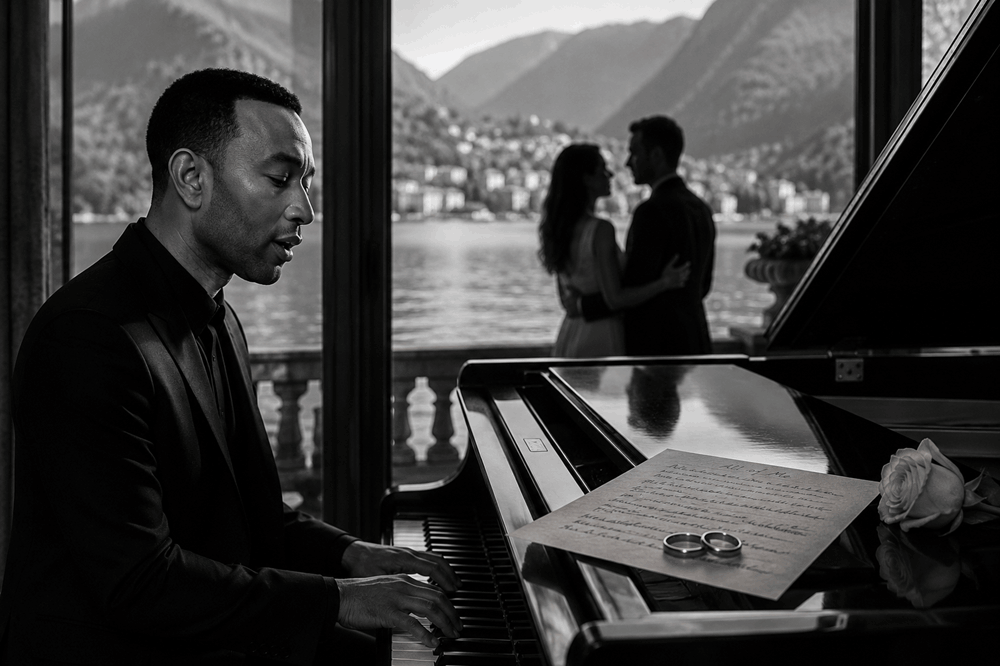
It shows Legend at the piano alongside intimate scenes with Teigen near Lake Como. Nabil Elderkin directed the video during the days immediately before the couple’s September 2013 wedding.
Elderkin had also directed “Stereo,” the earlier video shoot where Legend and Teigen first met. His return for “All of Me” creates a fitting sense of completion: the director who was present near the beginning of their relationship filmed them as they prepared to marry.
The finished video also includes footage connected with their wedding celebrations.
This history makes the production feel especially personal. The people shown onscreen are the same people whose relationship inspired the song.
Still, the video is a carefully constructed romantic portrait rather than an unfiltered documentary. Its locations, shots, and intimate moments were selected to express a particular emotional version of the relationship.
Why the video is black and white
The monochrome presentation removes many visual distractions.
Without strong color, attention moves toward faces, bodies, shadows, reflected light, water, and the polished surface of the piano. The result feels intimate and photographic.
The black-and-white style can also be read as a visual counterpart to the song’s musical arrangement.
Both are restrained. The recording avoids unnecessary instrumental layers, while the video avoids unnecessary visual complexity. Each directs attention toward the relationship at the center.
The contrast between light and shadow also fits a song built from opposing ideas. Beauty and difficulty, confidence and vulnerability, comfort and uncertainty remain visible beside one another.
This is an editorial interpretation of the visual style rather than a confirmed explanation from the director.
Water, reflections, and vulnerability
Water appears throughout the video and visually echoes the song’s feeling of being emotionally overwhelmed.
The scenes around and beneath the water create a sense of exposure. Legend and Teigen are often shown physically close and separated from the wider world, reinforcing the song’s private atmosphere.
Reflections can also be read as symbols of intimacy and self-recognition.
A reflection shows the same person from another angle. In a song about complete acceptance, that imagery may suggest seeing beyond the version of oneself or one’s partner that is deliberately presented to the world.
The video never needs to state this meaning directly. Its visual language supports the song by emphasizing closeness, exposure, and multiple ways of seeing the same person.
Why “All of Me” became a wedding standard
The song’s connection with Legend and Teigen’s wedding strengthened its association with marriage, but its lyrical structure made that association possible.
It sounds like a personal vow:
- I see that you are complicated.
- I will reveal my own complete self.
- I ask you to do the same.
- I accept that commitment creates risk.
- I intend to remain present during difficult moments.
The piano arrangement also allows the song to work in intimate ceremonies, first dances, and acoustic performances. It can fill a large room without losing the impression that one person is speaking directly to another.
Its message is specific enough to feel sincere but broad enough for other couples to make it part of their own stories.
Final meaning
John Legend’s “All of Me” is about choosing a complete person rather than an idealized version of them.
Its contradictions—surrender and victory, endings and beginnings, comfort and confusion—show that deep love can feel stabilizing and destabilizing at the same time.
The song’s most important promise is reciprocal.
The narrator offers his whole self while asking his partner to take the same emotional risk. Their bond depends not on pretending that imperfections do not exist, but on allowing those imperfections to be seen without immediately withdrawing love.
That is why “All of Me” remains more affecting than a simple list of romantic compliments. It presents love as complete recognition: seeing someone’s beauty, defenses, difficult edges, and vulnerability, then choosing to be fully known in return.