“Big Iron” Lyrics Meaning: Texas Red Loses Because He Believes His Own Legend
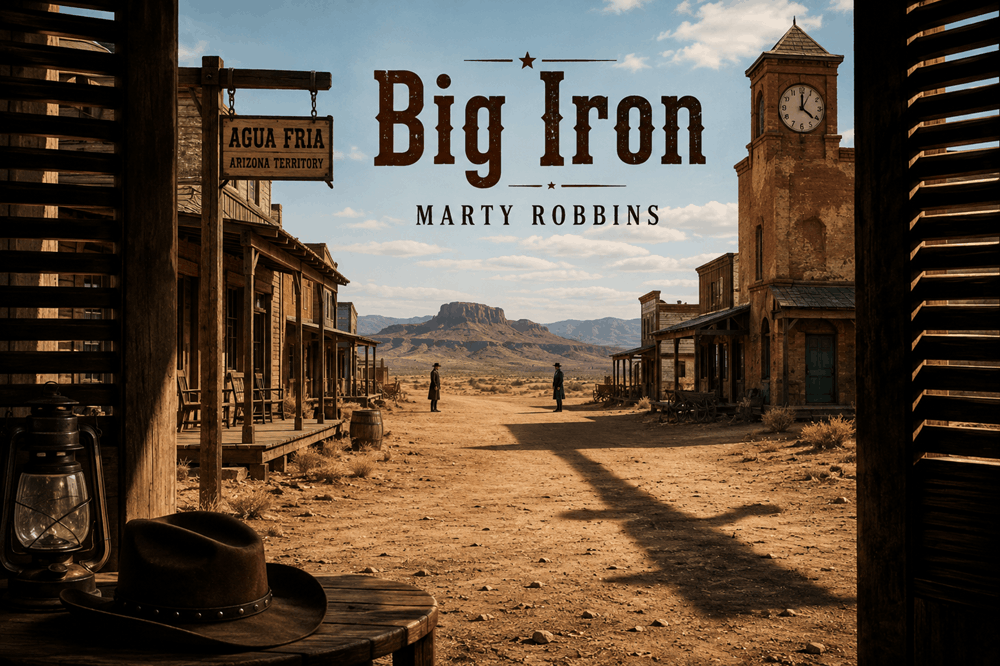
“Big Iron” by Marty Robbins is a Western story about an Arizona Ranger who enters the town of Agua Fria to capture a feared outlaw named Texas Red.
The townspeople assume the stranger is walking toward certain death. Texas Red has killed every man who previously challenged him, and his reputation has become so powerful that no one seriously imagines he can lose.
The Ranger defeats him almost instantly.
The song’s central idea is not simply that a good man kills a bad man. It is about the difference between reputation and actual ability.
Texas Red has built his identity around the fear he creates. The Ranger does not advertise himself at all. He speaks only when necessary, calmly states his purpose and allows his skill to become visible at the moment it matters.
That creates the song’s defining contrast:
Texas Red believes his past victories guarantee his future, while the Ranger treats the duel as a job that still has to be completed.
The “big iron” may attract everyone’s attention, but the Ranger’s true advantage is not the size of his gun.
It is discipline.
What is “Big Iron” about?
The song begins when a quiet stranger rides into Agua Fria.
The people watching him immediately become suspicious. He looks around carefully, carries a prominent handgun and refuses to explain himself. Because the town already lives under the shadow of Texas Red, any armed outsider appears likely to be another criminal.
The stranger eventually reveals that he is an Arizona Ranger. He has come specifically for Texas Red and is willing to return the outlaw alive or dead.
News of the challenge quickly reaches Red.
The outlaw remains confident because twenty other men have already tried to take him. None survived. He assumes the Ranger will simply become the twenty-first.
At 11:20 that morning, the two men face each other in the street while townspeople watch from windows.
Texas Red never completes his draw.
The Ranger fires first, and the outlaw dies before the town has time to understand that its most feared man has finally been defeated.
The complete official recording of “Big Iron” presents the story in less than four minutes, but Robbins gives it the shape of a complete Western film.
The Ranger’s silence is his first sign of power
The stranger hardly speaks when he enters town.
In another character, that silence might suggest fear or uncertainty. In the Ranger, it communicates control.
He does not need to impress the townspeople. Their opinions will not change his mission, and revealing too much could give Texas Red an advantage.
This makes him the opposite of the traditional boastful gunfighter.
The Ranger’s identity is based on what he can do rather than what people already believe about him. He has no interest in performing courage before the duel begins.
His silence also makes the townspeople—and the listener—study him more closely.
No one knows whether he is reckless, foolish or extraordinarily skilled. The large weapon at his side becomes the only visible clue that he may be more dangerous than he appears.
Texas Red, meanwhile, is introduced almost entirely through stories.
Before he physically enters the narrative, everyone already knows his name, age, violence and record of killing challengers. His reputation arrives before he does.
The Ranger enters as a mystery.
Texas Red enters as a legend.
The duel decides which is more powerful.
Texas Red has turned fear into authority
Texas Red does not appear to hold an official position in Agua Fria.
His authority comes from the town’s belief that opposing him leads to death.
Each failed attempt to capture him has strengthened that belief. The twenty men he killed do not merely represent victims. They form the evidence supporting his social power.
People avoid confronting him because other people avoided or failed to survive him.
That is how intimidation becomes self-sustaining.
The more dangerous Texas Red appears, the fewer serious challenges he receives. The fewer challenges he receives, the easier it becomes for him to believe that he is unbeatable.
His reputation therefore protects him—until it prevents him from recognizing a genuine threat.
His age makes the reputation more disturbing
Texas Red is only twenty-four.
That detail suggests a man who has achieved notoriety unusually quickly. He has already killed twenty people despite being barely into adulthood.
His youth can be interpreted in two ways.
It makes his speed and earlier victories more impressive. He has reached the top of the town’s violent hierarchy before most people have established an ordinary life.
It also exposes how little life he has built beyond that reputation.
Texas Red’s identity depends entirely on remaining the fastest and most feared man available. He has no stable authority, community role or future that does not rely on someone else being afraid of him.
A reputation built on violence must constantly be defended.
The Ranger’s arrival therefore represents more than another opponent. He threatens the only identity Texas Red has created.
Why does Texas Red accept the duel?
Texas Red could leave town.
He could hide, create an ambush or avoid facing the Ranger under conditions where both men can see one another clearly.
Instead, he walks into the street.
His decision reveals that reputation has become more important than survival.
If he refuses a public challenge, the town may begin doubting him. The fear protecting him could disappear as soon as people discover that he can be frightened.
Texas Red must therefore accept the duel to remain Texas Red.
This is the trap inside his legend.
The identity that once gave him power now controls his choices. He cannot act cautiously without admitting that the Ranger may be his equal.
His pride forces him to take the exact risk that ends his life.
The townspeople mistake repetition for certainty
Everyone expects the Ranger to die because earlier challengers died.
Their prediction seems reasonable. Texas Red has an established record, while the stranger has provided almost no information about himself.
But the townspeople make a common mistake: they assume the next encounter must repeat the previous ones.
They do not consider that the Ranger may be faster, calmer or better trained than the twenty men who came before him.
Their expectation also strengthens the drama of the final confrontation.
The song positions the entire town as witnesses who already believe they know the ending. When the Ranger wins, he does not merely kill an outlaw.
He breaks a story the town had begun treating as fact.
Texas Red was unbeatable only until someone defeated him.
The “big iron” is a symbol before it is a weapon
The song never identifies the gun’s exact make or model.
“Big iron” is descriptive and mythic rather than technical. It allows listeners to imagine an unusually large, serious handgun without turning the song into a firearms catalogue.
Before the Ranger fires, the weapon communicates several things:
- He expects trouble.
- He possesses the confidence to carry it openly.
- He may have experience with dangerous confrontations.
- He is not attempting to appear harmless.
- He has come prepared to finish his mission.
The people of Agua Fria notice the gun before they understand the man carrying it.
That makes the weapon a visual introduction. It announces danger while keeping the source of that danger uncertain.
Yet the final duel shows that size alone does not win.
Texas Red is also armed. What separates the men is the Ranger’s ability to act accurately before Red can respond.
The big iron becomes legendary because of the person carrying it.
Without the Ranger’s discipline, it would simply be heavy metal.
The Ranger represents professional violence
Texas Red uses violence to build personal power.
The Ranger uses violence on behalf of legal authority.
That distinction allows the song to present the Ranger as the hero, but it does not make his role entirely gentle or morally uncomplicated.
He announces that Texas Red may be taken alive or dead. The outcome does not appear to matter to him as long as the outlaw’s freedom ends.
The Ranger is therefore not a modern investigator carefully gathering evidence. He belongs to the mythology of frontier justice, where distance, weak institutions and immediate danger turn the lawman into judge, pursuer and executioner.
The song asks listeners to accept that Texas Red’s past actions have already justified whatever happens in the street.
That moral simplicity is part of the Western-ballad tradition.
The outlaw is dangerous.
The lawman arrives.
The confrontation restores order.
Real justice is usually more complicated. “Big Iron” deliberately gives the listener the cleaner satisfaction of a legend.
The long buildup makes the instant ending more powerful
Most of the song is preparation.
Robbins introduces the town, the stranger, Texas Red’s history, the Ranger’s mission and the residents’ expectations. Time moves slowly as morning approaches the scheduled confrontation.
Then the duel ends almost before it begins.
Texas Red has dominated the town for long enough to become part of its identity. His defeat requires only a moment.
That contrast is the song’s most effective storytelling decision.
The listener spends several verses anticipating a balanced gunfight. Robbins creates the possibility that the Ranger may die, especially because every person in town expects that outcome.
Instead, there is no extended exchange of shots.
The Ranger’s superiority is complete.
The speed of the ending also denies Texas Red a final heroic moment. He does not die after demonstrating that he was nearly equal to the Ranger.
He discovers too late that he never understood the difference between them.
Texas Red’s fatal mistake is not merely drawing too slowly
The final verse describes Texas Red as having made one decisive error by challenging the Ranger.
On the surface, that mistake is practical. He attempts to draw against someone faster.
At a deeper level, the fatal error occurs earlier.
Texas Red assumes that previous success has permanently proven his superiority. He evaluates the Ranger through his own record rather than through evidence about the man standing in front of him.
He also assumes that fear works equally on everyone.
The town fears him.
Earlier challengers may have feared him.
The Ranger does not appear emotionally influenced by his name at all.
Texas Red loses because he enters the duel believing the psychological battle has already been won.
The Ranger arrives without granting him that advantage.
Is the Ranger brave, or does he simply know he is better?
The song never describes the Ranger’s internal emotions.
He may feel fear and control it. He may be so experienced that he does not consider Texas Red an unusual threat. He may also possess the same dangerous confidence that destroys the outlaw, with the difference that his confidence is supported by greater skill.
This ambiguity makes the Ranger more compelling.
A detailed emotional explanation might reduce his mystery. Instead, Robbins defines him almost entirely through behavior:
He arrives.
He observes.
He identifies himself.
He waits.
He finishes the task.
The Ranger does not need to tell listeners that he is brave.
The structure of the story demonstrates it.
Why does the town watch from behind windows?
The townspeople are close enough to witness the duel but remain protected inside buildings.
Their position reflects their role throughout the song.
They observe danger.
They spread information.
They predict the outcome.
They do not participate.
This does not necessarily mean they are cowardly. Texas Red has already killed repeatedly, and an untrained resident confronting him would probably create another victim.
Still, their distance helps explain how the outlaw maintained power.
Everyone knows he is dangerous, but no one inside the community can stop him. They wait for an outsider with greater skill and official purpose to restore order.
The Ranger becomes heroic partly because he performs the action everyone else can only watch.
The smooth music makes the violence feel like legend
“Big Iron” does not sound chaotic.
Robbins sings with remarkable calm, supported by steady guitar and polished vocal harmonies. The arrangement moves forward with the relaxed confidence of someone telling a familiar story beside a campfire.
That musical control creates emotional distance from the violence.
The listener does not hear the panic of the crowd or the brutality of a man being shot. The duel is transformed into a clean narrative event.
This is how legends simplify violence.
Messy physical consequences disappear, leaving behind speed, courage, justice and a memorable final lesson.
Robbins’s warm baritone is central to that transformation. The Country Music Hall of Fame describes him as an unusually versatile singer whose voice allowed him to cross between country, pop and several other styles.
He does not sing as though he is celebrating bloodshed.
He sings as though he already knows how the story has entered history.
How “Big Iron” fits Gunfighter Ballads and Trail Songs
“Big Iron” opens Robbins’s 1959 album Gunfighter Ballads and Trail Songs.
The record collects stories about gunfighters, cowboys, outlaws, dangerous landscapes and the consequences of living by violence. Its songs work like short Western films, often giving listeners complete plots within only a few minutes.
The entire twelve-song album was recorded during one eight-hour session at Bradley Studios in Nashville on April 7, 1959. A Library of Congress essay about the album describes the unusually concentrated session and the energy among Robbins and the musicians. The album was later selected for preservation in the National Recording Registry.
“Big Iron” is an ideal opening because it immediately establishes the album’s moral world.
Names carry danger.
Violence creates reputation.
Justice arrives through a stranger.
One mistake can end a life before the rest of the town has finished holding its breath.
The story is fictional, but the mythology feels historical
Robbins does not present “Big Iron” as a documented report about one verified Arizona Ranger and outlaw.
The characters are archetypes.
The quiet Ranger represents lawful competence.
Texas Red represents violence inflated into legend.
Agua Fria represents the isolated Western town waiting for order to arrive from outside.
Because the details are specific—the time, the number of victims and the public street—the story feels as though it could have been preserved from a local newspaper.
That mixture of fiction and apparent history is one reason the song remains memorable.
Robbins gives the audience enough detail to imagine the dust, windows and silence without overexplaining the characters.
The listener completes the movie.
The song became a crossover success
The album was released in September 1959, and “Big Iron” followed as a single in February 1960.
It reached No. 5 on the U.S. country chart and No. 26 on the Billboard Hot 100, demonstrating that Robbins’s Western storytelling could reach beyond a specialist country audience. It also appeared briefly on the British chart, where the Official Charts archive records a peak of No. 48.
Its success was overshadowed to some extent by “El Paso,” the album’s larger hit.
Over time, however, “Big Iron” developed a cultural life distinct from the rest of the record.
Fallout: New Vegas gave the song a second life
A new generation discovered “Big Iron” through the 2010 video game Fallout: New Vegas.
The game places players in a post-apocalyptic Mojave Desert shaped by casinos, frontier settlements, rival factions and Western imagery. Robbins’s song fits that environment naturally: the player travels through dangerous territory while hearing a story about an armed stranger entering an unstable town.
The official Marty Robbins upload now directly identifies the recording with its appearance in Fallout: New Vegas. New York Magazine later traced the song’s online revival and numerous memes to its inclusion in the game.
The game also changed how many listeners experienced the narrative.
In 1959, “Big Iron” was a compact musical Western.
In New Vegas, it becomes a traveling companion. Players hear it while crossing desert roads, entering towns and facing armed characters whose motives may be as uncertain as the Ranger’s.
The song no longer merely describes a Western world.
It appears to narrate the player’s movement through one.
Why did “Big Iron” become an internet meme?
The song is unusually easy to recognize and repeat.
Its title phrase returns often enough to become almost hypnotic. The story is serious, but its exaggerated Western confidence can also become funny when placed beside unrelated images, games or modern situations.
The Ranger’s weapon became especially adaptable as a meme.
Anything unusually large, powerful or excessive could be described as the new “big iron.” The song’s calm delivery made that exaggeration even more effective.
Its online popularity does not mean listeners stopped appreciating the original storytelling.
The humor depends on the song already sounding complete and iconic. People can parody the Ranger because Robbins created him with enough clarity to survive outside the original narrative.
Confirmed background versus interpretation
It is confirmed that Marty Robbins wrote and recorded “Big Iron” for Gunfighter Ballads and Trail Songs, released in 1959. It was later issued as a single and became a country and pop crossover hit. The album was recorded in one concentrated session and was eventually selected for the National Recording Registry.
It is also confirmed that the song appeared in Fallout: New Vegas, which played a major role in its twenty-first-century revival.
The ideas that Texas Red is trapped by his own reputation, that the Ranger’s silence represents professional discipline and that the townspeople mistake repetition for certainty are interpretations based on the song’s narrative structure.
Robbins does not provide an official psychological history for either man.
He gives listeners their behavior and allows the duel to explain the rest.
Final meaning
“Big Iron” is about the collapse of a reputation that has gone unchallenged for too long.
Texas Red controls Agua Fria because everyone believes the same story about him: he is faster, more dangerous and impossible to capture.
The Arizona Ranger does not argue with that story.
He simply enters town and proves that it is no longer true.
Texas Red’s previous victories have taught him the wrong lesson. Instead of recognizing that every confrontation brings a new risk, he begins treating survival as evidence that he cannot lose.
The Ranger approaches the duel differently.
He does not depend on public fear, dramatic speeches or a famous name. He observes, waits and acts only when the moment arrives.
The big iron draws attention, but the real weapon is the mind behind it.
Texas Red loses before either man reaches for his gun because he has already mistaken legend for certainty.
The Ranger knows that a reputation cannot fire a bullet.