
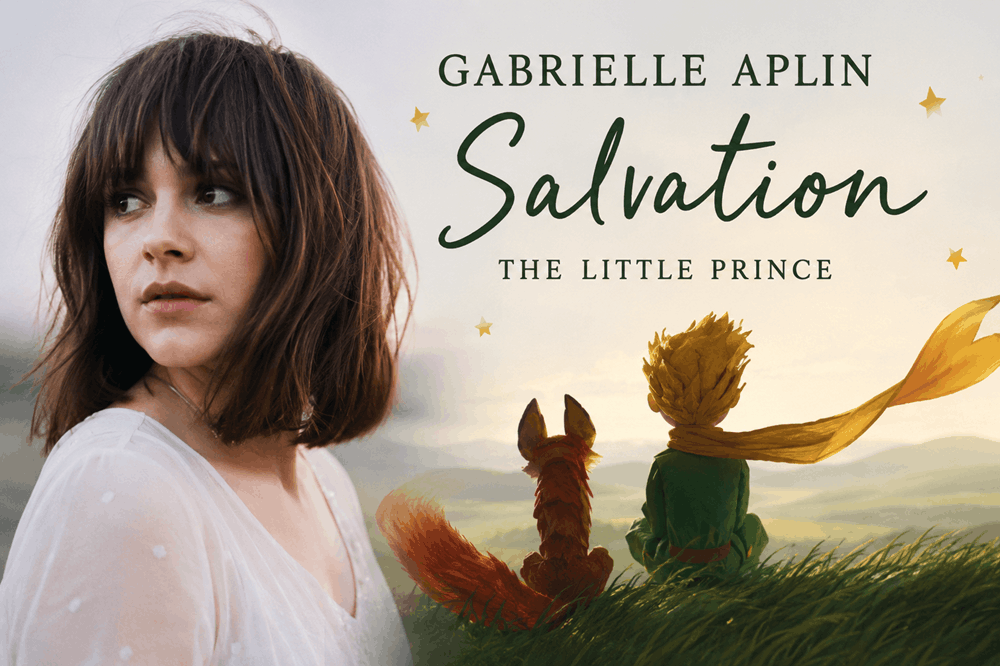
Gabrielle Aplin’s “Salvation” Meaning: The Little Prince
Gabrielle Aplin’s “Salvation” is a delicate piano ballad about falling for someone so completely that love feels both rescuing and overwhelming. Its images of an avalanche, a snowstorm and a world disappearing into white suggest an emotion that the narrator cannot control or escape.
The song later became closely associated with The Little Prince after appearing in an international trailer for the 2015 animated film. That pairing makes emotional sense: both works explore how forming a bond with someone can transform the way we see them, ourselves and the world around us.
Listen to “Salvation” and access the full lyrics
We do not reproduce the complete copyrighted lyrics here, but you can read and follow every line through Gabrielle Aplin’s official “Salvation” lyric video.
You can also:
- Watch the official music video
- Stream “Salvation” on Spotify
- Listen to English Rain on Apple Music
The lyric video and music video are both published through Aplin’s official YouTube channel.
“Salvation” at a glance
- Artist: Gabrielle Aplin
- Album: English Rain
- Album release: May 13, 2013
- Album position: Track six
- Songwriters: Gabrielle Aplin and Joel Pott
- Producer: Mike Spencer
- Film connection: Featured in an international trailer for The Little Prince
Apple Music lists “Salvation” as the sixth track on Aplin’s 2013 debut album, while the recording credits identify Aplin and Joel Pott as its writers and Mike Spencer as producer and mixer.
What is “Salvation” by Gabrielle Aplin about?
“Salvation” appears to be about unexpectedly falling in love with someone who changes the narrator’s entire emotional world.
She does not describe love as a calm decision or a gradual arrangement. Instead, it arrives like a force of nature. Her resistance disappears, her surroundings become unfamiliar and the person she loves becomes the only clear point of meaning left.
Calling that person her salvation suggests that they have rescued her from something—perhaps loneliness, emotional numbness or a lack of direction. The song never explains exactly what her life was like before the relationship, which allows listeners to connect the idea of rescue to their own experiences.
At the same time, this is not a simple song about feeling safe. The person offering salvation is also the person overwhelming her. That tension gives the song its emotional depth: love revives the narrator, but it also leaves her exposed.
Aplin does not appear to have publicly confirmed one definitive explanation of the complete song, so this reading is based on its imagery, language and musical development.
The avalanche as a metaphor for falling in love
The song opens with the striking image, “You are the avalanche.”
An avalanche is sudden, powerful and almost impossible to stop once it begins. Comparing the beloved to one suggests that the narrator’s feelings have moved beyond her control. She is not carefully choosing how deeply to become involved; she is being overtaken.
The image also combines beauty with danger. Snow moving across a mountain can look magnificent from a distance, yet anyone caught beneath it can lose their footing, direction and sense of where the surface lies.
That contradiction reflects the narrator’s experience. The relationship feels extraordinary, but it also buries the version of herself that existed before it.
This does not necessarily mean the relationship is destructive. Songwriting often enlarges emotions to communicate how they feel internally. The avalanche is less a practical judgment about the beloved than a picture of how completely love has disrupted the narrator’s familiar world.
What does the white imagery mean?
The song repeatedly surrounds the narrator with snow and whiteness. The clearest interpretation is a kind of emotional whiteout.
In a real whiteout, the horizon disappears. The ground and sky become difficult to distinguish, familiar landmarks vanish and a person can lose all sense of direction. The song uses a similar image to show how the narrator’s attention has narrowed until almost nothing exists outside the person she loves.
White can also suggest a blank page or a new beginning. The relationship may be wiping away an older life and replacing it with an unfamiliar emotional landscape.
These meanings can exist together. Falling in love has renewed the narrator, but it has also disoriented her. She has found something powerful enough to make her feel alive while losing the certainty she previously had about where she was going.
Why does she call the beloved her salvation?
The word “salvation” usually implies rescue from danger, suffering or loss. In the song, it becomes a name for the person who restores meaning to the narrator’s life.
That rescue may not involve a literal crisis. It can be understood as emotional salvation: the experience of meeting someone who breaks through isolation, revives buried feelings or creates a sense of belonging.
The phrase “My salvation” also reveals how central the beloved has become. This person is no longer simply someone the narrator desires. They have become connected to how she understands safety, hope and home.
There is vulnerability in that dependence. When another person becomes part of our sense of stability, their absence can feel larger than an ordinary disappointment. Loving them gives life greater meaning, but it also creates something important enough to lose.
The song does not resolve that tension. It remains suspended between gratitude and surrender.
Why “Salvation” fits The Little Prince
“Salvation” was not originally written for The Little Prince and should not be described as the film’s official theme song. It was already part of English Rain before being used in the movie’s second international trailer.
Gabrielle Aplin shared the trailer in April 2015 and described it as a trailer for The Little Prince “featuring Salvation.” The trailer’s official description emphasizes the story’s belief that human connections matter most, making the song’s use especially appropriate.
Readers can watch the official international trailer featuring “Salvation”.
The Fox and the creation of a bond
One of the most important lessons in Antoine de Saint-Exupéry’s story comes from the Fox. He explains that to “tame” someone is to create a bond with them.
Before that bond exists, one individual may appear no different from thousands of others. Time, attention and shared experience make that individual unique.
The official Little Prince website summarizes the Fox’s idea of taming as the act of creating bonds.
That idea closely matches the emotional movement of “Salvation.” The beloved becomes irreplaceable not because the song proves that they are objectively perfect, but because loving them has changed the narrator’s inner world.
They have become the person she recognizes as home.
The Rose and emotional responsibility
The Little Prince’s relationship with his Rose develops the same idea in a different way.
The Rose is not the only rose in existence. What makes her precious is the attention the Little Prince has given her and the responsibility he has accepted for their relationship.
That discovery teaches him that love is not only admiration. It also involves time, care and the willingness to become vulnerable.
The narrator of “Salvation” seems to be reaching a similar realization. Another person has become unique to her, and that connection has permanently changed what their presence—and possible absence—means.
Why meaningful relationships can hurt
The Fox’s lesson is not purely comforting. Forming a bond brings happiness, but it also makes separation painful.
Before someone matters to us, losing them may change very little. After they become connected to our routines, memories and sense of self, their absence can alter the appearance of everything around us.
That helps explain why the song’s romantic imagery feels so intense. The narrator is not merely attracted to someone. She is recognizing that they now occupy a place in her life that no one else can easily fill.
How the music reinforces the meaning
The recording begins quietly, with piano and Aplin’s restrained vocal creating an intimate, exposed atmosphere.
That opening sounds less like a confident declaration than a private realization. The narrator seems to be discovering the depth of her feelings while expressing them.
The arrangement gradually grows fuller and more cinematic. As the music expands, so does the emotional scale of the song. What begins as uncertainty builds toward surrender, reflecting how the narrator’s feelings spread until they fill nearly everything.
Aplin’s performance remains controlled even as the production rises around her. That contrast keeps the song from becoming overly dramatic. The emotion feels enormous, but the delivery retains a sense of fragility.
This gradual build also made the track well suited to a film trailer. It can accompany quiet moments of discovery before opening into something larger, matching the movement from an ordinary life toward wonder, connection and transformation.
Is “Salvation” a happy or sad song?
“Salvation” is hopeful, but it carries an unmistakable melancholy.
The hopeful side comes from renewal. The narrator has found someone who makes her feel awakened, understood or emotionally restored.
The melancholy comes from knowing how much power that person now holds in her life. Finding someone who feels like home is comforting, but it also means accepting the possibility that home could someday be lost.
That is why the snow imagery never feels entirely peaceful. The same landscape can be beautiful, isolating and dangerous. The song allows all three feelings to exist at once.
Final meaning
Gabrielle Aplin’s “Salvation” is about falling in love with someone who becomes both an overwhelming emotional force and a source of rescue.
The beloved changes the narrator’s sense of direction, identity and belonging. She feels buried beneath the intensity of the relationship, yet she also sees it as the thing that has brought her back to life.
Its appearance in The Little Prince trailer gives the song an additional layer. The story teaches that people become unique through the bonds we create with them—and that those bonds bring both meaning and vulnerability.
“Salvation” captures the same contradiction: love can save us by giving us somewhere to belong, but belonging to someone also means we can no longer remain untouched.