Flowers With Negative Meanings: 25 Beautiful Blooms With Surprisingly Dark Hidden Symbolism
Flowers usually represent love, celebration, friendship, and beauty, but not every bloom carries a cheerful message. In traditional flower symbolism, some flowers have represented jealousy, rejection, grief, betrayal, distrust, regret, vanity, anger, and even hatred.
Many of these darker meanings come from Victorian floriography, when books assigned symbolic messages to flowers and plants. Those meanings were never completely standardized, so the same flower can have a positive meaning in one tradition and a negative one in another.
Here are 25 flowers and plants with surprisingly negative meanings—and why you should not automatically assume a beautiful bouquet always sends a happy message.
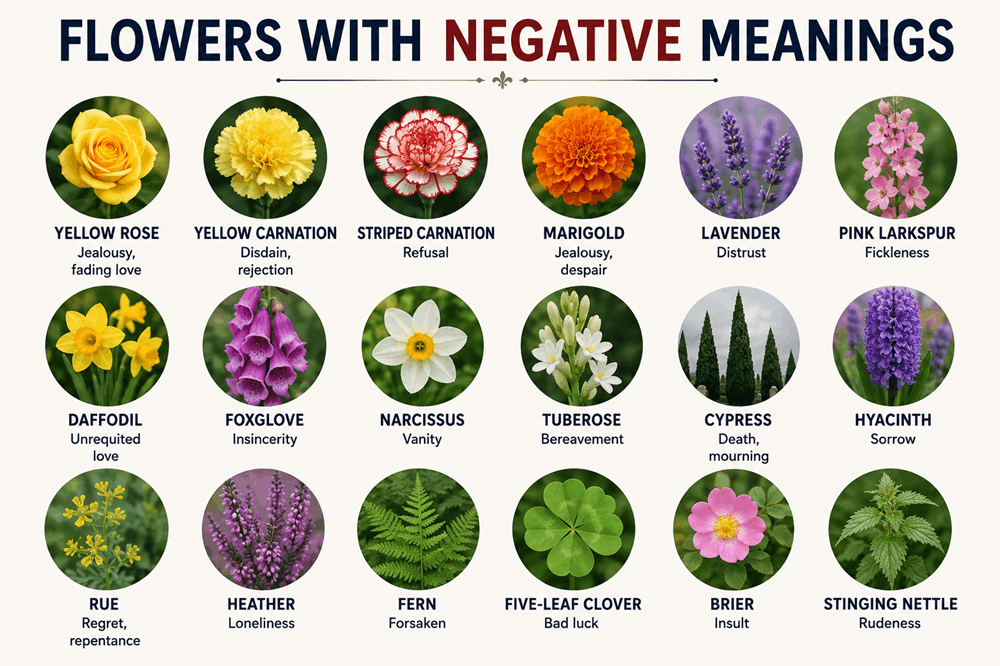
Flowers With Negative Meanings at a Glance
| Flower | Traditional Negative Meaning |
|---|---|
| Yellow Rose | Jealousy, infidelity, fading love |
| Yellow Carnation | Disdain, rejection |
| Striped Carnation | Refusal |
| Marigold | Jealousy, despair, contempt |
| Lavender | Distrust |
| Pink Larkspur | Fickleness |
| Daffodil | Unrequited love |
| Foxglove | Insincerity |
| Narcissus | Vanity |
| Tuberose | Bereavement |
| Cypress | Death, mourning |
| Hyacinth | Sorrow |
| Rue | Regret, repentance |
| Heather | Loneliness |
| Fern | Forsaken |
| Five-Leaf Clover | Bad luck |
| Brier | Insult |
| Stinging Nettle | Rudeness |
| Camellia | Illness in some older symbolism |
| Candytuft | Indifference |
| Oxalis | Regret |
| Japanese Lily | “You cannot deceive me” |
| Basil | Hatred in some Victorian flower dictionaries |
| Anemone | Withered or abandoned hope in some traditions |
| Lotus | Forgetfulness in some older flower-language lists |
1. Yellow Rose — Jealousy and Fading Love
Today, yellow roses are frequently associated with friendship, sunshine, happiness, and congratulations.
Historically, however, they could communicate something much less pleasant.
Victorian flower-language traditions associated the yellow rose with jealousy, infidelity, or decreasing love. English Heritage specifically lists yellow roses among the more negative Victorian floral messages.
That creates an interesting contrast with the modern meaning.
A bouquet of yellow roses today is unlikely to be interpreted as an accusation of cheating. Most recipients will see it as cheerful.
But if you are interested in historical floriography, yellow roses had one of the clearest darker messages.
2. Yellow Carnation — Disdain
Carnations can symbolize admiration and beauty, but color matters.
The yellow carnation was traditionally associated with disdain.
That makes it one of the more direct floral insults.
Instead of saying:
“I admire you,”
the message could essentially become:
“I am disappointed in you.”
Modern florists do not generally expect people to interpret yellow carnations this way, but the historical symbolism makes them an interesting choice for fiction, art, or symbolic arrangements.
3. Striped Carnation — Refusal
A striped carnation traditionally meant refusal.
In a romantic context, its message could be understood as:
“No.”
Or:
“I cannot accept your love.”
English Heritage notes that older flower-language writers treated striped carnations strongly enough as symbols of rejection that people were warned to think carefully before giving them to a romantic admirer.
Of all the flowers with negative meanings, this one may be among the most practical.
You were not expressing hatred.
You were simply turning someone down.
4. Marigold — Jealousy, Despair, or Contempt
Marigolds are bright, warm flowers, yet their traditional symbolism can be surprisingly dark.
Different flower-language traditions connected marigolds with:
- Jealousy
- Despair
- Contempt
- Grief
English Heritage lists marigold as representing despair or jealousy, while an older Canadian flower-language list records contempt.
This is an excellent example of why flower meanings should never be treated as one fixed universal dictionary.
The same flower accumulated different associations over time.
5. Lavender — Distrust
Lavender is now strongly associated with relaxation, calmness, fragrance, sleep, and peaceful gardens.
Its older flower symbolism is much stranger.
One Victorian interpretation assigned lavender the meaning of distrust.
That feels almost opposite to the plant’s modern image.
Today, receiving lavender is far more likely to suggest tranquility than suspicion.
Historically, though, the plant could carry the unspoken message:
“I don’t entirely trust you.”
6. Pink Larkspur — Fickleness
Pink larkspur has been associated with fickleness in Victorian flower symbolism.
Fickleness describes someone whose feelings or loyalties change easily.
In a romantic context, that could suggest:
“You are inconsistent.”
Or:
“Your affection cannot be trusted.”
That makes pink larkspur particularly interesting because its appearance is soft and romantic while its traditional message can question the reliability of someone’s feelings.
7. Daffodil — Unrequited Love
Daffodils usually feel cheerful.
They bloom early in spring and are commonly associated with renewal and fresh beginnings.
Yet some older flower-language lists gave daffodils the meaning of unrequited love.
Unrequited love means loving someone who does not return those feelings.
That turns a bright yellow spring flower into a symbol of one of the most familiar forms of heartbreak.
Modern meanings are often much more positive, so context matters enormously here.
8. Foxglove — Insincerity
Foxglove’s tall stems and bell-shaped flowers can look almost magical in a garden.
Traditional flower symbolism could give it a darker meaning: insincerity.
That can imply false friendliness, dishonesty, or feelings that are not genuine.
The symbolism works especially well in literature.
A character surrounded by foxgloves could appear beautiful and charming while concealing less trustworthy intentions.
9. Narcissus — Vanity
Few flower meanings are as culturally recognizable as the narcissus connection with vanity and self-obsession.
The association comes from the classical story of Narcissus, the beautiful young man who becomes captivated by his own reflection.
Older flower-language lists therefore used narcissus as an emblem of vanity.
A narcissus flower does not necessarily insult someone today.
But symbolically, it can suggest excessive self-admiration, pride, or obsession with appearance.
10. Tuberose — Bereavement
Tuberose is known for its powerful fragrance and elegant white flowers.
Yet one traditional meaning is bereavement—the grief associated with someone’s death.
That places tuberose among flowers whose negative symbolism is not hostile.
It does not say:
“I dislike you.”
Instead, it acknowledges sorrow and loss.
Negative flower meanings are not always insults. Some simply represent painful parts of human experience.
11. Cypress — Death and Mourning
Cypress has a long association with cemeteries, mourning, and death.
An older flower-language list gives cypress the direct meaning of death.
The tree’s dark evergreen appearance and longstanding use around burial grounds helped reinforce its funerary symbolism.
Unlike some Victorian meanings that have almost disappeared, the connection between cypress and mourning remains recognizable in art and landscape design.
12. Hyacinth — Sorrow
Hyacinths can carry several meanings depending on color and tradition.
One older symbolic meaning is sorrow.
The association also fits the tragic mythology surrounding Hyacinthus in ancient Greek tradition.
Because of this, hyacinth can work well in symbolic art or writing involving grief, remembrance, and beauty cut short.
Modern hyacinths can also communicate positive sentiments, so the flower is far from exclusively negative.
13. Rue — Regret and Repentance
The plant rue has a name that almost seems designed for its symbolism.
To “rue” something in English means to regret it.
Traditional flower-language lists associate rue with repentance.
Symbolically, rue can therefore express:
“I regret what happened.”
“I am sorry.”
Or:
“I wish I had acted differently.”
That makes it a negative symbol, but not necessarily an aggressive one.
It is more about remorse than rejection.
14. Heather — Loneliness
Heather often creates beautiful expanses of purple across moors and hillsides.
Yet one traditional flower-language meaning for heather is loneliness.
That association fits the visual image surprisingly well.
A single person standing on an enormous empty moor surrounded by heather can easily become a picture of isolation.
Modern symbolism may associate different heather colors with luck, admiration, or protection, so again, there is no one universal interpretation.
15. Fern — Forsaken
Ferns often symbolize nature, forests, and quiet beauty today.
An older flower-language interpretation assigned the fern the meaning forsaken.
To be forsaken means to be abandoned or left behind.
That gives the fern a melancholic symbolic meaning suitable for stories about separation, loneliness, or someone feeling forgotten.
16. Five-Leaf Clover — Bad Luck
Everyone knows the four-leaf clover as a symbol of good luck.
The five-leaf clover has had a very different symbolic meaning in at least some older flower-language lists: bad luck.
The contrast is almost perfect.
Four leaves: fortunate.
Five leaves: unfortunate.
Modern superstition surrounding unusual clovers varies considerably, so this is best understood as historical symbolism rather than a universal belief.
17. Brier — Insult
Brier refers to thorny shrubs, particularly wild roses or similar prickly plants.
One older flower-language list assigns brier the meaning insult.
The symbolism feels appropriate.
A brier can be attractive while still scratching anyone who reaches too close.
It carries a natural combination of beauty and hostility.
18. Stinging Nettle — Rudeness
Few plant meanings fit their physical characteristics better than stinging nettle.
Traditional flower symbolism connected nettles with rudeness.
Touch the plant carelessly and it stings.
That makes it easy to understand how nettles became symbolic of harsh behavior or unpleasant treatment.
A symbolic bouquet containing nettles would certainly not communicate gentle affection.
19. Camellia — Illness
Camellias are elegant flowering shrubs often associated today with admiration and beauty.
Yet at least one older flower-language source gives camellia the surprising meaning illness.
This is not the dominant modern meaning of camellias, and other traditions assign different symbolism to different colors.
That difference is important.
Historical floriography was full of contradictions.
A flower could carry one meaning in one book and something quite different in another.
20. Candytuft — Indifference
Candytuft may sound sweet, but its traditional symbolic message could be remarkably cold.
An older flower-language list connects it with indifference.
Indifference means not caring strongly one way or another.
In romance, that can be more painful than anger.
The message is not:
“I hate you.”
It is closer to:
“I simply don’t feel much.”
That makes candytuft one of the most emotionally chilly flowers on the list.
21. Oxalis — Regret
Oxalis has clover-like leaves and small flowers, and many species are popular garden or houseplants.
In older flower symbolism, oxalis could represent the pangs of regret.
That phrase suggests more than ordinary disappointment.
It implies the uncomfortable emotional pain that comes from wishing you had made a different decision.
As a symbolic plant, oxalis can therefore work particularly well for themes of mistakes and second thoughts.
22. Japanese Lily — “You Cannot Deceive Me”
Victorian flower symbolism could become extraordinarily specific.
English Heritage records Japanese lilies as communicating the message “you cannot deceive me.”
That is not simply a mood such as jealousy.
It sounds almost like an accusation.
Symbolically, giving the flower could imply:
“I know something is wrong.”
Or:
“I see through what you are doing.”
For writers interested in hidden floral messages, this is one of the most dramatic examples.
23. Basil — Hatred
Basil seems like an unlikely member of a list of hostile plants.
Most people think of pesto, herbs, gardens, and cooking.
Yet some Victorian flower-language traditions assigned basil the extremely direct meaning hatred.
This reveals an important feature of floriography: it was not limited to flowers.
Herbs, trees, leaves, and other plants could all be given symbolic meanings.
A Victorian-style symbolic arrangement could therefore contain plants that modern people would never think of putting in a romantic bouquet.
24. Anemone — Withered or Abandoned Hope
The anemone has accumulated several meanings across different flower dictionaries.
One historical association referenced by the Royal Horticultural Society is withered hope.
Other traditions have connected anemones with abandonment or anticipation.
All of those meanings share a sense of emotional uncertainty.
The flower’s delicacy makes it especially effective as a symbol for something beautiful that may not last.
25. Lotus — Forgetfulness
The lotus usually carries extremely positive spiritual symbolism in Asian religious and philosophical traditions.
That makes its appearance here especially important to explain carefully.
One older Western flower-language list assigned lotus the meaning forgetfulness.
That meaning should not be confused with the lotus’s much broader religious and cultural symbolism, where it can represent purity, enlightenment, rebirth, and spiritual development.
This is a perfect example of why flower meanings must always be tied to a particular cultural tradition.
Why Do Beautiful Flowers Have Negative Meanings?
A flower’s appearance did not necessarily determine whether its symbolic message was positive.
Writers compiling flower dictionaries drew inspiration from literature, mythology, plant characteristics, color, folklore, religion, and sometimes their own imagination.
This created an enormous symbolic vocabulary.
A thorny plant might represent insult.
A flower connected with tragic mythology might represent sorrow.
A yellow variation of an otherwise romantic flower could become associated with jealousy.
And different authors often disagreed with one another.
That disagreement is important because the “language of flowers” was never one universally standardized code.
Were Victorian Bouquets Really Secret Messages?
Victorian flower dictionaries were certainly popular, and the language of flowers appeared widely in literature, decorative arts, and popular culture.
However, historians caution against imagining that every Victorian carried around a universally understood floral code and secretly communicated entire conversations through bouquets.
Different books assigned different meanings to the same plants, making such communication surprisingly difficult. English Heritage notes that evidence for people routinely creating elaborate coded bouquets is limited, while the Royal Horticultural Society describes how contradictory the system became as more flower dictionaries appeared.
So floriography is best understood as a fascinating cultural tradition rather than a perfect secret language.
Do Flower Meanings Still Matter Today?
Sometimes.
Certain associations remain extremely strong.
Red roses still suggest romance.
White flowers are commonly associated with weddings or sympathy.
Poppies can represent remembrance.
But many of the more specific Victorian meanings have largely disappeared from ordinary life.
Someone handing you lavender probably does not mean:
“I distrust you.”
A yellow rose is much more likely to communicate friendship than infidelity today.
And someone cooking with basil almost certainly has no intention of symbolizing hatred.
The historical meanings become most useful when you are interested in:
- Literature
- Tattoos
- Art
- Character design
- Weddings
- Symbolic gardens
- Historical fiction
- Floral-themed gifts
- Gothic aesthetics
Which Flower Means Rejection?
The clearest traditional choice is the striped carnation.
Its historical meaning was refusal.
A yellow carnation can also work if the intended message is disdain rather than straightforward rejection.
For a fictional scene involving someone rejecting an admirer, the striped carnation is especially effective because its meaning is unusually specific.
Which Flower Means Jealousy?
The two strongest traditional examples are:
Yellow rose — jealousy, declining affection, or infidelity
Marigold — jealousy, despair, or contempt
The yellow rose is particularly interesting because its modern symbolism has shifted dramatically toward friendship and happiness.
Which Flower Means Betrayal?
There is no single universally accepted “betrayal flower.”
Yellow roses are sometimes associated with infidelity and declining love in older flower symbolism, making them one of the closest choices.
Flowers linked with distrust, insincerity, and deception can also communicate similar ideas:
- Lavender — distrust
- Foxglove — insincerity
- Japanese lily — “you cannot deceive me”
If you are choosing flowers for a story or artwork about betrayal, combining several symbolic meanings can create a clearer message than relying on one flower.
Which Flower Means Hatred?
One of the most direct historical examples is basil, which appears with the meaning hatred in Victorian flower-language traditions.
This surprises many people because basil is now thought of almost entirely as a culinary herb.
Its symbolism is a reminder that floriography could transform even familiar kitchen plants into emotional messages.
Which Flowers Represent Death or Grief?
Flowers and plants connected with grief include:
- Cypress — death
- Tuberose — bereavement
- Hyacinth — sorrow
- Marigold — despair in some traditions
- Fern — being forsaken
Not all of these would be appropriate for a modern funeral.
Traditional symbolism and modern funeral etiquette are separate things.
A flower with a historically gloomy meaning can have a completely different contemporary association.
Should You Avoid Giving These Flowers?
Usually not.
Most people do not use Victorian flower dictionaries to decode modern bouquets.
If someone loves lavender, giving them lavender is not secretly telling them you distrust them.
If your friend’s favorite flowers are yellow roses, you do not need to worry that your bouquet will accuse them of infidelity.
Modern personal meaning usually matters more than historical symbolism.
The old meanings become relevant when you deliberately want the bouquet to carry a symbolic message.
The Bottom Line
Flowers with negative meanings show that the traditional language of flowers was much more complicated than simply matching roses with love.
Yellow roses could represent jealousy or fading affection.
Yellow carnations could suggest disdain.
Striped carnations meant refusal.
Lavender could represent distrust.
Marigolds were linked with jealousy, despair, or contempt.
Foxgloves could symbolize insincerity, narcissus vanity, cypress death, rue repentance, and basil hatred.
But none of these meanings is universal.
Victorian flower dictionaries frequently disagreed, and symbolism has continued changing with culture and time.
Today, a flower’s personal meaning is often more important than its historical one.
Still, the older symbolism gives flowers another layer of fascination.
A bloom can be beautiful and still represent something uncomfortable.
Sometimes the prettiest flower in the garden has the darkest story.