DMV Road Signs and Meanings Cheat Sheet: Shapes, Colors, and Common Signs
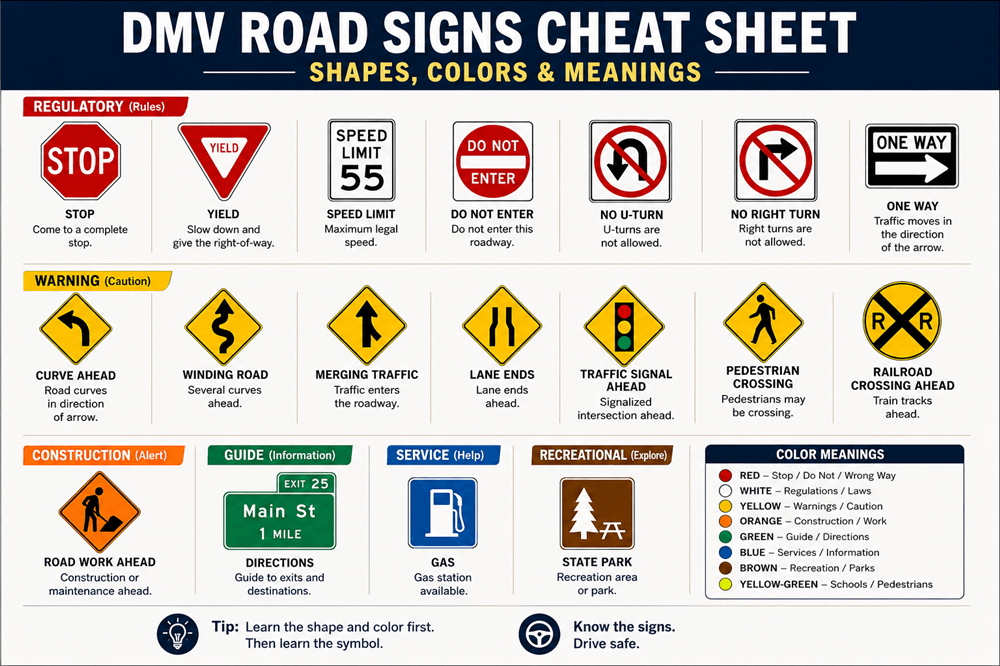
DMV road signs become much easier to remember when you learn their shapes and colors before memorizing individual signs. An octagon always means STOP, an upside-down triangle means YIELD, yellow diamonds warn about hazards, and white rectangular signs usually tell you traffic laws you must follow. This cheat sheet covers the most common U.S. road signs you are likely to encounter while studying for a permit or driver’s license knowledge test.
Exact rules and test questions can vary by state, so your state’s current driver’s handbook should always be your final study guide.
DMV Road Sign Shapes Cheat Sheet
| Shape | Usually Means | Common Example |
|---|---|---|
| Octagon | Stop | STOP |
| Upside-down triangle | Yield | YIELD |
| Diamond | Warning or hazard ahead | Curve, merging traffic, slippery road |
| Circle | Railroad crossing ahead | Railroad warning |
| Pentagon | School-related area | School crossing |
| Vertical rectangle | Traffic regulation | Speed limit, no parking |
| Horizontal rectangle | Information or guidance | Route or destination information |
| Pennant | No-passing zone | No passing warning |
| Crossbuck | Railroad crossing | Railroad crossing at tracks |
Learning these shapes can help you recognize an important sign before you are close enough to read its words.
Road Sign Colors and What They Mean
Color is another shortcut for identifying signs quickly.
| Color | General Meaning |
|---|---|
| Red | Stop, yield, prohibition, or wrong-way warning |
| White | Traffic regulations and laws |
| Yellow | General warning |
| Fluorescent yellow-green | Schools, pedestrians, bicycles, and related warnings |
| Orange | Construction and road work |
| Green | Directions, destinations, and highway guidance |
| Blue | Services and traveler information |
| Brown | Recreation, parks, and cultural destinations |
A useful memory trick is:
Red controls. Yellow warns. Orange works. Green guides. Blue helps. Brown explores.
1. STOP Sign
Shape: Octagon
Color: Red with white letters
A STOP sign means you must make a complete stop.
Stop before the limit line or crosswalk. If neither is present, stop before entering the intersection where you can safely observe approaching traffic.
Look for pedestrians, bicycles, and vehicles before proceeding.
The octagonal shape is unique to the STOP sign, which makes it one of the easiest signs to identify even from the back or at a distance.
Memory tip: Eight sides always mean STOP.
2. YIELD Sign
Shape: Upside-down triangle
Color: Red and white
A YIELD sign means slow down and give the right-of-way to traffic, pedestrians, or bicyclists that have priority.
You do not necessarily have to come to a complete stop if the way is clear.
However, you must be prepared to stop when necessary.
Memory tip: The triangle points downward as if telling you to lower your speed.
3. Speed Limit Sign
Shape: Vertical rectangle
Color: Usually black and white
A speed limit sign shows the maximum legal speed under normal conditions.
Driving at the posted speed is not always safe. Rain, snow, fog, heavy traffic, road construction, or poor visibility may require a slower speed.
Speed-limit questions are common on permit tests, so remember that posted limits do not remove your responsibility to adjust for conditions.
4. DO NOT ENTER Sign
Shape: Square or rectangular
Color: Red and white
DO NOT ENTER means you must not enter the roadway, lane, or ramp from your direction.
You often see this sign at freeway exits, one-way streets, parking facilities, and divided highways.
If you see one facing you while entering a road, stop and reassess your direction.
5. WRONG WAY Sign
Shape: Rectangle
Color: Red with white letters
A WRONG WAY sign warns that you are traveling or attempting to travel against the legal direction of traffic.
This is an urgent sign.
Slow down, stop somewhere safe, and correct your direction without creating another hazard.
WRONG WAY and DO NOT ENTER signs frequently appear together near freeway ramps and one-way roads.
6. No U-Turn Sign
Shape: Rectangle containing a symbol
Color: Usually white, black, and red
A curved U-shaped arrow with a red circle and slash means U-turns are prohibited at that location.
The red slash is important.
Whenever you see a red circle with a diagonal line through a symbol, the action pictured inside is prohibited.
7. No Left Turn Sign
A left-turn arrow crossed by a red slash means you cannot turn left at that intersection or location.
Do not confuse it with a NO U-TURN sign.
On a permit test, look carefully at the direction and shape of the arrow before choosing your answer.
8. No Right Turn Sign
The same principle applies to the right-turn version.
A right-turn arrow with the prohibition symbol means you cannot turn right.
Some intersections may instead display a NO TURN ON RED sign, which prohibits the turn only while the traffic signal is red.
9. ONE WAY Sign
A ONE WAY sign tells you that vehicles on the roadway travel in only the direction shown by the arrow.
These signs are particularly important in downtown areas and at intersections with one-way streets.
Before turning onto a street, check for one-way signs so you do not enter against traffic.
10. Keep Right Sign
A KEEP RIGHT sign commonly appears before medians, traffic islands, barriers, or other objects dividing traffic.
Follow the arrow and pass on the indicated side.
Its purpose is to keep traffic flowing around the obstruction safely.
11. Yellow Diamond Warning Sign
Shape: Diamond
Color: Usually yellow and black
A yellow diamond tells you that something requiring additional attention is ahead.
The symbol inside tells you what kind of condition to expect.
Common examples include:
- Curves
- Intersections
- Merging traffic
- Lane reductions
- Slippery pavement
- Traffic signals
- Pedestrians
- Animals
- Steep grades
Under national U.S. standards, diamond-shaped yellow signs are the standard form for many roadway warnings.
Memory tip: Yellow diamond = something is changing ahead.
12. Curve Ahead Sign
A black curved arrow on a yellow diamond warns that the roadway bends ahead.
The sharper the curve, the more important it is to adjust your speed before entering it.
Some curve signs are accompanied by an advisory speed plaque.
That number provides guidance for navigating the curve safely under normal conditions rather than functioning exactly like an ordinary regulatory speed limit.
13. Winding Road Sign
A winding arrow indicates several curves are coming rather than one simple bend.
Reduce speed and be prepared for repeated changes in direction.
Test tip: A single curved arrow usually indicates one curve. A snake-like arrow indicates a winding road.
14. Slippery When Wet Sign
This yellow warning sign normally shows a car with wavy skid marks behind it.
It means the roadway can become slippery when wet.
Reduce your speed in rain, avoid sudden steering movements, and allow extra distance between your vehicle and the one ahead.
15. Merging Traffic Sign
The merging traffic symbol shows one lane joining another.
It warns that vehicles may soon enter your lane or that you may need to combine with another stream of traffic.
Check mirrors, watch surrounding traffic, and be prepared to adjust speed safely.
16. Lane Ends Sign
A lane-ends warning tells you that one of the lanes will disappear ahead.
The symbol indicates whether the right or left lane ends.
Drivers in the ending lane need to merge safely into the continuing lane.
Do not wait until the road physically disappears before beginning to watch for a safe opening.
17. Two-Way Traffic Sign
This sign commonly shows two arrows pointing in opposite directions.
It means the roadway ahead carries traffic traveling both ways.
You may encounter it when leaving a divided highway or transitioning from a one-way section to a two-way road.
Be especially careful about lane position and oncoming traffic.
18. Divided Highway Begins Sign
This symbol shows two directional arrows separated by a median or divider.
It means opposing traffic will soon be separated by a physical median or barrier.
Keep to the correct side of the divider.
19. Divided Highway Ends Sign
This sign looks similar to the divided-highway-begins symbol but communicates the opposite situation.
The physical divider ends ahead, and opposing traffic will once again be closer together.
Watch carefully for oncoming vehicles.
20. Traffic Signal Ahead Sign
A yellow diamond containing a traffic-light symbol means a signal-controlled intersection is ahead.
It is often placed where the signal may be difficult to see early enough because of a curve, hill, vegetation, or other obstruction.
Be prepared for traffic to slow or stop.
21. STOP Ahead Sign
A yellow warning sign showing a STOP-sign symbol means you are approaching a STOP sign.
This warning is especially useful when the actual stop-controlled intersection may not be visible from far away.
Begin reducing speed early.
22. YIELD Ahead Sign
This works the same way as STOP Ahead.
It warns that a YIELD-controlled location is coming up.
Slow down and prepare to give the right-of-way as necessary.
23. Pedestrian Crossing Sign
A pedestrian symbol warns that people may be crossing the roadway.
Slow down, scan both sides of the street, and be ready to yield or stop when required.
Pedestrian warnings may use yellow or fluorescent yellow-green backgrounds depending on the type and location. National standards specifically allow fluorescent yellow-green for pedestrian and bicycle-related warnings.
24. School Zone or School Crossing Sign
Shape: Pentagon
Color: Commonly fluorescent yellow-green
The five-sided shape is strongly associated with schools.
Expect children, pedestrians, school buses, reduced speeds, crossing guards, or special school-zone rules.
Memory tip: Five sides = school children nearby.
25. Bicycle Crossing Sign
A bicycle symbol indicates that bicyclists may enter or cross the roadway.
Watch carefully before turning, changing lanes, or crossing a bike path.
Drivers should remember that bicycles can be difficult to notice when attention is focused only on larger vehicles.
26. Deer Crossing Sign
The familiar deer silhouette warns that animals commonly cross the roadway in the area.
Slow down and scan the roadside, particularly around dawn, dusk, and locations where visibility is limited.
Other versions may show cattle, horses, elk, or other animals depending on the area.
27. Railroad Crossing Ahead Sign
Shape: Round
Color: Yellow and black
A circular warning sign with a railroad symbol means railroad tracks are ahead.
Slow down, look and listen for trains, and be prepared to stop.
The round shape is one of the most distinctive shapes tested on written driving exams.
Memory tip: Round sign = railroad coming around.
28. Railroad Crossbuck Sign
A white X-shaped crossbuck is posted at the railroad crossing itself.
It marks the location of the tracks and indicates that drivers must yield to approaching trains.
Some crossings also have flashing red lights, bells, or gates.
Never attempt to drive around a lowered crossing gate.
29. No Passing Zone Sign
Shape: Pennant
The sideways triangular or pennant-shaped sign marks the beginning of a no-passing zone.
It is normally posted on the left side of the roadway.
This shape is unusual enough that it is worth memorizing specifically for DMV tests.
Memory tip: Pennant = passing prohibited.
30. Construction and Road Work Signs
Color: Orange and black
Orange signs warn about temporary road conditions involving construction, maintenance, workers, equipment, detours, or altered lanes.
Common messages include:
- ROAD WORK AHEAD
- DETOUR
- LANE CLOSED
- FLAGGER AHEAD
- ONE LANE ROAD
- UTILITY WORK AHEAD
Drivers should reduce speed, watch for workers and equipment, and follow temporary traffic controls.
Memory tip: Orange = people are working on the road.
31. Green Guide Signs
Green signs generally help drivers navigate.
They may provide:
- Street names
- Highway exits
- Distances
- Destinations
- Route directions
Unlike warning and regulatory signs, these signs usually provide information rather than ordering you to perform a particular maneuver.
Memory tip: Green gets you where you’re going.
32. Blue Service Signs
Blue signs usually identify services available to travelers.
They may point toward:
- Gas stations
- Food
- Lodging
- Hospitals
- Rest areas
- Emergency services
On long highway trips, blue signs help drivers find practical services without leaving the route blindly.
Memory tip: Blue = something useful for you.
33. Brown Recreation Signs
Brown signs usually identify recreational or cultural destinations.
You may see them directing drivers toward:
- State or national parks
- Campgrounds
- Historic sites
- Scenic areas
- Museums
- Recreational facilities
Memory tip: Brown = outdoors, history, and recreation.
34. Slow-Moving Vehicle Emblem
A fluorescent orange triangle with a red border identifies a vehicle that normally travels much more slowly than ordinary highway traffic.
You may see this emblem on tractors, farm equipment, maintenance vehicles, and similar machinery.
Reduce speed early rather than waiting until you are directly behind the vehicle.
Road Sign Shapes You Should Memorize for the DMV Test
If you have limited study time, memorize these shapes first:
- 8 sides: STOP
- Upside-down triangle: YIELD
- Diamond: WARNING
- Circle: RAILROAD AHEAD
- Pentagon: SCHOOL
- Pennant: NO PASSING
- Rectangle: REGULATION or INFORMATION
- Crossbuck: RAILROAD CROSSING
These shapes give you a major advantage because you can often determine the sign’s general purpose before reading anything printed on it.
Road Sign Colors You Should Memorize
Use this quick memory line:
Red = Stop or prohibited
White = Law
Yellow = Warning
Yellow-green = People and schools
Orange = Construction
Green = Directions
Blue = Services
Brown = Recreation
Once these colors become automatic, many permit-test questions become considerably easier.
Regulatory Signs vs. Warning Signs
This is another distinction worth memorizing.
Regulatory signs tell you what the law requires or prohibits.
Examples include:
- STOP
- YIELD
- Speed limit
- ONE WAY
- DO NOT ENTER
- No U-turn
- No parking
Warning signs tell you about a condition ahead.
Examples include:
- Sharp curve
- Slippery road
- Lane ending
- Traffic merging
- Railroad crossing
- Pedestrian crossing
A simple way to remember the difference is:
Regulatory = rule.
Warning = prepare.
Common DMV Road Sign Mistakes
Several signs are easy to confuse when studying quickly.
STOP vs. STOP Ahead
A red octagon means stop now.
A yellow diamond containing an image of a stop sign means a STOP sign is coming.
Railroad Warning vs. Crossbuck
The yellow circle warns that tracks are ahead.
The crossbuck is located at the crossing itself.
Lane Ends vs. Merge
A merge sign warns that two traffic streams are joining.
A lane-ends sign tells you that an existing lane disappears.
Divided Highway Begins vs. Ends
Look carefully at the median symbol.
Students frequently confuse these because the signs look almost identical.
Speed Limit vs. Advisory Speed
A standard black-and-white speed-limit sign is regulatory.
A smaller speed plaque accompanying a warning sign generally advises an appropriate speed for the condition ahead.
Fastest Way to Study Road Signs for a Permit Test
Do not begin by trying to memorize dozens of individual pictures.
Study in this order:
- Learn the eight important sign shapes.
- Memorize the major sign colors.
- Learn STOP, YIELD, and prohibition signs.
- Study common yellow warning symbols.
- Learn school and railroad signs.
- Review construction, service, and guide signs.
- Take practice tests.
- Review every sign you answer incorrectly.
This works because shapes and colors give you clues even when you have never seen a particular sign before.
Quick DMV Road Sign Quiz
What does an eight-sided sign mean?
STOP.
What does an upside-down triangle mean?
YIELD.
What does a yellow diamond usually mean?
Warning or changing road condition ahead.
What does a round yellow sign warn about?
A railroad crossing ahead.
What does a five-sided sign usually identify?
A school-related area or crossing.
What does orange mean?
Road construction or maintenance.
What does green mean?
Directions or highway guidance.
What does blue mean?
Traveler services or information.
What does brown mean?
Recreation or cultural destinations.
What does a red circle with a slash mean?
The pictured action is prohibited.
One-Minute DMV Road Signs Cheat Sheet
If you need one final review immediately before a test, remember this:
STOP = Red octagon
YIELD = Red-and-white upside-down triangle
WARNING = Yellow diamond
SCHOOL = Pentagon
RAILROAD AHEAD = Circle
NO PASSING = Pennant
CONSTRUCTION = Orange
DIRECTIONS = Green
SERVICES = Blue
RECREATION = Brown
TRAFFIC LAW = Usually white rectangular regulatory sign
The Bottom Line
The easiest way to learn DMV road signs is to memorize shape first, color second, and symbol third.
An octagon tells you to stop. An upside-down triangle tells you to yield. A yellow diamond warns you about a road condition. A circle warns of a railroad crossing, a pentagon points to a school area, and a pennant identifies a no-passing zone.
Colors provide another shortcut: red usually means stop or prohibition, yellow warns, orange marks road work, green provides directions, blue identifies services, and brown points toward recreation or cultural destinations.
Once those patterns become familiar, you no longer have to memorize every sign as an unrelated picture.
You can often work out what kind of message a sign is giving you before you even read it.
Use this cheat sheet for review, but study the current driver’s handbook issued by your own state before taking the knowledge test because state-specific laws, wording, and test content can differ. The Federal Highway Administration’s current MUTCD establishes national traffic-control standards, while state DMV handbooks provide the rules drivers are actually expected to learn for their local tests.