What Does … Mean in Text? Ellipsis Meaning in Messages and Chats Explained
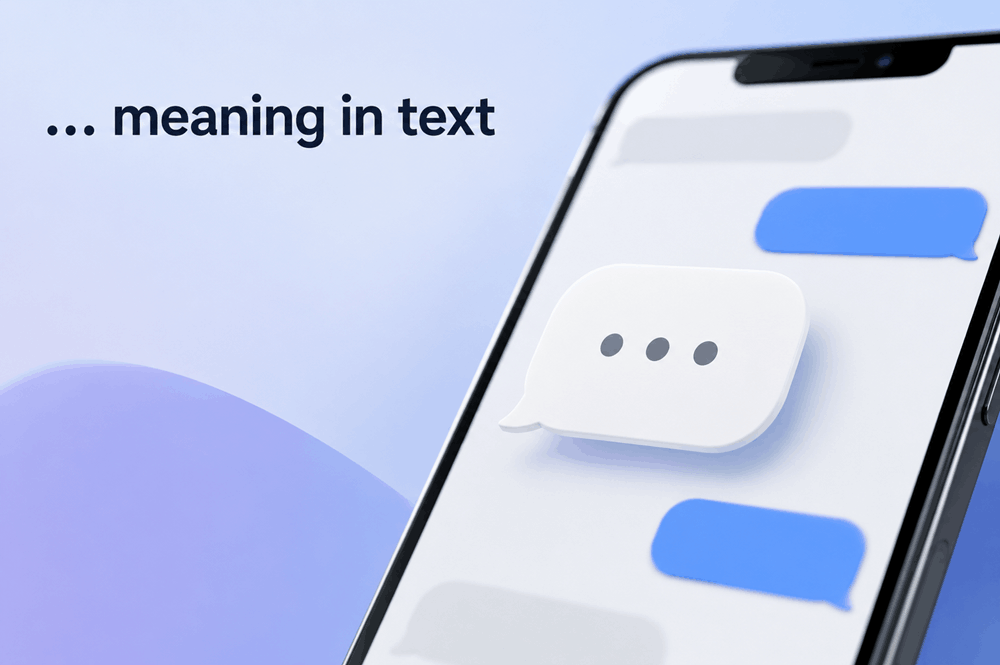
In texting, “…” usually represents a pause, hesitation, unfinished thought, awkward silence, or something left unsaid. Depending on the conversation, it can sound thoughtful, uncertain, disappointed, annoyed, suspicious, or even passive-aggressive. Three dots are called an ellipsis, and their meaning depends heavily on what comes before them and who is sending the message.
For example, “Okay…” can feel very different from “Okay.” The first may suggest doubt, discomfort, or that the sender has more to say.
What Does … Mean in a Text?
Three dots in a text message usually mean that the sender is intentionally leaving a pause.
They may be thinking.
They may be unsure how to respond.
They may want you to realize that something is wrong without saying it directly.
Or they may simply be writing the way they naturally speak.
Common meanings include:
- Hesitation
- Awkwardness
- An unfinished thought
- Disbelief
- Disappointment
- Suspicion
- Annoyance
- A dramatic pause
- Something being implied rather than stated
The punctuation itself is not automatically negative.
Context decides the tone.
What Is “…” Called?
The three dots are called an ellipsis.
In formal writing, an ellipsis can show that words have been removed from a quotation or that a thought trails off.
Texting uses the same punctuation much more emotionally.
Instead of simply removing words, “…” can imitate a silence that would happen during face-to-face conversation.
Imagine someone saying:
“Well…”
and then pausing.
The pause itself communicates something.
Text messages use an ellipsis to reproduce that feeling.
What Does “Okay…” Mean in Text?
“Okay…” often suggests that the sender is not completely okay with what was just said.
For example:
You: “I invited my ex to the party.”
Friend: “Okay…”
That response probably does not mean a cheerful, uncomplicated “okay.”
It may mean:
- “That seems like a bad idea.”
- “I don’t know what to say to that.”
- “Are you sure?”
- “I’m judging this a little.”
- “There is more I could say.”
The dots create hesitation that the plain word does not contain.
What Does “Sure…” Mean?
“Sure…” can suggest reluctant agreement.
Someone may be agreeing while clearly not sounding enthusiastic.
Compare:
“Sure!”
with:
“Sure…”
The first sounds excited.
The second may sound doubtful, uncomfortable, or unconvinced.
Sometimes it is almost equivalent to saying:
“I guess.”
Does … Mean Someone Is Mad?
Sometimes, but not always.
An ellipsis can create a cold or irritated tone when it follows a short response.
For example:
“Fine…”
can sound much more annoyed than:
“Fine!”
Similarly:
“Whatever…”
can sound dismissive.
But you should not assume someone is angry simply because they use three dots.
Some people use ellipses constantly as part of their normal texting style.
For them, “Thanks…” may not be sarcastic at all.
They may simply use dots where another person would use a period.
Why Do Older People Use … So Much in Texts?
Generational texting habits can make ellipses surprisingly confusing.
Many older texters use “…” as a soft pause or conversational separator.
For example:
“Hi… hope you’re doing well… call me when you can…”
The sender may intend that message to sound warm and relaxed.
A younger reader may interpret the same punctuation as ominous.
To someone accustomed to modern short-form messaging, repeated ellipses can feel like:
“Hi… we need to talk…”
even when nothing is wrong.
This difference is usually about communication style rather than emotion.
Why Can Three Dots Feel Passive-Aggressive?
An ellipsis leaves space.
And people naturally try to fill that space with meaning.
Consider:
“Interesting…”
The sender does not explicitly say anything negative.
But it can easily sound like:
“Interesting… and not in a good way.”
The unstated portion makes the message feel passive-aggressive.
The same can happen with:
- “Right…”
- “If you say so…”
- “Good luck…”
- “That’s nice…”
- “Whatever you want…”
None of those phrases is automatically rude.
But adding an ellipsis can make the reader imagine hidden criticism.
What Does “Hmm…” Mean in Texting?
“Hmm…” generally means someone is thinking.
Depending on context, it can show:
- Consideration
- Doubt
- Suspicion
- Curiosity
- Disagreement
For example:
“Hmm… maybe you’re right.”
sounds thoughtful.
But:
“Hmm… that’s not what she told me.”
sounds suspicious.
The same dots can create very different moods.
What Does “Well…” Mean?
“Well…” often signals that the sender is about to say something uncomfortable.
It can introduce disagreement, bad news, correction, or hesitation.
For example:
“Well… there is one problem.”
or:
“Well… I wouldn’t exactly call it a success.”
The pause prepares the reader for what comes next.
Sometimes “well…” is sent by itself.
In that case, it may be an invitation for the other person to explain more.
What Does “So…” Mean in a Text?
“So…” can be used to begin a difficult conversation.
Someone may write:
“So… are we going to talk about what happened?”
The ellipsis creates a pause before the main question.
It can also make a message playful:
“Sooo… guess who just texted me?”
In that case, the pause creates suspense rather than discomfort.
What Does “…” Mean by Itself?
If someone sends only:
“…”
the meaning is usually stronger.
It often represents speechlessness.
Possible interpretations include:
- “I have no words.”
- “What am I supposed to say to that?”
- “Seriously?”
- “I’m waiting for you to explain.”
- “That was awkward.”
For example:
You: “I accidentally sent the message to my boss instead.”
Friend: “…”
The dots function almost like a silent stare.
What Does … Mean From a Girl?
There is no special meaning just because a girl sends it.
The interpretation depends on the message and the relationship.
If she replies:
“Okay…”
after you cancel plans, she might be disappointed.
If she writes:
“You looked good tonight…”
the ellipsis could create a flirtatious or suggestive tone.
If she writes:
“Hmm…”
she may simply be thinking.
Gender is much less useful than context when interpreting punctuation.
What Does … Mean From a Guy?
The same rule applies.
There is no universal male meaning for an ellipsis.
A guy sending:
“I miss you…”
might be leaving room for an emotional response.
Someone writing:
“Okay then…”
might be annoyed.
Someone writing:
“So…”
may simply be trying to start a conversation.
Pay attention to the words around the punctuation.
Can … Be Flirty?
Yes.
An ellipsis can create anticipation or suggest that something is intentionally being left unsaid.
For example:
“Maybe I’ll tell you later…”
can sound teasing.
“You looked really good tonight…”
can feel more suggestive than the same sentence with a period.
“Come over…”
may sound more intimate or dramatic depending on the relationship.
The dots create a sense that the message extends beyond its literal words.
Can … Mean Someone Is Sad?
Yes.
People sometimes use ellipses when they want a message to sound quiet or emotionally heavy.
Compare:
“I guess it’s over.”
with:
“I guess it’s over…”
The second version feels less final even though the words are almost identical.
It sounds as though the person is lingering on the thought.
That can suggest sadness, uncertainty, or reluctance to accept what they are saying.
Can Three Dots Mean Someone Is Waiting?
Yes.
Sending “…” can sometimes mean:
“Well?”
or:
“I’m waiting for an answer.”
Imagine someone asks:
“Did you tell her what happened?”
You avoid answering.
They send:
“…”
The silent message may be pushing you to respond.
What Is the Difference Between … and a Period?
A period ends the thought.
An ellipsis leaves it hanging.
Compare:
“That’s fine.”
with:
“That’s fine…”
The first sounds more definite.
The second invites questions.
Is it really fine?
Is the sender disappointed?
Are they waiting for something else?
That ambiguity is exactly what makes the ellipsis so powerful in texting.
What Is the Difference Between … and !!!?
They create almost opposite types of energy.
An ellipsis slows a message down.
An exclamation mark speeds it up.
Compare:
“Wow…”
with:
“Wow!!!”
“Wow!!!” sounds excited.
“Wow…” might mean amazement, disbelief, disappointment, or even judgment.
Again, punctuation can completely change the emotional tone of a very short message.
What Is the Difference Between … and ?
A question mark directly asks for an answer.
An ellipsis may imply the question without actually asking it.
For example:
“And?”
clearly demands more information.
“And…”
can gently encourage someone to continue.
It may also sound impatient depending on the situation.
What Does “……” Mean?
Using more than three dots usually intensifies the pause.
Technically, an ellipsis is normally three dots.
Texting is not especially concerned with technical punctuation rules, however.
Someone may write:
“Seriously……….”
to create exaggerated disbelief.
The extra dots make the silence feel longer.
It is essentially the text-message equivalent of staring at someone for several uncomfortable seconds.
What Does “..” Mean?
Two dots are not technically a standard ellipsis, but they are commonly used informally in texting.
They usually serve the same general purpose as three dots:
a pause, hesitation, or unfinished thought.
Some people simply type two dots out of habit.
Others use them because three feels too dramatic.
The meaning usually comes from tone rather than punctuation rules.
Why Is It So Easy to Misread an Ellipsis?
Text messages remove many of the signals available during spoken conversation.
You cannot hear the person’s voice.
You cannot see their face.
You cannot tell whether they paused because they were thinking, joking, annoyed, or distracted.
Punctuation has to carry some of that emotional information.
An ellipsis is particularly ambiguous because its basic meaning is simply:
There is a pause here.
What the pause means depends on the people involved.
Should You Worry If Someone Sends …?
Usually not based on the punctuation alone.
Look at the whole conversation.
Did something uncomfortable happen immediately before the message?
Does this person normally use ellipses?
Are their responses suddenly shorter than usual?
Is the rest of the message friendly or cold?
One “…” does not automatically mean someone is angry with you.
If the meaning matters, the easiest solution is sometimes simply to ask.
The Bottom Line
In text messages, “…” usually means a pause, hesitation, unfinished thought, or something left unsaid.
It can communicate many different moods.
“Okay…” may sound doubtful.
“Hmm…” can suggest thinking or suspicion.
“I miss you…” may feel emotional or flirtatious.
And “…” by itself can mean speechlessness, awkwardness, or “I’m waiting for you to explain.”
The most important thing to remember is that ellipses do not have one universal emotional meaning.
Some people use them dramatically.
Some use them passive-aggressively.
Some use them simply because that is how they text.
So before assuming those three dots mean trouble, read the conversation around them.
Sometimes “…” means something is wrong.
And sometimes it is just a pause…