Hair of the Dog Meaning: Where the Strange Hangover Phrase Comes From
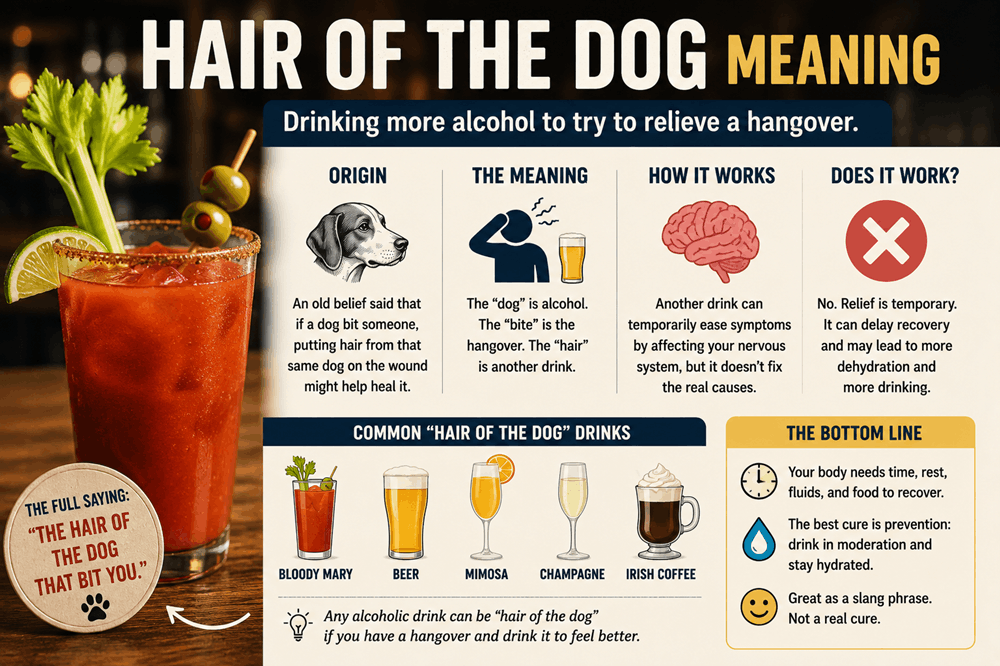
“Hair of the dog” means drinking more alcohol to try to relieve a hangover caused by drinking the night before. The full expression is “the hair of the dog that bit you,” based on the old idea that a small amount of whatever caused an injury might also help cure it. Today, someone suggesting a Bloody Mary, beer, or another alcoholic drink the morning after heavy drinking may jokingly call it “hair of the dog.”
The phrase sounds bizarre until you know its history—and its original meaning was much more literal than the modern hangover joke.
What Does “Hair of the Dog” Mean?
In everyday conversation, “hair of the dog” usually refers to drinking a small amount of alcohol when you already have a hangover.
For example:
“I feel terrible after last night.”
“Maybe you need a little hair of the dog.”
The suggestion is that another alcoholic drink may temporarily make the person feel better.
The phrase is usually used casually or humorously rather than as serious medical advice.
People may shorten the full saying to simply:
“Hair of the dog.”
The longer form is:
“The hair of the dog that bit you.”
That longer version makes the logic behind the expression easier to understand.
Why Is It Called “Hair of the Dog”?
The phrase comes from an old belief that if a dog bit someone, putting hair from that same dog onto the wound could help treat the injury.
In other words, part of the thing that caused the problem was supposedly used to cure the problem.
Eventually, the expression became metaphorical.
The “dog” became alcohol.
The “bite” became the hangover.
And the “hair” became another drink.
So when someone drinks alcohol the morning after drinking too much, they are figuratively taking a little bit of the thing that “bit” them.
Does Hair of the Dog Actually Cure a Hangover?
No. Another drink does not actually cure the underlying causes of a hangover.
Alcohol may temporarily reduce certain uncomfortable feelings because it affects the nervous system and can delay some withdrawal-like symptoms.
But the relief is temporary.
Your body still needs time to process the alcohol, restore fluids, sleep, and recover from the effects of drinking.
Adding more alcohol can simply postpone the moment when you feel bad again.
It may also extend dehydration, disrupt sleep further, and increase the total amount of alcohol your body needs to process.
So “hair of the dog” works much better as an idiom than as a hangover treatment.
Why Can Another Drink Make You Feel Better Temporarily?
A hangover is not caused by one single thing.
Alcohol can contribute to dehydration, poor sleep, stomach irritation, changes in blood sugar, inflammation, and other effects that leave you feeling terrible the next day.
Another alcoholic drink changes how your brain and nervous system feel for a short period.
That can make certain symptoms seem less noticeable.
The key word is seem.
You have not erased the previous night’s drinking.
You have added more alcohol to the situation.
Once the new drink wears off, the original discomfort may return, sometimes after being delayed for several hours.
What Is the Full Saying?
The full phrase is:
“The hair of the dog that bit you.”
Most people now shorten it because the meaning is familiar enough that the rest of the saying is unnecessary.
If someone says:
“You need some hair of the dog,”
they are not talking about an actual animal.
They are almost always referring to alcohol after a night of drinking.
Where Did the Phrase Come From?
The idea behind the expression is centuries old.
People once believed that hair taken from a dog that had bitten someone could be placed on the wound as part of a treatment.
There was no modern scientific basis for this practice, but it created a powerful metaphor:
The source of the problem can also provide the cure.
That idea eventually moved beyond dog bites.
By the time the phrase became associated with drinking, “hair of the dog” was essentially a humorous way to say that a small amount of the substance responsible for your suffering might help relieve it.
Is “Hair of the Dog” an Example of an Idiom?
Yes.
An idiom is an expression whose meaning cannot always be understood by interpreting every word literally.
“Hair of the dog” is a perfect example.
If an English learner heard the phrase for the first time, the literal words would provide almost no clue that the speaker was discussing a hangover.
Other examples work similarly.
“Break a leg” does not mean someone wants you injured.
“Spill the beans” usually has nothing to do with food.
“Hair of the dog” has almost nothing to do with dogs in modern conversation.
How Do You Use “Hair of the Dog” in a Sentence?
Here are a few natural examples:
“After the wedding reception, Jake joked that he needed some hair of the dog with breakfast.”
“She ordered a mimosa and called it the hair of the dog.”
“I don’t think more alcohol is going to help, even if you call it hair of the dog.”
“The bartender recommended a Bloody Mary as a little hair of the dog.”
The phrase usually appears in casual conversation rather than formal writing.
What Drinks Are Considered Hair of the Dog?
There is no official drink.
Technically, any alcoholic drink consumed to relieve a hangover could be described as hair of the dog.
Some drinks are more strongly associated with the idea because they are commonly served in the morning or at brunch.
Examples include:
- Bloody Mary
- Mimosa
- Beer
- Champagne
- Irish coffee
The Bloody Mary may be the drink most closely connected with the phrase because it is both alcoholic and strongly associated with brunch.
Its tomato juice, salt, spices, and other ingredients also give it the appearance of being restorative, even though the alcohol itself is not curing the hangover.
Why Is the Bloody Mary Associated With Hair of the Dog?
The Bloody Mary occupies an unusual place in drinking culture.
It contains vodka, but it also contains tomato juice and frequently includes salt, spices, citrus, vegetables, and elaborate garnishes.
That makes it feel halfway between a cocktail and breakfast.
For someone with a hangover, it can therefore seem like a sensible morning drink compared with ordering a straight whiskey at 10 a.m.
The phrase “hair of the dog” helped turn that morning-after drink into a cultural ritual.
Again, the ritual is more convincing than the medical logic.
Does “Hair of the Dog” Always Refer to Alcohol?
Most of the time, yes.
However, the underlying idea can occasionally be used more broadly.
Someone might jokingly describe repeating the thing that caused a problem as taking “the hair of the dog.”
For example, after staying up all night playing video games, someone might joke about waking up and immediately playing again.
But this usage is much less common.
If you hear the expression without additional context, assume the speaker is talking about drinking and hangovers.
Is the Phrase Positive or Negative?
Usually neither.
“Hair of the dog” is generally humorous and informal.
The tone depends on the situation.
Friends at brunch may use it jokingly.
Someone concerned about another person’s drinking might use it more critically.
The phrase itself does not necessarily approve or disapprove of drinking.
It simply names the idea of treating a hangover with more alcohol.
Why Has the Phrase Lasted So Long?
Part of its staying power comes from the image.
“Have another drink” is ordinary.
“Take the hair of the dog that bit you” is memorable.
The phrase also contains a strange kind of logic that people immediately understand once it is explained.
The thing that caused your suffering becomes the thing you use to relieve it.
That paradox gives the expression personality.
It also fits perfectly with the joking, slightly regretful mood that often surrounds conversations about hangovers.
What Does “Hair of the Dog” Mean in Music?
Music fans may also recognize Hair of the Dog as the title of the 1975 album by Scottish rock band Nazareth.
The album includes the title track “Hair of the Dog” and became one of the band’s best-known releases.
In that context, the familiar phrase gives the title a rough, rebellious quality that fits 1970s hard rock.
The expression itself existed long before the album, however.
Nazareth did not invent it.
What Does the Nazareth Song “Hair of the Dog” Mean?
The Nazareth song uses the phrase differently from the traditional hangover expression.
The track centers on a tough confrontation with a manipulative or difficult woman, delivered with aggressive guitar and a memorable vocal hook.
The title borrows the familiar expression, but the song is not simply about waking up with a hangover and having another drink.
This is a good example of how familiar idioms can take on new shades of meaning when used as song or album titles.
Is “Hair of the Dog” the Same as Drinking Through a Hangover?
Essentially, yes.
If someone wakes up hungover and begins drinking again specifically because they believe it will make them feel better, that is the classic hair-of-the-dog idea.
There is an important difference between having a drink later in the day because you want one and drinking specifically to avoid hangover symptoms.
The phrase normally refers to the second situation.
Why Can Hair of the Dog Be a Bad Habit?
Using alcohol repeatedly to escape the effects of previous drinking can create a difficult cycle.
You drink.
You feel bad when the alcohol wears off.
You drink again to avoid feeling bad.
Then you need to recover from the additional alcohol as well.
What begins as a joking brunch tradition can become more concerning if someone regularly feels unable to function without drinking again the following morning.
The phrase is lighthearted, but the behavior it describes should not always be treated casually.
What Actually Helps a Hangover?
There is no instant cure that makes a hangover disappear immediately.
Time is the main factor because your body needs to recover.
Rest, fluids, food if you can tolerate it, and avoiding additional alcohol are generally more sensible than trying to keep the effects of drinking going.
The best way to avoid a hangover remains preventing one in the first place by limiting alcohol intake, eating appropriately, and paying attention to hydration.
Is “Hair of the Dog” British or American Slang?
The expression has a long history in English and is understood in both Britain and the United States.
It is not exclusively American or British.
Today, the phrase appears broadly throughout English-speaking drinking culture.
The exact morning-after rituals may differ, but the underlying expression is widely recognizable.
Why Does “Hair of the Dog” Sound So Strange?
Because the original belief that created the phrase has disappeared while the words survived.
This happens frequently with old expressions.
People continue using them long after the literal situation behind them stops being familiar.
Most people saying “hair of the dog” today have never seriously considered putting dog hair on a bite wound.
They learned the expression as a complete phrase.
The strange literal image is essentially a fossil preserved inside modern language.
The Bottom Line
“Hair of the dog” means drinking more alcohol to try to relieve a hangover caused by earlier drinking.
The full expression, “the hair of the dog that bit you,” comes from the old belief that hair taken from the same dog responsible for a bite might help treat the wound.
Over time, that idea became a metaphor.
Alcohol is the dog.
The hangover is the bite.
Another drink is the hair.
The phrase remains common because it is funny, memorable, and perfectly captures the strange logic of trying to fix a problem with a little more of what caused it.
Just remember that while “hair of the dog” works well as slang, another drink does not truly cure a hangover. It generally postpones the recovery your body still has to go through.