
25 Songs That Tell a Story From Beginning to End
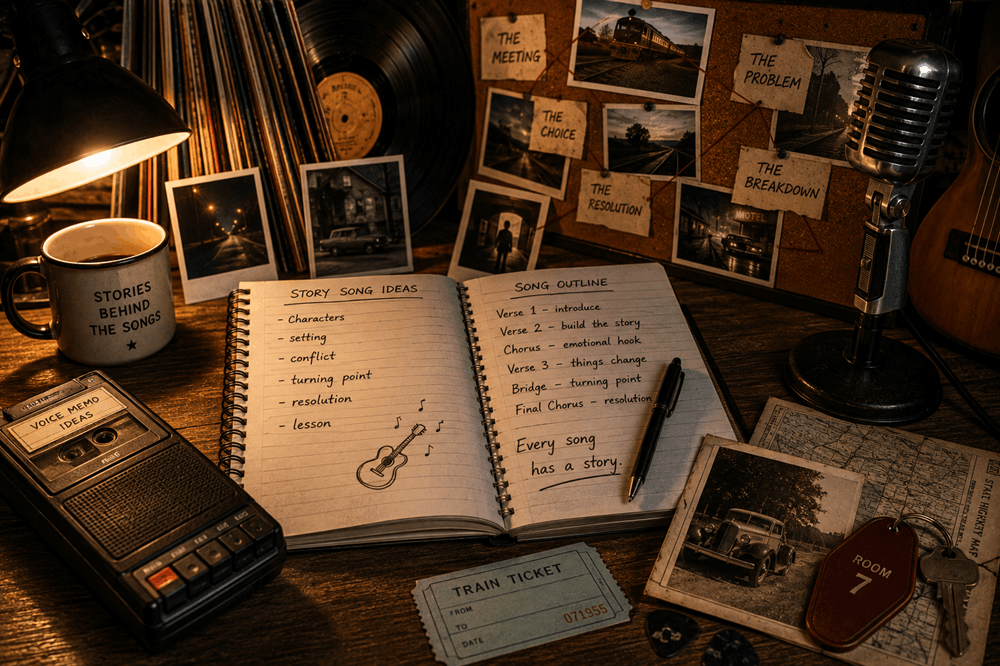
Some songs describe a feeling. Others introduce characters, create a setting, build a conflict, and reach an ending—all in a few minutes. The best songs that tell a story can feel like miniature movies, with details that make listeners picture exactly what is happening.
From murder ballads and doomed romances to road stories, family tragedies, and fictional fan letters, these songs prove that great songwriting can do much more than create a catchy chorus. It can tell an entire story.
1. “The Devil Went Down to Georgia” — The Charlie Daniels Band
Few story songs establish their conflict as quickly as “The Devil Went Down to Georgia.”
The Devil arrives in Georgia looking for a soul to steal and challenges a young fiddle player named Johnny to a musical contest. If Johnny loses, the Devil gets his soul. If Johnny wins, he receives a golden fiddle.
From there, the song practically becomes an action scene.
The Devil performs first. Johnny responds. The contest builds until Johnny confidently declares victory.
It works because the stakes are simple, the characters are clear, and the instrumental performances become part of the plot rather than merely accompanying it.
2. “Stan” — Eminem
“Stan” is one of the most famous examples of storytelling in modern popular music.
The song unfolds through letters written by an increasingly obsessed Eminem fan named Stan. At first, his admiration sounds intense but recognizable. Gradually, disappointment becomes resentment, and resentment becomes dangerous.
Eminem eventually responds, only to realize too late what has happened.
The ending forces listeners to reinterpret everything that came before it.
Stan became such a memorable character that his name eventually entered everyday language as a term for an extremely devoted fan.
3. “A Boy Named Sue” — Johnny Cash
“A Boy Named Sue” begins with a grievance.
A boy grows up furious at the father who abandoned him after giving him the name Sue. The unusual name leads to ridicule and forces him to become tough.
Years later, he finally finds his father and confronts him.
The resulting fight leads to an unexpected explanation: his father claims the name was intended to prepare him for a difficult world.
The song works because it moves from comedy to anger to a strange kind of reconciliation without losing its momentum.
4. “Fast Car” — Tracy Chapman
“Fast Car” begins as an escape story.
The narrator believes that leaving town with someone she loves might offer a route out of poverty and responsibility. The car represents possibility: movement toward a life that has not yet been defined by disappointment.
But the dream slowly changes.
The narrator takes on more responsibility while her partner contributes less. The relationship begins repeating the instability she hoped to escape.
By the end, the car means something different. It is no longer a shared ticket to freedom. She wants the other person to take it and leave.
5. “The Wreck of the Edmund Fitzgerald” — Gordon Lightfoot
Gordon Lightfoot turned a real maritime disaster into one of popular music’s best-known narrative songs.
The song follows the freighter Edmund Fitzgerald across Lake Superior as worsening weather turns a routine journey into catastrophe.
Lightfoot builds tension through practical details—weather, cargo, waves, crew decisions—rather than melodrama.
That restraint gives the story unusual weight.
Listeners know early that the voyage will end badly, but the song still creates suspense by making the ship and its crew feel increasingly isolated against the lake.
6. “Cat’s in the Cradle” — Harry Chapin
“Cat’s in the Cradle” tells a family story across years rather than minutes or days.
A father is too busy to spend much time with his young son. The boy admires him anyway and repeatedly says he wants to grow up to be just like his dad.
Eventually, he does.
When the father becomes older and finally wants more connection, his adult son is now the one who is too busy.
The ending hurts because the father receives exactly what he once modeled.
7. “Jolene” — Dolly Parton
“Jolene” does not contain a complicated plot, but it creates a complete dramatic situation.
The narrator believes another woman could take away the man she loves. Instead of attacking Jolene, she describes her beauty in extraordinary detail and pleads directly with her.
That choice makes the story much more interesting.
The narrator is not confident that love alone will protect the relationship. She believes Jolene has enough power to change her life simply by deciding to.
The entire song feels like one urgent conversation.
8. “El Paso” — Marty Robbins
“El Paso” plays like a Western film condensed into a song.
A cowboy falls in love with a woman named Feleena in a Texas cantina. Jealousy leads him to kill another man, after which he flees.
But escape cannot overcome obsession.
He eventually returns to El Paso because staying away from Feleena feels impossible, even though returning puts him in mortal danger.
The ending completes the tragedy the song has been moving toward from the moment jealousy takes control.
9. “Brandy (You’re a Fine Girl)” — Looking Glass
Brandy works in a harbor town where sailors admire her, but she loves one particular man.
He loves her too—just not enough to stay.
His deepest attachment is to the sea.
That is what gives the song its sadness. The relationship does not fail because either character is cruel. It fails because their desired lives are incompatible.
Brandy is worthy of love, but being worthy does not guarantee being chosen.
10. “Piano Man” — Billy Joel
“Piano Man” does not follow one central plot so much as introduce an entire room of small stories.
A bartender, a real-estate novelist, a businessman, regular customers, and the piano player all occupy the same bar while carrying different disappointments.
Music becomes the thing connecting them.
For a few hours, the piano player gives people somewhere to place their loneliness.
The song succeeds because it makes each character feel as though they existed before the listener entered the room and will continue after the song ends.
11. “Ode to Billie Joe” — Bobbie Gentry
“Ode to Billie Joe” is a storytelling song built around what it refuses to explain.
During an ordinary family meal, someone casually mentions that Billie Joe McAllister has died after jumping from a bridge.
The family continues eating and talking, while details gradually reveal that the narrator had some unexplained connection to him.
Then another mystery appears: what did the narrator and Billie Joe throw from the bridge before his death?
The song never gives a definitive answer.
That uncertainty is precisely what keeps the story alive.
12. “The Night the Lights Went Out in Georgia” — Vicki Lawrence
This Southern Gothic story is built around accusation, murder, and a late twist.
A man returns home, learns of betrayal, and becomes caught in a sequence of events that ends with him being blamed for a murder.
The legal system moves quickly.
Too quickly.
Only later does the narrator reveal information that completely changes the listener’s understanding of who committed the crime.
The song is essentially a murder mystery with a chorus.
13. “Jeremy” — Pearl Jam
“Jeremy” tells the story of an isolated teenager whose suffering is noticed too late.
The song focuses on neglect, humiliation, anger, and the emotional distance surrounding him.
Its power comes partly from hindsight.
Signs that might initially have seemed easy to dismiss become much more disturbing once listeners understand where the story is going.
The song is less interested in creating a shocking ending than in asking how someone could become so disconnected while surrounded by other people.
14. “Me and Bobby McGee” — Janis Joplin
“Me and Bobby McGee” begins with movement and companionship.
The narrator travels with Bobby, sharing roads, music, and temporary freedom.
But the relationship does not last.
By the time the narrator looks backward, freedom has acquired a second meaning. It once represented possibility, but after losing Bobby it also means having nothing left to hold onto.
The story is powerful because the narrator does not claim the relationship should have lasted forever.
She simply knows she would trade much of her freedom to feel that closeness again.
15. “Escape (The Piña Colada Song)” — Rupert Holmes
“Escape” is almost a romantic comedy in song form.
A man feels bored in his relationship and notices a personal ad from someone seeking a more adventurous partner.
He responds.
The two arrange to meet.
Then comes the twist: the mysterious woman is his current partner, who has apparently been just as dissatisfied.
Instead of ending in outrage, the discovery becomes an opportunity for them to realize how much they failed to know about each other.
16. “Papa Was a Rollin’ Stone” — The Temptations
The story begins after the father has already died.
The narrator asks his mother about the man he barely understood, and what follows is not a comforting family tribute.
Instead, he learns about absence, irresponsibility, rumors, and the complicated reputation his father left behind.
The repeated phrase about the father’s home being wherever he laid his hat becomes increasingly painful.
It sounds carefree until viewed from the perspective of the family he repeatedly left behind.
17. “Taxi” — Harry Chapin
A taxi driver picks up a passenger and gradually realizes she is someone he once loved.
That simple encounter opens an entire history.
Both characters once had dreams about the people they would become. Years later, neither life seems to have developed exactly as expected.
The taxi ride becomes an uncomfortable reunion between two people and their younger selves.
The story is not simply about lost romance. It is about meeting someone who remembers what you once thought your life would be.
18. “Take the Money and Run” — Steve Miller Band
“Take the Money and Run” is straightforward outlaw storytelling.
Billy Joe and Bobbie Sue are young lovers looking for adventure. They become involved in a robbery and killing, attracting the attention of a detective.
The song moves quickly, almost casually, which makes its criminal plot feel strangely playful.
Instead of deep psychological explanation, it gives listeners chase, characters, crime, and escape.
19. “Coward of the County” — Kenny Rogers
Tommy has spent his life being called a coward because he avoids fighting.
That decision comes from a promise he made to his dying father, who taught him that walking away does not automatically make someone weak.
Then something happens that pushes Tommy beyond what he is willing to tolerate.
The climax works because the entire song has carefully established his restraint.
When he finally fights back, the action carries more weight because listeners understand what it costs him to break that promise.
20. “Fancy” — Reba McEntire
“Fancy” tells the story of a girl growing up in severe poverty whose mother believes there is only one path available for her to escape it.
The narrator looks back on that turning point from adulthood.
The song is complicated because survival, exploitation, ambition, shame, and gratitude exist together.
Fancy eventually becomes successful, but the song never allows that success to erase the desperation that forced the story into motion.
21. “Last Kiss” — J. Frank Wilson and the Cavaliers
“Last Kiss” tells a tragedy with almost brutal simplicity.
A young couple is driving when an accident occurs.
The narrator survives long enough to find the person he loves dying nearby.
The title refers to their final moment together.
There is no complicated symbolism needed. The song’s power comes from the speed with which an ordinary drive becomes permanent loss.
22. “Travelin’ Soldier” — The Chicks
“Travelin’ Soldier” begins with a young soldier meeting a girl shortly before leaving for military service.
Their connection grows through letters.
That distance matters because the relationship develops through words rather than ordinary shared life.
The girl becomes the person waiting for news while almost everyone around her continues with everyday routines.
When the story reaches its ending, the public announcement of loss collides with very private grief.
23. “The Gambler” — Kenny Rogers
“The Gambler” is structured around a chance meeting on a train.
The narrator sits beside an experienced gambler who offers advice in exchange for a drink.
What begins as poker strategy gradually becomes something broader.
Knowing when to hold, fold, walk away, and run becomes advice about judgment itself.
The ending gives the encounter a finality that makes the gambler’s words feel like something deliberately passed from one person to another.
24. “Luka” — Suzanne Vega
“Luka” is unsettling because its narrator speaks so calmly.
A child tells a neighbor about life in an abusive home but repeatedly minimizes what is happening.
That restraint is the point.
The narrator has learned to explain away the signs of harm rather than describe them directly.
The story therefore depends as much on what Luka avoids saying as on what is actually said.
The listener understands more than the narrator is willing—or able—to admit.
25. “Leader of the Pack” — The Shangri-Las
“Leader of the Pack” has nearly everything a teenage melodrama needs.
A girl falls for a motorcycle-riding outsider. Her parents disapprove. She is pressured to end the relationship.
Then tragedy follows.
The sound effects, dialogue, and dramatic vocal performance make the song feel almost like an audio play.
It may be exaggerated, but that theatrical quality is part of its charm.
What Makes a Great Storytelling Song?
A good story song does not simply include a lot of events.
It gives those events shape.
Usually, listeners need some combination of character, setting, conflict, change, and consequence.
“The Devil Went Down to Georgia” establishes its conflict almost instantly. “Cat’s in the Cradle” uses the passage of time. “Ode to Billie Joe” uses missing information. “Stan” relies on escalation. “Escape” depends on a twist.
Different techniques can produce the same result: the listener wants to know what happens next.
Why Do Story Songs Feel So Memorable?
Stories give listeners something concrete to remember.
You may forget individual lines from “El Paso,” but remember the cowboy returning to the woman he cannot leave behind. You may forget the verses of “The Gambler,” yet still remember the stranger on the train giving advice.
Characters and events provide hooks beyond melody.
They also allow songs to explore emotions indirectly.
Instead of saying that regret hurts, “Taxi” shows two former lovers meeting after their lives have gone in different directions.
Instead of explaining that neglect has consequences, “Cat’s in the Cradle” lets a father watch his behavior return to him through his son.
The story does the emotional work.
Do Story Songs Have to Be Based on True Events?
No.
Some narrative songs draw from real events, while others are fictional or combine reality with invention.
“The Wreck of the Edmund Fitzgerald” is rooted in a real disaster. Songs such as “Stan,” “El Paso,” and “The Gambler” work primarily as constructed narratives.
Whether the story literally happened matters less than whether the details make it feel believable while the song is playing.
A fictional character can feel as emotionally real as a historical person if the songwriter gives listeners enough to imagine.
What Are the Best Story Songs With a Twist Ending?
Some songs become memorable because their final moments change everything that came before them.
“Escape (The Piña Colada Song)” reveals that the two strangers arranging an affair are already a couple. “The Night the Lights Went Out in Georgia” saves crucial information about the murder for the end. “Stan” creates a terrible moment of recognition when Eminem realizes whose story he has been hearing.
A good twist does more than surprise.
It makes the listener mentally replay the song with new information.
More Songs That Tell Great Stories
There are many more narrative songs worth hearing, including “Alice’s Restaurant” by Arlo Guthrie, “Scenes from an Italian Restaurant” by Billy Joel, “Uneasy Rider” by The Charlie Daniels Band, “Choctaw Bingo” by James McMurtry, “Goodbye Earl” by The Chicks, “Big Iron” by Marty Robbins, “The Mariner’s Revenge Song” by The Decemberists, “Rocky Raccoon” by The Beatles, “Boy Named Sue” by Johnny Cash, “Uneasy Rider,” “Long Black Veil,” and “The Ballad of Curtis Loew” by Lynyrd Skynyrd.
Some are funny. Some are violent. Some unfold across decades. Others capture one strange night.
What they share is movement: something changes between the first line and the last.
The Bottom Line
The best songs that tell a story make you forget how little time they actually have.
“Fast Car” traces a dream becoming a cycle. “Stan” builds obsession through letters. “Cat’s in the Cradle” covers an entire father-son relationship. “El Paso” creates a Western tragedy, while “The Gambler” turns a conversation on a train into a life lesson.
These songs do not merely tell listeners how someone feels.
They show what happened, who was there, what changed, and why it mattered.
That is why a great story song can feel less like a track on an album and more like a world you briefly entered.