Tears for Fears Songs From the Big Chair: Every Original Track Explained
Songs from the Big Chair contains only eight songs, but those eight tracks gave Tears for Fears some of the defining music of the 1980s. “Shout,” “Everybody Wants to Rule the World,” and “Head Over Heels” became enormous hits, while deeper cuts such as “The Working Hour,” “Broken,” and “Listen” reveal how strange, ambitious, and psychologically heavy the album could be underneath its polished pop production.
Released in 1985, the album marked a major expansion from the darker introspection of The Hurting. Tears for Fears did not abandon subjects such as fear, emotional conflict, power, and human behavior. They simply placed those ideas inside bigger drums, brighter melodies, guitars, saxophones, synthesizers, and arrangements designed to fill much larger spaces.
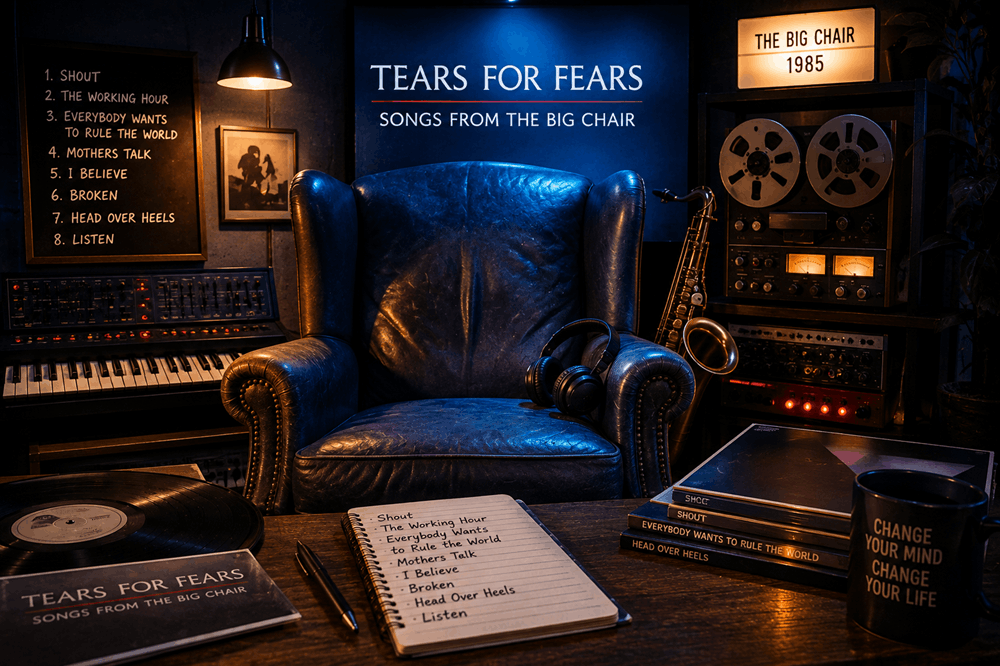
Songs From the Big Chair Track List
- Shout
- The Working Hour
- Everybody Wants to Rule the World
- Mothers Talk
- I Believe
- Broken
- Head Over Heels
- Listen
That short track list is deceptive. Several songs stretch beyond ordinary pop-single length, and the album moves through dramatically different sounds rather than repeating one successful formula.
1. “Shout”
Songs from the Big Chair opens with confrontation.
“Shout” takes frustration and turns it outward. Instead of quietly analyzing pain, the song encourages resistance—the idea that there comes a point when internal pressure has to become expression.
That helps explain why the recording feels so enormous.
The song begins with a relatively simple rhythmic idea and keeps accumulating weight. Drums, synthesizers, guitars, backing vocals, and instrumental layers gradually make the track feel larger than the phrase at its center.
Its repetition is important. “Shout” does not need a complicated narrative because it operates more like a demand or protest.
There is also an interesting connection to Tears for Fears’ earlier psychological interests. On The Hurting, emotional pain often seemed trapped inside the person experiencing it. “Shout” feels like the opposite movement: whatever has been suppressed is finally being pushed into the world.
That makes it an ideal opening track. The album announces immediately that Tears for Fears are still interested in fear and emotional pressure, but they are no longer interested in sounding small.
2. “The Working Hour”
After the force of “Shout,” “The Working Hour” changes the atmosphere completely.
The opening saxophone gives the song a late-night, almost jazz-like quality before the rhythm settles underneath it. Rather than rushing toward a chorus, the track unfolds patiently.
The song deals with fear, work, pressure, and the complicated relationship between creativity and the people who profit from it.
That makes “The Working Hour” especially interesting on an album that was transforming Tears for Fears into international pop stars.
Success creates freedom, but it also creates expectations. Music can begin as personal expression and gradually become schedules, deadlines, contracts, promotion, and something other people depend on financially.
The arrangement mirrors that uncertainty. It never sounds completely relaxed even when it is beautiful.
For listeners who know Songs from the Big Chair mainly through its singles, “The Working Hour” is one of the album’s best surprises. It shows that Tears for Fears could build atmosphere without relying on a giant pop hook.
3. “Everybody Wants to Rule the World”
“Everybody Wants to Rule the World” may be the album’s greatest contradiction.
It sounds effortless.
The guitar is bright, the rhythm moves easily, and Curt Smith’s vocal feels calm enough that the song can initially register as pure feel-good 1980s pop.
But the subject is power.
The song looks at the desire to control people, situations, nations, and outcomes. That makes the sunny production almost ironic. Something deeply troubling is being delivered in one of the most inviting recordings Tears for Fears ever made.
That contrast is a major reason the song has aged so well.
A more aggressive arrangement might have made its message obvious. Instead, “Everybody Wants to Rule the World” understands that power rarely presents itself as something ugly. It can feel attractive, natural, or even reasonable to the person seeking it.
The song also expands the scope of the album. “Shout” feels like resistance from the individual. “Everybody Wants to Rule the World” steps back and looks at the larger systems that make resistance necessary.
It is an unusually elegant pop song about an extremely unelegant human impulse.
4. “Mothers Talk”
“Mothers Talk” is one of the album’s most restless tracks.
Where “Everybody Wants to Rule the World” hides anxiety beneath an easy rhythm, “Mothers Talk” lets the anxiety become part of the sound.
The percussion feels busy. Electronic textures collide. The arrangement seems constantly on the verge of changing direction.
That nervousness suits a song concerned with warnings, fear, social pressure, and a world in which adults pass their anxieties down to younger generations.
There is a distinctly Cold War atmosphere around it. The possibility of catastrophe hangs over everyday life while people continue talking, worrying, preparing, and trying to understand threats too large for an individual to control.
The title is clever because a mother’s warning is normally associated with protection.
But warnings can also transmit fear.
When danger becomes part of everyday conversation, children inherit not only information about the world but also the anxiety surrounding it.
“Mothers Talk” is less immediately comfortable than the album’s biggest hits, but that discomfort is precisely what makes it useful to the record.
5. “I Believe”
“I Believe” brings the album almost to a standstill.
After four tracks filled with elaborate production and strong rhythmic identities, this piano-led song feels exposed.
Its title sounds confident, but the song itself is filled with uncertainty.
Belief here is not presented as absolute knowledge. It feels more like an attempt to understand whether suffering has meaning and whether people have any real control over what happens to them.
That distinction matters.
Someone saying “I believe” can sound certain. Someone repeatedly trying to convince themselves that they believe can sound vulnerable.
The sparse arrangement leaves more room for that vulnerability than the huge production surrounding songs such as “Shout.”
It also proves how varied Songs from the Big Chair really is. Tears for Fears were clearly capable of creating enormous singles, but they did not build the album by simply stacking eight possible versions of “Shout” together.
“I Believe” provides quiet space before the record becomes unsettled again.
6. “Broken”
“Broken” is short, tense, and intentionally unresolved.
It functions almost like a bridge between the reflective “I Believe” and the romantic rush of “Head Over Heels.”
The title returns to one of Tears for Fears’ central subjects: psychological fragmentation.
Being broken can mean much more than sadness. It can describe the feeling that different parts of the self no longer fit together properly—that fear, desire, identity, and behavior are pulling in different directions.
The track does not try to resolve that state.
Instead, it establishes it.
That becomes important because “Broken” and “Head Over Heels” are musically connected. The album does not treat them as completely isolated pieces. Material from “Broken” returns around the neighboring track, making the sequence feel almost circular.
The effect is subtle but meaningful.
Even when the album moves into one of its most openly romantic songs, the idea of emotional instability has not disappeared.
7. “Head Over Heels”
“Head Over Heels” is one of Tears for Fears’ most openly emotional love songs, but it is not as uncomplicated as its beautiful chorus suggests.
The narrator is overwhelmed by attraction and struggling to communicate it properly.
That is the important part.
Falling head over heels sounds romantic when viewed from outside. From inside the experience, it can also mean losing control.
The song captures both sides.
There is tenderness, but there is awkwardness. There is hope, but also fear that the relationship might never become what the narrator imagines.
The production keeps expanding until private romantic anxiety feels cinematic.
That is one of Tears for Fears’ greatest strengths on this album: small emotional experiences are allowed to sound enormous without losing their vulnerability.
The connection with “Broken” makes “Head Over Heels” even more interesting. The album places romantic surrender beside psychological instability, suggesting that love does not necessarily cure uncertainty. Sometimes it simply gives uncertainty a new subject.
For many listeners, “Head Over Heels” is the emotional peak of the album.
8. “Listen”
Instead of ending with another obvious single, Songs from the Big Chair closes with its most atmospheric song.
“Listen” feels less like a conventional pop composition and more like the album slowly dissolving.
Voices, keyboards, percussion, and spacious production create an almost dreamlike environment. The track does not rush toward a clear conclusion.
That makes its title appropriate.
After an album filled with shouting, talking, ruling, believing, working, and emotional confusion, the final instruction is simply to listen.
The contrast is striking.
The record begins with expression pushed outward at maximum volume. It ends in a much stranger and more reflective place.
That gives Songs from the Big Chair a shape that is easy to miss if listeners know only the singles.
It begins by demanding that something be said and ends by asking what might be heard afterward.
Why Is It Called Songs From the Big Chair?
The title was inspired by Sybil, the story of a woman undergoing psychiatric treatment who finds safety in her therapist’s chair.
That reference fits Tears for Fears particularly well.
The band’s earliest work was heavily influenced by psychological ideas, especially theories involving childhood trauma, repression, emotional release, and therapy.
The “big chair” can therefore be understood as a place where difficult experiences are examined rather than hidden.
But the plural word “songs” matters too.
This does not feel like an album built around one musical template. “Shout” is massive and industrial. “The Working Hour” has jazz-like touches. “I Believe” is restrained and piano-led. “Listen” becomes atmospheric and almost abstract.
The chair holds many different conversations.
What Were the Biggest Songs From Songs From the Big Chair?
“Shout” and “Everybody Wants to Rule the World” became the album’s two enormous international hits and remain the songs most closely associated with Tears for Fears.
“Head Over Heels” is nearly as important to the album’s legacy and has become one of the band’s most beloved recordings.
“Mothers Talk” and “I Believe” also received single releases in different forms and markets.
But reducing the record to its hits misses much of what makes it interesting.
“The Working Hour” may be the strongest deep cut, particularly for listeners who like the band’s more atmospheric side. “Broken” helps give the second half structural continuity, while “Listen” provides an ending far stranger than a collection of 1980s pop singles would suggest.
What Is the Best Song on Songs From the Big Chair?
“Everybody Wants to Rule the World” is the strongest choice if the question is which song best combines accessibility, production, melody, and meaning.
It sounds almost effortless while dealing with ambition, control, conflict, and the human desire for power.
“Head Over Heels,” however, may be the album’s emotional high point.
And “The Working Hour” is arguably the track most likely to surprise someone who only knows Tears for Fears from radio hits.
That gives the album several legitimate answers depending on what a listener values.
Are There More Songs on Deluxe Editions?
Yes.
Later editions of Songs from the Big Chair expanded the original record substantially with B-sides, alternate versions, remixes, demos, and related recordings.
Those collections include tracks such as “The Big Chair,” “Empire Building,” “The Marauders,” “The Conflict,” “Pharaohs,” “When in Love With a Blind Man,” and “Sea Song,” along with alternate versions of the album’s better-known material.
They are useful for dedicated fans, but they should not be confused with the original album.
The core Songs from the Big Chair remains the eight-track sequence beginning with “Shout” and ending with “Listen.”
The Bottom Line
The eight Tears for Fears songs on Songs from the Big Chair work because the album never chooses between intelligence and accessibility.
“Shout” turns protest into an anthem. “Everybody Wants to Rule the World” hides a dark view of power inside effortless pop. “Head Over Heels” makes romantic vulnerability enormous, while “The Working Hour,” “I Believe,” “Broken,” and “Listen” give the record psychological and musical depth beyond its famous singles.
That is why Songs from the Big Chair has survived as more than an artifact of 1980s production.
Its sounds are unmistakably tied to that decade, but its central concerns are much harder to date: fear, power, work, love, control, uncertainty, and the need to express what has been held inside.
Eight songs were enough.