Bon Jovi Songs List: 15 Essential Tracks From “Runaway” to “Legendary”
The best Bon Jovi songs combine working-class stories, enormous choruses and a belief that difficult circumstances do not have to define the ending.
“Livin’ on a Prayer” follows a young couple struggling to survive. “Wanted Dead or Alive” turns touring into the life of an exhausted outlaw, while “It’s My Life” transforms personal independence into a stadium chant. Ballads such as “Always,” “Bed of Roses” and “I’ll Be There for You” reveal the more vulnerable side of the band’s catalog.
Bon Jovi formed in New Jersey in the early 1980s and developed from a local hard-rock band into one of the world’s most durable arena acts. The Rock & Roll Hall of Fame credits the group with successfully moving from 1980s pop-metal to the more mature rock of “It’s My Life” and the country crossover “Who Says You Can’t Go Home.” The band was inducted in 2018.
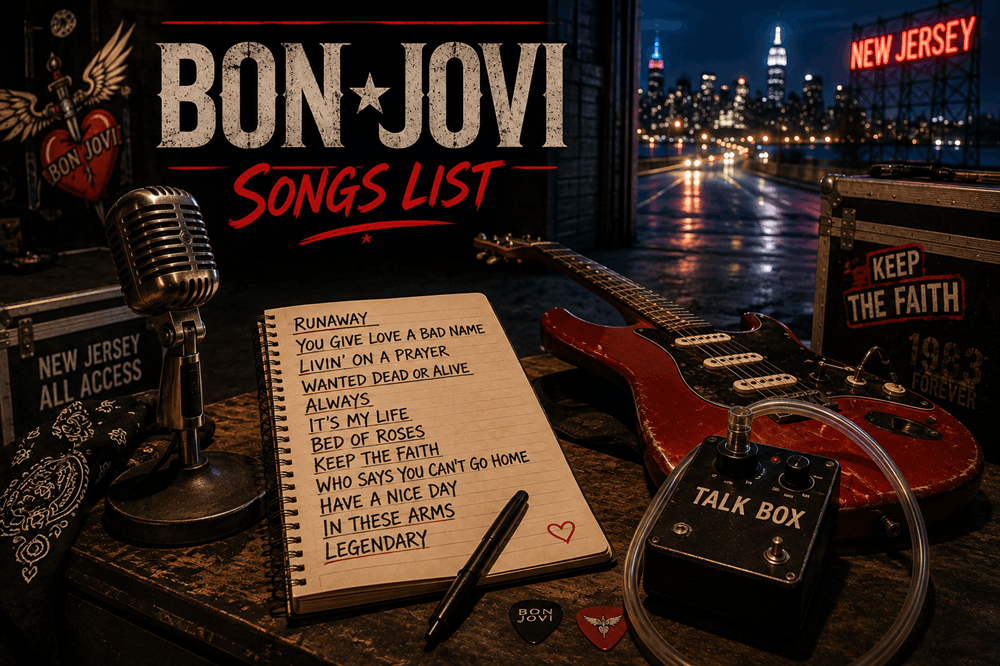
This Bon Jovi songs list moves chronologically through 15 essential recordings, showing how the band’s sound and themes developed across more than four decades.
1. “Runaway”
“Runaway” is where the Bon Jovi story begins.
The song follows a young woman escaping a difficult home and entering an equally dangerous city. Its bright keyboard introduction and hard-rock guitars create excitement, but the story beneath them is much darker.
The girl is searching for independence without having the protection or experience needed to navigate her new environment. Freedom and vulnerability arrive together.
Jon Bon Jovi originally recorded “Runaway” before the permanent band lineup had been assembled. Its regional radio success helped him secure a recording deal and form the group that would take his name.
The Recording Academy identifies it as Bon Jovi’s first Top 40 single.
“Runaway” does not yet contain the full arena-rock scale of the band’s later work, but the essential ingredients are present: a memorable keyboard part, a strong chorus and a story about someone trying to survive beyond the limits of a small life.
2. “You Give Love a Bad Name”
Listen to “You Give Love a Bad Name.”
“You Give Love a Bad Name” announces itself with one of rock music’s most effective vocal openings.
The song does not slowly introduce its conflict. It begins at the emotional accusation: someone has made promises, created trust and then transformed love into betrayal.
Jon Bon Jovi and Richie Sambora wrote the song with Desmond Child for 1986’s Slippery When Wet. The album turned the band into international stars, and “You Give Love a Bad Name” became its first U.S. No. 1 single. The Recording Academy identifies it alongside “Livin’ on a Prayer” as one of the album’s two chart-topping songs.
The production is designed for participation. The opening vocal can be shouted by an entire crowd before the instruments fully enter, while the chorus converts private betrayal into something communal.
The narrator may have been humiliated by one relationship, but the performance does not sound defeated. Anger gives him back some of the power the relationship removed.
3. “Livin’ on a Prayer”
Listen to “Livin’ on a Prayer.”
“Livin’ on a Prayer” is Bon Jovi’s defining song because it combines a personal story with a chorus large enough to belong to everyone.
Tommy and Gina are a working-class couple facing unemployment, financial pressure and an uncertain future. Neither character possesses a clear solution. Their strength comes from believing that the relationship gives them something worth protecting.
The song avoids promising that effort always produces success.
Tommy and Gina are not already halfway to prosperity. They are halfway through a struggle whose outcome remains unknown. The prayer in the title represents hope when practical resources are running out.
Richie Sambora’s talk-box guitar gives the song its instantly recognizable sound. The instrument seems to speak before Jon Bon Jovi begins telling the couple’s story.
Released on Slippery When Wet, the song became Bon Jovi’s second U.S. No. 1 hit. Decades later, it remains one of the band’s most persistent streaming and sales successes.
4. “Wanted Dead or Alive”
Listen to “Wanted Dead or Alive.”
“Wanted Dead or Alive” turns life on tour into a Western.
Jon Bon Jovi compares the traveling musician with an outlaw moving from town to town. Each concert offers another crowd and another temporary moment of recognition, but the routine also creates exhaustion and isolation.
The cowboy image is romantic, yet the details make the lifestyle less glamorous.
The narrator wakes without knowing where he is. Faces blur together. The road produces freedom, but it also prevents him from remaining anywhere long enough to feel at home.
The acoustic opening gives the song space before the electric guitars broaden its scale. That arrangement mirrors the narrator’s two lives: the isolated traveler and the public performer surrounded by noise.
“Wanted Dead or Alive” completed the central trio of hits from Slippery When Wet, the album that gave Bon Jovi worldwide recognition. The Rock Hall highlights the group’s gift for combining pop accessibility with hard-rock presentation, and this song is one of the clearest examples.
5. “Bad Medicine”
“Bad Medicine” uses illness and addiction as playful metaphors for attraction.
The narrator knows the relationship is unhealthy, yet he continues wanting more of it. Love becomes both the disease and the only treatment he will accept.
The medical language is intentionally exaggerated. There is no real diagnosis or cure. The metaphor captures the irrational part of desire—the willingness to return to something even after recognizing its negative effects.
Released as the lead single from 1988’s New Jersey, “Bad Medicine” showed that Bon Jovi could follow the extraordinary success of Slippery When Wet without becoming cautious.
The production is louder, the humor is broader and the call-and-response chorus is designed for live performance. New Jersey reached No. 1 on the Billboard 200 and remained there for four consecutive weeks.
6. “Born to Be My Baby”
Listen to “Born to Be My Baby.”
“Born to Be My Baby” returns to the working-class romantic world of “Livin’ on a Prayer.”
The couple does not possess much money or status. What they have is a private sense that their relationship makes an imperfect life more bearable.
The title sounds like a declaration of destiny, but the verses concentrate on ordinary commitment. Love is demonstrated through shared bills, hard work and continuing to imagine a future when the present offers few guarantees.
That combination became one of Bon Jovi’s specialties.
The band could turn economic struggle into an arena chorus without pretending the struggle itself was glamorous. The music provides escape, while the story remains connected with people who cannot simply purchase a better life.
“Born to Be My Baby” appeared on New Jersey, alongside “Bad Medicine,” “I’ll Be There for You” and “Lay Your Hands on Me.”
7. “I’ll Be There for You”
Listen to “I’ll Be There for You.”
“I’ll Be There for You” begins after devotion has already failed.
The narrator promises loyalty, protection and emotional presence, but those promises arrive when the relationship is ending. He now understands what he should have offered earlier.
That timing turns the song from a straightforward declaration into an apology.
He may sincerely intend to become a better partner, but sincerity cannot guarantee another opportunity. The person he hurt has already learned what his earlier behavior meant.
Richie Sambora’s backing vocals give the chorus additional emotional weight, while the guitar solo allows the regret to expand beyond the words.
Released from New Jersey, “I’ll Be There for You” became another major hit from an album already filled with rock anthems. Its lasting appeal comes from the contradiction at its center: the narrator promises permanence at the exact moment he may be too late to provide it.
8. “Keep the Faith”
“Keep the Faith” introduced a more mature Bon Jovi in 1992.
The music industry had changed dramatically since New Jersey. Grunge and alternative rock were reshaping popular taste, and many bands associated with 1980s glam metal struggled to remain relevant.
Bon Jovi responded by changing without abandoning its identity.
The song uses a bass-driven groove, heavier rhythm and less polished visual style. Its message is still optimistic, but the optimism sounds more tested than the confidence of the band’s earlier hits.
Faith here is not passive belief that everything will work out.
It is the decision to remain engaged when institutions, relationships and public expectations have become unreliable.
The Keep the Faith album marked a more serious development of the band’s pop-metal sound and produced “Bed of Roses” and “In These Arms” alongside its title track.
9. “Bed of Roses”
“Bed of Roses” is one of Bon Jovi’s most exposed power ballads.
The narrator is physically distant from the person he loves, surrounded by hotel rooms, alcohol and the consequences of a life built around travel.
He wants to offer romance and security, yet his circumstances continually prevent him from becoming the stable partner described in his promises.
The bed of roses is therefore an ideal rather than the narrator’s reality.
He imagines giving someone tenderness while waking in another temporary room. Fame allows him to perform love publicly but makes private consistency more difficult.
Jon Bon Jovi’s vocal begins with restraint and gradually rises toward the chorus, matching a confession that becomes harder to contain.
The song appeared on Keep the Faith, an album inspired partly by Jon Bon Jovi’s experiences traveling anonymously and reconsidering what the band should become after its first period of enormous fame.
10. “Always”
“Always” sounds romantic until the narrator’s behavior is examined closely.
He promises permanent love, but the relationship has ended and the other person appears to have chosen a life without him. His devotion is intense, yet it is also possessive and unable to accept the separation.
That tension makes the song more interesting than an uncomplicated wedding ballad.
The narrator’s feelings may be genuine, but genuine feelings do not automatically create a healthy relationship or give him the right to return.
Musically, “Always” delivers everything expected from a Bon Jovi power ballad: a gradual build, a dramatic key emotional shift and a chorus designed to carry across a stadium.
Released on the 1994 compilation Cross Road, it became one of the band’s biggest international singles. The collection itself remained a major long-term chart success, spending hundreds of weeks on the United Kingdom’s rock and metal albums ranking.
11. “This Ain’t a Love Song”
Listen to “This Ain’t a Love Song.”
“This Ain’t a Love Song” uses its title defensively.
The narrator insists that he is not performing a love song, but the emotional detail proves that he remains deeply affected by the relationship.
The denial resembles the logic of someone trying to regain control by renaming the experience. If this is not a love song, perhaps the loss does not need to be treated as love.
The slower, soul-influenced arrangement distinguished the track from Bon Jovi’s 1980s power ballads. Jon Bon Jovi sings with less theatrical confidence, while the band allows the spaces between phrases to carry some of the disappointment.
The song appeared on 1995’s These Days, an album with a darker and more reflective tone than the band’s earlier releases. It captures Bon Jovi at a stage when survival required more than repeating the formula of “Livin’ on a Prayer.”
12. “It’s My Life”
“It’s My Life” introduced Bon Jovi to a new generation in 2000.
The song returns to several familiar elements: an enormous chorus, the talk box and a reference to Tommy and Gina. However, it does not attempt to recreate the 1980s exactly.
Its message is broader and more individual.
The narrator refuses to postpone living until other people grant permission. He understands that time is limited and that safety can become another form of surrender.
The reference to Frank Sinatra’s determination to do things his own way connects personal independence with an older tradition of self-definition.
“It’s My Life” opened the album Crush, which arrived after a five-year gap between Bon Jovi studio records. The song received a Grammy nomination for Best Rock Performance by a Duo or Group with Vocal, while Crush was nominated for Best Rock Album.
The song’s success proved that Bon Jovi’s appeal was not confined to listeners who had experienced the band’s first rise.
13. “Who Says You Can’t Go Home”
Listen to “Who Says You Can’t Go Home.”
“Who Says You Can’t Go Home” is about discovering that maturity does not always require rejecting where you began.
The narrator leaves home because staying appears limiting. After traveling, succeeding and encountering the wider world, he realizes that returning does not erase the journey.
Home is no longer simply the place he needed to escape.
It becomes the location from which he can finally understand how much he has changed.
Bon Jovi recorded both a rock version and a country duet featuring Jennifer Nettles of Sugarland. The collaboration helped the band cross into country radio and earned Bon Jovi its first Grammy, for Best Country Collaboration with Vocals.
The song also connected naturally with the band’s New Jersey identity. After decades of international success, home remained central to how Bon Jovi explained itself.
14. “Have a Nice Day”
“Have a Nice Day” turns a polite phrase into an act of resistance.
The title is often used automatically, without much emotional meaning. In the song, it becomes the narrator’s response to people who expect him to accept their judgment or rules.
He is not offering cheerful customer-service politeness.
He is refusing to allow someone else’s criticism to determine how he lives.
The song’s compact structure and heavy guitar sound reflect Bon Jovi’s ability to adapt its arena-rock instincts to the shorter, sharper production of the mid-2000s.
Its defiance is also more controlled than the rebellion of a young band. The narrator has already survived long enough to understand that arguing with every critic may be unnecessary. Sometimes the strongest response is to continue.
15. “Legendary”
“Legendary” looks back on Bon Jovi’s history without treating the past as the only period that mattered.
The song values ordinary sources of meaning: lasting relationships, familiar places and the people who remain when applause disappears.
That perspective suits a band celebrating its 40th anniversary.
Earlier Bon Jovi songs often focused on escaping limitations or proving that success was possible. “Legendary” comes from someone who has already experienced success and is reconsidering how it should be measured.
The song opened 2024’s Forever, the band’s 16th studio album. The album reached No. 1 on the UK Albums Chart, while “Legendary” and the talk-box-driven “Living Proof” became its main introductory singles.
Bon Jovi later reimagined the album as Forever (Legendary Edition), with guest artists including Bruce Springsteen, Jelly Roll, Lainey Wilson and Jason Isbell. The expanded project also added the new song “Red, White and Jersey.”
More Bon Jovi songs worth hearing
A complete Bon Jovi playlist should extend beyond the 15 songs above.
“In These Arms” offers one of the strongest choruses from Keep the Faith, balancing longing with the promise of emotional safety.
“Lay Your Hands on Me” opens with percussion and audience-ready repetition, turning desire into something close to a rock revival meeting.
“Thank You for Loving Me” is a straightforward expression of gratitude from Crush, with less conflict than many of the band’s better-known ballads.
“Dry County” is an unusually long and ambitious song about economic decline, failed opportunity and communities built around industries that cannot last forever.
“Lost Highway” uses the open road as a symbol of reinvention and helped move Bon Jovi further toward country-influenced rock.
“We Weren’t Born to Follow” returns to the band’s recurring message that ordinary people can refuse the limits imposed on them.
“Living Proof” reconnects the modern band with Richie Sambora-era sonic history through the return of the talk box, while presenting survival itself as evidence of achievement.
Where should new listeners begin?
For the classic 1980s sound, begin with:
- “Livin’ on a Prayer”
- “You Give Love a Bad Name”
- “Wanted Dead or Alive”
- “Bad Medicine”
- “I’ll Be There for You”
For Bon Jovi’s more mature 1990s work, choose:
- “Keep the Faith”
- “Bed of Roses”
- “Always”
- “This Ain’t a Love Song”
- “In These Arms”
For the 2000s and later period, start with:
- “It’s My Life”
- “Who Says You Can’t Go Home”
- “Have a Nice Day”
- “We Weren’t Born to Follow”
- “Legendary”
The band’s official Grammy profile provides a concise career overview, while the Rock & Roll Hall of Fame traces how Bon Jovi evolved from 1980s arena rock into later pop, country and heartland-rock styles.
What makes a song sound like Bon Jovi?
The most recognizable Bon Jovi songs often contain four qualities.
First, the chorus is designed for a crowd. Even songs about private disappointment become communal when thousands of voices join the central line.
Second, the lyrics frequently focus on ordinary people under pressure. Tommy and Gina are not celebrities. They are workers trying to protect a relationship when money is disappearing.
Third, the songs balance realism with optimism. Difficulties are acknowledged, but the narrator usually believes that endurance, faith or love may still create another possibility.
Finally, Richie Sambora’s guitar work shaped the classic sound. His melodic solos, backing vocals and talk-box performances helped make the band more distinctive than a standard singer surrounded by anonymous rock instrumentation.
Final thoughts
Bon Jovi’s best songs have lasted because they make large emotions feel connected with ordinary lives.
“Runaway” follows a young woman searching for escape.
“Livin’ on a Prayer” turns financial struggle into a declaration of loyalty, while “Wanted Dead or Alive” reveals the loneliness behind the fantasy of touring.
The 1990s songs become more reflective. “Keep the Faith” deals with endurance after circumstances change. “Bed of Roses” recognizes the cost of distance, and “Always” shows how devotion can become possessive when a relationship has already ended.
“It’s My Life” brought the band into a new century without abandoning its belief in direct, memorable choruses. “Who Says You Can’t Go Home” made returning feel like growth rather than defeat, while “Legendary” measures success through the people and places that remain after four decades.
Bon Jovi’s catalog is filled with songs about survival.
Sometimes survival means holding on.
Sometimes it means changing.
The band’s greatest strength has been understanding that listeners often need music for both.