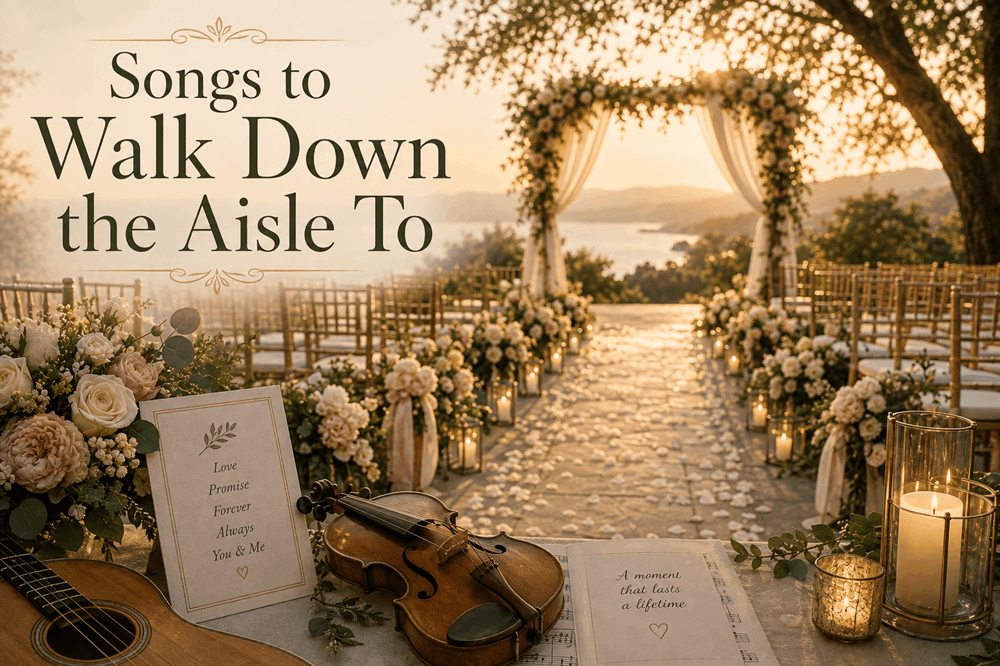
16 Beautiful Songs to Walk Down the Aisle To
The best song to walk down the aisle to should make the entrance feel personal before anyone hears a single vow.
Some couples want a sweeping romantic ballad. Others prefer an intimate acoustic song, a traditional classical piece or an unexpected track connected with their own relationship. The right choice is not necessarily the most popular wedding song. It is the one whose mood, lyrics and pacing match the ceremony you are creating.
Most wedding processionals need at least two selections: one for parents or the wedding party and another for the bride, groom or couple making the final entrance. Longer ceremonies may use separate songs for grandparents, attendants and each partner. The length of the aisle and number of people entering should influence whether you use the full recording or begin at a carefully selected point.
These 16 songs offer choices for traditional, modern, acoustic and less conventional ceremonies.
1. “Can’t Help Falling in Love” — Elvis Presley
“Can’t Help Falling in Love” is one of the safest choices for a timeless wedding entrance.
The melody moves slowly enough for a calm processional, while the message presents love as something natural and difficult to resist. It feels romantic without requiring a dramatic vocal climax.
The original Elvis Presley recording suits vintage, formal and candlelit ceremonies. Couples wanting something softer may choose an acoustic, piano or string arrangement.
Because the song begins quietly and develops gradually, it works particularly well for the final entrance rather than a large wedding party that needs a longer instrumental section.
Best for: A traditional ceremony with a warm, nostalgic atmosphere.
2. “A Thousand Years” — Christina Perri
“A Thousand Years” is built around waiting, courage and the feeling that two people were always moving toward one another.
The gradual piano-and-strings arrangement gives attendants time to enter before the song reaches its larger emotional sections. The recurring sense of moving “one step closer” also fits the physical action of approaching the altar.
Christina Perri originally wrote the song for Bella and Edward’s relationship in The Twilight Saga: Breaking Dawn – Part 1. It developed into a wedding standard far beyond the film and later received an expanded orchestral version.
Use the original recording for a cinematic entrance or a string version for a more formal ceremony.
Best for: A sweeping, emotional entrance with a long aisle.
3. “Turning Page” — Sleeping at Last
“Turning Page” is quiet, intimate and deeply devoted.
Rather than presenting love as excitement alone, the song describes it as a force that changes how a person understands life, time and vulnerability. Its restrained beginning allows the entrance to feel private even when many guests are present.
The recording grows slowly through piano, strings and a delicate vocal. That makes it especially effective for ceremonies in churches, forests, historic buildings or softly lit indoor spaces.
It does not require a dramatic editing point. The opening establishes the atmosphere almost immediately.
Best for: An intimate, cinematic or nature-inspired wedding.
4. “Perfect” — Ed Sheeran
“Perfect” is a modern wedding favorite because it describes a relationship developing into a shared future.
The waltz-like rhythm naturally supports a measured walking pace. Its imagery is romantic and familiar without becoming difficult for guests to understand.
The original version works for a relaxed contemporary ceremony. An orchestral duet or instrumental cover can make it feel more formal.
Couples should decide whether they want the vocal to remain prominent. During a processional, guests may focus more closely on lyrics than they would during a reception, so every line should reflect the meaning the couple wants associated with the entrance. Brides recommends reading all ceremony-song lyrics carefully rather than choosing from the chorus alone.
Best for: A modern romantic wedding with a classic feel.
5. “Lover (First Dance Remix)” — Taylor Swift
Taylor Swift’s “Lover (First Dance Remix)” also works beautifully as a processional song.
This version expands the original with a more orchestral arrangement, giving it greater scale without losing the song’s domestic warmth. Its message is not about idealized strangers or temporary passion. It imagines building a private life, sharing a home and continually choosing the same person.
The wedding-vow language in the bridge makes the track especially appropriate for the final entrance. However, that section arrives later, so the ceremony coordinator or musician should determine the best cue point in advance.
The remix was officially released specifically with a first-dance arrangement, although its slow build translates naturally to walking down the aisle.
Best for: Taylor Swift fans and romantic indoor ceremonies.
6. “At Last” — Etta James
“At Last” creates the feeling that a long period of searching has ended.
Etta James’s performance carries both relief and confidence. The strings immediately make the occasion feel important, while the tempo remains slow enough for a deliberate entrance.
The song is especially meaningful for couples who met later in life, endured a long-distance relationship or waited many years to marry.
Because James’s voice is so powerful, the track can dominate a small ceremony space. A live string arrangement or instrumental cover may be preferable when the couple wants the music to support the entrance without becoming its main focus.
Best for: Elegant weddings and couples with a long love story.
7. “Make You Feel My Love” — Adele
“Make You Feel My Love” is a promise of steady support rather than extravagant romance.
The narrator offers comfort through difficulty, uncertainty and change. That makes the song particularly suitable for wedding vows centered on partnership and endurance.
Adele’s recording is led by piano and voice, creating a reflective atmosphere without requiring a full orchestral arrangement. It works well in smaller venues where every word will be audible.
The song is tender but slightly solemn. Couples seeking a bright or celebratory entrance may prefer to use it for parents or the wedding party and reserve a lighter song for the final processional.
Best for: A quiet ceremony focused on commitment and emotional security.
8. “First Day of My Life” — Bright Eyes
“First Day of My Life” is one of the best choices for couples who prefer sincerity to grandeur.
The acoustic arrangement sounds conversational and imperfect in a deliberate way. Instead of promising a fantasy, the narrator recognizes that meeting one person has changed the direction of an ordinary life.
Its emotional appeal comes from humility. The relationship matters not because it makes the couple larger than everyone else, but because it makes everyday life feel worth choosing.
The song works particularly well for backyard weddings, courthouse ceremonies, rustic venues and smaller gatherings. The official video similarly emphasizes ordinary couples rather than elaborate spectacle.
Best for: Relaxed, alternative or deeply personal ceremonies.
9. “Bloom” — The Paper Kites
“Bloom” creates a gentle atmosphere through acoustic guitar, soft harmonies and nature imagery.
The song is about wanting closeness and finding one person continually present in your thoughts. Its tone is affectionate without becoming overly formal or emotionally overwhelming.
This makes it ideal for an outdoor ceremony surrounded by trees, fields, gardens or mountains. It also suits couples who want an indie-folk selection that guests may recognize without hearing at every wedding.
The original recording begins softly enough for a processional, although a live acoustic performer can adjust the length more easily for the entrance.
Best for: Garden, woodland, barn or bohemian weddings.
10. “Beyond” — Leon Bridges
“Beyond” captures the uncertainty of realizing that a relationship may be more important than anything experienced before.
The narrator is not merely declaring love. He is carefully considering whether he has found the person with whom he can build an entire life.
Leon Bridges combines a modern recording style with the warmth of classic soul. The result feels timeless without sounding like a song selected only because it has traditionally appeared at weddings.
Its steady beat works for a relaxed entrance, but couples should rehearse their pace because the rhythm is more pronounced than in a slow piano ballad.
Best for: Modern weddings with soul, R&B or vintage influences.
11. “You Are the Reason” — Calum Scott
“You Are the Reason” is dramatic, vulnerable and immediately recognizable.
The song describes the willingness to overcome distance and difficulty for one person. Its piano opening creates a clear emotional atmosphere before the vocal or full arrangement becomes larger.
This is a strong choice for couples whose relationship survived separation, personal challenges or a long period of uncertainty.
The original version can feel intense for a very informal ceremony. A piano, cello or violin arrangement preserves the melody while reducing the dramatic weight.
Best for: Emotional ceremonies and long-distance love stories.
12. “I Get to Love You” — Ruelle
“I Get to Love You” treats marriage as a privilege rather than an obligation.
That distinction gives the song unusual warmth. The narrator is grateful not simply to be loved, but to have the opportunity to love someone through the years ahead.
The piano-led arrangement builds gradually, creating a natural progression from the beginning of the aisle to the moment the couple meets at the altar.
It works well when the entrance is long enough to reach one of the fuller sections. For a short aisle, begin later in the recording or ask a musician to create a shortened arrangement.
Best for: Vow-centered ceremonies and a clearly romantic entrance.
13. “Here Comes the Sun” — The Beatles
“Here Comes the Sun” is bright, hopeful and less solemn than most processional choices.
The song associates a new beginning with warmth returning after a difficult season. That makes it meaningful for couples who have overcome hardship or simply want their ceremony to feel joyful from the beginning.
Its familiar guitar introduction creates recognition almost immediately. An acoustic or string version can make it feel more ceremonial while retaining the optimism of the original.
It is particularly effective for the wedding party, flower children or a daytime outdoor entrance. It may also suit couples who dislike slow, tearful ballads.
Best for: Spring, summer, garden and daytime weddings.
14. “From This Moment On” — Shania Twain
“From This Moment On” is one of the most direct wedding songs available.
Its message begins at the exact transition a ceremony represents: two people deciding that their lives will now move forward together.
Shania Twain’s recording combines country-pop warmth with the scale of a power ballad. It can create a major entrance without relying on classical music.
Because the full track becomes vocally and instrumentally large, couples should choose the cue carefully. The opening works for a gentle start, while a later section can accompany the final steps toward the altar.
Best for: Country weddings and couples wanting an unmistakable commitment song.
15. “Canon in D” — Johann Pachelbel
“Canon in D” remains the most dependable traditional processional.
Its repeating bass pattern allows the music to continue for as long as necessary without making a delayed entrance feel awkward. String quartets, pianists, harpists and guitarists can also shorten or extend it more easily than a fixed pop recording.
The music grows in complexity while maintaining a consistent emotional tone. This gives parents, attendants and the couple time to enter beneath one cohesive piece.
Modern versions range from formal string quartets to acoustic guitar and piano arrangements. Contemporary wedding guides continue to place it among the most frequently recommended ceremony selections.
Best for: Churches, formal ceremonies and large wedding parties.
16. “Clair de Lune” — Claude Debussy
“Clair de Lune” offers a quieter alternative to the predictable grandeur of traditional wedding music.
The piano piece feels reflective, elegant and slightly dreamlike. It creates space for the visual moment rather than telling guests what the couple’s relationship means through lyrics.
Because its dynamics change significantly, the exact section matters. A pianist can begin with a softer passage and build toward the couple’s arrival, while a fixed recording may require careful timing.
“Clair de Lune” is frequently included alongside “Canon in D” in recommendations for couples who want recognizable classical music without using the traditional bridal march.
Best for: Elegant evening weddings and ceremonies in historic venues.
Best aisle songs by wedding style
For a classic wedding
Choose:
- “Can’t Help Falling in Love”
- “At Last”
- “Canon in D”
- “Clair de Lune”
These songs feel established without requiring the traditional “Bridal Chorus.”
For a modern romantic wedding
Choose:
- “A Thousand Years”
- “Perfect”
- “Lover (First Dance Remix)”
- “I Get to Love You”
These selections create a recognizable emotional entrance and work well with piano or string arrangements.
For an intimate or acoustic wedding
Choose:
- “First Day of My Life”
- “Bloom”
- “Turning Page”
- “Make You Feel My Love”
Their quieter production is well suited to small guest lists and less formal venues.
For a joyful outdoor wedding
Choose:
- “Here Comes the Sun”
- “Beyond”
- “Bloom”
- “Can’t Help Falling in Love”
These songs feel warm rather than excessively solemn.
Should the wedding party and couple use different songs?
Usually, yes.
A separate final-entrance song creates a clear emotional shift and tells guests that the main processional moment has begun. The wedding party can enter to a longer instrumental or moderately romantic song, followed by a brief pause before the couple’s selection starts.
A simple sequence might be:
- Parents and grandparents: Soft classical or acoustic music
- Wedding party: “Bloom” or “Here Comes the Sun”
- Final entrance: “A Thousand Years” or “Can’t Help Falling in Love”
A couple can also use one continuous piece when they want the ceremony to feel seamless. This works especially well with “Canon in D,” because a live musician can adjust the arrangement to match the number of people walking. The Knot notes that processional choices may be divided among family members, attendants and each partner depending on the ceremony structure.
How long should an aisle song play?
The answer depends on the walking distance and number of people entering.
A short final entrance may last less than one minute. A complete wedding-party processional can require several minutes.
Before the wedding:
- Time the walk during rehearsal.
- Select an exact starting point.
- Decide where the music should fade.
- Give the DJ, musician or coordinator a written cue.
- Prepare a longer version in case the entrance is delayed.
Avoid asking the DJ to “play the chorus” without identifying a timestamp. The opening before the chorus may be too long, or the lyrics immediately after it may not suit the ceremony.
Check the lyrics before choosing
A beautiful melody does not guarantee appropriate wedding lyrics.
Some popular romantic-sounding songs are actually about jealousy, unfaithfulness, separation or a relationship that has already ended. Ceremony music is heard in a quiet environment where guests may notice the words more clearly.
Read the complete lyrics and ask:
- Does the relationship in the song last?
- Is the narrator speaking to a current partner or former lover?
- Is the song about commitment, desire, regret or loss?
- Are there any lines that would feel uncomfortable in front of family?
- Does the meaning reflect your relationship?
Also confirm whether the venue has restrictions. Some religious institutions permit only sacred, classical or preapproved music during the ceremony. Brides recommends checking those rules early rather than discovering them after selecting the processional.
Final thoughts
The best song to walk down the aisle to should create recognition between the couple, even when no one else understands why it was chosen.
“A Thousand Years” provides cinematic scale.
“Can’t Help Falling in Love” feels timeless.
“Bloom” makes the entrance intimate, while “Here Comes the Sun” fills it with optimism.
“Canon in D” remains dependable because it can adapt to almost any ceremony length. “First Day of My Life” offers the opposite kind of beauty: simple, imperfect and personal.
Choose the song whose emotional pace matches the way you want to enter.
Then rehearse the exact recording.
A meaningful song becomes even more powerful when the first note begins at the right moment, the couple reaches the altar with the music still unfolding and the ending feels as intentional as the entrance itself.