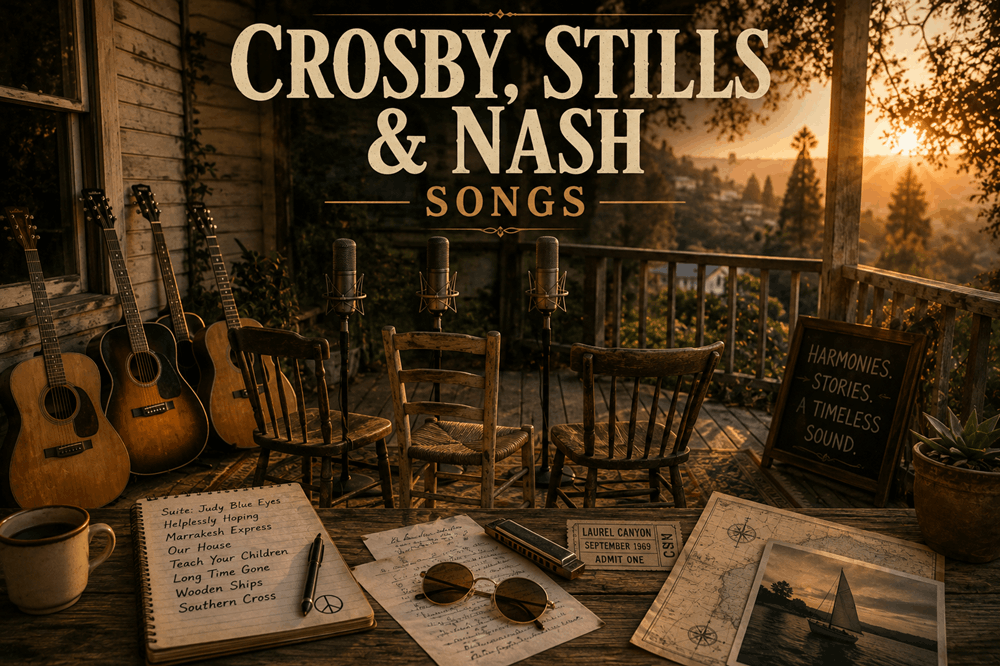
Crosby, Stills & Nash Songs: 12 Essential Tracks From Folk-Rock’s Greatest Harmony Group
The best Crosby, Stills & Nash songs combine intimate songwriting with harmonies that make three separate voices sound like one emotional instrument.
“Suite: Judy Blue Eyes” captures the excitement of the trio’s formation. “Helplessly Hoping” strips their sound down to almost nothing but language and breath. “Long Time Gone” turns political exhaustion into a dark electric warning, while “Southern Cross” uses sailing as a way to understand heartbreak.
A complete introduction must also include several songs recorded as Crosby, Stills, Nash & Young. Neil Young changed the group’s instrumental chemistry, but songs such as “Teach Your Children,” “Our House” and “Carry On” were written by the original trio’s members and remain central to the Crosby, Stills & Nash songbook.
The group formed in 1968 from three already established musicians: David Crosby of the Byrds, Stephen Stills of Buffalo Springfield and Graham Nash of the Hollies. Their 1969 debut helped place sophisticated vocal harmony at the center of folk rock, and the Rock & Roll Hall of Fame inducted the trio in 1997. (Crosby, Stills & Nash)
1. “Suite: Judy Blue Eyes”
“Suite: Judy Blue Eyes” is the clearest introduction to everything that made Crosby, Stills & Nash different.
Stephen Stills wrote the multipart song while his relationship with singer Judy Collins was ending. Instead of reducing that experience to one straightforward breakup verse and chorus, he created a sequence of connected musical sections that move through affection, frustration, acceptance and release.
The arrangement continually changes shape. Acoustic guitars provide rhythmic urgency, but the real drama comes from the voices. Crosby and Nash do not merely decorate Stills’s lead; their harmonies make every change feel larger and more emotionally complicated.
The final section abandons conventional English lyrics for exuberant syllables inspired partly by Latin music. After several minutes of emotional argument, the song ends by turning language into pure sound.
“Suite: Judy Blue Eyes” opened the trio’s self-titled 1969 album and became a Top 30 U.S. single. The Recording Academy identifies Collins as the inspiration and describes the debut as the essential entry point into the group’s work. (Grammy)
2. “Helplessly Hoping”
“Helplessly Hoping” demonstrates how much the trio could accomplish without a large arrangement.
The recording centers on acoustic guitar and three voices. There is no need for a dramatic instrumental climax because the tension already exists inside Stills’s writing.
The lyrics use repeated initial sounds and carefully balanced phrases to describe two people who remain emotionally connected but cannot communicate clearly. Words seem to approach one another, overlap and then pull apart—just like the people in the song.
Its famous numerical progression gives the relationship several contradictory forms. The couple can be united, isolated and bound together at the same time.
That ambiguity is the point. Love has not disappeared, but it no longer guarantees understanding.
“Helplessly Hoping” appeared on the 1969 debut, an album the Recording Academy highlights for the way songs such as this one placed the trio’s voices above almost every other feature. (YouTube)
3. “Long Time Gone”
“Long Time Gone” reveals the darker, more confrontational side of Crosby, Stills & Nash.
David Crosby wrote the song amid the political violence and disillusionment of the late 1960s. He later connected its emotional release with the assassinations of John F. Kennedy, Martin Luther King Jr. and Robert F. Kennedy, whose death became the immediate trigger.
The production sounds heavy and unsettled. Electric instruments, organ and an unusually deep Crosby vocal replace the acoustic clarity associated with much of the debut.
The song does not present protest as a clean path toward victory. It warns that meaningful change takes time and that democratic language becomes empty when people stop questioning power.
Stephen Stills reportedly rebuilt the difficult arrangement through an overnight studio session, helping turn Crosby’s raw composition into one of the debut album’s most forceful recordings. (Grammy)
4. “Marrakesh Express”
“Marrakesh Express” captures Graham Nash’s instinct for bright, immediate pop songwriting.
Nash drew the idea from a train journey through Morocco. The song turns travel into a fast sequence of colors, people, animals, food and unfamiliar scenery.
Unlike songs in which a destination represents escape from emotional pain, “Marrakesh Express” is primarily interested in attention. The traveler becomes excited because ordinary assumptions no longer organize everything he sees.
The playful rhythm and vocal arrangement make the train feel as though it is continually moving beneath the recording. Yet the performance never becomes chaotic. The harmonies provide structure while the verses present one vivid impression after another.
Released from the group’s debut, “Marrakesh Express” became one of its two original Top 40 singles, reaching No. 28 in the United States. (Grammy)
5. “Guinnevere”
“Guinnevere” is one of David Crosby’s most mysterious compositions.
The song uses the name of King Arthur’s queen, but it does not tell a conventional medieval story. Guinnevere becomes an imagined figure built from beauty, distance and fragments of real relationships.
The unusual guitar tuning removes the sense of familiar musical ground. Chords appear to float rather than resolve in predictable patterns, while the vocal lines move around one another with dreamlike patience.
Crosby and Nash carry most of the vocal atmosphere. Their blend feels intimate, yet the woman being described remains impossible to reach completely.
That tension gives “Guinnevere” its lasting power. The narrator sounds close enough to notice the smallest details but too far away to understand the person as a whole.
The recording appeared on the 1969 debut, where its spacious acoustic form balanced the heavier sound of “Long Time Gone” and “Wooden Ships.” (Grammy)
6. “Wooden Ships”
“Wooden Ships” turns Cold War fear into a science-fiction escape story.
David Crosby, Stephen Stills and Jefferson Airplane’s Paul Kantner developed the song together. It imagines survivors from opposing sides of a devastating conflict meeting after the political identities separating them have lost their meaning.
The wooden ship offers escape because metal has become contaminated or dangerous. But the departure is not presented as a complete victory. Those aboard must watch other people die as they leave the ruined society behind.
That moral discomfort separates the song from a simple countercultural fantasy about sailing away and beginning again.
Musically, the track moves between ominous stillness and electric release. Crosby and Stills exchange lead vocals, while the instrumental sections suggest both freedom and uncertainty.
Crosby, Stills & Nash and Jefferson Airplane recorded different versions of the composition in 1969. (Wikipedia)
7. “Carry On”
“Carry On” opens Déjà Vu with the sound of a group trying to turn division into momentum.
Stephen Stills assembled the song from multiple musical ideas, including material connected with an earlier composition called “Questions.” The result moves from urgent folk rock into a more open, rhythmically fluid second section.
Its title offers encouragement, but not easy optimism.
The song acknowledges that relationships fail, circumstances change and emotional certainty can disappear. Continuing does not mean pretending that the loss never happened. It means refusing to let that loss end every possibility.
Neil Young had joined the group by the time Déjà Vu was made, creating the Crosby, Stills, Nash & Young configuration. Graham Nash later described it as their first record with Young, and the album was selected for the National Recording Registry. (The Library of Congress)
8. “Teach Your Children”
“Teach Your Children” is often interpreted as advice flowing from parents to children, but Graham Nash makes the relationship reciprocal.
Adults are responsible for passing on experience, values and emotional security. Children, however, also teach adults by exposing how inherited fear and bitterness can be repeated across generations.
The song’s gentleness is essential. It does not sound like a lecture delivered by someone claiming superior wisdom. The voices suggest a conversation among people who all possess incomplete knowledge.
Its country influence also distinguished it from the heavier material on Déjà Vu. Jerry Garcia contributed pedal steel guitar, giving the recording a warmth that complements Nash’s plainspoken writing.
“Teach Your Children” became one of the group’s most durable songs and later received a Grammy nomination in a collaborative country recording with Suzy Bogguss, Alison Krauss and Kathy Mattea. (YouTube)
9. “Our House”
“Our House” finds significance in an ordinary domestic moment.
Graham Nash wrote the song while living with Joni Mitchell in Laurel Canyon. After the couple returned home on a cold, rainy day, Mitchell arranged flowers while Nash lit a fire and sat at the piano.
Nothing dramatic happens.
That is precisely what the song protects.
The home represents a brief space where affection, routine and creative life feel secure. In an era dominated by war, political violence and cultural conflict, Nash wrote about the emotional value of closing the door and caring for one other person.
The arrangement remains light enough for the details to feel natural rather than idealized. Piano, harpsichord and layered vocals create warmth without turning the home into a grand monument.
Nash later described the song as being about peace and a beautiful moment between two people. (Performing Songwriter)
10. “Woodstock”
“Woodstock” became an anthem for an event its songwriter did not attend.
Joni Mitchell wrote the song after hearing about the 1969 Woodstock festival and watching television coverage. Graham Nash, who had performed there with the newly expanded CSNY lineup, helped communicate the atmosphere she had missed.
Mitchell’s own recording is reflective and spiritually searching. Crosby, Stills, Nash & Young transformed the composition into a harder rock performance driven by electric guitar and an urgent rhythm.
That change alters the listener’s position.
Mitchell sounds as though she is contemplating the festival from a distance. CSNY sounds as though the crowd is still moving around them.
The song’s vision is idealistic, but not entirely naïve. Returning to a symbolic garden means recovering a sense of shared humanity from a society divided by war, technology and political mistrust. (MusicRadar)
11. “Just a Song Before I Go”
“Just a Song Before I Go” compresses the emotional cost of touring into slightly more than two minutes.
Graham Nash reportedly wrote it in Hawaii after a friend bet him that he could not produce a song before leaving for the airport. The speed of its creation suits the subject: a relationship is being interrupted by another departure, and there is barely enough time to acknowledge the pain.
The narrator understands that constant travel creates excitement and professional success. It can also burn through intimacy.
Small actions carry the emotional weight. Packing a suitcase, driving to the airport and passing through security become stages in a separation neither person knows how to prevent.
Released from the 1977 album CSN, the song reached No. 7 on the Billboard Hot 100, making it the trio’s highest-charting U.S. single. (American Songwriter)
12. “Southern Cross”
“Southern Cross” uses an ocean voyage to describe someone discovering that distance cannot automatically remove heartbreak.
Stephen Stills adapted a Curtis Brothers song called “Seven League Boots,” writing new lyrics partly from his experiences sailing after the end of a marriage.
The narrator travels through beautiful and remote locations, but the person he is trying to forget remains attached to every observation.
The Southern Cross becomes more than a constellation used for navigation. Seeing it offers perspective: the truth he has been escaping may appear small against the scale of the world, yet it remains large enough to organize his emotional life.
The music creates forward movement even when the narrator’s thoughts continue circling the past. Its broad chorus also gives the song a communal power that made it a lasting concert favorite.
Released on Daylight Again in 1982, “Southern Cross” reached No. 18 on the Billboard Hot 100. David Crosby returned to the project late and did not sing on the original album recording, although he appeared in the video and performed it with the group later. (Wikipedia)
More Crosby, Stills & Nash songs worth hearing
“Déjà Vu” is one of Crosby’s most structurally unusual songs, built around the sensation that the present may be repeating an experience the mind cannot completely retrieve.
“Almost Cut My Hair” turns Crosby’s hesitation about changing his appearance into a larger statement about identity and pressure to conform.
“Cathedral” follows Nash through an intense encounter with religious history and his discomfort with institutions that demand reverence while carrying records of violence.
“Wasted on the Way” looks back on the trio’s years of conflict and lost time with unusual directness.
“Ohio,” written by Neil Young and recorded by CSNY after the Kent State shootings, remains one of the group’s most immediate political recordings.
“Wasted on the Way,” “Cathedral,” “Déjà Vu” and “Ohio” all appear within the group’s official or Rhino-supported catalogs, although the last two belong specifically to the CSNY configuration. (Crosby, Stills & Nash)
Where should new listeners begin?
Start with five songs that reveal the group’s full range:
- “Suite: Judy Blue Eyes” for the signature harmonies
- “Helplessly Hoping” for acoustic precision
- “Long Time Gone” for political and electric intensity
- “Teach Your Children” for accessible songwriting
- “Southern Cross” for the mature 1980s sound
Listeners drawn to David Crosby’s unusual writing should continue with “Guinnevere,” “Wooden Ships” and “Déjà Vu.”
Those who prefer Graham Nash’s direct melodies should choose “Our House,” “Marrakesh Express” and “Just a Song Before I Go.”
Stephen Stills is most clearly represented by “Suite: Judy Blue Eyes,” “Carry On” and “Southern Cross.”
Final thoughts
Crosby, Stills & Nash were not remarkable simply because three talented singers happened to harmonize well.
Their voices preserved their differences.
Stephen Stills brought restless structure, rhythmic force and instrumental ambition. David Crosby created strange musical spaces filled with political doubt, desire and mystery. Graham Nash wrote direct melodies that made intimate experiences immediately understandable.
The harmony did not erase those identities.
It allowed them to occupy the same song.
“Helplessly Hoping” makes emotional isolation sound beautiful. “Long Time Gone” makes beauty feel politically uneasy. “Our House” finds peace in ordinary domestic life, while “Southern Cross” discovers that even an ocean cannot guarantee escape from memory.
The strongest Crosby, Stills & Nash songs continually move between those extremes:
Private love and public conflict.
Escape and responsibility.
Three individuals and one voice.