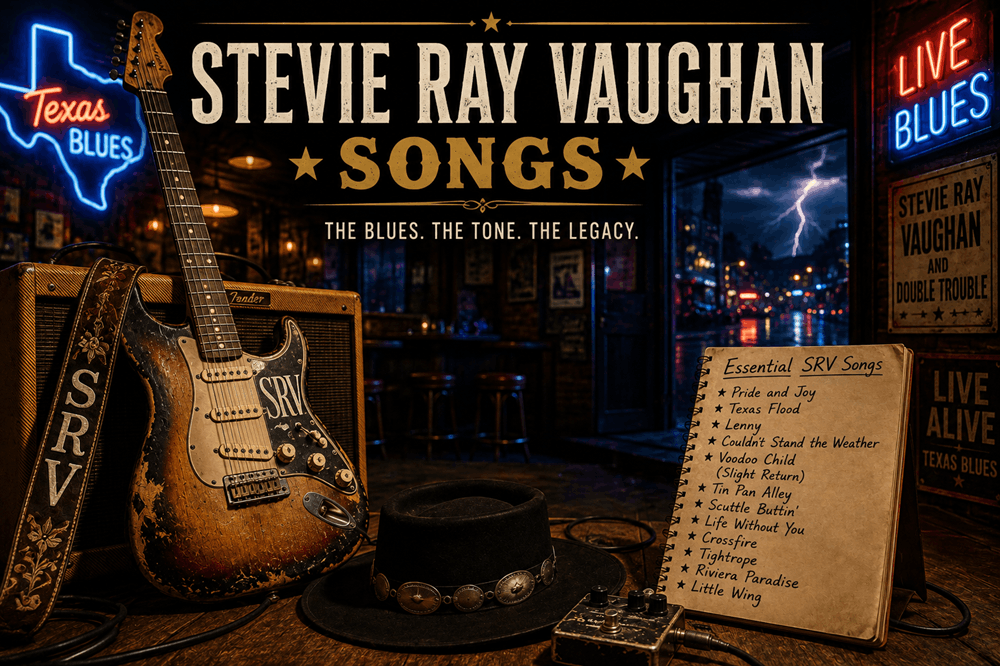
Stevie Ray Vaughan Songs: 12 Essential Tracks That Define His Texas Blues Legacy
The best Stevie Ray Vaughan songs combine explosive guitar technique with the direct emotional force of traditional blues.
“Pride and Joy” captures his famous Texas shuffle. “Texas Flood” turns a slow blues standard into a dramatic guitar showcase. “Crossfire” and “Tightrope” reflect the recovery period behind In Step, while “Lenny,” “Riviera Paradise” and “Little Wing” reveal how expressive he could be without singing a word.
Vaughan’s mainstream recording career lasted only seven years, but he helped return electric blues to rock radio during the 1980s. Stevie Ray Vaughan and Double Trouble were inducted into the Rock & Roll Hall of Fame in 2015, which credited them with reviving a genre that had faded from mainstream attention.
These 12 songs provide the clearest introduction to his playing, songwriting and interpretation of earlier blues traditions.
1. “Pride and Joy”
“Pride and Joy” is the essential starting point for understanding Stevie Ray Vaughan.
Released on the 1983 debut album Texas Flood, the song combines a traditional 12-bar blues structure with a fast Texas shuffle. Vaughan alternates between bass notes, muted chord strikes and sharp lead fills, making one guitar sound as though it is handling several rhythmic jobs at once.
The lyrics are simple and affectionate, but the guitar performance gives the song its personality. Vaughan does not wait for a formal solo before demonstrating his skill. Nearly every gap around the vocal contains a bend, accent or rhythmic variation.
The song became his debut single and reached No. 20 on Billboard’s Mainstream Rock chart.
“Pride and Joy” also demonstrates why Vaughan’s virtuosity remained approachable. The playing is technically demanding, yet the groove is immediate enough for listeners who know nothing about guitars.
2. “Texas Flood”
“Texas Flood” is Vaughan’s definitive slow-blues performance.
The song was not his own composition. Larry Davis first recorded it in the late 1950s, and Vaughan used it as the title track of Double Trouble’s debut album. The record was completed during a remarkably concentrated session at Jackson Browne’s Los Angeles studio, with much of the album recorded in only a few days.
Vaughan stretches the song’s spaces almost as effectively as its notes.
He allows individual bends to rise, shake and decay before answering them with another phrase. The band remains restrained beneath him, creating enough room for the guitar to become the narrator’s second voice.
The official recording of “Texas Flood” shows how Vaughan transformed inherited material. He preserved the basic blues lament while increasing its volume, sustain and dramatic scale.
3. “Lenny”
“Lenny” reveals the quiet side of a musician often remembered for speed and physical intensity.
The instrumental appeared on Texas Flood and was written as a tribute to Vaughan’s wife, Lenora. Rather than building toward a conventional rock climax, the piece moves through gentle chords, suspended notes and delicate melodic fragments.
The performance feels private.
Notes sometimes arrive hesitantly, as though Vaughan is discovering the melody while playing it. His control of volume is especially important: a barely touched phrase can be followed by a fuller chord without disturbing the song’s calm atmosphere.
“Lenny” proves that his identity did not depend on playing as loudly or quickly as possible. His tone remains recognizable even when most of the aggression has disappeared.
For listeners who find instrumental guitar music overly technical, “Lenny” offers a different model. The technique exists entirely in service of tenderness.
4. “Couldn’t Stand the Weather”
“Couldn’t Stand the Weather” combines blues rhythm with a darker, more modern rock arrangement.
The title track opened a new stage in Vaughan’s career after the immediate success of Texas Flood. The second album was recorded at New York’s Power Station and reached No. 31 on the Billboard 200. Its title song also received regular MTV exposure, helping Vaughan reach listeners beyond traditional blues audiences.
The main riff feels unstable and threatening.
Instead of settling into a comfortable shuffle, the guitar and rhythm section repeatedly interrupt the song’s momentum. Those sudden changes suit lyrics about people who remain close during good times but disappear when circumstances become difficult.
The production is larger than that of the debut, but it does not smooth away the band’s force. Vaughan sounds as though he is testing how far the blues can move toward hard rock without losing its rhythmic foundation.
5. “Voodoo Child (Slight Return)”
Vaughan’s interpretation of Jimi Hendrix’s “Voodoo Child (Slight Return)” is both a tribute and a declaration of independence.
Hendrix first released the composition with the Jimi Hendrix Experience in 1968. Vaughan included his version on Couldn’t Stand the Weather, extending the track into a display of controlled feedback, wah-wah effects and muscular rhythm playing.
Trying to cover Hendrix is dangerous because the original performance is already so closely tied to its creator.
Vaughan avoids becoming a simple impersonator. His attack is heavier, the shuffle influence is stronger and the notes have the thick, compressed tone associated with his own Stratocaster playing.
The recording received a Grammy nomination for Best Rock Instrumental Performance.
It also clarifies Vaughan’s relationship with musical tradition. He did not treat earlier guitar heroes as museum pieces. He entered their songs, tested himself against them and allowed his own style to alter the result.
6. “Tin Pan Alley”
“Tin Pan Alley,” sometimes subtitled “Roughest Place in Town,” contains one of Vaughan’s most controlled slow-blues performances.
Bob Geddins wrote the song, and Jimmy Wilson and His All-Stars first released it in 1953. Vaughan’s interpretation appeared on Couldn’t Stand the Weather.
The track is nearly the opposite of “Scuttle Buttin’.”
Instead of filling every second with motion, Vaughan allows tension to accumulate through silence. His guitar enters like a warning from the edge of the room, often answering the vocal with only one carefully shaped phrase.
The dynamics are unusually wide. Quiet sections feel almost fragile, making the louder attacks seem physically enormous when they arrive.
“Tin Pan Alley” is essential because it demonstrates that Vaughan’s power came from restraint as much as force. He knew that a single note, delayed long enough, could create more tension than an entire run of fast ones.
7. “Scuttle Buttin’”
“Scuttle Buttin’” is Vaughan at his most technically aggressive.
The brief instrumental opens Couldn’t Stand the Weather with a rapid shuffle riff that moves through slides, open strings and sharply articulated blues-scale phrases. The complete performance lasts less than two minutes, yet it contains enough energy for a much longer song.
Recent assessments of Vaughan’s career have continued to identify it as one of his most technically demanding recordings.
The speed is impressive, but speed alone does not explain the track’s appeal.
The riff swings. Vaughan maintains a loose rhythmic bounce even while playing notes that could easily become rigid or mechanical in another guitarist’s hands.
“Scuttle Buttin’” works like an opening challenge. Before the album has properly begun, Vaughan establishes that the success of his debut has not made him cautious.
8. “Life Without You”
“Life Without You” is one of Vaughan’s most direct emotional songs.
Released on the 1985 album Soul to Soul, it unfolds as a slow farewell built around grief, memory and the necessity of continuing after loss. The official Sony-provided recording credits Vaughan and Double Trouble and places the track within the original 1985 album.
The performance begins with restraint but gradually becomes more forceful.
Vaughan’s vocal carries the plainspoken message, while his guitar expresses everything the words cannot contain. The final sections do not feel like decorative soloing. They sound like resistance against the idea that someone important has permanently disappeared.
Live performances often expanded the song further, with Vaughan using the ending to speak about love, addiction, friendship and the importance of caring for people while they are still present.
It is among his most moving recordings because the vulnerability never feels separated from his physical playing style.
9. “Crossfire”
“Crossfire” was Stevie Ray Vaughan and Double Trouble’s largest rock-radio hit.
The song appeared on 1989’s In Step, Vaughan’s final Double Trouble studio album released during his lifetime. It was written by Bill Carter, Ruth Ellsworth, Chris Layton, Tommy Shannon and keyboardist Reese Wynans rather than by Vaughan himself.
Its compact riff and horn arrangement give it a different character from the band’s earlier records.
The song is still rooted in blues, but its structure is tighter and more radio-focused. Vaughan’s guitar supports the groove rather than constantly dominating it.
“Crossfire” reached No. 1 on Billboard’s Mainstream Rock chart, becoming the only chart-topper of his lifetime on that ranking.
Its lyrics about pressure, temptation and being trapped between destructive forces also fit the recovery period surrounding In Step. Vaughan had entered treatment after years of addiction, and the album became closely connected with his return to sobriety.
10. “Tightrope”
“Tightrope” turns recovery into a physical balancing act.
Written by Vaughan with longtime collaborator Doyle Bramhall, the song appeared on In Step in 1989.
The central image is simple: the narrator is attempting to move forward while knowing that one careless step could return him to an earlier destructive life.
That tension shapes the music.
The rhythm remains disciplined and propulsive, while Vaughan’s guitar continually pushes against it. He sounds powerful, but the lyrics reject the fantasy that strength makes someone permanently safe from relapse or self-deception.
“Tightrope” is one of his most complete songs because the subject, performance and historical moment align so closely. The guitar is still fierce, yet the confidence feels earned differently than it did on the early records.
The narrator is no longer proving that he can overpower a room.
He is proving that he can remain standing.
11. “Riviera Paradise”
“Riviera Paradise” closes In Step with nearly nine minutes of instrumental stillness.
The track moves beyond straightforward electric blues into a spacious blend of blues, jazz and soul. Reese Wynans’s organ creates a soft foundation while Vaughan plays long melodic lines instead of aggressive riffs.
The placement is important.
After songs concerned with temptation, recovery and renewed energy, “Riviera Paradise” sounds like the peace that the rest of the album has been seeking. Contemporary accounts of In Step continue to connect the instrumental with Vaughan’s period of emotional and creative renewal.
The song also contains some of his most patient phrasing.
Individual notes seem to float above the band rather than strike against it. He allows melody, tone and silence to carry the performance without relying on a recognizable vocal hook.
For listeners who think Vaughan’s appeal begins and ends with loud Texas shuffles, “Riviera Paradise” may be the recording most likely to change that impression.
12. “Little Wing”
Vaughan’s version of “Little Wing” is one of the most admired instrumental interpretations of a Jimi Hendrix composition.
Hendrix first released the song in 1967. Vaughan recorded his extended version during the 1980s, but it remained unreleased until the posthumous 1991 album The Sky Is Crying.
Removing the lyrics changes the piece.
Vaughan must express the song’s dreamlike atmosphere entirely through guitar. He preserves the delicacy of Hendrix’s composition while expanding it into a longer sequence of melodic variations.
The track gradually moves from soft chordal passages toward more forceful soloing, yet it never loses the original song’s floating quality.
“Little Wing” won the Grammy for Best Rock Instrumental Performance, while The Sky Is Crying won Best Contemporary Blues Album.
The official “Little Wing” video remains one of the clearest demonstrations of Vaughan’s ability to honor another guitarist without surrendering his own identity.
More Stevie Ray Vaughan songs worth hearing
“The Sky Is Crying”
Vaughan’s reading of the Elmore James standard combines slow-blues sorrow with an exceptionally vocal guitar tone. James, Clarence Lewis and Bobby Robinson wrote the song, which was first released by Elmo James and His Broomdusters in 1960.
Vaughan’s version became the title track of the 1991 collection assembled after his death.
“Life by the Drop”
Written by Doyle Bramhall, “Life by the Drop” is an acoustic reflection on friendship, addiction and the passage of time. Vaughan’s recording appeared posthumously on The Sky Is Crying.
Its stripped-down arrangement makes it one of the most accessible vocal performances in his catalog.
“The House Is Rockin’”
Written by Vaughan and Doyle Bramhall, “The House Is Rockin’” opens In Step with compact rock-and-roll energy.
It is less emotionally complicated than “Tightrope” or “Crossfire,” but its speed and economy make it an effective introduction to the revitalized sound of his final Double Trouble album.
“Look at Little Sister”
Vaughan’s version of Hank Ballard’s “Look at Little Sister” appeared on Soul to Soul. The original had been recorded by Hank Ballard and the Midnighters in 1959.
The track demonstrates how naturally Vaughan could translate early rhythm and blues into his heavier Texas style.
The best Stevie Ray Vaughan songs for new listeners
A five-song introduction should begin with:
- “Pride and Joy” for the Texas shuffle
- “Texas Flood” for slow-blues drama
- “Couldn’t Stand the Weather” for blues-rock power
- “Crossfire” for his later, more polished sound
- “Little Wing” for lyrical instrumental playing
Listeners interested primarily in guitar technique should add “Scuttle Buttin’” and “Voodoo Child.”
Those who prefer emotional, slower recordings should continue with “Lenny,” “Life Without You” and “Riviera Paradise.”
The official Essential Stevie Ray Vaughan and Double Trouble collection gathers 33 tracks and provides a broader path through the studio albums, live performances and posthumous releases.
Why Stevie Ray Vaughan’s songs still matter
Vaughan did not invent Texas blues, the 12-bar shuffle or the amplified guitar traditions he used.
His achievement was making those traditions sound urgent to a new audience.
He absorbed Albert King’s bending, Jimi Hendrix’s sonic experimentation, Buddy Guy’s intensity and the rhythmic language of Texas blues. He then combined those influences with a tone and physical attack that listeners could identify almost immediately.
The songs also reveal more variety than his reputation sometimes suggests.
“Scuttle Buttin’” is almost violently fast.
“Tin Pan Alley” depends on silence.
“Crossfire” is a compact radio record.
“Riviera Paradise” approaches jazz.
“Lenny” sounds like a private love letter.
Vaughan’s six Grammy wins and induction with Double Trouble into the Rock & Roll Hall of Fame reflect the continuing importance of a catalog completed before he died in 1990 at age 35.
Final thoughts
Stevie Ray Vaughan’s best songs are remembered because technique never completely replaces emotion.
“Pride and Joy” swings before it impresses.
“Texas Flood” makes every sustained note sound connected with the singer’s desperation.
“Tightrope” gives recovery a dangerous rhythm, while “Little Wing” uses the guitar to communicate without language.
Vaughan could play faster, louder and more forcefully than most musicians around him.
His lasting gift was knowing when not to.
The silence before a bend, the slight change in volume and the note allowed to decay are as important as the runs that made guitarists study his recordings for decades.
That balance—between force and vulnerability—is what makes the songs more than demonstrations of skill.
It makes them human.