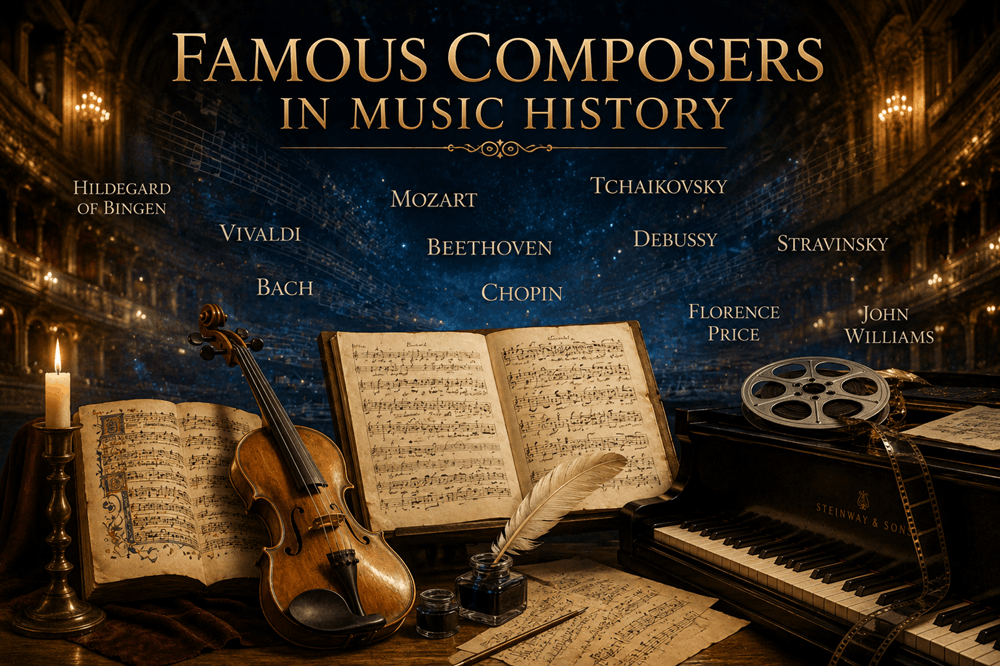
Famous Composers in Music History: 12 Musicians Who Changed How the World Hears Music
The most famous composers in music history did more than write beautiful pieces. They changed what music could express, how instruments could be used and what audiences expected to hear.
Johann Sebastian Bach made complex counterpoint feel natural. Mozart brought extraordinary dramatic life to Classical forms. Beethoven transformed the symphony into a personal statement. Chopin made the piano sound like an intimate human voice, while Stravinsky used rhythm to challenge almost every assumption inherited from the 19th century.
This list is not a definitive ranking. Music history reaches across every culture, and no short article can represent all its traditions. Instead, it focuses on 12 influential figures from Western art music and film scoring whose works remain widely performed, studied and recognized.
1. Hildegard of Bingen: One of the Earliest Named Composers
Hildegard of Bingen lived in the 12th century, long before composers were normally treated as public artistic personalities.
She was a Benedictine abbess, writer, theologian and visionary as well as a musician. A large collection of her sacred songs survives, making her one of the earliest composers whose name, ideas and body of work can still be studied in detail.
Her music is generally built around a single vocal line, but it often rises through unusually wide ranges and dramatic melodic leaps. The result can sound freer and more emotionally expansive than the restrained chant many listeners associate with medieval religious music.
Hildegard also created Ordo Virtutum, a sacred morality drama that combines music, poetry and theatrical characters. It is sometimes described as one of the earliest surviving musical dramas by a known composer.
Her importance extends beyond chronology. Hildegard demonstrated that composition could unite spirituality, natural imagery and a distinct personal imagination centuries before the modern idea of the composer took shape. Her music has experienced a major revival among choral, early-music and experimental performers.
Start with: O vis aeternitatis or Ordo Virtutum.
2. Antonio Vivaldi: The Composer Who Made the Concerto Exciting
Antonio Vivaldi helped establish the solo concerto as one of the most exciting forms of Baroque music.
A gifted violinist, Vivaldi spent much of his career working with the young women of Venice’s Ospedale della Pietà, an institution known for its accomplished orchestra and choir. He wrote concertos that allowed individual performers to emerge from the ensemble, display dazzling technique and then return to the larger musical group.
His most famous work, The Four Seasons, uses instrumental music to depict storms, birds, freezing winds, barking dogs and the heat of summer. Each concerto is connected to a descriptive poem, making the collection an early and enduring example of program music—music that evokes a story, scene or natural experience.
Vivaldi’s fast movements are driven by recurring orchestral ideas that alternate with freer solo passages. This structure influenced composers across Europe, including Bach, who studied and arranged several of Vivaldi’s concertos.
Venice’s Museo della Musica continues to place Vivaldi within the city’s larger history of violinmaking and musical performance. His music remains popular because it combines clear structure with color, speed and theatrical energy.
Start with: The Four Seasons, especially “Spring” and “Winter.”
3. Johann Sebastian Bach: The Master of Musical Structure
Johann Sebastian Bach is often treated as the central figure of Baroque music.
He composed for churches, courts, schools and private performers, producing sacred choral works, organ music, keyboard collections, concertos and pieces for solo violin and cello. During the final 27 years of his life, he worked in Leipzig as cantor of St. Thomas Church and directed music for several of the city’s churches. The Bach Archive Leipzig now serves as a major center for research into his life and works.
Bach’s music is especially famous for counterpoint, the art of combining independent melodic lines. In a fugue, one musical idea may enter in a single voice before appearing in several others, creating a structure in which every line seems independent yet connected.
This complexity rarely feels mechanical. Bach could use strict musical forms to express joy, grief, spiritual longing and physical movement. The St. Matthew Passion turns religious narrative into intense human drama, while the Cello Suites create the impression of several interacting voices from one unaccompanied instrument.
His influence became even greater after his death. Mozart, Beethoven, Chopin, Mendelssohn and many later composers studied his music, while modern musicians continue using his works to learn harmony, keyboard technique and composition.
Start with: the Brandenburg Concertos, Cello Suite No. 1 or The Well-Tempered Clavier.
4. Wolfgang Amadeus Mozart: Clarity With a Human Voice
Wolfgang Amadeus Mozart became famous as a child prodigy, but his lasting importance comes from the maturity and emotional range of his adult music.
He wrote more than 800 works across most of the major genres of his time, including symphonies, piano concertos, chamber music, sacred works and operas. The International Mozarteum Foundation preserves manuscripts, correspondence and other materials connected with Mozart and his family.
Mozart is sometimes described as effortless because his melodies sound balanced and natural. That apparent ease hides extraordinary control. Musical ideas pass between instruments with conversational clarity, and changes in harmony can transform a cheerful passage into something uncertain within seconds.
His operas reveal his particular understanding of character. In The Marriage of Figaro, Don Giovanni and Così fan tutte, different characters can sing simultaneously while expressing conflicting emotions. Mozart allows comedy, jealousy, desire and social tension to exist within the same scene.
His music helped define the Classical style, yet it never feels limited to formal elegance. Beneath the symmetry is an intense awareness of how quickly confidence can become sadness and playfulness can become fear.
Start with: The Marriage of Figaro, Piano Concerto No. 21 or Symphony No. 41, “Jupiter.”
5. Ludwig van Beethoven: The Composer Who Made Music Personal
Ludwig van Beethoven stands between the Classical and Romantic periods.
He inherited forms developed by Haydn and Mozart but expanded them until they could carry a new level of conflict, individuality and emotional scale. His symphonies no longer sounded like elegant entertainment alone. They became public journeys through tension, struggle and transformation.
The opening of Symphony No. 5 turns a short four-note idea into the foundation of an entire movement. Symphony No. 3, the Eroica, greatly enlarged the ambition of the symphonic form. Symphony No. 9 brought voices into the final movement, connecting orchestral music with a vision of shared humanity.
Beethoven continued composing as his hearing deteriorated. His late string quartets became increasingly exploratory, moving through abrupt changes, unusual structures and passages of remarkable intimacy.
The Beethoven-Haus Bonn, established at his birthplace, preserves documents and supports research into his life and music. His continuing influence comes partly from the sense that musical form is under pressure in his works: every theme seems to be struggling to become something larger.
Start with: Symphony No. 5, the Moonlight Sonata or the final movement of Symphony No. 9.
6. Frédéric Chopin: The Poet of the Piano
Frédéric Chopin devoted most of his creative life to the piano.
Rather than attempting to dominate every major musical genre, he explored what one instrument could express. His nocturnes, mazurkas, études, preludes, waltzes and ballades helped transform piano music into a deeply personal art.
Chopin’s melodies often resemble singing. One hand may create a flexible, ornamented line while the other supplies harmony and rhythm beneath it. Although the music can sound spontaneous, its architecture is carefully controlled.
He also drew on Polish dance traditions, especially the mazurka and polonaise. These works connect personal expression with memories of Poland, which he left as a young man and never permanently returned to.
Chopin’s études are especially important because they unite technical training with musical substance. A piece designed to develop rapid arpeggios, repeated notes or difficult stretches becomes a complete emotional statement rather than a dry exercise.
The Fryderyk Chopin Institute preserves manuscripts, correspondence and research devoted to his work. Chopin’s influence can be heard in later classical pianists, film music, jazz harmony and popular ballads.
Start with: Nocturne in E-flat Major, Op. 9 No. 2; Prelude in E Minor, Op. 28 No. 4; or Ballade No. 1.
7. Clara Schumann: A Performer Who Helped Create the Modern Concert Tradition
Clara Schumann was one of the most celebrated pianists of the 19th century.
She began performing publicly as a child and maintained an international career lasting roughly six decades. Her programs helped establish the serious piano recital as audiences know it today, with greater emphasis on major works by composers such as Bach, Beethoven, Robert Schumann and Johannes Brahms.
Clara was also a composer. Her surviving works include songs, piano pieces, chamber music and a piano concerto written during her teenage years. Her music combines lyrical Romantic expression with the technical understanding of a world-class performer.
Her composing career became increasingly restricted by family responsibilities, social expectations and the practical demands of supporting her household. That history helps explain why the traditional musical canon includes fewer works by women: the absence often reflects unequal opportunities rather than an absence of talent.
The Schumann Portal describes Clara as one of the 19th century’s most famous pianists and documents her long European career. Her recent revival has encouraged orchestras and soloists to examine her music independently rather than discussing her only as Robert Schumann’s wife.
Start with: Piano Trio in G Minor or Piano Concerto in A Minor.
8. Pyotr Ilyich Tchaikovsky: Melody, Drama and Emotional Scale
Pyotr Ilyich Tchaikovsky wrote music that communicates emotion with unusual immediacy.
His melodies can sound intimate even when performed by a large orchestra. He understood how to build tension gradually, allowing a theme to return with greater weight after the listener has already formed an emotional connection with it.
Tchaikovsky’s ballets—Swan Lake, The Sleeping Beauty and The Nutcracker—helped establish ballet music as something worth hearing beyond the stage. His scores do not merely accompany dancers. They create characters, atmosphere and dramatic movement.
His symphonies and concertos explore conflict on a larger scale. Symphony No. 6, the Pathétique, moves between tenderness, agitation and an unusually subdued conclusion. The Piano Concerto No. 1 opens with one of classical music’s most recognizable orchestral statements, even though that opening theme does not return later in the piece.
Tchaikovsky Research provides an extensive catalogue of his compositions, letters, diaries and photographs, reflecting the unusually rich documentary record surrounding his life.
Start with: The Nutcracker, Piano Concerto No. 1 or Symphony No. 6.
9. Claude Debussy: The Composer Who Made Sound Feel Like Light
Claude Debussy changed how composers thought about harmony and orchestral color.
Traditional harmony often creates tension that clearly resolves. Debussy frequently allowed chords to exist for their color rather than forcing them toward an expected destination. His music can seem to float, shift or dissolve instead of moving through a conventional dramatic argument.
He drew inspiration from Symbolist poetry, visual art and musical traditions outside the standard European conservatory curriculum. Although Debussy is often labeled an Impressionist, he disliked the term. His music nevertheless shares Impressionist art’s fascination with atmosphere, perception and changing light.
In La mer, the orchestra does not simply imitate waves. It captures the sea’s movement, scale and constantly changing surface. Prélude à l’après-midi d’un faune opens with an uncertain flute line that seems to emerge before the surrounding musical world has fully formed.
The Paris Opera’s Debussy biography traces his development from a modest background to his emergence as one of France’s most distinctive composers. His harmonic language influenced classical music, jazz, film scoring and ambient music.
Start with: Clair de lune, La mer or Prélude à l’après-midi d’un faune.
10. Igor Stravinsky: Rhythm That Shocked the 20th Century
Igor Stravinsky repeatedly changed his musical language during a career lasting approximately six decades.
His early ballets combined Russian folk material, brilliant orchestration and increasingly forceful rhythm. The Rite of Spring became his most famous work because its irregular accents, dense harmonies and ritualistic energy sounded radically different from conventional ballet music.
The piece is often connected with the famously disorderly reaction at its 1913 Paris premiere. Whatever caused the audience’s behavior, the music’s long-term influence is undeniable. Stravinsky demonstrated that rhythm could organize a composition as powerfully as melody or harmony.
He did not remain inside that early style. His later works moved through neoclassicism and serial techniques, demonstrating a continual willingness to rebuild his own musical identity.
The Igor Stravinsky Foundation describes a productive life shaped by several major artistic currents rather than one fixed method. His influence extends into concert music, jazz, film scores, modern dance and experimental rock.
Start with: The Firebird, The Rite of Spring or Pulcinella.
11. Florence Price: An American Voice Rediscovered
Florence Price combined European symphonic traditions with African American spirituals, dance rhythms and musical experiences connected to Black life in the United States.
In 1933, the Chicago Symphony Orchestra performed her Symphony No. 1 in E Minor. It became the first large-scale composition by a Black woman presented by a major American orchestra.
Price wrote symphonies, concertos, chamber music, songs and works for organ and piano. Yet racial and gender discrimination limited the attention her music received during her lifetime. Much of it remained neglected for decades.
A major rediscovery began after manuscripts and other materials were found in an abandoned Illinois house in 2009. Performers, publishers and orchestras have since returned many of her compositions to concert programs.
The Chicago Symphony Orchestra’s Florence Price collection documents both her historical connection with the ensemble and the recent revival of her work. Her return to prominence demonstrates that music history is not fixed: composers can disappear from the standard narrative because institutions failed to preserve or perform them.
Start with: Symphony No. 1, Symphony No. 3 or Adoration.
12. John Williams: The Composer Who Gave Modern Cinema Its Musical Memory
John Williams helped bring large-scale symphonic music into the everyday lives of millions of filmgoers.
His scores for Jaws, Star Wars, Superman, E.T., Indiana Jones, Jurassic Park, Schindler’s List and the Harry Potter series contain themes that can identify a character or fictional world within only a few notes.
Williams frequently uses leitmotifs—recurring musical ideas associated with characters, places or concepts. As a story develops, these themes can change in orchestration, harmony or tempo, allowing the music to reveal how a character or situation has evolved.
His work draws on the symphonic traditions of Wagner, Tchaikovsky, Holst, Korngold and other earlier composers, but he adapted that language to the pacing and emotional demands of modern cinema.
Williams has also composed concertos and other works for the concert hall. He served as music director of the Boston Pops from 1980 to 1993 and remains its conductor laureate. The Boston Symphony Orchestra describes a career spanning more than six decades across film and concert music.
Start with: the main title from Star Wars, the theme from Schindler’s List or the score for Jaws.
What Makes a Composer Historically Important?
Fame alone does not determine musical importance.
Some composers became famous because they introduced a new musical language. Others perfected forms that already existed, expanded the possibilities of an instrument or wrote works that remained meaningful to audiences across different centuries.
Historical reputation also depends on institutions. Publishers, orchestras, schools, recording companies and archives influence which composers remain visible. Bach’s manuscripts were studied and revived. Mozart’s letters and works were carefully preserved. Florence Price’s music, by contrast, had to be recovered after decades of neglect.
The musical canon is therefore both an artistic inheritance and an unfinished historical argument.
Listening across different periods makes its development easier to hear. Hildegard’s unaccompanied sacred melodies lead into the counterpoint of Bach. Mozart’s Classical balance expands into Beethoven’s dramatic symphonies. Chopin and Tchaikovsky deepen Romantic expression, while Debussy and Stravinsky challenge inherited ideas about harmony and rhythm. Price reshapes the symphonic tradition through an American and African American musical language, and Williams carries orchestral storytelling into cinema.
Final Thoughts
The most famous composers in music history are remembered because their work continues to create a recognizable world.
Bach makes separate musical lines sound as though they were designed to meet. Mozart allows elegance and human confusion to exist together. Beethoven turns structure into struggle. Chopin makes the piano breathe, while Debussy makes the orchestra shimmer.
Their music also reminds us that history is never complete.
Some composers remain famous because their works were performed continuously. Others are being rediscovered after prejudice, lost manuscripts or changing tastes pushed them out of view.
The best way to understand these figures is not to memorize names and dates. It is to listen.
A few minutes with a Bach fugue, a Chopin nocturne, a Price symphony or a Williams film theme reveals why composition matters: organized sound can preserve an emotion, personality or imagined world long after the person who created it is gone.