
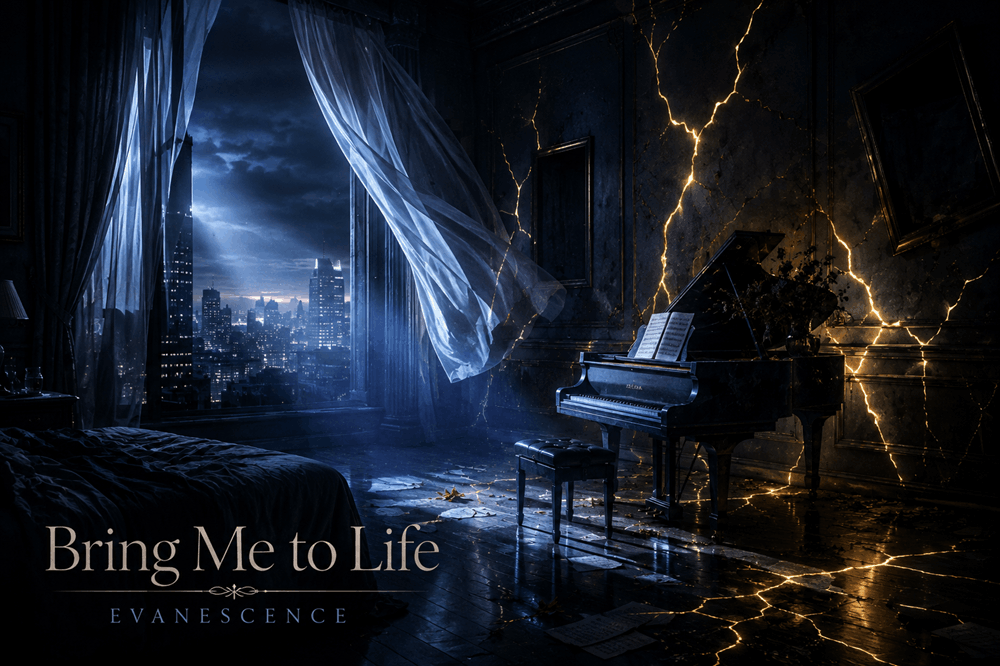
“Bring Me to Life” Lyrics Meaning: Evanescence’s Song Is About Waking Up to a Life You Can No Longer Accept
“Bring Me to Life” by Evanescence is about awakening from emotional numbness and realizing that the life you have been pretending to accept is slowly destroying you.
Amy Lee’s narrator has become disconnected from her own feelings. She can move through daily life and appear normal, but internally she feels empty, frozen and almost absent from herself.
Then another person recognizes the truth she has been hiding.
That moment does not magically rescue her. It makes denial impossible.
This is the song’s central contradiction:
Being truly seen feels like salvation, but it also forces the narrator to confront everything she has been afraid to change.
The title sounds like a request for someone else to save her. At a deeper level, the person who sees her does not create a new life for her. He awakens the part of her that already knows she must save herself.
What is “Bring Me to Life” about?
The song follows a woman who has become emotionally numb inside an unhealthy situation.
She has learned how to conceal what she feels, possibly from the people around her and possibly from herself. Her outward life continues, but her inner life has gone quiet.
The person she addresses sees through that performance.
His recognition begins an emotional awakening. Once she understands how empty she has become, she cannot simply return to pretending that everything is fine.
The song moves through several stages:
- Emotional numbness
- The shock of being understood
- Awareness of what is missing
- Fear that the awakening may disappear
- A desperate desire to escape
- The recognition that she has been living dishonestly
- A demand to feel fully alive again
The narrator begins inside darkness without knowing how completely it surrounds her.
She ends by fighting against it.
Amy Lee confirmed that the song came from a real moment of recognition
Lee has explained that “Bring Me to Life” was partly inspired by an encounter with Josh Hartzler, who later became her husband.
At the time, Lee was in an abusive relationship and believed she was successfully hiding her unhappiness. During a brief conversation at a restaurant, Hartzler looked at her and asked whether she was truly happy.
The question affected her because she felt that he had seen through the image she was presenting.
In a 2022 interview with Dazed, Lee described Hartzler as an unknowing part of her emancipation. She said the song was initially connected to him but more broadly concerned finding the courage to escape something she already knew she had the power to leave.
That background changes the song’s meaning.
It is not simply about a lifeless person being rescued through romantic love.
It is about the frightening moment when someone asks the right question and the truth you have been avoiding becomes visible.
The opening is about being seen too clearly
The narrator is shocked that another person can look at her and recognize what exists beneath the surface.
She has treated her inner self like a closed space. Other people may see her face, behavior and public identity, but they do not reach the numbness underneath.
The person addressed in the song appears to enter that hidden space without permission.
This is both comforting and frightening.
Being understood can create intimacy. It can also remove the protection provided by secrecy.
As long as no one notices her unhappiness, the narrator can continue telling herself that the situation is manageable. Once another person recognizes it, she must consider why the truth was so obvious to him and so difficult for her to admit.
He does not merely see her.
He reveals her to herself.
Emotional numbness is not the same as feeling nothing
The narrator describes herself as empty and frozen, but numbness usually develops because a person has felt too much for too long.
When someone lives under sustained emotional pressure, disconnecting from feelings can become a form of survival.
Pain is harder to endure when it remains fully present every day. Numbness reduces the immediate intensity. It allows the person to continue functioning without constantly confronting fear, humiliation or disappointment.
But numbness also blocks joy, desire and identity.
The narrator has protected herself from pain by becoming distant from the part of herself capable of feeling alive.
This is why awakening is urgent.
She is not merely bored or temporarily sad. She feels that the coping mechanism that once protected her has begun erasing her.
What does “bring me to life” mean?
The phrase does not refer to literal death and resurrection.
It describes the return of emotional awareness.
To be brought to life means:
- Feeling again after a period of numbness
- Recognizing that an unhealthy life is not normal
- Recovering desires that were suppressed
- Speaking honestly after remaining silent
- Remembering the person you were before fear took control
- Believing that another future may be possible
The narrator wants the distance between her outer appearance and inner reality to end.
She has been physically present while emotionally absent. Awakening means becoming one complete person again.
However, the title places the action in someone else’s hands.
She asks to be brought back rather than initially declaring that she will return by herself. That wording reveals how powerless she feels at the beginning of the song.
The emotional journey is therefore not complete independence. It is the first recognition that independence is needed.
The person who awakens her is not necessarily the person who will save her
The song’s language can make the relationship sound like a rescue fantasy.
One person sees the narrator, calls her back and becomes the only source of life in an otherwise dead world.
Read literally, this can seem to place too much responsibility on another person. No romantic partner can permanently create someone else’s identity, emotional health or freedom.
Lee’s explanation offers a more grounded interpretation.
Hartzler did not arrive with a complete solution. He asked a question that interrupted her self-deception.
He became a catalyst rather than a savior.
That distinction matters because awakening is different from rescue.
Someone can recognize your pain, remind you that another life exists and help you see what you have normalized. You must still decide what to do with that knowledge.
The song captures the moment before that decision becomes action.
Why does she fear being left after awakening?
Once the narrator recognizes what she has been missing, she becomes desperate for the person who awakened her not to disappear.
Before this encounter, numbness was familiar. It may have been miserable, but it protected her from knowing exactly how miserable she was.
Now she has experienced recognition, emotional movement and the possibility of freedom.
Returning to the earlier state would feel worse because she could no longer mistake it for normal life.
This explains the urgency in the chorus.
She is not only asking the other person to remain romantically close. She is asking him to help preserve the version of herself that has started waking up.
The danger is that she may begin treating him as the only bridge to that identity.
The healthier truth beneath the song is that he did not create the awakened self.
He revealed that she was still there.
The darkness represents denial as much as sadness
The song repeatedly contrasts life with darkness.
Darkness can represent depression, abuse or emotional isolation. It also represents the inability—or refusal—to see clearly.
The narrator has been kept in darkness partly by the situation surrounding her and partly by the stories she has used to survive it.
She may have told herself:
The relationship is not really that bad.
No one would understand.
Leaving would be worse.
This is simply what love feels like.
I should be able to tolerate it.
Awakening means those explanations no longer work.
The darkness becomes visible as darkness only after she sees the possibility of light.
Realizing what she lacks makes her pain stronger
Before being awakened, the narrator feels empty without fully understanding the emptiness.
Once she recognizes what she has been missing, the absence becomes more painful.
This is a common stage of personal change.
Awareness does not always produce immediate relief. Sometimes it initially makes a situation harder to endure.
A person may recognize that they have been mistreated but remain unable to leave immediately. They may discover what healthy connection feels like while still living inside an unhealthy relationship. They may finally understand that their numbness is not a personality trait but a response to what has happened.
The truth provides direction.
It does not remove every obstacle.
“Bring Me to Life” occupies this uncomfortable middle stage.
The narrator is no longer asleep.
She is not yet safely free.
The duet turns an internal struggle into a dramatic conversation
The best-known recording features Paul McCoy of 12 Stones responding to Lee during the chorus and later joining the song more fully.
His voice gives the track the feeling of two people calling to one another across an emotional divide.
Lee sounds trapped inside herself.
McCoy’s responses sound like an external force trying to reach her—or like the force she wishes could reach her.
The two voices can be interpreted in several ways:
- The narrator and the person who recognizes her
- Her numb public self and awakening inner self
- Despair and resistance
- A victim calling outward and a rescuer answering
- Two sides of the same internal argument
The male vocal was not part of Lee’s preferred original vision.
She has said that Evanescence’s label pressured the band to add a male voice because executives doubted whether a female-fronted rock act could reach a large audience. The compromise brought in McCoy, and Lee wrote the additional vocal section even though she initially resisted the idea.
That history creates another layer of meaning.
A song about finding one’s own voice became famous in a version shaped by industry pressure to add a man’s voice.
The unwanted rap became part of the song’s identity
Lee has spoken openly about not wanting the rap-rock section included.
The label initially pushed for a permanent male member, while the final compromise limited the male vocal to this song. Lee later acknowledged that the addition did not destroy the band as she had feared, although Evanescence’s later work helped clarify that the guest rap did not define their complete sound.
For many listeners, however, the contrast between the voices became inseparable from “Bring Me to Life.”
The quieter opening feels private and internal.
The chorus explodes into competing commands and pleas.
The difference makes the awakening sound physically violent, as though the narrator’s numbness must be broken rather than gently lifted.
The label’s commercial decision did not create the song’s meaning.
It intensified the drama through which listeners experienced it.
The piano represents the hidden self before the guitars arrive
“Bring Me to Life” begins with a delicate piano figure.
The sound is exposed and isolated. It creates the feeling of someone speaking from a private interior space before the full force of the song arrives.
When the guitars and drums enter, that private feeling becomes an emergency.
The arrangement follows the narrator’s awakening:
- The piano suggests the quiet numbness she has been hiding.
- The strings add emotional tension.
- The guitars represent the force of realization.
- The competing voices dramatize the struggle to remain awake.
- The final repetitions turn the private confession into a demand.
Lee has said the band created numerous demos while developing the song, eventually replacing an earlier synth sound with the now-famous piano opening and fighting to use real strings arranged by David Campbell.
The resulting production combines vulnerability with enormous scale.
The narrator feels alone.
Her awakening sounds large enough to shake an entire building.
The music video makes emotional distance physical
The official “Bring Me to Life” video places Lee high inside a dark city building while McCoy performs in another room.
She moves through an isolated dreamlike space, climbs outside and eventually hangs above the street.
The visual turns emotional risk into physical danger.
Lee’s character is no longer safely contained by the building. Once she moves beyond its walls, she becomes exposed to the night and to the possibility of falling.
McCoy reaches toward her but cannot securely pull her inside.
That moment reflects the song’s deepest idea.
Another person may see that you are in danger.
They may call your name and reach toward you.
They cannot always make the final movement for you.
The fall can also be interpreted as the terror of losing the awakening. She has moved outside the room that imprisoned her but has not yet found stable ground.
Freedom begins before safety.
Is “Bring Me to Life” a religious song?
The imagery of awakening, salvation, darkness and spiritual emptiness has led some listeners to interpret the song through Christianity or another form of spiritual rebirth.
That reading is understandable.
The narrator speaks as though her soul has become dormant and needs to be restored. The language can resemble a prayer for divine intervention.
However, Lee’s explanation connects the original inspiration to emotional awakening, an abusive relationship and the courage to break free. She has described the song in personal rather than doctrinal terms.
The song remains open enough to support a spiritual interpretation for individual listeners.
Its central experience is broader than one religious framework:
A person has become disconnected from life and encounters something that makes continued numbness impossible.
How the song fits Fallen
“Bring Me to Life” appears on Evanescence’s debut album, Fallen, released on March 4, 2003.
Evanescence’s official timeline describes the album as combining gothic atmosphere, classical influence and modern rock. The record introduced the band to a global audience and later received an expanded 20th-anniversary edition featuring demos and material from its early creative process. (Evanescence’s official timeline)
The album repeatedly explores emotional isolation, deception, grief and the struggle to recover a self hidden beneath pain.
“Bring Me to Life” is an ideal introduction to that world because it captures the first movement out of numbness.
The narrator has not solved every problem.
She has begun refusing to remain asleep inside them.
Why did the song become so successful?
“Bring Me to Life” combined several sounds that rarely occupied the same mainstream space so dramatically: piano, orchestral strings, heavy guitars, electronic textures, Lee’s classically influenced vocal and McCoy’s rap-rock response.
The result was dark enough to feel distinctive and direct enough to become a large pop chorus.
The song reached No. 1 on the UK Singles Chart, where it remained for four weeks. (Official Charts)
It also won the Grammy for Best Hard Rock Performance, while Evanescence received the Grammy for Best New Artist at the same ceremony. (Recording Academy)
Its success came from more than production.
The emotional request at its center is widely recognizable.
Many people understand the fear that life is continuing while they remain disconnected from it. They understand waiting for a person, event or realization strong enough to break through the numbness.
The song gives that private experience the scale of an action scene.
The Synthesis version reveals the song beneath the rap-rock production
Evanescence later reimagined “Bring Me to Life” for the 2017 album Synthesis.
That version removes the rap section and emphasizes orchestral and electronic textures, bringing the track closer to Lee’s preferred artistic direction. She described the reworking as a chance to align the song more closely with the band’s original vision.
Without the male responses, the song feels less like an external rescue.
It becomes more clearly an internal awakening.
The narrator’s own voice must carry the plea, the realization and the struggle to emerge from darkness.
The two versions therefore emphasize different meanings.
The original sounds like someone calling across a divide.
The orchestral version sounds like someone confronting the divide within herself.
Confirmed background versus interpretation
It is confirmed that Amy Lee connected “Bring Me to Life” to a moment when Josh Hartzler recognized the unhappiness she had been hiding during an abusive relationship.
She has also said that the song became more broadly about finding the courage to break free from something she knew she had the power to escape.
It is confirmed that the label pressured Evanescence to include a male vocal, leading to Paul McCoy’s appearance on the single, and that Lee initially opposed the addition.
The ideas that numbness acts as a survival mechanism, that the male voice can represent part of the narrator’s inner struggle and that the video’s fall symbolizes awakening before safety are interpretations.
The song does not require one fixed symbolic reading.
Its emotional movement is clear even when listeners imagine different sources of darkness.
Final meaning
“Bring Me to Life” is about the moment emotional survival is no longer enough.
The narrator has protected herself by becoming numb. She performs happiness, avoids the truth and continues existing without feeling fully present inside her own life.
Then someone sees through her.
That recognition is not a complete rescue. It is the shock that breaks the illusion.
Once she understands what she has become, she cannot peacefully return to the darkness. She wants to feel, speak and recover the self she buried beneath fear.
At first, she believes another person must bring her back.
The deeper truth is that he has only shown her the door.
She must decide whether she is brave enough to walk through it.
That is why the song remains so powerful.
It does not describe awakening as peaceful.
It describes awakening as an emergency.
The old life has become unbearable.
The new one has not yet begun.
Between them, the narrator finally opens her eyes.