
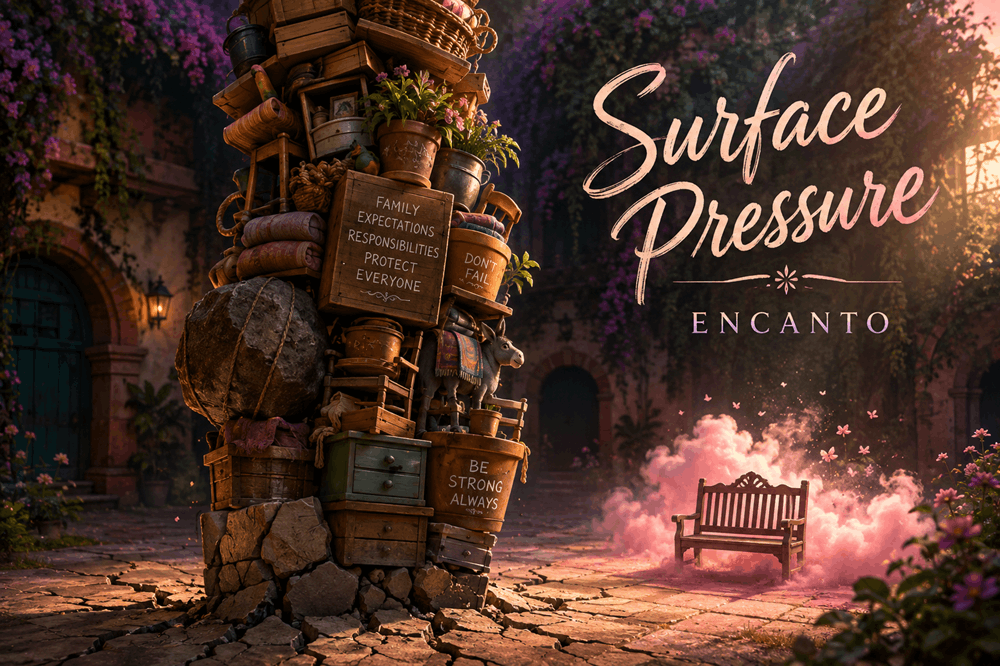
“Surface Pressure” Lyrics Meaning: Luisa Is Strong Because She Is Not Allowed to Be Weak
“Surface Pressure” from Disney’s Encanto is about the hidden anxiety of being the person everyone relies on.
Luisa Madrigal possesses superhuman strength, so her family and community naturally give her the heaviest work. She carries buildings, animals and impossible physical burdens without complaint. Beneath that confident image, however, she is terrified that one mistake will make everyone see her as useless.
That is the song’s central contradiction:
Luisa’s strength gives her value, but being valued only for her strength makes her feel trapped.
She does not merely worry that she may fail at a task. She worries that failure will reveal she has no identity beyond service.
“Surface Pressure” begins like a celebration of power. It gradually becomes a confession from someone who has been dependable for so long that no one has stopped to ask what dependability is costing her.
What is “Surface Pressure” about?
The song occurs after Mirabel notices that Luisa’s magical strength appears to be weakening.
Luisa initially insists that she is calm, capable and almost impossible to hurt. That confidence quickly collapses when Mirabel gives her a rare opportunity to speak honestly.
Luisa admits that she feels responsible for protecting the entire Madrigal family. She believes she must absorb every problem before it reaches anyone else. If another person struggles, she should carry more. If the family is threatened, she should be the wall standing between them and danger.
Her fear is not only physical exhaustion. It is the possibility that she may stop being useful.
The song reveals several connected pressures:
- The expectation that she must always be dependable
- The belief that rest is selfish
- Fear that one failure will disappoint everyone
- Anxiety that her strength could suddenly disappear
- A need to protect younger family members
- Uncertainty about who she would be without her gift
In Disney’s official description of Encanto, each Madrigal child receives a magical gift intended to help the family and community. Luisa’s gift is strength, but the song shows how quickly a gift can become an obligation when everyone assumes it will always be available.
Luisa’s confidence is a performance
At the beginning, Luisa describes herself as completely steady.
She presents strength as something natural and effortless. She can move enormous objects, solve practical problems and remain composed while everyone around her depends on her.
But she is not simply explaining what she can do.
She is repeating the identity she believes she must maintain.
People who are consistently treated as “the strong one” often learn to perform confidence before anyone asks whether they actually feel it. The performance protects others from worry and protects the strong person from appearing unreliable.
Luisa has become so accustomed to this role that vulnerability feels dangerous.
If she admits she is overwhelmed, her family may lose confidence in her. If she says no, someone else may struggle. If she rests, the next problem may arrive without anyone prepared to carry it.
Her confidence is therefore partly real. She is brave and extraordinarily capable.
It is also armor.
The title describes pressure that cannot yet be seen
“Surface Pressure” refers to stress hidden beneath a stable exterior.
On the surface, Luisa appears almost indestructible. She smiles, works and continues accepting new responsibilities. Underneath, anxiety is accumulating faster than she can release it.
The pressure metaphor matters because pressure can remain invisible until something cracks.
A structure may look secure while internal force is weakening it. By the time visible damage appears, the strain has often existed for a long time.
That is what happens to Luisa.
Her temporary loss of strength is not the beginning of the problem. It is the first outward sign of a problem that has been building quietly.
Mirabel notices the symptom.
The song reveals the emotional cause.
The constant dripping represents small demands that never end
Luisa does not describe one enormous responsibility destroying her.
Instead, she imagines pressure arriving drop by drop.
Each individual request may appear manageable:
Move this object.
Carry these animals.
Repair this problem.
Help one more person.
Because every task looks small compared with Luisa’s strength, no one sees a reason not to ask. The burden becomes dangerous through accumulation.
This is why the dripping image is more accurate than a single explosion.
Burnout often grows through repeated minor demands rather than one dramatic event. Every request takes a little energy. Every interruption removes a little rest. Every assumption that the dependable person will handle it makes refusing the next task more difficult.
Luisa fears the final drop because she does not know which ordinary request will become the one she can no longer carry.
The community sees isolated favors.
She feels the combined weight of all of them.
Her strength has become her entire identity
Luisa’s deepest fear is not that she will become physically weaker.
It is that weakness will make her worthless.
This reveals how completely her self-esteem has become tied to usefulness. She does not say that losing her gift would be inconvenient. She imagines it destroying the reason other people value her.
The Madrigal family’s gifts are publicly visible. Each family member is known partly through what their magic allows them to provide. Luisa’s physical power makes that connection especially direct: people need something heavy moved, so they call Luisa.
Over time, she begins to confuse being needed with being loved.
Those experiences can feel similar, but they are not identical.
Being needed means other people value what you do.
Being loved means they continue valuing you when you cannot do it.
Luisa does not yet trust that the second kind of value exists.
The Hercules reference questions the idea of effortless heroes
Luisa compares herself with legendary heroes who are always expected to accept another impossible challenge.
Myths often celebrate strength without spending much time on exhaustion. Heroes defeat monsters, complete labors and continue toward the next adventure. Their fear and reluctance rarely become the most remembered parts of the story.
Luisa wonders whether those heroes ever wanted to refuse.
That question changes how strength is understood.
A hero may be capable of completing a task and still resent being asked. Courage does not eliminate tiredness. Talent does not create unlimited capacity.
Luisa has been treated like a mythological figure inside her own household. Everyone sees the result of her strength but not the mental effort required to keep proving it.
She is not asking to become helpless.
She is asking whether powerful people are allowed to have limits.
Why the camel image fits Luisa perfectly
One of the song’s recurring ideas is that a heavily loaded animal can continue walking until one additional burden finally causes collapse.
Luisa occupies both sides of this image.
She is the person carrying everything.
She is also the person watching for the final addition that may break her.
The metaphor exposes the unfairness of judging someone only by their last reaction. When an overwhelmed person finally cries, refuses or loses control, others may focus on the small event immediately preceding the breakdown.
They ask why such a minor problem caused such a large response.
The answer is that the final problem was never the entire weight.
Luisa has been carrying years of expectations, unspoken fear and responsibility for other people’s safety. The latest demand merely arrives when no capacity remains.
The song asks listeners to notice the full load rather than blaming the final straw.
Luisa bends because she believes breaking is forbidden
Luisa takes pride in her ability to adjust under pressure.
She can bend, compensate and absorb more without openly collapsing. That flexibility looks impressive, but it may be preventing anyone from recognizing that the situation needs to change.
Every time she successfully carries too much, people learn that giving her too much is acceptable.
Her resilience unintentionally trains others to keep relying on it.
This is one of the song’s most painful insights: surviving pressure can create additional pressure.
People see that Luisa managed yesterday, so they assume she can manage tomorrow. They do not see the recovery she never received or the fear she hid afterward.
Her ability to cope becomes evidence that she does not need help.
The bridge reveals the life Luisa secretly wants
For a brief section, the song’s heavy rhythm softens.
Luisa imagines what life might feel like without constant responsibility. She floats through a pink, open environment where she can rest, experience joy and consider desires that are not connected to serving someone else.
The fantasy is striking because it is so gentle.
Luisa does not dream of ruling the family, receiving public praise or becoming even more powerful. She dreams of relief.
She wants space to breathe.
That small desire shows how limited her life has become. Rest feels so unfamiliar that her imagination transforms it into an impossible paradise.
The fantasy also reveals that Luisa has a softer identity beneath the role others assigned her. Strength is one part of her personality, but it is not the complete person.
She wants beauty, ease and freedom from calculation.
For a few moments, the song allows her to imagine receiving care instead of providing it.
Then the pressure returns.
Why the fantasy cannot last
Luisa’s imagined freedom is interrupted before she can fully explore it.
The heavy beat returns, and she is pulled back toward responsibility.
This resembles the mental experience of someone who briefly considers setting a boundary and immediately begins worrying about the consequences.
What happens if she rests?
Who completes the work?
Will her family be disappointed?
Will someone get hurt?
Will people decide she has become selfish?
Luisa cannot enjoy the fantasy because guilt follows her into it.
The pressure is no longer only external. She has internalized it.
Even if no one directly orders her to continue, she has learned to police herself.
The tower of expectations now stands inside her mind.
Luisa is protecting Mirabel as much as the family
“Surface Pressure” is not only a confession of exhaustion.
It is also an older sister’s attempt to keep a younger sibling safe.
Luisa understands that something is wrong with the family’s magic. She is frightened, but she still tries to position herself between Mirabel and the danger.
Her instinct is to carry the fear alone.
This helps explain why she has not spoken honestly before. Silence is part of how she protects people. If Luisa appears confident, everyone else can continue believing the family is secure.
But this protection has a cost.
By hiding the truth, she prevents her family from understanding how unstable the situation has become. Mirabel’s willingness to notice and listen is what finally allows the hidden problem to become visible.
Luisa does not need someone stronger than her.
She needs someone who sees her before asking her to lift anything.
The song reflects the burden placed on older siblings
Lin-Manuel Miranda has explained that the song was inspired partly by his older sister, who carried responsibilities he did not fully recognize when they were younger. He later described it as a love letter and apology to older siblings who absorb family pressure before younger children understand it.
That background explains why Luisa’s fear feels broader than her magical situation.
Older children are often expected to mature earlier, set an example and protect younger siblings. In families affected by stress, migration, financial difficulty or trauma, the oldest or most dependable child may become an unofficial additional caregiver.
They learn to solve problems quietly because adding their own needs may appear to create more work for everyone else.
Luisa’s superhuman strength makes that family pattern visible.
She literally carries buildings and animals, but the emotional burden is recognizable even without magic.
Abuela’s expectations are shaped by trauma
Luisa’s pressure does not come from a family that simply enjoys using her.
The Madrigals’ expectations developed after a history of violence, displacement and loss.
Abuela Alma survived the death of her husband and was given a miracle that protected her children and created a safe community. Because the miracle emerged from catastrophe, she becomes terrified of losing it.
That fear shapes how she treats the family’s gifts.
Each magical ability must prove that the miracle remains strong and useful. Service becomes a way of protecting the family from returning to the insecurity of the past.
Luisa inherits that fear without fully knowing its origin.
She believes she must prevent the family from breaking because Abuela has built the family around the belief that breaking cannot be allowed.
This does not make the pressure harmless.
It shows how trauma can move from one generation to another through expectations rather than direct explanation.
Jessica Darrow’s voice makes strength sound heavy
“Surface Pressure” was written by Lin-Manuel Miranda and performed by Jessica Darrow as Luisa. The soundtrack credits Miranda as songwriter and producer, with Mike Elizondo and Germaine Franco among the musicians and arrangers involved in the recording. (Apple Music’s official credits)
Darrow’s low, powerful voice is essential to the song.
Luisa does not sound fragile. Even while describing fear, she retains the physical authority associated with her character.
That prevents vulnerability from being mistaken for weakness.
Her voice communicates that a strong person can experience anxiety without becoming less strong. In fact, admitting the pressure requires a different kind of courage from lifting another impossible object.
The performance also grows increasingly breathless and urgent, making the lyrics feel as though they have been held inside for too long.
Once Mirabel asks the correct question, Luisa cannot stop the confession from coming out.
The rhythm recreates the burden she describes
The song’s reggaeton-influenced pulse is heavy, steady and difficult to escape.
It resembles the repeated impact of responsibility: another task, another expectation, another day of carrying more than anyone notices.
The beat gives Luisa’s strength a physical presence. It sounds large enough to support the exaggerated visual sequences in which she handles donkeys, rocks and enormous architectural structures.
During the softer bridge, that weight briefly disappears.
When the rhythm returns, the listener feels the pressure re-enter rather than merely hearing Luisa describe it.
The arrangement therefore creates the emotional pattern of burnout:
Endure.
Imagine relief.
Feel guilty.
Return to work.
What the visual sequence adds
In the official “Surface Pressure” sequence, Luisa’s imagination moves through donkeys, falling rocks, mythological battles, circus imagery and enormous structures.
The rapid changes show how many kinds of responsibility she is trying to process at once.
Some images are comic, but the humor makes the anxiety more accessible rather than removing it. Luisa’s fear becomes visible through exaggerated physical metaphors that children can understand while adults recognize the emotional experience beneath them.
The pink-cloud bridge is especially important.
The visual world becomes soft precisely when Luisa imagines a life in which she does not have to earn her place through strength.
The sequence then pulls her back into falling, carrying and preventing disaster.
Her imagination can create rest.
Her sense of duty does not allow her to remain there.
Why the song connected so strongly with listeners
“Surface Pressure” became one of Encanto’s largest hits, reaching No. 3 on the UK Official Singles Chart. It was performed by a character rather than released as a conventional pop single, yet audiences treated it as a personal anthem. (Official Charts)
The song resonated because Luisa’s problem is not limited to older sisters or physically strong people.
Many listeners know what it feels like to become the dependable person in a family, workplace or friendship group.
They are praised for coping, so they keep coping.
They are calm during emergencies, so people bring them more emergencies.
They provide support so consistently that others forget support must also reach them.
The Recording Academy later included the song in a collection addressing mental health, describing Luisa’s confidence as a form of bluster hiding insecurity.
Its popularity suggests how many people recognized themselves beneath her strength.
Confirmed background versus interpretation
It is confirmed that “Surface Pressure” appears in Disney’s 2021 film Encanto, was written by Lin-Manuel Miranda and is performed by Jessica Darrow as Luisa Madrigal. The song appears on the official soundtrack and was released in November 2021.
Miranda has also connected the song to the responsibilities carried by his older sister and other older siblings.
The ideas that Luisa confuses being needed with being loved, that her resilience teaches others to overload her and that guilt prevents her from remaining inside her fantasy of rest are interpretations based on the song and film.
The lyrics do not present Luisa as consciously explaining those psychological patterns.
They show her experiencing them.
Final meaning
“Surface Pressure” is about the hidden cost of becoming everyone’s strongest person.
Luisa can lift nearly anything, but her greatest burden is the belief that she must never put anything down.
Her family and community see capability. She feels obligation. Every successful task strengthens the expectation that she will accept the next one without hesitation.
The pressure becomes part of her identity.
If she is strong, she is useful.
If she is useful, she belongs.
If she stops being useful, she fears that love may disappear with her gift.
Mirabel begins to change that pattern simply by noticing.
She does not approach Luisa with another object to carry. She asks what is wrong and remains present long enough to hear the answer.
That is what Luisa has been missing.
Not greater strength.
Permission to be more than the strong one.