
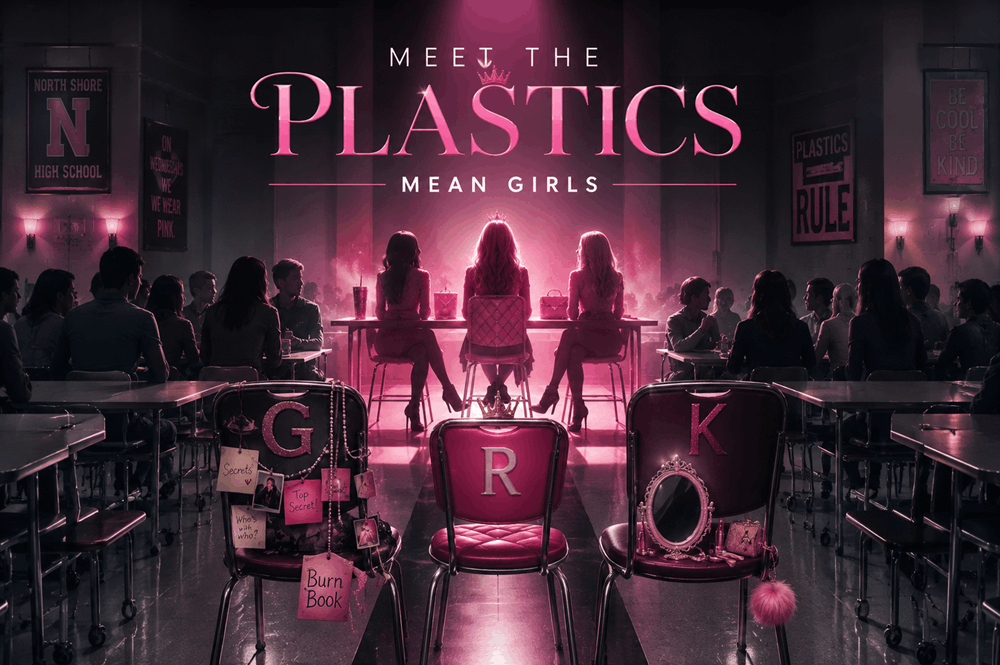
“Meet the Plastics” Lyrics Meaning: How Regina, Gretchen and Karen Reveal the Rules of Popularity
“Meet the Plastics” from Mean Girls introduces Regina George, Gretchen Wieners and Karen Smith as more than three popular girls. Together, they form a complete social system built on power, insecurity and appearance.
Each Plastic receives a different musical introduction:
- Regina presents herself as someone who deserves obedience.
- Gretchen explains her value through access to secrets and social connections.
- Karen treats beauty as the only identity she needs.
The song initially makes their lives look glamorous. They receive attention, control the lunchroom and decide who is socially valuable. Yet each verse also reveals a weakness beneath that power.
That is the song’s central idea:
The Plastics appear united because everyone fears Regina, but each member occupies a different and unequal position inside the group.
Regina controls the hierarchy. Gretchen works desperately to remain useful to it. Karen survives by never seriously challenging it.
Before Cady officially joins them, “Meet the Plastics” shows exactly what she will have to become—and what she may lose.
What is “Meet the Plastics” about?
The song occurs after Cady Heron arrives at North Shore High School and begins learning its complicated social structure.
Janis and Damian identify the Plastics as the school’s most powerful clique. Their name describes something attractive, artificial and difficult to break. They look polished from a distance, but their relationships are shaped by manipulation and fear.
Cady watches as Regina, Gretchen and Karen enter the cafeteria and introduce themselves.
The song performs two jobs at once.
On the surface, it gives the audience basic information about the three girls. More importantly, it explains how their power works.
Regina controls attention.
Gretchen collects information.
Karen supplies beauty and comic charm.
They do not hold equal authority. Their differences are what allow the clique to function.
The Plastics resemble a small corporation in which each member has a role, but only one person makes the final decisions.
Why are they called the Plastics?
Plastic can appear smooth, colorful and valuable while still being artificial.
That makes it an effective name for a group whose identity depends heavily on presentation.
The Plastics carefully manage:
- Their clothes
- Their bodies
- Their social associations
- Their reputations
- The information they reveal
- The people permitted to sit with them
Their appearance suggests perfection, but that perfection must be constantly maintained.
Plastic is also moldable. It can be shaped into whatever form is required.
That describes the pressure inside the group. Gretchen and Karen adjust themselves around Regina’s expectations. Later, Cady also changes her clothes, behavior and priorities to fit the Plastic image.
The name therefore does not mean that every emotion they experience is fake.
Their fear, jealousy and loneliness are real.
What is artificial is the polished identity designed to hide those feelings.
Regina’s entrance establishes her as the center of power
Regina introduces herself as though her importance requires no explanation.
She does not ask Cady to like her. She assumes that everyone already knows her status and should respond with some mixture of admiration, fascination and fear.
This confidence separates Regina from the other Plastics.
Gretchen and Karen explain what they can offer. Regina behaves as though her existence is the offer.
Her verse turns popularity into authority. Students are expected to watch her, discuss her and measure themselves against her. Even negative attention strengthens her position because it confirms that she remains the center of the school’s social world.
Music Theatre International describes Regina as the Plastics’ “Queen Bee,” someone whose approval can make another person feel uniquely important and whose withdrawal of that approval can be emotionally devastating. (MTI’s official character guide)
“Meet the Plastics” demonstrates that power immediately.
Regina’s attention is presented as a scarce resource.
Everyone wants it.
She decides who receives it.
Regina does not need to insult everyone personally
Regina’s greatest strength is that her reputation works even when she is silent.
Janis and Damian warn Cady before Regina directly interacts with her. Other students already understand what Regina can do, so fear prepares the room for her arrival.
This is how social power becomes efficient.
A person who must constantly prove authority does not fully possess it. Regina’s classmates enforce her status for her by repeating stories, watching her movements and adjusting their behavior before she issues a command.
Her appearance produces an immediate reaction because the school has already agreed that she matters.
The song’s music reinforces that effect. Regina receives the most commanding and controlled section, while the other characters seem to orbit around her.
She does not enter the cafeteria like another student.
She enters like an event.
Why does Regina invite Cady into the group?
Regina notices Cady because Cady is new, attractive and socially unclaimed.
Inviting her to sit with the Plastics appears generous, but it also allows Regina to control a potential competitor before Cady can form an independent identity.
Regina can define the rules, decide how Cady should dress and establish that membership is a privilege granted by her.
The invitation consequently contains both approval and ownership.
Cady feels chosen.
Regina remains the person doing the choosing.
The official synopsis for the stage musical places the number at precisely this turning point: Janis and Damian introduce the Plastics, Regina notices Cady and invites her to sit with them for the week. (Music Theatre International’s synopsis)
That invitation begins the main conflict of Mean Girls.
Cady enters intending to observe the Plastics.
She eventually begins to depend on the same status Regina offers.
Gretchen’s verse reveals that information is currency
Gretchen does not possess Regina’s effortless authority.
Her position depends on being useful.
She presents herself as someone who knows everyone’s secrets and understands how information moves through the school. She can connect people, expose them or protect them depending on what helps her maintain social value.
The official character description calls Gretchen a “banker”: she forms relationships partly to collect secrets that can later be traded. It also describes her as desperate to please Regina and preserve her position inside the group.
That combination explains Gretchen’s behavior.
She collects private information because private information gives her temporary security.
If Regina needs her, Regina may keep her close.
Gossip is therefore not merely entertainment for Gretchen. It is a survival strategy.
She may not control the hierarchy, but she can make herself difficult to remove from it.
Gretchen’s confidence is already collapsing
Gretchen tries to sound powerful, but her verse exposes insecurity.
She defines herself through people she knows, secrets she holds and the influence of her wealthy family. None of these qualities tells the audience who she is independently.
Her identity depends on social relationships that could change at any moment.
This makes her position fragile.
Regina’s power appears internal: she believes she deserves attention.
Gretchen’s power is borrowed. It lasts only while other people continue valuing the information and access she provides.
That is why she watches Regina so carefully.
A small change in Regina’s mood could mean that Gretchen is no longer trusted, needed or protected.
Her loyalty is consequently mixed with fear.
She wants Regina’s friendship.
She also needs Regina’s approval to preserve the identity she has built around being a Plastic.
Gretchen demonstrates how exclusion reproduces itself
Gretchen understands what it feels like to fear rejection.
Instead of becoming kinder to other students, she helps enforce the same hierarchy that makes her anxious.
This is one of the darker truths inside “Meet the Plastics.”
People do not always respond to exclusion by opposing it. Sometimes they seek safety by moving closer to power and helping exclude someone else.
Gretchen judges classmates, protects Regina’s position and participates in gossip because doing so proves that she still belongs on the inside.
Her cruelty is connected to insecurity rather than confidence.
That does not excuse the harm she causes.
It explains why the group’s system continues.
Regina cannot maintain the hierarchy alone. She needs people such as Gretchen to repeat its values, circulate its judgments and make membership appear desirable.
Karen’s verse makes beauty sound like both power and limitation
Karen introduces herself primarily through physical attractiveness.
Unlike Gretchen, she does not need to demonstrate social intelligence or access to secrets. Beauty provides her place in the group.
Karen’s confidence seems simpler because she does not appear to analyze the hierarchy as intensely as Gretchen does.
She knows that people find her attractive.
For the moment, that appears to be enough.
But the verse also reveals how narrowly the school sees her.
Karen is not valued for ambition, intelligence or emotional depth. Her role is to be beautiful, relaxed and entertaining.
MTI’s character guide describes Karen as fundamentally kind and generous while noting that her intellect and personality were never given an opportunity to develop.
That description adds sadness to the comedy.
Karen may seem comfortable because no one expects her to become more than the image she already provides.
Karen’s apparent freedom comes from not competing with Regina
Gretchen is visibly anxious because she wants recognition and influence.
Karen appears less threatened because she does not openly challenge Regina’s leadership.
She receives attention for beauty without attempting to become the group’s strategist or ruler. Regina can therefore keep her nearby without viewing her as an immediate threat.
This creates a strange form of protection.
Karen’s limited role reduces her authority, but it may also spare her some of the constant struggle Gretchen experiences.
She survives through harmlessness.
The group treats her lack of complexity as amusing, which allows her to say foolish or surprisingly honest things without destabilizing the hierarchy.
Yet that safety has a cost.
Karen is liked partly because no one takes her seriously.
The three verses form a complete hierarchy
The structure of “Meet the Plastics” is more revealing than a single group introduction would have been.
Each girl’s section communicates a different relationship to power:
Regina commands it.
She expects other people to recognize her importance without negotiation.
Gretchen manages it.
She gathers secrets, connections and favors to remain close to the person in control.
Karen decorates it.
Her beauty helps make the group desirable, but she has relatively little authority over how it operates.
Together, they create the illusion of a perfectly united clique.
In reality, Regina stands at the top while the others depend on her.
The song allows Cady and the audience to admire the surface before revealing the instability underneath it.
Why do Janis and Damian introduce them like dangerous animals?
Before the Plastics describe themselves, Janis and Damian warn Cady about them.
Their language makes the cafeteria resemble a habitat with predators, prey and clearly marked territories.
This matches Cady’s background. She grew up around wildlife and initially understands American high school through animal behavior.
The Plastics’ table is treated like dangerous ground. Looking too long, approaching incorrectly or breaking an unwritten rule could attract punishment.
This framing makes teenage popularity appear less trivial.
For the students inside North Shore, social standing controls who feels safe, visible or humiliated. The consequences may not be physically fatal, but they feel emotionally serious.
Janis and Damian also shape Cady’s first impression before she meets the girls directly.
They are not neutral narrators. Janis has a painful history with Regina and already sees the Plastics as enemies.
Her warning is accurate in many ways, but it also begins the process of turning Cady into a participant in someone else’s conflict.
“Shiny, fake and hard” is more than an insult
The Plastics’ name is explained through three qualities.
They are shiny because their appearance attracts attention.
They are fake because their polished friendship hides competition, fear and manipulation.
They are hard because entering or challenging the group can be emotionally painful.
These qualities also describe the defensive identities the girls have built.
The harder their image becomes, the less safely they can admit insecurity. Regina cannot reveal uncertainty without risking authority. Gretchen cannot confess how afraid she is of being replaced. Karen receives little encouragement to show depth.
Their artificiality protects them while also trapping them.
The group survives by ensuring that no one becomes too honest.
Why does the song make them so entertaining?
“Meet the Plastics” does not introduce the girls through a dark warning song alone.
Their sections are funny, stylish and memorable.
This is essential because Cady must feel genuinely attracted to their world. If the Plastics appeared miserable from the beginning, her transformation would be difficult to understand.
Their appeal is real.
They have confidence, social influence, beautiful clothes and the ability to make ordinary school life feel theatrical. Joining them appears to offer Cady a ready-made identity in a place where she knows almost no one.
The audience is placed in a similar position.
We recognize their cruelty, but their entrances are among the show’s most enjoyable moments.
The musical therefore allows us to experience how power seduces before showing what it costs.
How the music distinguishes the three Plastics
Mean Girls features music by Jeff Richmond, lyrics by Nell Benjamin and a book by Tina Fey. The Broadway production opened in 2018 and received 12 Tony Award nominations. (the official MTI show page)
“Meet the Plastics” uses contrasting musical personalities to define the group quickly.
Regina’s material feels commanding and spacious. She controls the pace, allowing attention to settle on her.
Gretchen’s section moves more nervously. The density of her information reflects a mind constantly monitoring relationships.
Karen’s section is lighter and more openly comic. Her melody does not carry the same threat because her role inside the group is less strategic.
The original Broadway cast recording features Taylor Louderman as Regina, Ashley Park as Gretchen and Kate Rockwell as Karen. It places “Meet the Plastics” as the fourth track, immediately after “Where Do You Belong?”—a useful sequence because the show first explains North Shore’s social categories and then introduces the people standing at the top.
Why the 2024 movie version is much shorter
The 2024 film adaptation condenses “Meet the Plastics” into a brief Regina-centered number performed by Reneé Rapp.
The official Paramount soundtrack page lists the film version at 1 minute and 29 seconds and credits Jeff Richmond and Nell Benjamin as its writers.
This change gives Regina an even more dominant entrance.
Instead of allowing Gretchen and Karen to explain themselves fully, the film initially presents the Plastics through the force of Regina’s presence. She becomes the immediate center of the group, while the other girls receive more characterization in later songs and scenes.
The revised version suits Rapp’s darker, pop-oriented portrayal of Regina.
However, it changes the original song’s purpose.
The Broadway version introduces a hierarchy containing three distinct survival strategies.
The film version concentrates on the person at the top.
Both approaches establish Regina’s power, but the stage song reveals more quickly that Gretchen and Karen are not simply interchangeable followers.
The song foreshadows the group’s collapse
Every weakness that later damages the Plastics is already visible in their introduction.
Regina’s certainty makes her unable to tolerate losing control.
Gretchen’s dependence on approval makes her increasingly unstable when Regina withholds affection.
Karen’s limited investment in the hierarchy makes her less loyal once the group begins falling apart.
Cady initially sees a perfect clique.
The audience hears three people whose relationships are already vulnerable.
The Plastics do not collapse because Cady creates weakness from nothing. She enters a system built on fear and competition, then redirects those existing pressures.
Their unity was always conditional.
It lasted only while Regina remained powerful enough to keep everyone in position.
Confirmed background versus interpretation
It is confirmed that “Meet the Plastics” was written for the Mean Girls stage musical by composer Jeff Richmond and lyricist Nell Benjamin. The Broadway recording gives separate sections to Regina, Gretchen and Karen, while the 2024 movie soundtrack features a shortened version performed by Reneé Rapp.
The ideas that Regina represents command, Gretchen represents information and Karen represents decorative social value are interpretations based on the song’s structure and the characters’ behavior.
The musical does not present those roles as a formal theory.
It demonstrates them by allowing each girl to explain why she belongs at the most powerful table in school.
Final meaning
“Meet the Plastics” is about how popularity looks from the outside and how it functions underneath.
To Cady, Regina, Gretchen and Karen initially appear glamorous, confident and united. They possess everything she lacks at North Shore: visibility, belonging and a clear social identity.
Their individual verses reveal a different reality.
Regina rules because people fear losing her attention.
Gretchen survives by collecting secrets and making herself useful.
Karen is protected by beauty and by her willingness to remain outside the struggle for leadership.
The group looks powerful because its internal inequality is hidden beneath coordinated clothes and shared status.
That is why the song is both an introduction and a warning.
Cady is not merely being invited to join three new friends.
She is being offered a place inside a hierarchy.
To become a Plastic, she must learn its rules.
To remain one, she may have to become less like herself.