“Fireflies” Lyrics Meaning: Owl City’s Dreamy Song Is Really About Insomnia
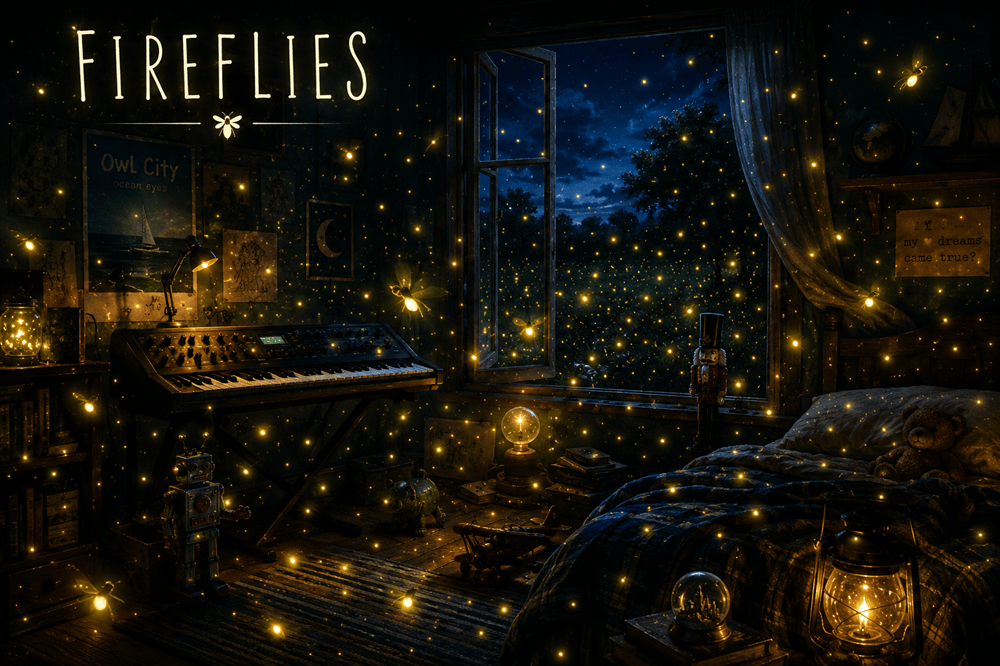
“Fireflies” by Owl City is about lying awake at night while imagination transforms an ordinary bedroom into a magical world.
Adam Young does not describe insomnia only as frustration. In the song, sleeplessness opens a temporary space between reality and dreaming. Fireflies fill the room, household objects seem alive, and impossible scenes feel believable for a few minutes.
The narrator enjoys this escape, but he also knows it cannot last. Morning will arrive, the lights will disappear and he will return to a world that feels less vivid.
That gives “Fireflies” its emotional center:
The narrator wants to sleep, yet he is afraid that sleep will end the imaginative world his restless mind has created.
The song sounds cheerful because its fantasy is beautiful. Beneath that brightness is a quieter sadness—the feeling that wonder becomes harder to hold onto as we wake up, grow older and return to everyday life.
What is “Fireflies” about?
“Fireflies” follows a sleepless narrator whose bedroom becomes filled with millions of glowing insects.
The fireflies dance, surround him and create an entire nighttime performance. The experience is impossible on a literal level, but the narrator does not attempt to explain it logically. He accepts the scene in the same way someone accepts strange events inside a dream.
As the song continues, the narrator reveals that he has difficulty falling asleep. His mind remains active even when his body is tired. Instead of experiencing a clear boundary between waking and dreaming, he enters a state where the two overlap.
The fireflies can therefore be understood as several things at once:
- Memories of real summer nights
- Thoughts moving through an overactive mind
- The visual language of a half-dream
- Childhood wonder returning during adulthood
- Small flashes of creativity appearing in darkness
The song does not tell a conventional story with a beginning, conflict and resolution. It recreates a mental state.
Listeners enter the narrator’s room, experience his imagination and then watch the vision fade.
Adam Young really did write the song about insomnia
The connection to sleeplessness is not merely a fan interpretation.
In a detailed Songwriting Magazine interview, Young explained that he began creating “Fireflies” late at night in the basement of his parents’ home in Owatonna, Minnesota. He was experimenting with a MicroKorg synthesizer at around two or three in the morning when he discovered the bright, delayed “ping” that became the song’s recognizable opening sound.
Young built the instrumental gradually, beginning with the synth loop before adding drums, bass and atmospheric layers. He developed the vocal melody first and later filled it with stream-of-consciousness lyrics inspired by his inability to turn off his mind.
He also drew on the large numbers of fireflies he had seen during Minnesota summers. Another account of the song’s creation connects its imagery to a camping trip in northern Minnesota, where fireflies and a meteor shower blended together in his imagination.
“Fireflies” is therefore not a coded story about a secret event. Its surreal images grew from a recognizable experience: a young musician awake in a dark basement, unable to sleep and allowing his thoughts to wander.
The fantasy is unusual.
The sleeplessness behind it is very real.
Why does he imagine millions of fireflies?
Young deliberately uses an impossible number.
A few fireflies would create a pleasant summer scene. Millions of them would transform the entire world. Their light would be so overwhelming that ordinary surroundings could no longer remain ordinary.
That exaggeration captures the way imagination works during sleepless nights.
When external activity stops, small thoughts can feel enormous. A memory becomes a complete scene. A faint light becomes an entire universe. An idea that might seem ridiculous during the day can feel emotionally convincing at three in the morning.
The fireflies also resemble thoughts because they are bright, numerous and difficult to control.
They appear suddenly, move unpredictably and vanish before they can be held. The narrator can observe them, but he cannot direct every movement.
This makes them an especially appropriate image for an overactive mind.
The song does not portray imagination as a calm, organized process. It arrives as a swarm.
The fireflies turn loneliness into companionship
Insomnia can be deeply isolating.
The rest of the household is usually asleep, the outside world is quiet and there is no one available to share the strange thoughts that arrive during the night.
The fireflies solve that problem temporarily.
They do not merely light the room. The narrator imagines them interacting with him, teaching him movements and offering physical affection. The fantasy gives him the sensation of being surrounded, noticed and understood.
This helps explain why he does not want the experience to end.
The fireflies are not frightening intruders. They are visitors who enter at the exact moment when he would otherwise be alone.
Their companionship is impossible, but the comfort it represents is genuine.
Young later responded humorously when listeners questioned the physical logic of thousands of insects embracing one person. His elaborate answer treated the absurd image as though it were a scientific problem, reinforcing that the line was meant to operate through playful imagination rather than realism.
The arithmetic is not the point.
The emotional idea is that the narrator feels held by a world he created for himself.
Why does he want to stay awake?
The narrator repeatedly struggles with a contradiction: he is tired, but he does not want to lose the night.
Normally, insomnia is defined by the desire to sleep. “Fireflies” complicates that desire by making wakefulness magical.
If the narrator falls asleep, the fireflies may disappear. If he stays awake, he can remain inside the fantasy—but he must continue experiencing exhaustion and disconnection from normal time.
Neither option is completely satisfying.
This is why the song feels more emotionally complex than its playful sound initially suggests. The narrator is caught between two forms of escape:
- Sleep would remove him from conscious reality.
- Imagination makes conscious reality easier to tolerate.
He wants rest, but he also wants wonder.
The fireflies provide something that sleep itself cannot guarantee. Dreams are uncontrollable and often forgotten. The waking fantasy feels close enough to reality that he can participate in it and remember it.
By resisting sleep, he is trying to extend the moment before ordinary life returns.
“Planet Earth turns slowly” reflects distorted nighttime time
One of the song’s most recognizable ideas is that the planet seems to move unusually slowly.
Literally, Earth continues rotating at the same rate. The narrator’s perception has changed.
Anyone who has remained awake while waiting for sleep knows this feeling. Minutes become difficult to measure. A clock may show that very little time has passed even though the night feels endless.
The line expands that private experience to a planetary scale.
The narrator does not merely feel that his bedroom clock is slow. The whole Earth seems unwilling to move toward morning.
This creates two possible emotions.
On one hand, slow time can feel painful. The narrator is trapped inside wakefulness, waiting for a night that refuses to end.
On the other hand, he may welcome the delay because it allows the fireflies to remain longer.
The same slowed time is therefore both the problem and the gift.
Insomnia stretches the night.
Imagination fills the extra space.
Why do the fireflies dance in old-fashioned ways?
The song combines fireflies with images of dances such as the foxtrot and sock hop.
These references give the insects human behavior, but they also create a feeling of nostalgia. The narrator’s fantasy does not resemble a modern nightclub. It feels like a playful scene assembled from old dances, childhood toys and fragments of cultural memory.
The language is intentionally mismatched.
Fireflies cannot perform choreographed dances. A bedroom floor is not a ballroom. Yet the impossible combination feels natural within the song because every object and creature has been absorbed into the narrator’s imagination.
The dance imagery also gives movement to the music.
Young’s synthesizer notes flash on and off like tiny points of light. The electronic sounds appear in different parts of the arrangement, creating the impression that the fireflies are moving around the listener.
The lyrics describe a dance.
The production makes the lights seem to dance.
The song takes place between childhood and adulthood
“Fireflies” is often described as childlike, but that does not mean its narrator is necessarily a child.
The song is more powerful when heard as an adult returning temporarily to a child’s way of seeing.
Children can accept that toys wake up, insects communicate and bedrooms become other worlds. Adults are generally trained to separate fantasy from reality and dismiss impossible ideas before fully experiencing them.
Insomnia weakens that discipline.
In the middle of the night, the narrator becomes receptive again. He does not ask whether the fireflies are scientifically possible. He wonders what they might do next.
This return to wonder is comforting because it restores something adulthood often reduces: the ability to treat imagination as an experience rather than merely an invention.
The official “Fireflies” music video strengthens that idea by placing Young in a room filled with vintage toys, lamps and household objects that come to life as he plays. When the music ends, the objects become still and the room goes dark again.
The video does not present childhood as a place the narrator can permanently reenter.
It presents wonder as something that briefly reactivates.
Why does the song sound happy when it is about sleeplessness?
The production is bright, melodic and full of small electronic details.
Those sounds prevent the song from feeling like a conventional description of anxiety or exhaustion. Instead of emphasizing the physical discomfort of insomnia, the arrangement recreates the creativity that insomnia releases in Young’s mind.
The opening synth resembles a small light blinking in darkness.
Additional electronic notes appear around it, creating the impression that one firefly has become many. As the arrangement grows, the room seems to expand beyond its physical walls.
The rhythm remains gentle rather than aggressive. It gives the fantasy movement without making it threatening.
Young’s vocal delivery also matters. He sings with sincerity but avoids sounding overly dramatic. His voice remains soft enough to belong to the private hour in which the song was created.
The combination of melancholy and brightness is central to Owl City’s sound. The project’s official biography describes “Fireflies” as both heavy-hearted and effervescent—a useful description because the song’s joy and sadness cannot be separated.
The music sparkles because the fantasy is beautiful.
The melody aches because the fantasy will disappear.
The song is not simply about refusing to grow up
It is tempting to interpret “Fireflies” as a wish to remain a child forever.
The song does contain nostalgia, but it does not reject adulthood directly. Young does not describe responsibilities, work or other adults as enemies. Instead, he focuses on preserving a kind of perception that adulthood often loses.
The narrator wants to continue noticing the impossible possibilities hidden inside familiar surroundings.
A bedroom is not just a bedroom.
A blinking synthesizer is not just a sound.
A summer memory is not only something that happened in the past.
Each can become the beginning of another world.
The song therefore treats imagination not as immaturity but as a way of surviving ordinary life. The narrator does not permanently abandon reality. He transforms it long enough to experience wonder.
Morning will still arrive.
The value of the fantasy comes partly from knowing that it is temporary.
Why was “Fireflies” originally called “Back to Bed”?
Young revealed that the song carried the working title “Back to Bed” for a period during its creation.
That earlier title emphasizes insomnia more directly. It sounds like an instruction someone gives themselves after wandering mentally or physically during the night.
“Fireflies,” however, is a much stronger final title because it focuses on what wakefulness creates rather than what the narrator is failing to do.
“Back to Bed” would make the song primarily about a sleep problem.
“Fireflies” makes it about the world born from that problem.
The title change reflects the song’s emotional priorities. Insomnia provides the setting, but imagination provides the experience listeners remember.
How a basement recording became a worldwide hit
Young created Owl City largely as a solo recording project, making electronic music in his parents’ basement before achieving mainstream success. He later said he wrote “Fireflies” for fun without expecting it to become important, and it was not even his favorite song on the album at the time.
Released in 2009 as part of Ocean Eyes, the song eventually reached No. 1 in the United States and numerous other countries. It spent three weeks at the top of the United Kingdom’s Official Singles Chart.
Its enormous success is surprising only if “Fireflies” is judged by its unusual imagery.
Emotionally, the song is highly accessible.
Many listeners understand:
- Being unable to quiet the mind
- Wanting to escape ordinary surroundings
- Missing the imaginative freedom of childhood
- Finding comfort in private fantasy
- Wishing a beautiful moment could last longer
The glowing insects are unusual.
The desire behind them is universal.
Confirmed background versus interpretation
Young has confirmed that “Fireflies” grew from insomnia, Minnesota summers, his memories of fireflies and the stream-of-consciousness ideas that appeared while he was awake late at night. He has also described creating the opening sound on a newly acquired synthesizer in his parents’ basement.
The idea that the fireflies represent thoughts, creative inspiration, companionship or disappearing childhood wonder is interpretation.
Those readings fit the song’s imagery and structure, but Young did not assign every firefly one fixed symbolic meaning.
That openness is part of the song’s appeal.
“Fireflies” does not operate like a puzzle with one hidden solution. It operates like a dream. Its images matter because of the emotions they produce, even when they do not obey literal logic.
Final meaning
“Fireflies” is about a sleepless mind turning darkness into a place of wonder.
Unable to fall asleep, the narrator imagines millions of glowing insects filling his room. They dance, surround him and offer temporary companionship. For a moment, loneliness and exhaustion become something beautiful.
But the narrator knows the vision is fragile.
Sleep may erase it. Morning will replace it. Adulthood and ordinary life will make its impossible logic harder to believe.
That is why he wants to remain awake even while longing for rest.
The fireflies are not merely insects.
They are the thoughts that appear when the world becomes quiet, the childhood wonder that adulthood cannot completely destroy and the creative light that briefly makes a dark room feel limitless.
Eventually, the lights go out.
The song preserves the moment before they do.