“A Million Dreams” Lyrics Meaning: The Greatest Showman Song About Imagination, Love and Building a Better Life
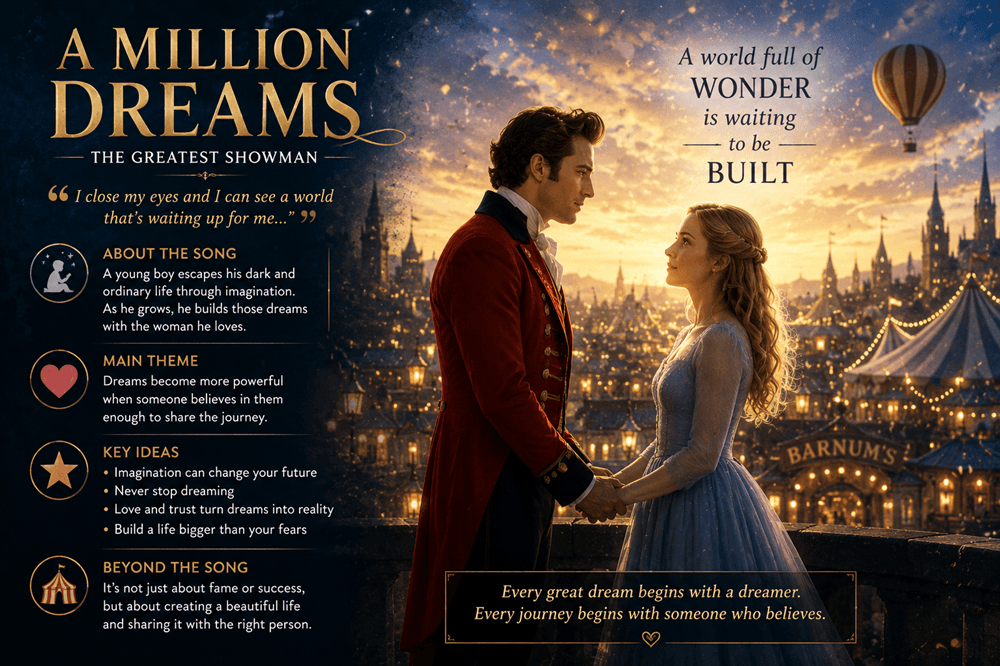
“A Million Dreams” from The Greatest Showman is about imagining a better future before there is any proof that it can become real.
The song begins with the young P. T. Barnum escaping poverty through his imagination. He sees color, possibility and wonder in places that other people consider empty. As he grows older, the dream remains, but it becomes something he wants to build with Charity rather than pursue alone.
The song’s central meaning is:
A dream becomes more powerful when another person believes in it enough to help turn it into a shared life.
“A Million Dreams” is both an ambition anthem and a love song. Barnum imagines creating an extraordinary world, while Charity’s participation shows that his deepest dream is not merely fame or wealth. He wants someone beside him who can see the same future.
The complete recording is available through Atlantic Records’ official “A Million Dreams” audio. The film version is performed by Ziv Zaifman, Hugh Jackman and Michelle Williams.
What is “A Million Dreams” about?
“A Million Dreams” follows Barnum from childhood into adulthood.
As a poor child, he has limited control over his surroundings. He cannot change his social class, family circumstances or the way wealthy people view him.
What he can control is his imagination.
He creates an inner world filled with:
- Color
- Possibility
- Unusual sights
- Freedom
- Beauty
- A future larger than his present life
The song then moves forward through time.
Young Barnum becomes an adult, but his basic desire remains unchanged. He still wants to create the world he imagined as a child.
The difference is that Charity now shares the vision.
This transforms the song from a private fantasy into a promise between two people.
What do the “million dreams” represent?
The million dreams are not one million separate plans.
They represent the endless possibilities inside Barnum’s imagination.
He does not picture only one house, one career or one achievement. He imagines an entire way of living that is more colorful and expansive than the world he currently knows.
The phrase can represent:
- Creative ideas
- Career ambitions
- A future family
- Freedom from poverty
- The desire to entertain people
- The belief that life can be redesigned
- Small hopes accumulating into one larger vision
The exaggerated number reflects the scale of his imagination.
Barnum does not dream cautiously.
He allows one possibility to lead to another until the future feels almost unlimited.
Why does Barnum dream at night?
Night separates him from the practical limits of the day.
During the day, Barnum is reminded of his circumstances. Adults, social rules and financial limitations tell him what is realistic.
At night, those voices become quieter.
His imagination allows him to enter a world where:
- Poverty does not define him.
- Social class does not determine his future.
- Empty spaces can become extraordinary places.
- Other people’s opinions cannot restrict him.
- The impossible feels temporarily available.
This does not mean dreaming is only an escape.
The imagined world eventually becomes a source of motivation. Barnum’s private vision gives him something to pursue when the visible evidence of success is still absent.
The song suggests that imagination can be a survival tool.
When the present offers little hope, the ability to picture something different can prevent a person from accepting limitation as destiny.
Is the song about ambition or love?
It is about both.
Barnum begins as an individual dreamer. He imagines a future because his current world feels too small.
Once Charity joins him, the dream gains an emotional purpose.
He is no longer building only for himself.
He wants to create a life they can inhabit together.
This gives the song two connected stories.
The ambition story
Barnum refuses to accept that his difficult beginning must determine the rest of his life.
The love story
Charity chooses to believe in a future that does not yet exist because she believes in the person imagining it.
The song would be more self-centered if Barnum remained the only voice. Charity’s part changes its meaning.
A private fantasy becomes a shared promise.
Why is Charity’s part important?
Charity does not merely listen to Barnum describe his plans.
She asks to be included.
Her response means that she is willing to accept uncertainty and participate in building the imagined world.
That is a significant commitment because Barnum cannot offer immediate security. He offers a vision.
Charity’s participation suggests:
- Trust in Barnum’s potential
- Emotional loyalty
- Willingness to leave a more conventional life
- Desire for partnership rather than observation
- Belief that happiness can be created together
She does not ask him to abandon his dreams and become more realistic.
She asks him to share them.
This is one of the song’s most romantic ideas: the greatest form of support is not simply encouraging someone from a distance but choosing to enter the uncertain future with them.
What does the imagined house symbolize?
The house represents the life Barnum wants to build.
It is not merely a physical home filled with possessions. It is a symbol of security, family and the ability to transform imagination into something real.
For a child who has experienced poverty, designing an ideal home can mean reclaiming control.
Barnum cannot choose the circumstances into which he was born, but he can imagine choosing:
- Where he will live
- What the home will contain
- Who will live there with him
- What emotional atmosphere it will create
- How different it will feel from his childhood
The imagined house also reflects a limitation in Barnum’s thinking.
He often assumes that happiness can be constructed through bigger spaces, more impressive objects and visible success.
The rest of The Greatest Showman complicates that belief. Barnum eventually learns that creating an extraordinary spectacle does not automatically protect the relationships that gave his dream meaning.
Does “A Million Dreams” encourage unrealistic thinking?
The song celebrates imagination, but it does not necessarily claim that dreaming alone is enough.
Barnum’s vision gives him direction. It helps him survive difficult circumstances and motivates him to create something new.
However, the film later shows the dangers of allowing ambition to grow without limits.
A dream can become harmful when:
- Success is never considered sufficient
- Family is treated as secondary
- Public approval becomes addictive
- Other people become tools inside the vision
- The dreamer stops listening to those who supported them
- Achievement matters more than the reasons it was pursued
“A Million Dreams” captures the hopeful beginning, before those complications become visible.
Its optimism is genuine, but the larger story eventually asks whether Barnum can control the dream once it begins controlling him.
What does the song say about being called “crazy”?
Barnum understands that other people may consider his vision unrealistic.
Instead of treating their judgment as proof that he should stop, he accepts that unusual ideas often look unreasonable before they exist.
The song distinguishes between two ways of seeing.
One person looks at an empty space and sees nothing.
Another looks at the same space and sees what might eventually be built there.
The difference is imagination.
This does not mean every unusual dream will succeed. The song’s point is that ridicule should not automatically determine which possibilities deserve to be explored.
Barnum’s greatest strength is his refusal to let other people’s limited expectations become his own.
His later weakness is that he sometimes stops recognizing the difference between ignoring destructive criticism and ignoring necessary advice.
Why does the song move from childhood to adulthood?
The time transition shows that Barnum’s dream is not temporary.
Children frequently imagine impossible futures, but many abandon those ideas as adult responsibilities become more demanding.
Barnum does not.
The same imaginative energy continues into adulthood.
Songwriters Benj Pasek and Justin Paul have explained that the number was intended to show the “flame” of Barnum’s vision continuing from childhood into his adult life. It also creates irony: although he still possesses the dream, he has not yet found the achievement capable of satisfying it.
The transition therefore communicates both consistency and restlessness.
Barnum’s imagination survives.
So does his dissatisfaction with ordinary life.
Why does the song begin quietly and become larger?
The arrangement mirrors the growth of the dream.
At first, the music belongs to one child and one private thought. The sound is gentle because the imagined world has not yet been shared or tested.
As the song progresses:
- More voices enter
- The instrumentation expands
- The characters grow older
- The imagined future becomes more detailed
- A solitary dream becomes a shared commitment
The growing arrangement makes the dream feel as though it is becoming physically larger around the singers.
This is musical storytelling.
Instead of simply informing the audience that years have passed and the relationship has deepened, the recording allows listeners to feel that expansion.
The quiet beginning resembles the first private thought.
The final swell resembles a future that now feels large enough to contain two lives.
Who sings “A Million Dreams” in the film?
The film recording is credited to Ziv Zaifman, Hugh Jackman and Michelle Williams.
Zaifman provides the singing voice for the young Barnum section. Jackman continues the number as the adult Barnum, while Williams sings as the adult Charity. The transition between performers allows one dream to continue across different stages of the characters’ lives.
This structure is essential to the song.
If the entire number were performed only by adult Barnum, the audience would hear a statement of ambition.
By beginning in childhood, the film establishes that the dream is part of his identity rather than a recent business idea.
Who wrote “A Million Dreams”?
“A Million Dreams” was written by Benj Pasek and Justin Paul, the songwriting team behind the original songs in The Greatest Showman.
Atlantic Records’ original soundtrack announcement credits Pasek and Paul with the film’s songs and confirms that the soundtrack was released on December 8, 2017, shortly before the movie’s theatrical release.
The soundtrack’s production team included Greg Wells, Alex Lacamoire, Pasek and Paul.
The album later won the 2019 Grammy Award for Best Compilation Soundtrack for Visual Media.
Is the song historically accurate?
“A Million Dreams” should not be treated as a factual account of the real P. T. Barnum’s childhood or marriage.
The Greatest Showman is a highly fictionalized musical inspired by Barnum rather than a strict biography.
The song serves the film’s version of the character: an ambitious outsider who wants to create wonder and rise beyond the limits of poverty.
Its purpose is emotional and theatrical.
It establishes:
- Why Barnum refuses an ordinary life
- Why Charity is drawn to him
- Why spectacle becomes so important to him
- Why he continues pursuing increasingly larger achievements
- Why his ambition later threatens the life they built
The song is therefore most useful as an explanation of the movie’s Barnum, not as historical evidence about the real man.
What does the song reveal about Barnum’s character?
“A Million Dreams” establishes Barnum’s greatest strength and his most dangerous weakness at the same time.
His strength is imagination.
He sees possibility where other people see emptiness. That ability eventually allows him to create performances, gather outsiders and produce experiences audiences had never seen.
His weakness is endless dissatisfaction.
One dream leads to another, and the number of dreams never decreases.
The phrase “a million dreams” sounds inspiring, but it also suggests that no single achievement may ever satisfy him.
Once one imagined world becomes real, he may immediately begin pursuing the next.
This pattern explains much of the film’s later conflict.
Barnum’s problem is not that he dreams.
It is that he sometimes values the next dream more than the people already living inside the one he achieved.
Why do people use the song at graduations and school performances?
The song’s meaning extends easily beyond the film.
It can describe anyone imagining a future that does not yet exist:
- A student choosing a career
- A child discovering creativity
- A family beginning a new chapter
- A performer hoping to reach an audience
- A community planning something better
- A person leaving a difficult past
Its message is optimistic without being attached to one specific profession or achievement.
The dream remains undefined enough for listeners to supply their own.
The contrast between a young voice and adult voices also makes the song particularly effective for school choirs, youth performances and graduation events. It allows childhood imagination to be connected with future possibility.
Why did P!nk record “A Million Dreams”?
P!nk recorded a pop version for The Greatest Showman: Reimagined, an album featuring new interpretations of the soundtrack by contemporary artists.
Her version was released in 2018, and her daughter Willow Sage Hart performed the reprise.
P!nk’s performance changes the emotional emphasis.
In the film, the song follows Barnum and Charity from childhood into marriage.
In P!nk’s version, the presence of her daughter gives it an additional parent-child meaning. The dream can be heard as something one generation passes to another.
P!nk’s recording reached No. 11 on the UK Official Singles Chart, while the original cast version peaked at No. 22.
Why did the song become so popular?
“A Million Dreams” combines personal emotion with a broadly adaptable message.
It works as:
- A love song
- A childhood song
- An ambition anthem
- A family song
- A graduation song
- A statement about creativity
- A promise to build a shared future
The melody also grows gradually rather than demanding attention immediately. This gives performers and listeners time to enter the imagined world before the largest emotional moment arrives.
The soundtrack itself became a major commercial success and won the Grammy for Best Compilation Soundtrack for Visual Media. The film’s songs continued reaching audiences through cast recordings, sing-along editions and The Greatest Showman: Reimagined.
The song lasts because listeners do not need to share Barnum’s exact dream.
They only need to remember a time when they imagined life becoming larger than it currently was.
Is the song ultimately hopeful?
Yes, but its hope is not completely uncomplicated.
The song believes imagination can lead people beyond the circumstances into which they were born.
It also believes that love can turn one person’s private ambition into a shared future.
However, the larger film shows that dreams require balance.
Ambition can create wonder, but it can also become an excuse to neglect the people who made achievement meaningful.
The most hopeful moment is not Barnum imagining success alone.
It is Charity choosing to share the vision.
Her response suggests that happiness does not come only from creating an extraordinary world. It comes from deciding who will stand beside you inside it.
Final meaning
“A Million Dreams” is about imagining a better life before that life appears possible.
Young Barnum uses fantasy to rise emotionally above poverty and social limitation. He sees a bright, expansive world in places other people consider empty.
As he grows older, the dream remains.
Charity’s voice then changes its meaning. She does not merely admire his imagination; she asks to participate in it. His private escape becomes their shared promise.
The million dreams represent creativity, ambition and all the possible futures Barnum refuses to abandon.
They are inspiring because they help him believe life can change.
They are also dangerous because endless dreaming can make the present feel permanently insufficient.
That tension gives the song greater depth than a simple motivational anthem.
Dreams can rescue people from hopelessness.
They can also pull people away from what they already have.
“A Million Dreams” ultimately suggests that the strongest vision is not the one a person builds alone. It is the one large enough to include someone else—and grounded enough to remember why both people began dreaming in the first place.