
“Carol of the Bells” Lyrics Meaning: The Ukrainian Song Behind the Christmas Classic
“Carol of the Bells” is about Christmas bells spreading joy from one home to another.
The English lyrics imagine bells ringing across towns and villages, repeating a message of celebration until everyone can hear it. Their sound pushes worries aside, brings people together and announces that Christmas has arrived.
However, the familiar English carol began as a very different song.
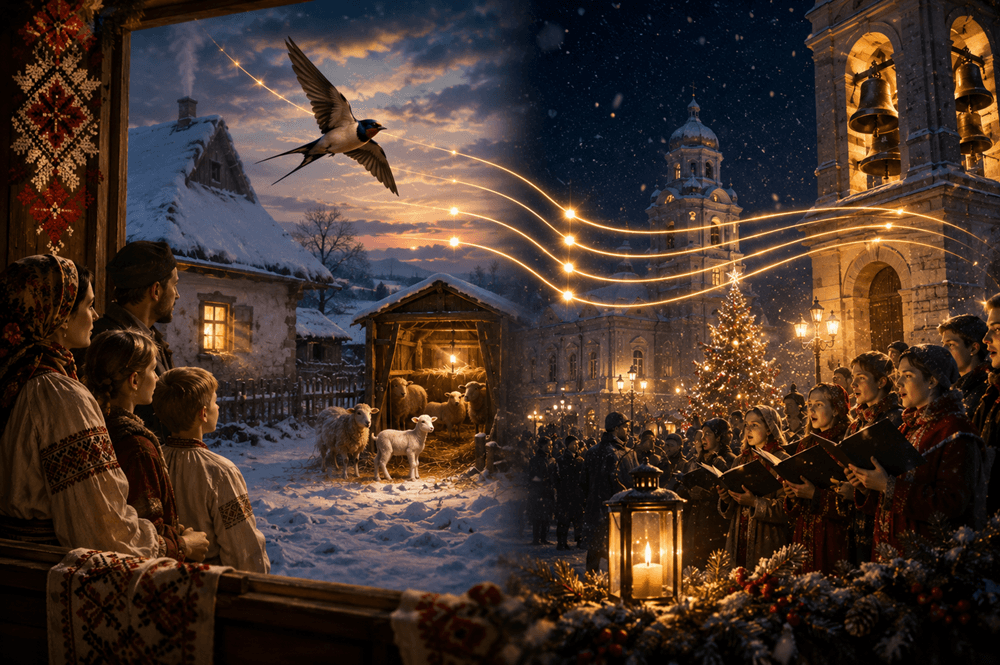
Its melody comes from “Shchedryk,” a Ukrainian New Year folk chant arranged by composer Mykola Leontovych. The original Ukrainian words do not mention bells, Christmas or caroling. They describe a swallow visiting a household and predicting prosperity in the coming year.
The song therefore has two connected but distinct meanings:
- “Shchedryk” celebrates abundance, renewal and good fortune.
- “Carol of the Bells” celebrates Christmas through the imagined voices of ringing bells.
The English version preserves the Ukrainian melody but gives it an entirely new story.
What does “Carol of the Bells” mean?
The English lyrics present bells as messengers.
They ring repeatedly and seem to speak words of happiness to everyone who hears them. Their sound travels beyond one church, street or household, creating a shared celebration.
The basic message is:
Christmas has arrived, so release your worries and join the joy spreading around you.
The bells do not carry detailed religious teachings. They do not describe the birth of Jesus, Bethlehem, the shepherds or the wise men.
Instead, they communicate the emotional atmosphere of Christmas:
- Excitement
- Community
- Celebration
- Warmth
- Music
- Shared good wishes
- A temporary release from ordinary worries
This makes “Carol of the Bells” different from narrative carols such as “Silent Night” or “O Little Town of Bethlehem.”
It is less concerned with telling the Christmas story than with recreating the sound and energy of the holiday arriving.
Why do the lyrics repeat so much?
Repetition allows the singers to imitate actual bells.
A bell does not deliver a long sentence. It creates a short sound that returns again and again. When several bells ring together, their patterns overlap and form something larger.
The lyrics work in the same way.
Short phrases pass between different voices. Words return with slight changes, while the choir grows louder and more complex.
The repetition creates the impression that the message is spreading:
- One bell begins ringing.
- Another bell responds.
- More bells join.
- The sound reaches additional homes.
- The celebration becomes impossible to ignore.
The lyrics are therefore written as much for their sound as for their literal meaning.
Certain syllables are chosen because they can be sung quickly and sharply, resembling the striking of metal bells.
What are the bells saying?
The bells appear to be telling listeners that Christmas is here and that happiness should replace worry.
They encourage people to set aside their cares, listen to the music and share good wishes with others.
The bells speak to everyone rather than one specific person.
Rich or poor, young or old, every listener hears the same message. This gives the song a communal quality.
The bells do not ask whether someone is prepared for Christmas. Their ringing announces that the season has already arrived.
The listener is invited to join something larger than an individual celebration.
What does “throw cares away” mean?
This idea means putting ordinary worries aside temporarily.
Christmas does not automatically solve financial problems, grief, loneliness or family conflict. The song does not seriously claim that ringing bells can remove every difficulty.
Instead, it presents celebration as a pause.
For a few moments, people can stop focusing entirely on responsibilities and remember joy, music and community.
The message is similar to someone saying:
The holiday is here. Let yourself experience it before it passes.
This is one reason the song can feel uplifting even though its melody has a dark or urgent quality. The lyrics insist on joy as though they are pushing against sadness.
Why does the song mention every home?
The bells are imagined as carrying their sound from place to place.
Christmas cheer should not remain inside one church or wealthy household. It continues outward until it reaches everyone.
The image of music entering every home suggests inclusion.
People may celebrate differently, but the bells create a common background. Everyone becomes part of the same moment simply by hearing them.
The repeated movement from one location to another also gives the song momentum. It feels as though the sound is traveling while the choir performs.
The song begins with individual bells and ends with an entire landscape filled with ringing.
Is “Carol of the Bells” a religious song?
It is a Christmas song, but its English lyrics are not strongly theological.
They mention Christmas and express good wishes, yet they do not describe a specific Christian event or doctrine.
For that reason, the song can work in several settings:
- Church concerts
- School performances
- Holiday films
- Secular Christmas programs
- Orchestral concerts
- Winter celebrations
Its spiritual feeling comes more from the communal sound than from explicit religious language.
The choir resembles a group making a joyful announcement, while the constant repetition can feel ceremonial.
Listeners may connect that atmosphere with church bells and worship, even though the lyrics themselves remain broad.
The original song was called “Shchedryk”
Before it became “Carol of the Bells,” the melody belonged to a Ukrainian song called “Shchedryk.”
Mykola Leontovych created the famous choral arrangement from a traditional Ukrainian folk melody. Leontovych composed more than 150 works inspired by Ukrainian folk texts and melodies, but “Shchedryk” became his best-known composition internationally. His life and musical legacy are documented by the Internet Encyclopedia of Ukraine. (encyclopediaofukraine.com)
“Shchedryk” belongs to a tradition of Ukrainian well-wishing songs performed around the New Year.
Its title is connected with generosity, abundance and a bountiful evening.
Rather than announcing Christmas, the original song announces the possibility of a prosperous new year.
What do the original Ukrainian lyrics mean?
The Ukrainian words tell the story of a swallow arriving at a household.
The bird calls the owner outside and asks him to look at his property. New lambs have been born, the animals are healthy and the household can expect wealth.
The swallow predicts that the family will enjoy abundance during the coming year.
The original imagery includes:
- A returning swallow
- A prosperous household
- Healthy livestock
- Newborn animals
- Money or a plentiful harvest
- A beautiful wife
- Good fortune in the year ahead
The swallow functions as a messenger, much as the bells do in the English version.
However, the messages are different.
The swallow announces material prosperity and renewal. The bells announce Christmas cheer.
The Ukrainian World Congress describes “Shchedryk” as an ancient Ukrainian New Year chant in which a swallow enters a home and predicts a bountiful year. (Ukrainian World Congress’ history of “Shchedryk”) (ukrainianworldcongress.org)
Why is there a swallow in a winter song?
The swallow reflects the song’s older connection with seasonal renewal.
Swallows return when the weather becomes warmer, so the bird can represent spring, fertility and the beginning of a productive new cycle.
This may seem unusual to modern listeners who associate the melody with snow, December and Christmas trees.
The folk tradition behind “Shchedryk” developed before the melody acquired its modern Christmas identity. Its agricultural images belonged to communities where the success of livestock and crops directly shaped a family’s future.
The swallow’s prediction is therefore not merely decorative.
Healthy animals, new lambs and an abundant harvest represented security.
The original song wishes the household something practical: enough prosperity to survive and thrive during the coming year.
Is “Carol of the Bells” a translation of “Shchedryk”?
No.
The English words are not a translation of the Ukrainian lyrics.
Peter J. Wilhousky wrote a completely new English text after hearing the repeated four-note pattern as the sound of ringing bells.
He kept Leontovych’s melody but replaced the swallow, livestock and New Year blessings with bells and Christmas celebration.
This explains why direct comparisons between the two versions can be confusing.
The same music supports two different sets of images:
| Ukrainian “Shchedryk” | English “Carol of the Bells” |
|---|---|
| A swallow | Ringing bells |
| New Year | Christmas |
| A household blessing | A public holiday announcement |
| Livestock and prosperity | Joy and good wishes |
| Agricultural renewal | Seasonal celebration |
The English version should therefore be described as an adaptation, not a translation.
Who wrote the English lyrics?
Peter J. Wilhousky, a choral conductor and music educator, wrote the best-known English lyrics and published them in 1936.
The Library of Congress catalog identifies Wilhousky as the English lyricist and records 1936 as the publication date associated with “Carol of the Bells.” (Library of Congress authority record for “Shchedryk” and “Carol of the Bells”) (loc.gov)
Wilhousky heard bells inside the repeated melody and built the new lyrics around that impression.
His adaptation demonstrates how strongly music can suggest images even before words are understood.
To Ukrainian listeners, the melody belonged to a bird and a New Year blessing.
To Wilhousky, it sounded like bells spreading Christmas news.
Both interpretations depend on repetition, movement and a messenger arriving with good wishes.
How did “Shchedryk” reach the United States?
The Ukrainian Republic Capella, conducted by Oleksander Koshyts, brought “Shchedryk” to international audiences during a major concert tour.
The choir performed the song at Carnegie Hall in New York on October 5, 1922. This performance introduced many American listeners to Leontovych’s arrangement.
Carnegie Hall describes the event as the American premiere of the future Christmas standard. Wilhousky created his familiar English version less than two decades later. (Carnegie Hall’s history of “Carol of the Bells”) (carnegiehall.org)
The performance also carried cultural importance.
The Ukrainian choir was presenting its country’s music to international audiences during a period when Ukraine’s independence and national identity faced enormous political pressure.
A song now treated as a familiar part of American Christmas culture entered the country through a Ukrainian ensemble sharing its musical heritage.
Did Mykola Leontovych hear “Carol of the Bells”?
No.
Leontovych died in 1921, before the 1922 Carnegie Hall performance and fifteen years before Wilhousky’s English lyrics were published.
He therefore never heard the version that would make his melody internationally associated with Christmas bells.
His death was violent. The composer was shot by a Soviet Cheka agent at his parents’ home in January 1921, according to the Internet Encyclopedia of Ukraine. (encyclopediaofukraine.com)
This history adds a bittersweet dimension to the song’s popularity.
Leontovych created the arrangement that became known around the world, but he did not live to witness its American success or its transformation into a global holiday standard.
Why does the song use only a few notes?
The recognizable foundation of “Carol of the Bells” is a repeating four-note pattern.
Its simplicity allows the music to become increasingly complex without losing its identity.
One voice can begin the pattern. Additional voices then enter at different times, creating layers around the same musical idea.
The effect resembles several bells ringing from different locations.
The notes themselves do not change dramatically, but the texture does.
This is one reason the song feels as though it is constantly growing:
- The first pattern feels small and distant.
- New voices increase the pressure.
- Harmonies make the sound darker or brighter.
- Higher voices create excitement.
- Lower voices add weight.
- The final repetition feels much larger than the opening.
The composition shows how repetition does not have to mean stillness.
The same four notes can feel increasingly urgent as more voices join.
Why does “Carol of the Bells” sound slightly frightening?
Many listeners find the song darker than its joyful lyrics would suggest.
Several musical qualities contribute to that feeling.
The pattern never seems to rest
The repeated notes continue almost without interruption.
This creates excitement, but it can also feel obsessive, as though something is approaching and cannot be stopped.
The voices enter in layers
Each new vocal line adds intensity.
The listener may feel surrounded by sound rather than gently accompanied by it.
The harmony often feels dark
The melody carries a minor quality that contrasts with the cheerful English message.
Minor sounds are not automatically sad or frightening, but they can add mystery and tension.
The volume usually builds
Many arrangements begin quietly and become increasingly forceful.
The bells no longer sound distant by the end. They seem to fill the entire space.
This mixture makes the song unusually flexible.
It can sound joyful in a children’s choir, sacred in a church, dramatic in an orchestra or threatening in a film trailer.
Why is it often used in suspenseful films?
The music naturally creates forward movement.
Its repeated pattern can support scenes involving:
- Approaching danger
- Urgent preparation
- Winter storms
- Supernatural events
- Large-scale action
- Holiday chaos
- A countdown toward an important moment
The English lyrics are cheerful, but instrumental versions can remove that reassurance.
Without words, listeners are left with a fast, repeating pattern that grows more intense. The music can then feel less like a celebration and more like a warning.
This contrast has helped “Carol of the Bells” become one of the few Christmas melodies that works equally well in joyful and frightening settings.
It can announce Santa Claus, or it can suggest that something dangerous is moving through the snow.
Does the song have a hidden dark meaning?
The English lyrics do not contain a hidden horror story.
They are openly celebratory and focus on Christmas joy.
The darker feeling comes primarily from the music rather than the words.
However, the history behind the melody includes political struggle, cultural displacement and Leontovych’s tragic death. Modern listeners may also hear greater seriousness in “Shchedryk” after learning how important the song became as a symbol of Ukrainian culture.
This does not turn the lyrics into a secret warning.
It does show that the melody carries more history than its modern use in cheerful holiday advertising may suggest.
Why are there so many versions?
The melody is simple enough to recognize but flexible enough to transform.
It can be performed by:
- A cappella choirs
- Children’s choirs
- Full orchestras
- Handbell ensembles
- Rock bands
- Metal groups
- Electronic producers
- Solo pianists
- String quartets
- Film composers
The basic four-note figure remains recognizable even when the tempo, instruments and atmosphere change.
Some versions emphasize the English lyrics and Christmas cheer.
Others remove the words and treat the piece as dramatic instrumental music.
Ukrainian performers may sing the original “Shchedryk” text, returning the melody to its New Year story about the swallow and the prosperous household.
Each arrangement reveals a different part of the composition.
Is it a Christmas carol or a Ukrainian New Year song?
It is both, depending on which lyrics are being performed.
When singers use Wilhousky’s English text, the piece is “Carol of the Bells,” a Christmas song about bells spreading holiday joy.
When they sing the original Ukrainian text, it is “Shchedryk,” a New Year well-wishing song about a swallow predicting prosperity.
The distinction matters because calling the entire composition an American Christmas carol can hide its Ukrainian origin.
A more complete description is:
“Carol of the Bells” is an American English Christmas adaptation of Mykola Leontovych’s arrangement of the Ukrainian folk song “Shchedryk.”
This wording recognizes both parts of the song’s identity.
What is the deeper meaning?
Both versions are about receiving a message of hope.
In “Shchedryk,” a swallow tells a household that abundance is coming.
In “Carol of the Bells,” bells tell an entire community that Christmas joy has arrived.
The messenger changes, but the emotional purpose remains similar.
Both songs ask listeners to look beyond present difficulties and imagine a better season ahead.
The original household is told to expect prosperity.
The English audience is told to release its worries and welcome celebration.
This shared structure may explain why the new lyrics fit the melody so effectively despite telling a completely different story.
The music already sounded like good news traveling quickly.
Wilhousky simply changed who was delivering it.
Final meaning
“Carol of the Bells” is about bells spreading Christmas joy until their message reaches everyone.
The repeated words and overlapping voices imitate bells ringing from different places. Their sound announces the holiday, encourages listeners to put worries aside and turns individual celebration into a shared community experience.
Yet the melody has a much older meaning.
It comes from “Shchedryk,” Mykola Leontovych’s choral arrangement of a Ukrainian folk chant. In the original lyrics, a swallow enters a household and predicts healthy livestock, wealth and abundance in the coming year.
Peter J. Wilhousky did not translate those words. He heard bells in Leontovych’s four-note pattern and created a new English Christmas text in 1936.
The two versions are connected by more than melody.
Both imagine sound arriving from outside and carrying hope:
- The swallow promises prosperity.
- The bells promise joy.
- Both messages spread through repetition.
- Both ask people to welcome a new season.
The deeper story of “Carol of the Bells” is therefore one of transformation.
A Ukrainian New Year blessing crossed the ocean, received new English words and became one of the world’s most recognizable Christmas songs.
Behind every ringing bell is still the flight of the original swallow.