
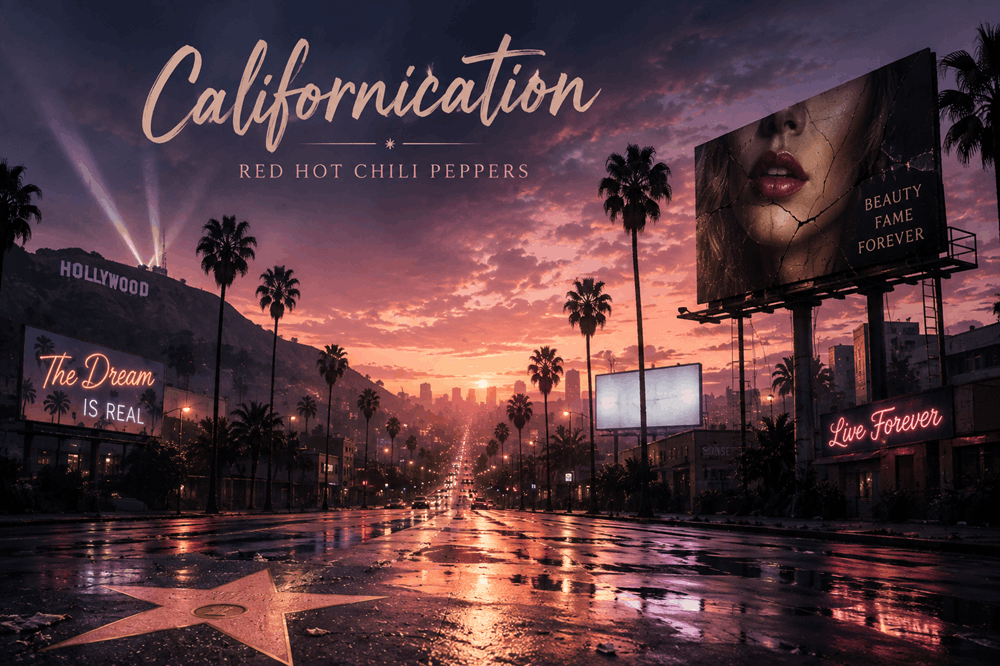
“Californication” Lyrics Meaning: Hollywood Sells a Dream That Changes the World
“Californication” by Red Hot Chili Peppers is about the global spread of Hollywood’s fantasies—and the damage created when people begin treating those fantasies as reality.
The song presents California as more than a physical place. It is an idea exported through movies, television, celebrity culture, advertising, beauty standards and sexual imagery. People across the world learn what success, attractiveness and happiness are supposed to look like by watching stories manufactured in Los Angeles.
The problem is that the dream is designed to be desired, not necessarily lived.
That is the song’s central warning:
Hollywood does not merely entertain the world. It teaches the world what to want, even when those desires are artificial, destructive or impossible to satisfy.
“Californication” sounds calm and almost beautiful, but its images are filled with exploitation, cosmetic alteration, environmental destruction and fame that leads toward emptiness.
The dream is seductive.
That is what makes it dangerous.
What is “Californication” about?
“Californication” describes a world increasingly shaped by the stories California tells about itself.
Young people imagine becoming movie stars. Adults fear aging because celebrity culture presents youth as a requirement for relevance. Sex becomes a product. Tragedy becomes entertainment. Even history, science and outer space can be transformed into another Hollywood production.
The title combines California with fornication, creating a word that suggests cultural seduction, commercialization and the spread of an unhealthy fantasy.
California is not simply corrupting people through force.
People willingly dream about it.
They watch the films, study the celebrities, copy the appearances and measure their real lives against fictional images. Hollywood’s influence succeeds because it offers something many people already want: beauty, excitement, recognition and escape.
The song’s criticism is therefore not directed only at movie studios or celebrities. It also implicates the audience.
Hollywood sells the fantasy.
The world keeps buying it.
California is presented as a product, not just a place
The California in the song is not limited to beaches, freeways or specific neighborhoods.
It is a manufactured version of California distributed across the world.
Someone can experience “Californication” without ever visiting the state. A teenager in another country may absorb its beauty standards. An aspiring actor may build an identity around the dream of fame. A consumer may purchase products designed to recreate a celebrity lifestyle.
The geographic California is real.
The commercial California can exist anywhere there is a screen.
This distinction explains why the song begins with images involving people far beyond the United States. Hollywood’s fantasies travel across national borders more easily than most political ideas.
A film, television show or celebrity photograph can communicate a complete vision of success without requiring translation.
The exported message is simple:
This is what beauty looks like.
This is what freedom looks like.
This is what a successful life should become.
The title describes cultural seduction
The sexual element of the title should not be understood only literally.
Fornication becomes a metaphor for the way Hollywood seduces the public. The entertainment industry offers beautiful images, emotional stimulation and fantasies of transformation.
It makes people desire participation before they understand the cost.
This seduction can affect almost every part of life:
- Appearance becomes something that must be constantly improved.
- Youth becomes more valuable than age.
- Fame becomes evidence of personal worth.
- Private pain becomes public content.
- Romance becomes performance.
- Rebellion becomes a marketable style.
- Reality becomes disappointing because it lacks cinematic intensity.
The song does not claim that movies or popular culture are inherently evil.
It questions what happens when imagination becomes an industry powerful enough to define reality for millions of people.
Hollywood turns private dreams into mass-produced desires
People have always wanted admiration, beauty and adventure.
Hollywood did not invent those desires.
It learned how to package them.
A private wish to be noticed becomes the fantasy of becoming famous. A natural fear of aging becomes a market for surgery, treatments and carefully maintained public images. The desire for love becomes a collection of cinematic expectations about how romance should look.
Once those desires are packaged, they can be sold repeatedly.
The audience begins believing that it independently chose the dream, even though countless films, advertisements and celebrity stories helped shape it.
This is one of the song’s darker ideas.
Control does not always feel like control.
Sometimes it feels like desire.
Why are people outside America dreaming of the silver screen?
The song emphasizes Hollywood’s international reach.
California’s entertainment industry does not simply create American celebrities. It produces images consumed by people who may know the United States mainly through screens.
For a young person living far away, Hollywood can appear to offer an escape from ordinary life. Fame seems capable of crossing class, language and national boundaries.
The fantasy is especially powerful because the audience usually sees the finished image rather than the machinery behind it.
They see the premiere, not the rejection.
The glamorous photograph, not the editing.
The successful actor, not the thousands who arrived with the same dream.
The lifestyle, not the debt required to imitate it.
The screen turns rare outcomes into something that feels personally available.
The edge of the world becomes the center of the imagination
Geographically, California sits on the western edge of the continental United States.
Culturally, the song presents it as a center capable of shaping how the entire world imagines itself.
This creates an important contradiction.
The place is physically located at an edge, yet its images occupy the center of global attention.
Hollywood’s influence allows one region’s preferences to become universal standards. Its ideas about bodies, romance, youth and success can appear natural even though they emerged from a particular commercial culture.
The world begins looking toward California for dreams.
California begins exporting whatever dreams are most profitable.
Cosmetic surgery becomes a war against time
One of the song’s sharpest sections focuses on altering the body to resist aging.
Hollywood depends heavily on appearance, but appearance is temporary. Faces change, skin changes and the public’s attention moves toward younger performers.
Cosmetic intervention promises to interrupt that process.
The song presents this as a battle rather than a simple beauty choice. The person is not peacefully caring for their appearance. They are fighting the evidence that time has passed.
That battle cannot produce a permanent victory.
Every procedure may temporarily adjust the surface, but aging continues underneath it. The person becomes trapped in a cycle of trying to preserve an image that was always temporary.
The criticism is not necessarily directed at every individual who chooses surgery.
It is directed at a culture that makes natural change feel like professional or personal failure.
Celebrity beauty makes ordinary people distrust their own faces
Famous people rarely appear before the public without preparation.
Lighting, makeup, styling, editing and carefully chosen photographs create images that may look natural while requiring extensive production.
The audience then compares unproduced reality with manufactured perfection.
That comparison is designed to be lost.
The ordinary person sees their face in a bathroom mirror. The celebrity appears through professional photography, controlled angles and commercial presentation.
Yet both images are treated as though they belong to the same category.
The result is dissatisfaction.
People begin viewing their own bodies as unfinished projects rather than living parts of themselves.
“Californication” recognizes that Hollywood sells not only attractive people, but also the anxiety created by failing to resemble them.
Innocence and sexualization exist beside each other
The song repeatedly combines childlike fantasy with adult commercial sexuality.
That collision is deliberate.
Hollywood often markets innocence and sexual availability at the same time. Young performers may be presented as wholesome enough to attract broad audiences while being styled in ways that encourage adult fascination.
The industry can then deny responsibility by pretending those messages are separate.
They are not.
The song’s unsettling combinations suggest a culture that turns nearly everything into a product, including youth, purity and rebellion.
The result is a fantasy that appears innocent on the surface while carrying a much darker commercial logic underneath.
Fame promises recognition but often produces loss of identity
Hollywood offers the possibility of becoming known by millions of people.
That does not guarantee being understood by anyone.
A celebrity’s public identity is built from selected images, interviews, performances and stories. Over time, the manufactured identity may become more valuable to the audience than the human being behind it.
The person becomes a character inside their own life.
This helps explain why “Californication” refers to famous artists alongside fictional worlds. Celebrity culture blurs the distinction between human beings and entertainment properties.
A musician’s pain becomes part of a mythology.
A death becomes a cultural event.
A private struggle becomes material that other people analyze, purchase and romanticize.
Fame may preserve someone’s image while consuming the person who created it.
The Kurt Cobain reference connects fame with destruction
The song invokes Kurt Cobain, whose death became inseparable from the story told about fame, alienation and alternative rock.
Cobain was a real person, but popular culture transformed him into a symbol. His appearance, music, suffering and death became part of a continuing commercial narrative.
By placing him beside other references to movies and fictional worlds, the song shows how celebrity culture can absorb even its critics.
A musician may reject commercial expectations.
After death, the same industry can package that rejection and sell it back to audiences.
The person is gone.
The image remains profitable.
David Bowie’s cosmic imagery becomes part of Hollywood’s dream machine
The song also gestures toward David Bowie’s work, connecting rock mythology with images of space and transcendence.
Bowie repeatedly used fictional identities and extraterrestrial imagery to explore fame, performance and unstable identity. Those ideas fit naturally within “Californication.”
Hollywood promises that people can escape the limits of ordinary life.
They can become stars.
They can reinvent themselves.
They can enter worlds more exciting than their own.
But every escape can become another commercial identity. Even rebellion, strangeness and artistic transformation can be converted into recognizable branding.
The machine does not need everyone to conform in the same way.
It can sell individuality too.
The Hollywood-basement image questions reality itself
One of the song’s most memorable ideas suggests that even humanity’s greatest achievements could be recreated inside a studio.
The immediate reference recalls conspiracy theories claiming that space exploration was staged for cameras. The song does not need listeners to believe those theories literally.
The image makes a larger point:
Hollywood has become so skilled at manufacturing convincing realities that people no longer know which images to trust.
If a studio can create another planet, a historical battle or a perfect human body, visual evidence loses some of its authority.
Seeing is no longer automatically believing.
The song anticipated a media environment in which altered photographs, digital effects and carefully staged personal lives increasingly compete with direct experience.
The more convincing the illusion becomes, the harder reality must work to prove itself.
Fictional planets feel emotionally close
The song places fictional worlds beside real places and people.
That choice shows how deeply entertainment enters the imagination.
A planet created for a film may feel more familiar than a real location the viewer has never visited. Audiences know its landscapes, history and tragedies because they have repeatedly returned to the story.
Fiction is not presented as meaningless.
Stories can create real emotional attachment.
The danger appears when fictional familiarity begins replacing engagement with the actual world. People may know the rules of an invented universe while remaining disconnected from the political, environmental or human realities around them.
Hollywood gives people worlds to care about.
Sometimes those worlds are easier to care about because they cannot demand anything from the viewer.
Destruction becomes another source of entertainment
Earthquakes, tidal waves and urban collapse appear throughout the song’s imagery.
California is vulnerable to natural disaster, but disaster also belongs to Hollywood’s visual vocabulary. Cities are repeatedly destroyed on screen because destruction produces spectacle.
The audience can experience catastrophe without confronting its real human cost.
Buildings collapse beautifully.
Crowds run dramatically.
The world nearly ends before the credits restore safety.
This creates another form of Californication: actual fear is transformed into entertainment.
Destruction becomes visually exciting and commercially useful.
The song also recognizes that California repeatedly reinvents itself through collapse. Careers fail and return. Trends disappear and reappear. Personal disaster can become material for a comeback story.
Ruin is not outside the industry.
It is one of the industry’s most valuable narratives.
Creation and destruction feed each other
The song does not present destruction as the final state.
It acknowledges that collapse can generate new art, identities and movements.
California repeatedly attracts people who want to escape earlier versions of themselves. They arrive hoping to create music, films, businesses or entirely new lives.
That creative energy is real.
The same city capable of producing artificiality also produces extraordinary art.
This prevents the song from becoming a simple attack on Los Angeles.
The Red Hot Chili Peppers emerged from the culture they criticize. Their music, fame and visual identity are also products of California.
They understand the attraction because they participated in it.
“Californication” is criticism from inside the dream.
The chorus is seductive because the dream still works
The song does not tell people to stop dreaming about California.
Instead, it repeatedly returns to the dream itself.
That repetition sounds almost inviting.
Even after describing exploitation, surgery, tragedy and environmental destruction, the music makes the fantasy feel beautiful. The listener can understand why people continue wanting it.
This is essential to the song’s meaning.
If Hollywood produced only misery, its influence would be easy to reject. The system survives because it also produces pleasure, beauty and genuine artistic inspiration.
People know celebrity images are constructed.
They still enjoy looking.
They know fame can be destructive.
They still imagine being recognized.
They know films are fictional.
They still allow fictional worlds to shape real desires.
The dream continues because awareness alone does not end attraction.
Why does such a dark song sound so calm?
“Californication” is built around one of John Frusciante’s most restrained guitar parts.
The opening is sparse, with guitar and bass leaving considerable space between notes. Chad Smith’s drums enter without turning the song into the explosive funk-rock associated with some of the band’s earlier work.
The result feels reflective rather than confrontational.
That calmness makes the lyrics more disturbing.
Kiedis does not shout his warning like someone standing outside the culture. He sounds like someone walking through it, observing images that have become too familiar to provoke surprise.
The chorus then opens melodically, giving the dream an emotional beauty that the verses continually question.
The music seduces the listener in the same way Hollywood does.
Its surface is smooth.
Its subject is decay.
The song took time to find its final musical form
Kiedis reportedly brought a large collection of words and images to the writing process, but the band initially struggled to find music that matched them. He later recalled that he and Frusciante first attempted to develop “Californication” from pages of material that contained too many words.
The final arrangement’s restraint was therefore important.
Instead of competing with the dense imagery, the instruments created open space around it. The listener can move from one strange reference to another without the track becoming musically overcrowded.
The simplicity also gives the song a timeless quality.
Its ideas concern media, fame and artificial desire, but the recording is not built around production effects strongly tied to one brief trend.
The lyrics describe a culture obsessed with spectacle.
The music refuses spectacle.
The song marked the return of a defining lineup
“Californication” appeared on the band’s seventh studio album, also titled Californication, which the official Red Hot Chili Peppers discography dates to June 8, 1999.
The album reunited Anthony Kiedis, Flea, Chad Smith and guitarist John Frusciante after Frusciante’s earlier departure. Contemporary reviews immediately emphasized how strongly his return changed the band’s sound, bringing a more melodic and emotionally spacious guitar style back into the group.
That context strengthens the title track.
The song examines reinvention, destruction and the California promise of becoming someone new. The band recording it was also attempting a rebirth after instability, addiction and lineup changes.
They were criticizing California’s mythology while living through a version of it.
The music video turns California into a video game
The official “Californication” music video presents the band members as characters inside a fictional open-world video game.
They move through exaggerated California environments involving cities, wilderness, celebrity imagery and natural disaster. The game world is colorful, exciting and obviously artificial.
That format perfectly matches the song.
A video game gives players apparent freedom while keeping them inside rules created by someone else. They can explore, collect rewards and choose routes, but every possibility has already been programmed.
Hollywood’s dream works similarly.
It offers countless identities and fantasies while quietly defining what counts as winning.
The video also turns California itself into something playable. The state becomes a collection of recognizable images rather than a complicated real place.
The earthquake ending exposes the weakness beneath the fantasy
The video’s game world eventually begins collapsing.
An earthquake destroys the landscape, and the bright artificial environment can no longer hide its instability.
This represents more than California’s physical vulnerability.
It shows how quickly manufactured worlds can fail.
Fame can disappear.
Beauty standards can change.
Technology can become outdated.
A celebrity identity can collapse after one scandal.
A dream built entirely from public approval has no stable foundation.
When the game ends, the band members return to human form. The artificial avatars disappear, but the people behind them remain.
That ending suggests a possible escape from Californication:
Remembering the difference between the image and the person.
Why the song remains relevant
The entertainment industry described in “Californication” has expanded beyond film studios and television networks.
People now participate in their own image production. Social platforms allow users to edit photographs, construct public identities and turn daily life into content.
Hollywood’s methods have become personal tools.
A person does not need to move to Los Angeles to begin performing a more attractive version of life. They can create it from a bedroom, select the most flattering images and present happiness as a continuing series.
This makes the song’s warning broader than celebrity culture.
Californication occurs whenever appearance becomes more important than experience and whenever an image designed for attention begins controlling the person who created it.
The technology changes.
The desire remains the same.
How successful was “Californication”?
The song became one of the band’s defining recordings. In the United Kingdom, it reached No. 16 on the Official Singles Chart in August 2000. (Official Charts)
Its cultural life has extended far beyond that original chart run. The official video later crossed one billion YouTube views, demonstrating how strongly its turn-of-the-millennium imagery continued connecting with later audiences.
Entertainment Weekly has described the song as a form of Los Angeles noir: beauty on the surface with exploitation and tragedy underneath. That contrast explains why it remains one of the band’s most recognizable statements about its home culture. (Entertainment Weekly)
Confirmed background versus interpretation
It is confirmed that “Californication” was recorded by Anthony Kiedis, Flea, John Frusciante and Chad Smith for the band’s 1999 album of the same name. The album was produced by Rick Rubin and marked Frusciante’s return to the group.
It is also confirmed that the official video uses a video-game format and depicts exaggerated California adventures ending amid large-scale destruction.
The ideas that California represents an exported cultural product, that cosmetic alteration becomes a war against time and that the video game represents freedom limited by hidden rules are interpretations of the lyrics and visuals.
The song does not provide one formal explanation for every reference.
Its larger subject is nevertheless clear: Hollywood creates fantasies powerful enough to reshape how people understand beauty, fame, history and themselves.
Final meaning
“Californication” is about a dream factory that has become powerful enough to influence the entire world.
Hollywood promises transformation.
It tells ordinary people that they can become stars, that aging can be defeated, that reality can be edited and that personal value can be measured through attention.
Some of those promises produce genuine art and inspiration.
Others create anxiety, exploitation and endless dissatisfaction.
The Red Hot Chili Peppers do not describe California as purely evil because they know why people want it. The sunlight is real. The creativity is real. The possibility of reinvention is real.
So are the illusions.
That is why the song never destroys the California dream completely.
It shows the machinery beneath it and then returns to the dream again.
People may understand that the image is artificial.
They may recognize the cost of chasing it.
They may still want to enter the screen.
That continuing desire is Californication.