
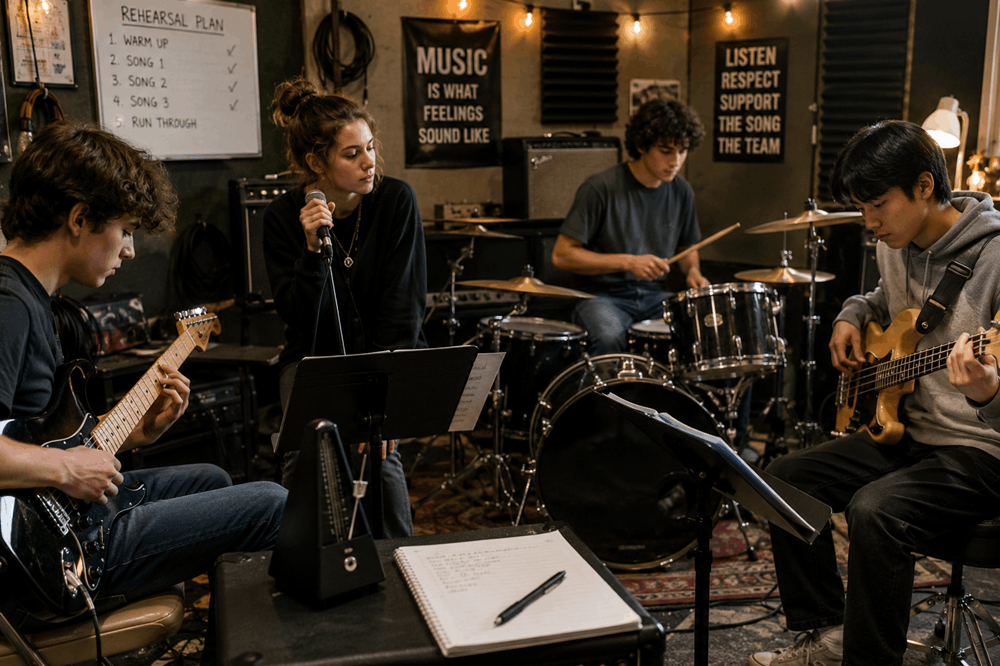
Habits of a Successful Beginner Band Musician: 12 Practices That Build Real Progress
A successful beginner band musician does not need to be the most technically impressive person in the room. The musicians who improve fastest usually develop simpler habits: they arrive prepared, keep time, listen to everyone else, practice difficult sections independently, take feedback without becoming defensive, and show up when they say they will.
That last point matters more than beginners often realize.
A band is not four or five people practicing separately at the same time. It is a group learning how to depend on one another.
If you want to become the beginner musician other people enjoy playing with, these habits matter as much as scales, chords, drum fills, or vocal range.
1. Learn Your Part Before Band Practice
One of the best habits a beginner musician can develop is understanding the difference between personal practice and band rehearsal.
Personal practice is where you learn your part.
Band rehearsal is where everyone learns how the parts fit together.
If the band plans to rehearse three songs on Saturday, do not wait until Saturday to figure out your chords.
Listen to the songs during the week.
Learn the basic structure.
Know where the verses, choruses, bridges, stops, and solos occur.
Work through difficult transitions.
You do not need to arrive playing everything perfectly. You are a beginner, and mistakes are expected.
But you should arrive knowing enough that the rest of the band can work with you.
Imagine four musicians meeting for two hours.
If three people know the song and one person spends 45 minutes learning basic chord changes, most of the rehearsal has effectively become that musician’s private lesson.
Do that repeatedly and people will eventually stop enjoying rehearsals with you.
Preparation is one of the easiest ways for a beginner to earn respect.
2. Practice With a Metronome
Playing the correct notes is only half of playing music well.
Those notes also need to happen at the correct time.
A guitarist can know every chord in a song and still make the band sound unstable if the tempo constantly speeds up.
A drummer can perform impressive fills and still create problems if those fills pull everyone away from the beat.
A bassist who consistently lands slightly late can make an otherwise good band feel strangely sluggish.
This is why practicing with a metronome is so valuable.
Start slower than the song’s normal tempo if necessary.
Play the difficult section cleanly.
Then gradually increase the speed.
Beginners sometimes avoid metronomes because they reveal mistakes immediately.
That is exactly why you should use one.
The click does not care how impressive the part feels. It tells you whether you are actually keeping time.
3. Listen More Than You Play
New musicians often concentrate so hard on their own instrument that they stop hearing the band.
A guitarist watches the fretboard.
The drummer thinks about the next fill.
The singer focuses on remembering lyrics.
The keyboard player worries about chord changes.
Everyone may technically perform the correct parts while the group still sounds disconnected.
Successful band musicians learn to divide their attention.
You should hear yourself, but you should also hear what everyone around you is doing.
If you play bass, pay particular attention to the drummer’s kick drum.
If you sing, listen for the instruments that establish your starting pitch.
If you play rhythm guitar, notice whether your strumming is supporting or fighting the drummer.
If another musician becomes quieter, ask whether you should become quieter too.
A band becomes good when musicians stop thinking only about my part and start hearing our song.
4. Learn the Entire Song Structure
Beginners often learn songs as isolated pieces.
They know a riff.
They know the chorus.
They know the solo.
Then somebody asks, “How many times do we play the chorus after the second verse?”
Silence.
Knowing your individual notes is not enough. You should understand the map of the song.
A simple structure might look like:
Intro
Verse 1
Chorus
Verse 2
Chorus
Bridge
Solo
Final chorus
Outro
Write it down if necessary.
Some musicians make short rehearsal charts such as:
Intro x4 – V – C – V – C – B – Solo – C x2 – End
You do not need formal music notation to benefit from knowing the structure.
Once the arrangement becomes familiar, you stop worrying about what comes next and can concentrate on actually playing.
5. Record Your Rehearsals
Your memory of a rehearsal is often kinder than the recording.
You may leave thinking:
“That sounded pretty good.”
Then you listen back and discover the chorus sped up dramatically, the guitar was too loud, the backing vocals were out of tune, and nobody ended the song together.
That is useful information.
A simple phone recording is enough for beginners.
You are not trying to produce a finished live album.
Listen for practical problems:
- Did the tempo stay consistent?
- Were the vocals audible?
- Did everyone enter together?
- Was one instrument overpowering everything?
- Which transitions felt weak?
- Did the song lose energy anywhere?
- Was the ending clean?
Recording rehearsals can accelerate improvement because it replaces vague impressions with evidence.
Just avoid turning every rehearsal into an endless recording-analysis session.
Play first.
Listen later.
Fix the biggest problems next time.
6. Keep Your Gear Ready
Musicians naturally love talking about equipment.
But reliability matters more than owning expensive equipment.
A beginner guitarist with a modest instrument, spare strings, working cables, picks, tuner, and properly functioning amplifier is more useful than someone with an expensive guitar who arrives without the power supply for a pedalboard.
Create a simple pre-rehearsal routine.
Check your instrument.
Charge anything that needs charging.
Pack spare batteries if you use them.
Bring cables.
Bring picks or sticks.
Bring a tuner.
Bring any charts or notes you need.
If you sing, bring water.
If you need a special adapter, do not assume someone else will have one.
You do not need to prepare for every possible equipment failure.
You should simply avoid losing rehearsal time because of preventable problems.
7. Do Not Play Constantly Between Songs
This is a small habit that can make a surprisingly large difference.
The band stops playing.
Someone wants to discuss the bridge.
The guitarist begins practicing a riff.
The drummer starts tapping.
The bassist joins in.
The singer tries to explain something over all of it.
Nobody can communicate.
Beginners often play between songs because they are excited, nervous, or simply enjoy making sound.
But rehearsals need quiet moments.
When someone is speaking, stop playing.
When the band is discussing an arrangement, listen.
When someone is tuning, give them enough quiet to do it.
Professional behavior often looks less glamorous than people imagine.
Sometimes it means knowing when not to make noise.
8. Accept Corrections Without Turning Them Into Arguments
Sooner or later, another band member will say something like:
“You’re coming in too early.”
“That chord doesn’t sound right.”
“Can you play that section quieter?”
“The tempo is speeding up.”
A beginner’s first instinct may be to defend themselves.
“I thought you were speeding up.”
“That’s how the original guitarist plays it.”
“I couldn’t hear the drummer.”
Sometimes your explanation may be correct.
But immediately defending every mistake makes rehearsal exhausting.
Try the suggestion first.
Then listen.
A useful response is simply:
“Okay, let’s try it.”
Bands need discussion, and you should absolutely speak up when you have an idea or genuinely disagree.
The problem is not disagreement.
The problem is treating every correction like an attack on your ability.
You are learning.
Being corrected is part of learning.
9. Practice the Parts You Are Bad At
It is extremely easy to spend an hour practicing what you already do well.
The familiar riff feels good.
The easy chord progression makes you sound competent.
The solo you memorized months ago is fun.
Meanwhile, the difficult eight-second transition that keeps ruining rehearsal receives five minutes of attention.
Reverse that habit.
Identify the weakest section.
Work on it slowly.
Repeat it.
If necessary, practice only the two measures surrounding the problem.
Suppose you can play 95% of a song confidently but always stumble when moving from the bridge into the final chorus.
You do not need to play the entire four-minute song 20 times.
Practice that transition 20 times.
Efficient musicians concentrate their effort where the mistakes actually occur.
10. Learn to Control Your Volume
Louder does not automatically mean better.
This lesson can be particularly difficult for new guitarists and drummers because loud playing feels exciting.
But if one instrument overwhelms everyone else, the band cannot hear itself properly.
Good dynamics make songs feel larger because not every section is equally intense.
A verse might need restraint.
A chorus might open up.
A bridge might become almost quiet.
The final chorus might become the loudest moment.
If you play at maximum intensity from the first note, the band has nowhere left to go.
Volume is therefore not simply a technical setting.
It is part of the arrangement.
Ask yourself:
What does this part of the song need from me?
Sometimes the answer is more.
Sometimes the answer is less.
11. Become the Band Member Who Is Reliable
Musical ability gets attention.
Reliability gets invitations.
Show up when rehearsal begins.
Answer important band messages.
Give people reasonable notice if you cannot attend.
Learn the agreed songs.
Do not repeatedly cancel because something slightly more interesting appeared.
If rehearsal begins at 7:00, arriving at 7:00 with equipment still in the car may mean you are not actually ready to play until 7:20.
Try to be set up by the agreed starting time.
This habit becomes increasingly important once a band performs publicly.
A venue does not care that your guitarist is incredibly talented if nobody knows whether the guitarist will actually appear.
People want to work with musicians they can trust.
For a beginner, reliability can compensate for a surprising amount of technical inexperience.
Skills can improve.
Chronic unreliability usually becomes a much harder problem.
12. Serve the Song Instead of Trying to Impress Everyone
A beginner can easily believe that successful musicians are the ones playing the most complicated parts.
That is often wrong.
Good musicians ask what the song needs.
Maybe the guitarist can play an impressive 30-second solo.
That does not mean the song needs one.
Maybe the drummer knows an elaborate fill.
That does not mean it belongs between every vocal line.
Maybe the bassist can play six notes where the original part uses two.
The two notes may sound better.
Restraint is difficult because it does not attract immediate attention.
But bands often become noticeably better when everyone stops trying to prove something at the same time.
Your goal is not to make listeners think:
“That guitarist is playing a lot.”
Your goal is to make them think:
“That song sounds good.”
Learn to Recover From Mistakes
You will make mistakes during rehearsals and performances.
Everyone does.
A beginner musician often makes the mistake worse by reacting dramatically.
They stop playing.
They make a face.
They look at another musician.
They restart the section even though everyone else continued.
The audience may not have noticed the original mistake.
They definitely notice the reaction.
Practice recovery.
If you hit the wrong note, find the next correct one.
If you lose your place, listen for the section and rejoin.
If you forget a chord, simplify temporarily.
If you miss a drum fill, keep the beat.
Continuing confidently is usually more valuable than attempting to repair a moment that has already passed.
Take Care of Your Hearing
Band practice can become extremely loud, particularly in small rehearsal spaces.
Protecting your hearing should become a habit from the beginning rather than something you start worrying about years later.
Use appropriate hearing protection when volume levels are high.
Be careful with headphones and in-ear monitoring.
Do not treat ringing ears after rehearsal as evidence that the practice was exciting.
Your ears are part of your musical equipment.
Unlike a broken cable or guitar string, they cannot simply be replaced at the music store.
Stay Curious About Instruments Other Than Your Own
You do not need to become a multi-instrumentalist.
But understanding what your bandmates are doing makes collaboration easier.
A guitarist benefits from understanding how drums establish rhythm.
A drummer benefits from hearing chord changes.
A singer benefits from understanding where instrumentalists need space.
A bassist benefits from understanding both harmony and percussion.
Ask questions.
What is the drummer listening for before the chorus?
Why does the keyboard player choose that chord inversion?
Why does the bass part become simpler during the guitar solo?
Why does the singer need the band quieter during one verse?
The more you understand the other roles, the less likely you are to treat music as several unrelated parts happening simultaneously.
Do Not Compare Your Beginning to Someone Else’s Middle
You will eventually rehearse with someone who seems impossibly good.
They change keys instantly.
They know every chord.
They hear mistakes you cannot hear.
They improvise without thinking.
It can make you wonder whether you belong in the room.
Remember that you are seeing the result of practice you did not witness.
Your job is not to become the best musician in the band immediately.
Your job is to become better than you were last month.
Use stronger musicians as information rather than evidence that you should quit.
Notice what they do.
Ask useful questions.
Watch how they prepare.
Listen to how they respond when something goes wrong.
Good musicians can teach you even when they are not formally teaching.
The Best Beginner Musicians Make Other People Want to Play Again
A successful beginner band musician is not necessarily the person with the fastest fingers, highest vocal range, largest drum kit, or most expensive instrument.
It is often the musician who makes the group function better.
They know their part.
They listen.
They maintain the tempo.
They control their volume.
They bring working equipment.
They accept useful feedback.
They communicate.
They arrive prepared.
And when they make a mistake, they keep going.
Those habits create something technical skill alone cannot guarantee:
trust.
Once other musicians trust you, they can relax.
The drummer knows you will enter at the right moment.
The singer knows you will leave enough space.
The guitarist knows you learned the arrangement.
Everyone knows you will actually appear for rehearsal.
That is when a collection of beginner musicians starts becoming a band.
You do not need to behave like a professional musician before you have professional-level skills.
But developing professional-level habits early will make learning those skills much easier.
Practice your instrument.
Then practice being someone other musicians want beside them.
That combination will take you much further than talent alone.