Hyundai Dashboard Symbols and Meanings: Warning Lights Every Driver Should Recognize
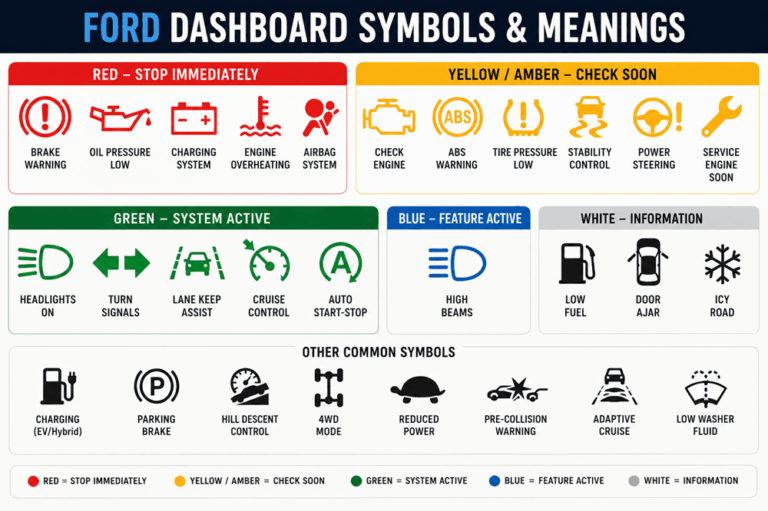
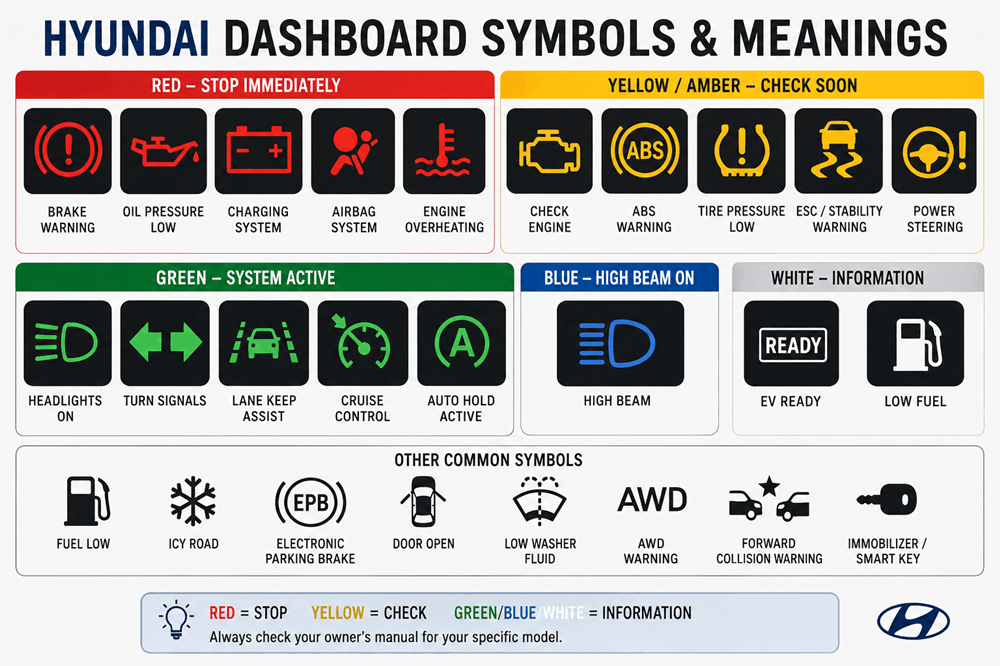
If a symbol suddenly appears on your Hyundai dashboard, the color and shape can tell you how urgently you need to react. Red lights generally deserve immediate attention, yellow or amber lights usually indicate a problem that should be checked soon, and green, blue, or white symbols usually show that a feature is operating normally.
Hyundai dashboard symbols vary somewhat by model, model year, powertrain, equipment, and software version, so your owner’s manual is always the final reference for your specific vehicle.
This guide explains the Hyundai warning lights drivers are most likely to see and what to do when they appear.
Hyundai Dashboard Warning Light Colors
Before trying to memorize every symbol, learn what the colors generally communicate.
| Color | What It Usually Means |
|---|---|
| Red | Stop, safety issue, or condition requiring immediate attention |
| Yellow/Amber | Warning, malfunction, or condition that needs checking |
| Green | System is active or operating normally |
| Blue | Feature such as high beams is active |
| White/Gray | System status, standby mode, or information |
A warning light that briefly comes on when you start your Hyundai can be normal. Many systems perform a self-check and turn their lights off after a few seconds.
The concern begins when a warning stays illuminated after the vehicle starts or appears while you are driving. Hyundai advises drivers to investigate warning lights that remain on after startup.
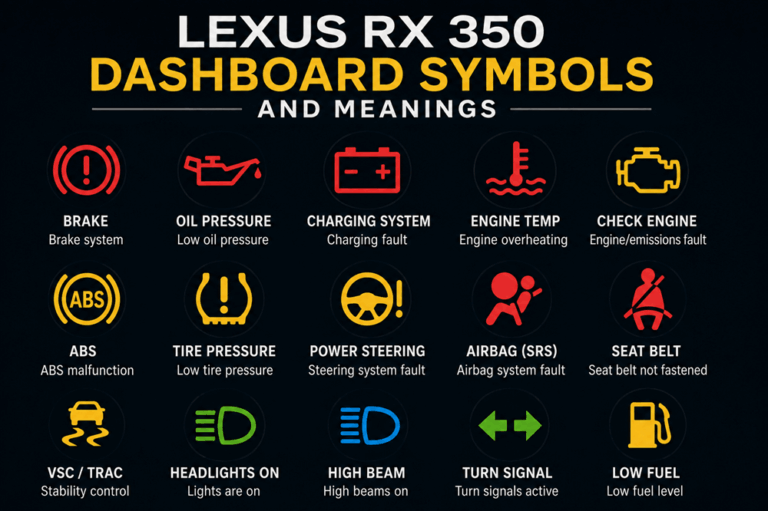
1. Brake Warning Light
Looks like: A circle containing an exclamation mark or the word BRAKE, usually surrounded by parentheses.
This is one of the Hyundai dashboard symbols you should take seriously.
The brake warning light can appear when:
- The parking brake is applied
- The brake fluid level is low
- A braking-system problem is detected
- On some electrified Hyundai models, regenerative braking is not operating normally
If the light goes out when you release the parking brake, everything may be normal.
If it stays illuminated with the parking brake released, Hyundai indicates that the brake-fluid level may be low. If braking feels abnormal, do not continue driving.
What to do: Stop somewhere safe. If the parking brake is released and the warning remains on, have the braking system checked.
2. ABS Warning Light
Looks like: The letters ABS inside a circle.
ABS stands for Anti-lock Brake System.
The system helps prevent the wheels from locking during hard braking so you can retain better steering control.
If the ABS light remains on, the normal hydraulic brakes may still work, but the anti-lock function may not operate correctly.
What to do: Drive cautiously and arrange service.
ABS and Brake Lights Together
Seeing the ABS warning and brake-system warning simultaneously is more serious.
Hyundai warns that this combination can indicate a problem with the Electronic Brake Force Distribution system and can affect braking performance during sudden stops.
Avoid high speeds and abrupt braking and have the vehicle inspected promptly.
3. Engine Oil Pressure Warning Light
Looks like: An old-fashioned oil can with a drop coming from the spout.
The red oil-can symbol means engine oil pressure is too low.
This does not simply mean you are approaching your next oil change.
Insufficient oil pressure can prevent important engine components from receiving proper lubrication.
Hyundai warns that continuing to drive with the oil-pressure warning illuminated can cause severe engine damage.
What to do:
- Pull over safely.
- Turn off the engine.
- Check the engine-oil level.
- Add the correct oil if it is low.
- Do not continue driving if the light remains on.
If oil level appears normal but the light remains illuminated, the problem may involve oil pressure rather than simply oil quantity.
4. Battery or Charging System Warning Light
Looks like: A rectangular battery with plus and minus symbols.
Despite its appearance, this symbol does not necessarily mean the battery itself is bad.
It indicates a problem with the vehicle’s electrical charging system, which may involve the alternator, charging components, wiring, or related equipment on gasoline-powered models.
If the charging system stops working, your Hyundai may continue running temporarily using stored battery power, but eventually the electrical supply can be exhausted.
What to do: Reduce unnecessary electrical use and move to a safe location. Arrange inspection as soon as possible.
5. Check Engine Light
Looks like: A small engine outline.
Hyundai calls this the Malfunction Indicator Lamp, or MIL.
It can illuminate when the vehicle detects a problem involving:
- The engine
- Emissions system
- Powertrain
- Related sensors or controls
A steady check-engine light can indicate anything from a relatively minor emissions problem to something requiring prompt repair.
Hyundai advises inspection when the light remains illuminated because continued driving with certain faults can affect drivability, fuel economy, or emissions equipment.
What If the Check Engine Light Is Flashing?
A flashing check-engine light is generally more urgent than a steady one and may indicate a condition capable of damaging the catalytic converter.
Reduce engine load and arrange service immediately.
6. Airbag Warning Light
Looks like: A seated person with a large circle in front of them.
The circle represents the airbag.
The light normally comes on briefly during startup and then goes off.
If it remains illuminated, Hyundai says there may be a malfunction in the Supplemental Restraint System, which includes the airbags and related safety components.
What to do: Have the system inspected. A malfunction may prevent an airbag or other restraint component from operating properly during a collision.
7. Seat Belt Warning Light
Looks like: A seated person wearing a diagonal belt.
This is one of the simplest Hyundai dashboard symbols.
It means the driver or another monitored occupant has not fastened a seat belt.
Depending on the model, the light may flash and be accompanied by a warning chime.
What to do: Make sure occupants are properly buckled.
8. Tire Pressure Warning Light
Looks like: A horseshoe-shaped tire cross-section with an exclamation mark.
This is the Tire Pressure Monitoring System, or TPMS, warning.
A solid light normally means one or more tires are significantly underinflated.
Low tire pressure can affect:
- Handling
- Braking
- Tire wear
- Fuel economy
- Tire temperature
What to do: Check all tire pressures when it is safe and inflate them to the pressure specified on the vehicle’s tire-information label.
Do not simply inflate tires to the number printed on the tire sidewall.
What Does a Blinking Tire Pressure Light Mean?
On Hyundai vehicles, a TPMS light that blinks for a period and then remains illuminated can indicate a TPMS malfunction, rather than simply low pressure.
The sensors or monitoring system may need inspection.
9. Power Steering Warning Light
Looks like: A steering wheel, sometimes with an exclamation mark.
Hyundai commonly refers to its electric steering system as Motor Driven Power Steering, or MDPS.
If the warning remains illuminated, a steering-system malfunction may be present.
The steering wheel may still turn, but the amount of steering assistance can change and the wheel may feel unusually heavy.
What to do: Drive cautiously and have the vehicle inspected.
If steering becomes extremely difficult, stop somewhere safe.
10. Electronic Parking Brake Warning
Looks like: The letters EPB.
Hyundai models equipped with an Electronic Parking Brake may display an EPB warning when the system detects a malfunction.
The light normally appears briefly during startup.
If it stays on while driving, the Electronic Parking Brake may require service.
Do not confuse this with the normal red parking-brake indicator showing that the brake is currently applied.
11. AUTO HOLD Light
Looks like: The words AUTO HOLD.
Auto Hold can keep the vehicle stationary after you stop without requiring you to continuously press the brake pedal.
On current Hyundai models, color can change the meaning:
- White: Auto Hold has been activated
- Green: Auto Hold is actively holding the vehicle
- Yellow: A malfunction has been detected
A persistent yellow AUTO HOLD light should be inspected.
12. Electronic Stability Control Light
Looks like: A car with two wavy skid lines underneath.
Electronic Stability Control, or ESC, helps manage wheel slip and vehicle stability.
The meaning depends on what the light is doing.
Flashing ESC Light
A flashing ESC symbol usually means the system is actively working.
This can happen when the tires lose traction during acceleration or cornering.
It is not necessarily a malfunction.
ESC Light Staying On
A continuously illuminated ESC warning can indicate a system problem.
Hyundai recommends having the system inspected if the light remains on unexpectedly.
13. ESC OFF Light
Looks like: The skid-car symbol with OFF underneath it.
This indicates that Electronic Stability Control has been manually disabled or reduced.
For ordinary road driving, stability control is normally best left active.
The system may occasionally be turned off in specific circumstances, such as attempting to free a vehicle stuck in snow or mud.
14. Low Fuel Warning
Looks like: A gas pump.
This light means the fuel tank is nearly empty.
What to do: Refuel as soon as practical.
Running a gasoline vehicle extremely low on fuel repeatedly is not a good habit, and Hyundai warns that extremely low fuel levels can contribute to engine misfire and catalytic-converter damage on applicable models.
15. Master Warning Light
Looks like: A triangle containing an exclamation mark.
The Hyundai Master Warning Light is essentially a general attention symbol.
It may appear because another system needs attention.
Depending on the vehicle, causes can include problems involving:
- Forward safety systems
- Driver-assistance sensors
- Smart Cruise Control
- Lane systems
- LED headlights
- AWD
- Washer fluid
- Doors or liftgate
- Other monitored functions
The instrument-cluster message should tell you what triggered the master warning.
What to do: Read the accompanying message rather than treating the triangle itself as the diagnosis.
16. Forward Collision Warning Symbol
Looks like: Vehicles approaching each other, sometimes with a star or collision symbol.
Hyundai’s Forward Collision-Avoidance Assist can display different colors depending on the situation.
A yellow warning can mean the system is disabled, unavailable, blocked, or has detected a malfunction.
A red flashing warning may appear when the collision-avoidance system is actively warning or intervening.
A dirty camera, snow, heavy rain, ice, or blocked radar sensor can sometimes make driver-assistance warnings appear.
17. Lane Keeping Assist Symbol
Looks like: A vehicle between two lane lines or a steering-wheel/lane symbol.
On newer Hyundai models, the Lane Safety indicator can use several colors.
Common meanings include:
- Green: System conditions are satisfied or assistance is operating
- Gray: System is not currently able to operate
- Yellow: System has been disabled, is unavailable, or has detected a malfunction
Camera visibility plays a major role in lane-assistance operation.
A dirty windshield near the camera can sometimes trigger a warning.
18. Lane Following Assist Symbol
Looks like: A steering wheel with lane markings.
Lane Following Assist helps the vehicle remain centered in a detected lane when operating conditions are satisfied.
A green symbol generally indicates active operation, while gray or white can indicate standby or unavailable conditions depending on the Hyundai model.
This is an assistance feature, not autonomous driving.
The driver remains responsible for controlling the vehicle.
19. Driver Attention Warning
Looks like: Depending on the model, a driver or attention-related symbol.
Hyundai’s Driver Attention Warning can monitor certain driving behaviors and conditions.
A warning may recommend taking a break when the system detects signs associated with inattentive driving.
On newer Hyundai models, yellow can also indicate that the feature is disabled, a camera is blocked, or a malfunction has been detected.
20. Icy Road Warning
Looks like: A snowflake.
This means outside conditions may allow ice to form.
On some current Hyundai models, the warning can appear when outside temperature falls to around 40°F or 4°C.
It does not mean the road is definitely frozen.
It means you should be alert for possible ice, particularly on:
- Bridges
- Overpasses
- Shaded roads
- Wet pavement
21. AWD Warning Light
Looks like: AWD lettering or an AWD-related drivetrain symbol.
On Hyundai vehicles equipped with all-wheel drive, an AWD warning can mean the system has detected a malfunction.
This should not be confused with an AWD LOCK or terrain-mode indicator showing that a normal selectable feature is active.
A persistent AWD warning should be inspected.
22. Downhill Brake Control Light
Looks like: A vehicle descending a steep hill.
Downhill Brake Control, or DBC, helps control speed while descending steep slopes.
Depending on the model:
- Green: DBC is activated
- Flashing green: DBC is operating
- Yellow: A malfunction may be present
DBC is mostly useful during slow, steep descents rather than ordinary highway driving.
23. Immobilizer or Smart Key Light
Looks like: A key, vehicle with key, or security-related symbol.
On Hyundai vehicles with a smart key, the immobilizer indicator can show whether the vehicle recognizes the key.
A flashing indicator may appear if:
- The smart key cannot be detected
- The key is not inside the vehicle
- There is a problem with the immobilizer system
If your Hyundai will not start, first make sure the smart key is inside the vehicle and that its battery is functioning.
24. Turn Signal Indicators
Looks like: Green arrows pointing left and right.
The arrow flashes when the corresponding turn signal is operating.
If a turn-signal indicator begins flashing much faster than normal, a turn-signal lamp or system fault may be present. Hyundai specifically notes abnormal rapid flashing as a possible sign of a malfunction.
25. High Beam Indicator
Looks like: A headlamp with straight horizontal light rays.
The blue high-beam symbol means your high beams are currently on.
It is not a warning.
Remember to switch to low beams when approaching other road users whenever required.
26. Headlight Indicator
Looks like: A headlamp with light rays.
A green or white headlamp-related indicator generally shows that exterior lights are switched on.
Newer Hyundai models may also provide separate indicators for:
- Low beams
- High beams
- High Beam Assist
- Fog lights
- Automatic headlights
These are normally status indicators rather than warnings.
27. LED Headlight Warning
Looks like: A headlamp with an exclamation mark or related warning symbol.
Certain Hyundai models have a dedicated LED headlight warning light.
If it remains illuminated or begins blinking, a problem may exist with an LED headlight or one of its related components.
28. Door or Liftgate Open Symbol
Looks like: A vehicle viewed from above with one or more doors open.
It means a door, trunk, or liftgate has not been fully closed.
Make sure everything is securely latched before driving.
Some Hyundai models identify exactly which door is open on the digital instrument cluster.
29. Low Washer Fluid Warning
Looks like: A windshield with water spraying upward.
This light means the windshield-washer reservoir is nearly empty.
It is not mechanically serious, but having washer fluid available is important for visibility.
Refill the reservoir with suitable windshield-washer fluid.
30. Cruise Control Indicator
Looks like: A speedometer, vehicle, or CRUISE text.
This usually shows that cruise control or Smart Cruise Control has been turned on.
Depending on the model, additional graphics can show:
- Selected speed
- Following distance
- Whether a vehicle ahead has been detected
- Whether Smart Cruise Control is actively controlling speed
These are generally status indicators rather than warning lights.
Hyundai Electric Vehicle Dashboard Symbols
Hyundai EVs such as the IONIQ 5, IONIQ 6, and Kona Electric include symbols that gasoline-only vehicles do not have.
31. READY Indicator
Looks like: The word READY.
Because an electric vehicle can be completely silent when switched on, the READY indicator tells you whether it is actually capable of driving.
If READY is illuminated normally, the vehicle can be driven.
If it goes out unexpectedly or begins blinking, Hyundai says a problem may have occurred and the vehicle should be inspected.
32. EV Mode Indicator
The EV indicator means the vehicle is currently being propelled by its electric motor.
On hybrids and plug-in hybrids, this can appear when the gasoline engine is off and the electric motor is providing propulsion.
It is a normal operating indicator.
33. EV Service Warning
Looks like: A vehicle or electrical-system warning icon, depending on model.
This warning can indicate a problem with components of the electric vehicle or hybrid control system.
If it remains on after startup or appears while driving, the vehicle should be inspected.
34. Power Down Warning
Looks like: A turtle or reduced-power symbol on some Hyundai EVs.
This means the vehicle’s power output is being limited.
Possible reasons can include battery conditions, temperature, or an electric-drive-system issue depending on the model.
Acceleration may be noticeably reduced.
Move carefully and follow any instrument-cluster instructions.
35. Charging Cable Connected Indicator
Plug-in hybrid and fully electric Hyundai vehicles can show an indicator when the charging connector is attached.
Do not attempt to drive with the charging cable connected.
The exact symbol and behavior vary by model.
Which Hyundai Dashboard Lights Mean Stop Immediately?
Not every dashboard light requires you to pull over.
The symbols that deserve the most immediate attention include:
Engine Oil Pressure
Stop the engine as soon as safely possible.
Brake Warning With Parking Brake Released
Stop and investigate, especially if braking feels abnormal.
Charging-System Warning
Move to a safe place because the vehicle may eventually lose electrical power.
Severe Engine Warning
If a check-engine light flashes or the engine runs badly, reduce load and stop if necessary.
Overheating Warning
If your Hyundai displays an engine-temperature or overheating warning, stop safely and allow the engine to cool according to the owner’s-manual procedure.
Never open a hot cooling system.
What Do Yellow Hyundai Dashboard Lights Mean?
Yellow or amber normally means:
Pay attention and investigate, but an immediate emergency stop is not always required.
Common yellow warnings include:
- Check engine
- ABS
- TPMS
- ESC malfunction
- EPB malfunction
- AWD malfunction
- Forward Safety unavailable
- Lane Safety unavailable
- Master Warning
- LED headlight malfunction
The urgency depends on the symbol and how the vehicle is behaving.
A yellow tire-pressure light with a stable vehicle is very different from a yellow steering warning accompanied by suddenly heavy steering.
Always consider both the warning and the symptoms.
Why Do All the Dashboard Lights Come On When You Start a Hyundai?
This is normally part of the vehicle’s self-check.
When you switch the ignition or Start/Stop button to ON, the instrument cluster briefly illuminates multiple warning lamps.
Most should disappear after the system check or after the engine starts.
A light becomes important when it:
- Does not turn off
- Appears while driving
- Begins flashing unexpectedly
- Appears with a warning message
- Is accompanied by unusual sounds or vehicle behavior
Why Are Several Hyundai Warning Lights On at Once?
One fault can sometimes trigger several warnings.
Modern Hyundais contain interconnected systems.
A problem involving a wheel-speed sensor, battery voltage, camera, radar unit, or another shared component may affect several features simultaneously.
For example, an ABS problem can also affect stability-control functions.
Similarly, a camera blocked by snow or dirt may cause several driver-assistance features to report that they are temporarily unavailable.
Do not automatically assume that five warning lights mean five separate components have failed.
Read the dashboard messages and have the underlying problem diagnosed.
Can You Keep Driving With a Hyundai Warning Light On?
It depends entirely on the light.
A blue high-beam indicator requires no repair.
A low-fuel warning simply means you should refuel soon.
A steady yellow TPMS warning means you should check tire pressures.
A red oil-pressure warning can mean you should shut off the engine immediately.
Color helps, but the symbol matters more.
When in doubt, stop somewhere safe and check the owner’s manual rather than guessing.
Why Does a Hyundai Warning Light Come On and Then Disappear?
Some warnings are temporary.
A driver-assistance sensor may become blocked by:
- Heavy rain
- Snow
- Ice
- Dirt
- Fog
- Road spray
Once the sensor can see properly again, the warning may disappear.
Temperature can also affect tire pressure, which is why a TPMS warning sometimes appears on a cold morning and disappears later.
A warning that repeatedly returns still deserves investigation.
How to Find the Exact Meaning of Your Hyundai Dashboard Symbol
The fastest method is to identify three things:
- The symbol
- The color
- Any text displayed beside it
Then check the warning-and-indicator section of the owner’s manual for your exact Hyundai model and year.
This matters because a 2017 Elantra, 2026 Palisade, IONIQ 5, Tucson Hybrid, and Kona Electric do not have identical instrument clusters.
Some symbols are universal.
Others exist only on vehicles equipped with specific driver-assistance, hybrid, EV, AWD, lighting, or parking systems.
Hyundai Dashboard Symbols Quick Cheat Sheet
| Symbol | Meaning | What to Do |
|---|---|---|
| Red brake symbol | Parking brake or braking problem | Release brake; investigate if it stays on |
| Oil can | Low engine oil pressure | Stop engine |
| Battery | Charging-system fault | Stop safely and inspect |
| Engine outline | Engine/emissions fault | Arrange diagnosis |
| ABS | Anti-lock brake fault | Drive cautiously; service |
| Tire + ! | Low tire pressure | Check tire pressure |
| Steering wheel + ! | Power steering problem | Drive cautiously; service |
| Person + airbag | Airbag/SRS fault | Arrange service |
| Skidding car | ESC active or malfunction | Flashing can be normal; steady needs checking |
| Triangle + ! | Master warning | Read dashboard message |
| Gas pump | Low fuel | Refuel |
| Snowflake | Possible icy road | Drive cautiously |
| EPB | Electronic parking brake fault | Arrange service |
| AUTO HOLD yellow | Auto Hold fault | Arrange service |
| AWD warning | AWD malfunction | Arrange service |
| Vehicle/lane symbol | Lane assistance status | Check color/message |
| Collision symbol | Forward Safety warning | Slow down/check system |
| Blue headlamp | High beams on | Normal indicator |
| Green arrows | Turn signals | Normal indicator |
| READY | EV ready to drive | Normal when illuminated |
The Bottom Line
Hyundai dashboard symbols are much easier to understand once you separate warnings from normal indicators.
Red warnings deserve the most attention. An oil-pressure light, brake-system warning, serious charging problem, or overheating warning may require you to stop driving.
Yellow and amber symbols usually indicate something that needs inspection, such as low tire pressure, an ABS fault, a check-engine condition, or a driver-assistance system problem.
Green, blue, white, and gray lights usually tell you that a feature is active, available, or in standby.
The most important rule is simple: do not judge a warning by color alone. Identify the symbol and read the dashboard message.
And because Hyundai’s warning lights vary by model, equipment, powertrain, and year, always compare an unfamiliar icon with the owner’s manual for your exact vehicle before deciding what it means.