Salt of the Earth Meaning: What This Compliment Really Says About Someone
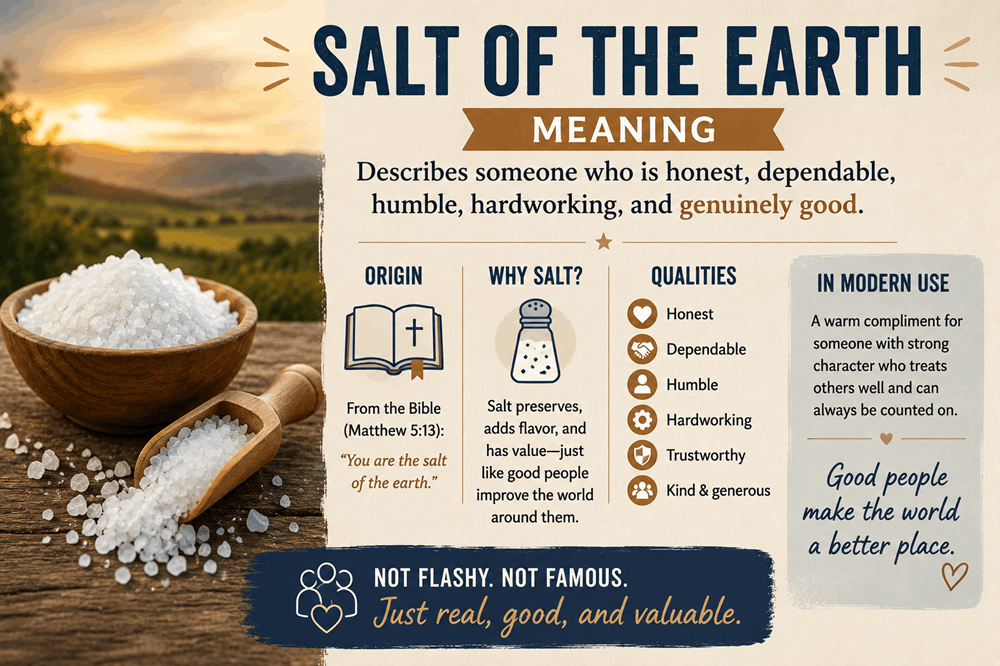
“Salt of the earth” describes someone who is honest, dependable, humble, hardworking, and genuinely good. If someone calls you the salt of the earth, they are usually paying you a strong compliment. They mean you are the kind of person others can trust—someone practical, sincere, and valuable without needing attention or praise.
The expression has biblical roots, but its modern meaning has expanded far beyond religion. Today, it is often used for ordinary people whose kindness, loyalty, and steady character make them especially respected.
What Does “Salt of the Earth” Mean?
Calling someone “the salt of the earth” means they are considered a particularly good and trustworthy person.
The phrase is commonly associated with qualities such as:
- Honesty
- Kindness
- Humility
- Reliability
- Hard work
- Loyalty
- Common sense
- Generosity
- Strong moral character
The person being described is usually not flashy.
They may never be the loudest person in the room or the one looking for recognition.
Instead, they are someone who shows up when needed, keeps promises, treats people fairly, and does what they believe is right.
That is the heart of the modern expression.
Is “Salt of the Earth” a Compliment?
Yes, almost always.
It is a warm and respectful compliment.
If someone says:
“Her grandparents are the salt of the earth,”
they probably mean the grandparents are kind, decent, hardworking people.
If someone says:
“John would give you the shirt off his back. He’s salt of the earth,”
the speaker is praising John’s generosity and character.
The compliment can sound somewhat traditional or old-fashioned, but it remains easy to understand.
It is especially common when describing someone valued for character rather than wealth, status, appearance, or fame.
Where Does “Salt of the Earth” Come From?
The expression comes from the Bible.
In the Gospel of Matthew, Jesus tells his followers, “You are the salt of the earth.” The phrase appears during the Sermon on the Mount.
To understand why salt was used as the image, it helps to remember how valuable salt was historically.
Salt was not simply something sprinkled casually over food.
It was useful for seasoning, preserving food, and everyday life. Before refrigeration, its ability to preserve food made it especially important.
Calling people “salt” therefore suggested that they had value and purpose.
They could have a preserving or beneficial influence on the world around them.
Why Was Salt Such a Powerful Symbol?
Modern supermarkets make salt look ordinary.
Historically, however, salt was extremely important.
Food spoils.
Salt can slow that process.
Food can taste bland.
Salt adds flavor.
This made salt a natural symbol for something that improves, preserves, or strengthens what surrounds it.
That symbolism helps explain why the phrase eventually became associated with good people.
A salt-of-the-earth person makes life around them a little better.
They may not transform the world dramatically.
They simply add something valuable to it through the way they live.
What Does “Salt of the Earth” Mean in the Bible?
In its biblical setting, the expression has a broader meaning than simply “nice person.”
Jesus uses salt as a metaphor while speaking about how his followers should live and influence the world around them.
Salt preserves and flavors.
Likewise, people of faith are encouraged to have a positive moral and spiritual influence.
The passage also warns about salt losing its saltiness.
The image suggests that having a role or identity matters only if that purpose is actually lived out.
Modern everyday speech has simplified this idea considerably.
Today, someone does not need to be religious to call another person “salt of the earth.”
The phrase has become a general compliment for good character.
What Kind of Person Is Salt of the Earth?
Imagine someone who helps without making a show of helping.
They remember when a neighbor needs a ride.
They bring food when someone is sick.
They work hard even when nobody is watching.
They treat the person cleaning the building with the same respect they give the company president.
They do not constantly remind everyone about the good things they have done.
That person fits the modern image of “salt of the earth.”
The phrase is less about impressive achievements and more about dependable character.
Does “Salt of the Earth” Mean Working Class?
Sometimes the phrase carries working-class associations, but that is not its literal meaning.
People often use it to describe farmers, tradespeople, laborers, small-town families, and other people seen as hardworking and down-to-earth.
For example:
“He came from a salt-of-the-earth farming family.”
In this sentence, the phrase suggests humility, hard work, and straightforward values.
But a wealthy person could also be described as salt of the earth if they are humble, kind, dependable, and unpretentious.
The expression describes character more than income.
What Does “Down-to-Earth” Mean Compared With “Salt of the Earth”?
The two expressions overlap, but they are not identical.
Down-to-earth usually means practical, realistic, friendly, and unpretentious.
Salt of the earth adds a stronger sense of moral goodness and reliability.
Someone can be down-to-earth without necessarily being unusually generous or honorable.
But calling someone salt of the earth usually suggests that you admire who they are as a person.
For example:
“Despite becoming famous, she’s very down-to-earth.”
This means fame did not make her arrogant.
But:
“She’s salt of the earth.”
This suggests something deeper about her character.
What Does “Salt-of-the-Earth Person” Mean?
A salt-of-the-earth person is someone who is good in a straightforward, uncomplicated way.
They are often described as someone you can count on.
If they say they will help, they help.
If they make a promise, they try to keep it.
If someone is struggling, they do not need a public audience before offering support.
The expression usually suggests consistency.
One kind gesture does not necessarily make someone salt of the earth.
It is more about a pattern of behavior over time.
Can “Salt of the Earth” Be Sarcastic?
Yes, although this is much less common than the sincere use.
Someone might say:
“Oh yes, he’s really the salt of the earth,”
after describing someone behaving selfishly or dishonestly.
The tone would make it clear that the speaker means the opposite.
In writing, sarcasm can be harder to recognize because you cannot hear the speaker’s voice.
Without obvious context, assume “salt of the earth” is a compliment.
How Do You Use “Salt of the Earth” in a Sentence?
Here are a few natural examples:
“My uncle is the salt of the earth. He’ll help anyone who asks.”
“Everyone in town loved her because she was truly salt of the earth.”
“They aren’t wealthy, but they are hardworking, generous, salt-of-the-earth people.”
“His parents are the salt of the earth—honest, kind, and completely unpretentious.”
“She never looks for praise. She’s just one of those salt-of-the-earth people.”
The expression can be used as a noun phrase or as an adjective before another noun.
For example:
“They are the salt of the earth.”
or:
“They are a salt-of-the-earth family.”
Why Do People Say “The Salt of the Earth” Instead of “Salt of Earth”?
The familiar expression comes from the older biblical wording, so it has survived as a fixed phrase.
English idioms often preserve wording that people would not naturally invent today.
You normally hear:
“the salt of the earth”
or:
“a salt-of-the-earth person.”
Removing “the” can make the phrase sound unnatural unless it is being used adjectivally.
What Is the Opposite of Salt of the Earth?
There is no exact opposite expression, but several descriptions contrast with it.
A person who is:
- Selfish
- Arrogant
- Dishonest
- Unreliable
- Manipulative
- Pretentious
- Unkind
would be difficult to describe as salt of the earth.
Words such as “self-serving” or “untrustworthy” express almost the opposite character.
Is “Salt of the Earth” Old-Fashioned?
It can sound traditional, but it is not obsolete.
You are more likely to hear it in thoughtful descriptions of someone than in fast-moving internet slang.
It often appears in:
- Tributes
- Obituaries
- Speeches
- Family stories
- Interviews
- Character descriptions
That makes sense because the phrase communicates something deeper than saying someone is merely “nice.”
It implies that their goodness has substance.
Why Is Salt Connected With Good Character?
The metaphor works because salt does something useful without drawing much attention to itself.
You rarely eat a meal and think only about the salt.
But remove it completely and you may immediately notice the difference.
Salt-of-the-earth people can be similar.
They may not be celebrities, leaders, or the most outspoken members of a community.
But their reliability holds families, workplaces, friendships, and neighborhoods together.
People notice their value most clearly when they are no longer there.
Does the Phrase Mean Someone Is Perfect?
No.
A person can be salt of the earth and still have flaws.
The phrase does not mean someone never makes mistakes or always knows the right answer.
It means their underlying character is considered good.
They are sincere.
They try to do right by other people.
They are dependable when it matters.
In fact, part of the phrase’s appeal is that it describes ordinary goodness rather than unrealistic perfection.
Can You Call Yourself Salt of the Earth?
You can, but it may sound strange.
Because humility is part of the expression, describing yourself as “the salt of the earth” can accidentally sound boastful.
It is much more natural as something another person says about you.
Someone else saying:
“She’s the salt of the earth,”
sounds affectionate.
Someone saying:
“I’m the salt of the earth,”
may sound as though they are praising their own humility.
That creates an obvious contradiction.
What Does “Salt of the Earth” Mean in Relationships?
If someone describes a partner as salt of the earth, they are usually praising qualities that make the relationship feel secure.
They may mean the person is:
- Loyal
- Dependable
- Honest
- Caring
- Supportive
- Unpretentious
This is not the language of dramatic romance.
It is the language of trust.
Calling someone salt of the earth may not sound as passionate as calling them irresistible, but it can express something more lasting.
It says: this is someone you can build a life around.
What Does It Mean When Someone Calls a Family Salt of the Earth?
When an entire family is described this way, the speaker is usually praising the values they seem to share.
A “salt-of-the-earth family” may be viewed as hardworking, welcoming, honest, modest, and community-minded.
The phrase often suggests that the family treats others well regardless of status.
They may not have the most impressive house or the most money.
What matters is that people trust them.
Why Is the Phrase Still Meaningful Today?
Modern culture often rewards visibility.
People are encouraged to build personal brands, gather followers, advertise achievements, and make themselves noticeable.
“Salt of the earth” celebrates almost the opposite quality.
It praises someone for being valuable without needing to perform that value publicly.
The person helps because help is needed.
They work because the work matters.
They keep promises because they believe promises should be kept.
That kind of goodness can look ordinary.
But ordinary does not mean unimportant.
The Bottom Line
“Salt of the earth” means a genuinely good, honest, humble, hardworking, and dependable person.
The expression comes from the Bible, where salt is used as a metaphor for value and positive influence.
Over time, the phrase became a general compliment that no longer requires a religious meaning.
Today, calling someone the salt of the earth says more than simply calling them nice.
It means they are trustworthy.
They treat people well.
They do not need constant recognition.
And when life becomes difficult, they are often the kind of person everyone hopes will still be standing nearby.
They may not be the loudest or most impressive person in the room.
They are simply someone whose presence makes the room better.