25 Songs With Baby in the Title That You’ll Instantly Recognize and Love
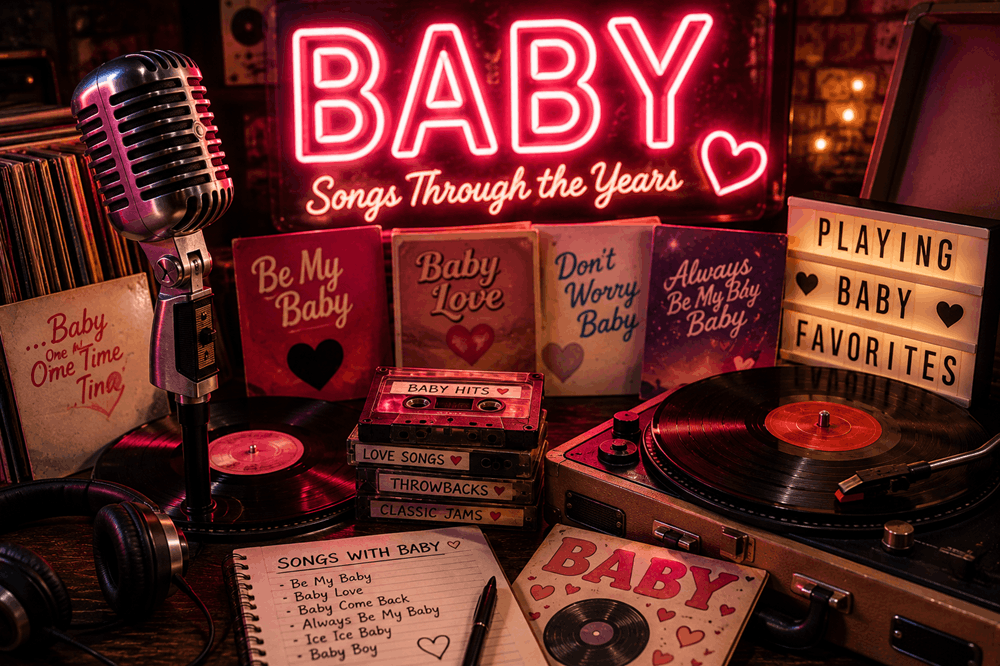
Songs with “baby” in the title appear in almost every era of popular music. Sometimes “baby” is a romantic nickname. Sometimes it refers to a child, a former lover, or someone the singer is trying desperately to keep. The word can sound tender, flirtatious, nostalgic, pleading, or even sarcastic depending on the song around it.
From Britney Spears and Justin Bieber to The Ronettes, Amy Grant, and Salt-N-Pepa, these songs show just how many different emotions can fit inside one familiar word.
1. “…Baby One More Time” — Britney Spears
Britney Spears’ debut single turned “baby” into one of the most recognizable phrases in late-1990s pop.
The song is about wanting another chance with someone after a breakup. The narrator feels lonely, regrets the separation, and wants the relationship restored.
Its polished production and instantly memorable chorus make the emotional desperation sound energetic rather than miserable.
That contrast became part of the song’s identity: heartbreak presented as huge, irresistible pop.
2. “Baby” — Justin Bieber featuring Ludacris
Justin Bieber’s “Baby” is one of the most famous songs ever to use the word as its entire title.
The track deals with young heartbreak. The narrator cannot understand how a relationship he believed was real has ended.
The repeated word “baby” becomes almost obsessive, which fits the adolescent feeling at the center of the song. When a first major relationship ends, the loss can feel enormous because there is little emotional history available for comparison.
3. “Be My Baby” — The Ronettes
“Be My Baby” is one of pop music’s defining love songs.
The title is direct: the narrator wants commitment from the person she loves.
What makes the song enormous is not the complexity of its story but the size of its feeling. The famous drum opening and dense production make a simple romantic request sound monumental.
The result is a song in which asking someone to “be my baby” feels like the most important decision in the world.
4. “Baby Love” — The Supremes
“Baby Love” combines sweetness with insecurity.
The narrator loves someone deeply but is hurt by the way he treats her. Instead of walking away, she asks him to return and stop breaking her heart.
Diana Ross’ delicate vocal delivery makes the song sound almost weightless, even though its emotional situation is painful.
That mixture of vulnerability and polish became a hallmark of many Motown classics.
5. “Always Be My Baby” — Mariah Carey
Mariah Carey’s “Always Be My Baby” is about accepting a breakup without completely accepting emotional separation.
The narrator allows the other person to leave, but she remains convinced that their connection will survive.
That confidence gives the song an unusual tone. It is not quite a plea and not quite a farewell.
The relationship may be over in practice, but in the narrator’s mind, some part of it is permanent.
6. “Baby Boy” — Beyoncé featuring Sean Paul
“Baby Boy” is built around desire.
Beyoncé sings about someone who occupies her thoughts so completely that fantasy and reality begin to blur.
The production reinforces that atmosphere with a warm, rhythmic sound that makes the song feel sensual and hypnotic.
Here, “baby boy” is less about tenderness than attraction.
7. “Baby, I Love Your Way” — Peter Frampton
Peter Frampton’s “Baby, I Love Your Way” is a straightforward expression of affection.
The song surrounds romance with images of changing daylight, stars, and quiet observation.
Instead of creating drama, it captures the feeling of simply wanting to remain near someone.
That simplicity has helped the song work across generations and through numerous cover versions.
8. “Baby Come Back” — Player
“Baby Come Back” is exactly what its title suggests: a plea after a breakup.
The narrator has tried to convince himself that he can live without the other person, but eventually admits that the separation hurts more than his pride will allow him to say.
That confession gives the song its emotional center.
He does not merely miss the relationship. He recognizes that pretending not to care has failed.
9. “Ice Ice Baby” — Vanilla Ice
Not every “baby” song is romantic.
“Ice Ice Baby” uses the word as part of a catchy phrase that became inseparable from Vanilla Ice’s public identity.
The track helped bring rap further into mainstream pop audiences in the early 1990s and remains instantly recognizable from its opening bass line.
Here, “baby” functions more like punctuation—a piece of swagger attached to the hook.
10. “Baby Got Back” — Sir Mix-a-Lot
“Baby Got Back” is another example where “baby” has little to do with romantic tenderness.
The song celebrates a particular body type while poking fun at narrow beauty standards in mainstream media.
Its exaggerated delivery, spoken introduction, and enormous hook made it one of the defining novelty-rap hits of the early 1990s.
The title became a phrase recognizable far beyond the song itself.
11. “Don’t Worry Baby” — The Beach Boys
“Don’t Worry Baby” combines romance with reassurance.
The narrator is nervous about a situation involving pride and competition, while the person he loves offers calm support.
Her reassurance becomes the emotional anchor of the song.
The result is not simply a love song. It is about how one person’s confidence in you can temporarily quiet your own fear.
12. “Baby, Baby” — Amy Grant
Amy Grant’s “Baby, Baby” is bright, affectionate pop built around uncomplicated warmth.
The title repeats the term of endearment until it becomes part of the song’s rhythm.
Rather than focusing on heartbreak or conflict, the track celebrates attachment and joy.
That optimistic tone helped make it one of Grant’s biggest crossover pop successes.
13. “Baby Hold On” — Eddie Money
“Baby Hold On” asks someone not to give up on a relationship.
The narrator believes the future remains uncertain but insists that uncertainty is not a reason to leave.
That makes the title a request for patience as much as love.
Sometimes staying together is less about knowing everything will work and more about deciding not to walk away before finding out.
14. “Baby Don’t Forget My Number” — Milli Vanilli
“Baby Don’t Forget My Number” turns romantic anxiety into a bright pop hook.
The narrator fears being forgotten and repeatedly asks the other person to remember how to reach him.
The idea is simple, but it captures a familiar insecurity: wondering whether someone who matters deeply to you is already moving on.
15. “Baby, Now That I’ve Found You” — The Foundations
This song begins with a romantic discovery but quickly introduces fear.
The narrator has finally found someone he loves and does not want to lose her.
That makes the title more complicated than it first sounds.
Finding love creates happiness, but it also creates something new to lose.
16. “Cry Baby” — Janis Joplin
Janis Joplin’s “Cry Baby” turns consolation into raw emotional performance.
The narrator addresses someone who has been hurt elsewhere and tells him he can return to her.
Joplin’s vocal makes the invitation sound almost physically painful.
This is not gentle reassurance. It is devotion delivered at full force.
17. “Baby Blue” — Badfinger
“Baby Blue” is a bittersweet song about love complicated by distance, timing, and regret.
The narrator addresses someone he still cares about while acknowledging that things between them have changed.
The phrase “baby blue” sounds affectionate, but the color also naturally carries associations with sadness.
That double meaning suits the song perfectly.
18. “Hey Baby” — No Doubt featuring Bounty Killer
No Doubt’s “Hey Baby” looks at attraction from within the strange environment of touring life.
Rather than presenting romance as intimate and permanent, the song describes social scenes, flirtation, and the distance of watching people interact around you.
The repeated “hey baby” works as the kind of casual phrase heard in noisy clubs and backstage spaces.
It is less a declaration of love than part of the atmosphere.
19. “Baby, It’s Cold Outside” — Various Artists
“Baby, It’s Cold Outside” is structured as a conversation between two people at the end of an evening.
One person says it is time to leave while the other repeatedly gives reasons to stay.
The song has been recorded by countless artists, and modern listeners have debated its flirtatious back-and-forth extensively.
Whatever interpretation a listener brings to it, its duet structure makes it unlike most other songs on this list.
20. “There Goes My Baby” — The Drifters
“There Goes My Baby” captures the moment after a relationship has already slipped away.
The narrator watches the person he loves leave and realizes the consequences of his own actions.
The title is painful because it describes movement.
She is not merely gone in an abstract sense. He can almost see the separation happening in front of him.
21. “Since I Lost My Baby” — The Temptations
“Since I Lost My Baby” is about how heartbreak changes everything around you.
The outside world continues normally. The sun still shines. People still work, laugh, and live.
But none of that feels right to the narrator because the person he loves is missing.
That contrast is one of the song’s strongest ideas: the world can look perfectly fine while your private experience of it has completely changed.
22. “Baby Can I Hold You” — Tracy Chapman
Tracy Chapman’s “Baby Can I Hold You” is really a song about words arriving too late.
The narrator struggles with saying the things that might repair emotional distance.
Apologies and declarations of love sound simple, yet sometimes they become nearly impossible to say at the moment when they matter most.
The title finally reduces that emotional difficulty to one physical request: can closeness say what language has failed to express?
23. “Baby I Need Your Loving” — Four Tops
“Baby I Need Your Loving” turns longing into urgency.
The narrator is separated from someone he loves and admits just how deeply her absence affects him.
The song does not pretend independence.
Its emotional power comes from openly acknowledging need, which the soaring Motown arrangement makes feel enormous rather than embarrassing.
24. “My Baby Just Cares for Me” — Nina Simone
“My Baby Just Cares for Me” celebrates a lover who seems uninterested in status, luxury, and fashionable distractions.
The narrator takes pleasure in the idea that affection matters more than everything else competing for attention.
Nina Simone’s playful performance gives the song personality and sophistication.
Here, “my baby” suggests secure affection rather than desperate longing.
25. “Give It to Me Baby” — Rick James
Rick James’ “Give It to Me Baby” uses the word in a funkier and more provocative context.
The track is driven by desire, nightlife, and an unmistakably physical energy.
Its bass-heavy groove carries as much meaning as the words.
Rather than sounding tender, “baby” becomes part of a confident demand.
Why Is “Baby” Used in So Many Songs?
Few words work as naturally in popular music as “baby.”
It is short, easy to sing, emotionally flexible, and immediately understandable.
A singer can use it tenderly, as in “Be My Baby,” desperately, as in “Baby Come Back,” confidently, as in “Give It to Me Baby,” or playfully, as in “Ice Ice Baby.”
The word also fits easily into choruses because its two syllables can stretch, repeat, or sit naturally on a beat.
That practical musical quality is one reason it appears so often across pop, rock, R&B, soul, country, and hip-hop.
What Are the Most Famous Songs With Baby in the Title?
Several songs stand above the rest in cultural recognition.
Britney Spears’ “…Baby One More Time,” Justin Bieber’s “Baby,” The Ronettes’ “Be My Baby,” The Supremes’ “Baby Love,” Mariah Carey’s “Always Be My Baby,” and Vanilla Ice’s “Ice Ice Baby” are among the clearest examples.
Interestingly, they use the same word in completely different ways.
Britney Spears uses it in a plea for another chance. Bieber uses it in young heartbreak. The Ronettes make it a request for commitment. Mariah Carey makes it a claim that emotional attachment will survive separation.
Vanilla Ice barely uses it romantically at all.
More Songs With Baby in the Title
There are plenty more choices for a “baby” playlist, including “Baby Please Don’t Go,” “Baby What a Big Surprise” by Chicago, “Baby Be Mine” by Michael Jackson, “Baby Jane” by Rod Stewart, “Baby I’m-a Want You” by Bread, “Baby Hold On to Me” by Gerald Levert featuring Eddie Levert, “Baby Come to Me” by Patti Austin and James Ingram, and “Baby Don’t Get Hooked on Me” by Mac Davis.
The word has appeared so frequently that a complete list could stretch across decades of popular music.
Why Do So Many Love Songs Call Someone “Baby”?
Terms of endearment create instant intimacy.
A songwriter could use a person’s actual name, but “baby” allows almost any listener to place themselves—or someone they know—inside the song.
That universality helps explain why the word has survived changing musical fashions.
A production style can sound dated. Slang can disappear. Instruments and genres can change.
But calling someone you love “baby” remains immediately understandable.
The Bottom Line
Songs with “baby” in the title cover far more emotional territory than the word might suggest.
“Be My Baby” asks for commitment. “Baby Come Back” admits regret. “Always Be My Baby” refuses to believe emotional connection can disappear completely. “Don’t Worry Baby” offers reassurance, while “Baby Can I Hold You” deals with the painful difficulty of saying the right thing in time.
That flexibility is why “baby” has remained one of music’s favorite words for generations.
Sometimes it means love. Sometimes it means desire. Sometimes it means heartbreak.
And sometimes it simply makes the chorus impossible to forget.