Taylor Swift Songs About Friendship: 12 Tracks About Loyalty, Distance and Growing Apart
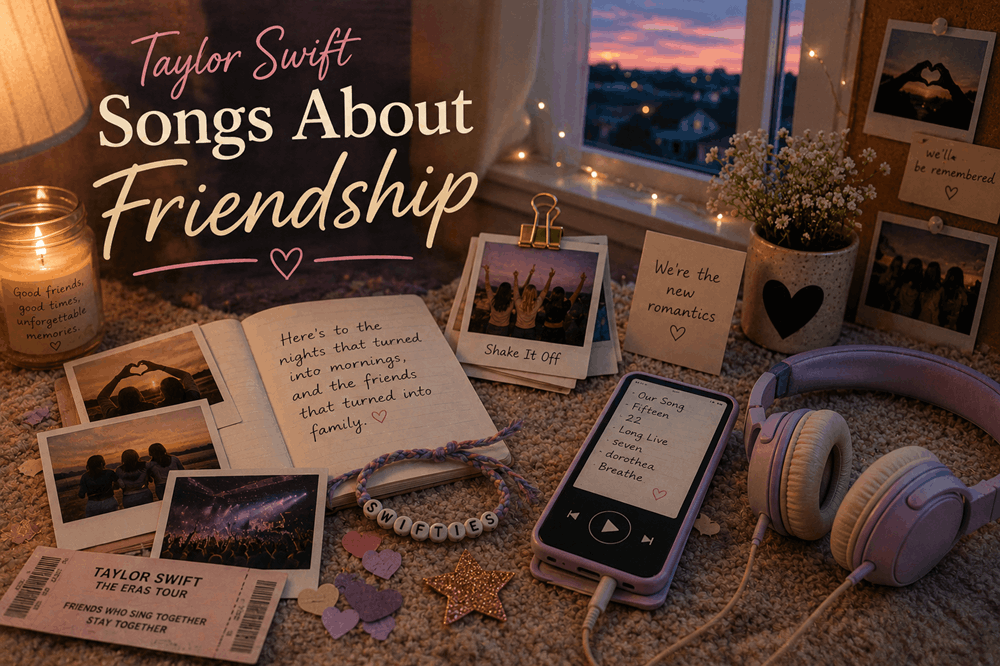
Taylor Swift’s best songs about friendship include “I’m Only Me When I’m With You,” “Fifteen,” “Long Live,” “seven,” “dorothea” and “Breathe.”
They do not all describe friendship at its happiest. Some celebrate the person who makes you feel completely yourself. Others look back on childhood companions, friendships weakened by distance or the unusually painful experience of losing a friend without either person becoming the villain.
More recent songs such as “CANCELLED!,” “Ruin the Friendship” and “I Knew It, I Knew You” expand that theme into public loyalty, romantic hesitation and reunion after years apart.
These 12 tracks reveal how friendship has remained one of the quieter but most consistent subjects in Swift’s songwriting.
1. “I’m Only Me When I’m With You”
“I’m Only Me When I’m With You” is Swift’s most direct celebration of uncomplicated companionship.
The relationship in the song feels comfortable rather than dramatic. The narrator does not need to impress the other person, control the conversation or hide the less polished parts of herself. Being together creates the freedom to behave naturally.
That makes the central idea more meaningful than a simple statement about enjoying someone’s company.
A close friendship can become the place where a person feels most recognizable to themselves. The friend is not changing the narrator into someone new. Their presence removes the pressure that ordinarily prevents her real personality from appearing.
The music video reinforces that warmth through personal footage of Swift spending time with friends and family rather than staging a conventional romantic storyline.
2. “Fifteen”
“Fifteen (Taylor’s Version)” is remembered partly as a song about teenage romance, but its most lasting relationship is the friendship between the narrator and Abigail.
Both girls enter high school believing older students, first dates and popularity may determine their futures. As the year unfolds, they experience disappointment together and begin understanding that early romantic attention is not the same as lasting love.
The friendship matters because neither girl is presented as wiser from the beginning.
They learn beside each other.
When one of them is hurt, the other does not deliver a perfect lesson or say she should have known better. They cry together. That small response gives the song its emotional honesty.
“Fifteen” respects teenage heartbreak while quietly showing why a dependable friend may become more important than the boy who originally seemed to define the entire school year.
3. “Long Live”
“Long Live (Taylor’s Version)” expands friendship beyond one private relationship.
The song reads as a thank-you to the bandmates, collaborators and listeners who helped create a shared period of success. Swift turns those people into a small kingdom of outsiders who reached something extraordinary together.
Its fantasy imagery is intentionally enormous: walls fall, crowds gather and ordinary young people become kings and queens.
Yet the song’s emotional center is the fear that the group may not remain together forever.
Success changes careers. People leave. Tours end. Even intense friendships formed through shared work may eventually exist mainly in photographs and stories.
“Long Live” does not deny that possibility. It asks the people involved to remember what they accomplished together and to preserve one another’s names when the moment has passed.
4. “22”
“22 (Taylor’s Version)” captures the temporary freedom of going out with friends while adulthood still feels negotiable.
The characters are not completely happy or completely secure. They are excited, confused, lonely and optimistic at the same time.
That emotional mixture is what makes the song work.
A night with friends does not solve anyone’s career anxiety, romantic disappointment or uncertainty about the future. It creates several hours during which those concerns become less powerful.
The group can leave an overcrowded party, laugh about former relationships, eat at an unreasonable hour and postpone responsibility until morning.
“22” celebrates friendship as a form of temporary shelter. Nothing has been permanently fixed, but being surrounded by the right people makes instability feel adventurous rather than frightening.
5. “seven”
“seven” remembers a childhood friendship through incomplete adult understanding.
The narrator recalls games, hiding places and the intensity with which children attach themselves to one another. She also remembers signs that her friend’s home may not have been safe or happy.
As a child, she cannot name the problem or provide a realistic solution.
Instead, she imagines escape.
That response is innocent but emotionally perceptive. Children may not understand abuse, family conflict or fear in adult terms, yet they often recognize that something feels wrong.
The friendship survives in memory even though the two children apparently do not remain close. The narrator can no longer recall every physical detail, but she remembers the love and protectiveness she felt.
“seven” is one of Swift’s strongest songs about how an early friend can disappear from your life while remaining part of the person you became.
6. “dorothea”
“dorothea” addresses a former friend who has left a small hometown and entered a more glamorous life.
The narrator watches from a distance and wonders whether Dorothea still remembers the person she was before other people began recognizing her.
There is no angry accusation.
He does not demand that she return, apologize or abandon her ambitions. He simply reminds her that she would still be welcome in the place where she was known without the performance attached to her public identity.
That makes “dorothea” a song about one of friendship’s gentler forms: keeping a door open.
Some friendships cannot remain part of everyday life because careers, geography and personal growth pull people in different directions. Their value may survive as the knowledge that someone, somewhere, remembers who you were before everything changed.
7. “I Knew It, I Knew You”
“I Knew It, I Knew You” explores the moment when an old bond suddenly becomes recognizable again.
Swift wrote the original song for Toy Story 5, connecting it with Jessie and a relationship separated by time. The song works beyond the film because its central experience is familiar: seeing someone after many years and discovering that memory has preserved more than expected.
The friends have changed.
Life has carried them through experiences they did not share. Yet a familiar expression, voice or mannerism returns the emotional connection almost instantly.
The song does not pretend the missing years never happened. Its comfort comes from realizing that distance did not make the earlier love imaginary.
Some friendships cannot continue in a straight, uninterrupted line. They disappear, circle back and prove their strength through recognition.
The official video identifies it as an original song created for Disney and Pixar’s film, while the song’s country-pop arrangement also reconnects Swift with the sound of her early career.
8. “It’s Nice to Have a Friend”
“It’s Nice to Have a Friend” follows companionship from childhood into adult partnership.
The early images are deliberately ordinary: walking home, sharing gloves, playing games and exchanging notes. Friendship grows through repeated acts that seem insignificant while they are happening.
The relationship later becomes romantic, but the song does not treat romance as a replacement for friendship.
It treats friendship as the foundation.
The two people can speak honestly, acknowledge stress, spend unremarkable weekends together and trust that the other person will remain present. Marriage becomes another stage of the same companionship rather than the beginning of an entirely different relationship.
The song’s minimal arrangement suits that idea. It does not need a huge declaration because its version of love is built from small, consistent moments.
“It’s Nice to Have a Friend” is one of Swift’s clearest arguments that the strongest romantic relationship may still feel, at its center, like friendship.
9. “Breathe”
“Breathe (Taylor’s Version)” is a friendship-breakup song disguised as a romantic ballad.
Neither person has committed an obvious betrayal. The friendship is ending because circumstances, careers or personal development have made the old relationship impossible to continue in the same way.
That absence of blame makes the separation more difficult.
Anger can simplify a goodbye. It allows someone to decide that leaving is necessary because the other person behaved badly. “Breathe” describes a loss in which affection remains and neither person can be reduced to the villain.
Colbie Caillat, who co-wrote and sings on the track, has explained that Swift was processing the end of a friendship during a period of change involving her career and touring circle.
The song recognizes a painful truth: caring about someone does not always give two people a workable future together.
Sometimes a friendship ends without invalidating what it once meant.
10. “New Romantics”
“New Romantics (Taylor’s Version)” is less about one friend than about surviving disappointment as a group.
The characters have experienced romantic failure, social pressure and the emotional exhaustion of trying to appear unaffected. Instead of waiting for perfect relationships to rescue them, they turn heartbreak into a shared culture.
The group laughs, dances and continues.
That response does not mean the pain is fake. It means friendship prevents pain from becoming the only available story.
“New Romantics” captures the particular confidence of entering a room with people who already understand what happened. No detailed explanation is necessary. Everyone carries their own version of disappointment, and that mutual recognition becomes a source of energy.
The song is useful for friendship playlists because it celebrates chosen community: the people who help transform romantic chaos into a night you may eventually remember with affection.
11. “CANCELLED!”
“CANCELLED!” presents friendship as loyalty under public pressure.
Rather than choosing only socially approved companions, the narrator is drawn to people who have been judged, criticized or reduced to controversy. She understands what it feels like to become the subject of mass opinion and therefore views another person’s public downfall with greater skepticism.
The song is not a claim that friends should excuse every action.
Its sharper point is that public outrage rarely captures a whole person. A loyal friend may remain close enough to distinguish an actual mistake from the simplified character created online.
“CANCELLED!” appeared on 2025’s The Life of a Showgirl. Swift has not confirmed that it describes one specific friend, so theories attaching it to particular public figures remain speculation. The song works more clearly as a statement about solidarity among women who have experienced scrutiny and reputational damage.
12. “Ruin the Friendship”
“Ruin the Friendship” asks whether protecting a friendship can become its own form of regret.
The narrator remembers a close connection that might have developed into romance. At the time, crossing that line appeared dangerous. A confession or kiss could have destroyed the comfortable relationship already available.
Looking back, caution no longer seems obviously wise.
The song is not simply advising everyone to pursue a friend romantically. It is about the permanent uncertainty created by a choice that was never tested.
Later grief gives that hesitation additional weight. The narrator can no longer return to the moment and discover what might have happened.
Released on The Life of a Showgirl, “Ruin the Friendship” extends a subject already present in “It’s Nice to Have a Friend.” One song imagines friendship developing successfully into lasting love; the other examines the possibility left behind when fear prevented that development.
Taylor Swift songs about broken or betrayed friendships
Several other tracks fit a less affectionate friendship playlist.
“Bad Blood” describes trust becoming hostility after a serious betrayal. Its language is deliberately broad, so attaching every detail to one rumored real-life relationship is unnecessary.
“This Is Why We Can’t Have Nice Things” turns a damaged friendship into sarcastic celebration. The narrator briefly believed reconciliation was possible before deciding that renewed trust had been mishandled.
“closure” rejects an attempt to make a broken relationship feel neatly resolved.
“I Forgot That You Existed” focuses on the quieter ending that follows anger: the moment when someone who once occupied your thoughts stops feeling important.
These songs show that Swift’s friendship writing is not limited to loyalty and nostalgia. It also examines distrust, fallout and the relief of finally releasing a connection that became harmful.
The best Taylor Swift friendship songs for different moments
For a best-friend tribute, begin with “I’m Only Me When I’m With You,” “Fifteen” and “Long Live.”
For childhood friends, choose “seven,” “dorothea” and “I Knew It, I Knew You.”
For a friendship that became romantic, use “It’s Nice to Have a Friend” or “Ruin the Friendship.”
For a night out with friends, “22” and “New Romantics” create the strongest energy.
For a friendship breakup, “Breathe” is the clearest and most compassionate choice.
For loyalty during difficult times, “CANCELLED!” presents friendship as remaining close when public approval has disappeared.
Final thoughts
Taylor Swift’s friendship songs recognize that platonic relationships can shape a life as deeply as romantic ones.
“I’m Only Me When I’m With You” celebrates the friend who makes self-consciousness disappear.
“Fifteen” shows two girls learning about adulthood beside each other, while “Long Live” preserves a larger community built through shared ambition.
The later songs become more complicated.
“seven” remembers a child the narrator could not save. “dorothea” keeps a place open for someone who left, and “Breathe” accepts that love does not always prevent friends from growing apart.
“CANCELLED!” values loyalty under scrutiny. “Ruin the Friendship” wonders whether caution protected a bond or prevented it from becoming something more, while “I Knew It, I Knew You” imagines recognition surviving years of separation.
Taken together, the songs argue that friendship is not secondary to the important events of life.
Friendship is one of those events.