Did Elvis Write Any Songs? The Truth Behind His Songwriting Credits
Elvis Presley was not primarily a songwriter, and he did not write most of the songs that made him famous.
He recorded hundreds of compositions written by professional songwriters, including “Hound Dog,” “Jailhouse Rock,” “Suspicious Minds,” “Can’t Help Falling in Love,” “In the Ghetto” and “Burning Love.”
However, the answer is not simply that Elvis never wrote anything.
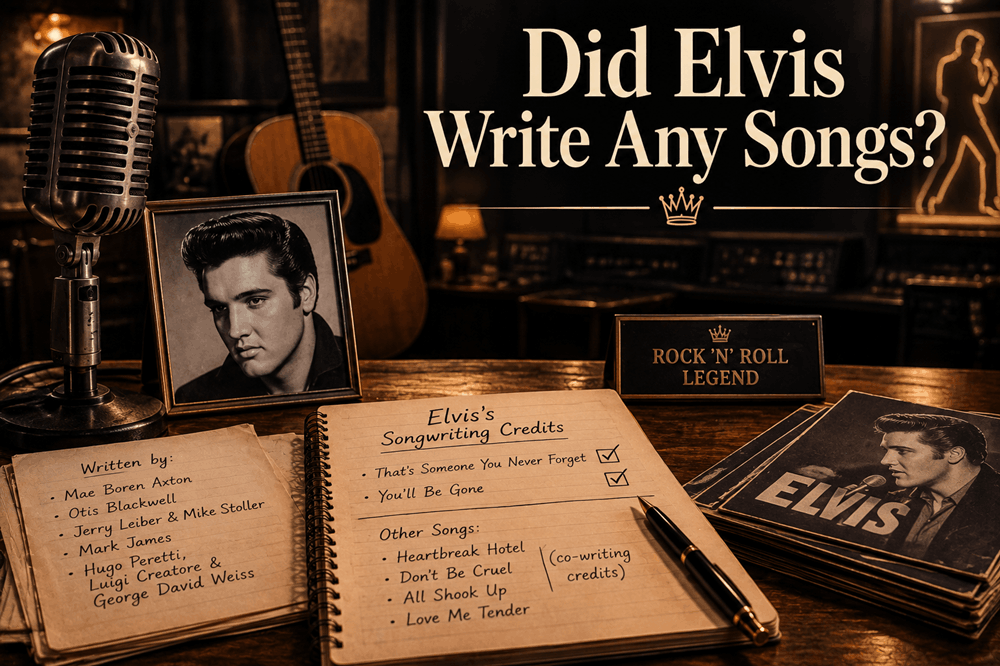
He received official co-writing credit on a small group of recordings, and at least two songs—“That’s Someone You Never Forget” and “You’ll Be Gone”—are generally recognized as genuine collaborations in which he contributed to the song’s creation.
Other credits, including “Heartbreak Hotel,” “Don’t Be Cruel” and “All Shook Up,” were connected more closely with publishing and royalty arrangements than with Elvis sitting down and composing the songs.
The clearest answer is:
Elvis did help write a few songs, but he was primarily a singer and interpreter. Many of the famous songs carrying his name in the writing credits were written mainly—or entirely—by other people.
Which songs did Elvis genuinely help write?
The two strongest examples are “That’s Someone You Never Forget” and “You’ll Be Gone.”
Both were created during the early 1960s with members of Elvis’s close circle rather than professional songwriting teams sending finished demos through his publishing company.
“That’s Someone You Never Forget”
“That’s Someone You Never Forget” is officially credited to Elvis Presley and Red West.
West was Elvis’s longtime friend, bodyguard and occasional songwriter. Historical accounts say Elvis supplied the title and central idea, then asked West to develop a song around it.
The composition appeared on the 1962 album Pot Luck and was later released as a single in 1967. Sony’s official Elvis catalog lists both Red West and Elvis Presley as its writers.
The song is often interpreted as being connected with Elvis’s mother, Gladys, who died in 1958. That interpretation is plausible because of the song’s theme of a person whose memory never disappears, but Elvis did not leave a definitive public explanation confirming that she was its subject.
What matters for the authorship question is that Elvis appears to have contributed more than his name. He suggested the concept that became the foundation of the song.
“You’ll Be Gone”
“You’ll Be Gone” is credited to Elvis Presley, Red West and Charlie Hodge.
The official Elvis catalog confirms all three names and states that the song was recorded at RCA Studio B in Nashville in March 1962.
The project reportedly began when Elvis wanted to create new lyrics for Cole Porter’s “Begin the Beguine.” After permission to alter that composition was not granted, Elvis, West and Hodge developed new music and lyrics instead.
The completed recording carries a Latin-influenced rhythm and a more unusual melodic shape than the average Elvis soundtrack song. It was eventually released in 1965 as the B-side of “Do the Clam.”
Accounts associated with Elvis by the Presleys identify “You’ll Be Gone” as Elvis’s final serious attempt at songwriting.
These two tracks are the clearest evidence that Elvis was capable of contributing to a composition when he chose to. He simply did not make songwriting a central part of his career.
Did Elvis write “Heartbreak Hotel”?
Elvis received an official co-writing credit on “Heartbreak Hotel”, alongside Mae Boren Axton and Tommy Durden. Sony’s official catalog continues to display all three names.
However, the song was created by Axton and Durden before Elvis recorded it.
Archival materials at Columbia University preserve an interview in which Axton and Durden discuss how they wrote “Heartbreak Hotel,” and contemporary accounts consistently identify them as the people who developed the story, title and lyrics.
Elvis was presented with the song, recognized its potential and transformed it through his recording. His performance, unusual vocal echo and bleak atmosphere helped make it his first major RCA breakthrough.
That creative interpretation was enormously important, but it is different from writing the underlying song.
His name was added to the published credit as part of the agreement surrounding his recording and the song’s royalties.
Did Elvis write “Don’t Be Cruel”?
“Don’t Be Cruel” is officially credited to Otis Blackwell and Elvis Presley.
The song itself was written by Otis Blackwell, one of the most important professional writers of early rock and roll. The Songwriters Hall of Fame identifies “Don’t Be Cruel,” “All Shook Up” and “Paralyzed” among the Blackwell compositions recorded by Elvis.
Elvis may have adjusted phrasing, lyrics or arrangement details during the recording process, but he was not the primary composer.
The shared credit gave him a portion of the publishing income and made the song appear to be a formal collaboration even though Blackwell supplied the composition.
What about “All Shook Up”?
The official credit for “All Shook Up” also names Otis Blackwell and Elvis Presley.
Graceland’s own history of Elvis’s No. 1 songs states more directly that “All Shook Up” was written by Blackwell. It also notes that Elvis had become uncomfortable with receiving writing credit through publishing arrangements and that this was the last Blackwell song on which he accepted such a credit.
That distinction is valuable because it comes from an official Elvis source.
The record label says Blackwell and Presley.
The historical explanation says Blackwell wrote the song, while Presley’s name reflected the business practices surrounding the recording.
“Paralyzed” followed the same pattern
“Paralyzed” is another recording officially credited to Otis Blackwell and Elvis Presley.
As with “Don’t Be Cruel” and “All Shook Up,” Blackwell was the professional songwriter responsible for the composition.
Elvis’s importance was in turning the material into a performance that sounded specifically like him. His rhythmic delivery, vocal attack and relationship with the musicians shaped the record, even when he did not create the song on paper.
Did Elvis write “Love Me Tender”?
The published credit for “Love Me Tender” names Elvis Presley and Vera Matson.
Its history is considerably more complicated.
The melody was adapted from the 19th-century song “Aura Lea.” New lyrics and the arrangement used for the film were created by Ken Darby, but Darby’s wife, Vera Matson, received the published credit alongside Elvis.
Darby later joked that he credited his wife because she had contributed about as much to the writing as Elvis had. Although the official credits remain Presley and Matson, the song is historically regarded as Darby’s adaptation.
The same credit appears on three other songs prepared for Elvis’s first film:
Sony’s catalog lists Vera Matson and Elvis Presley as the writers of all three recordings.
Their official credits therefore belong in a list of songs carrying Elvis’s name, but they should not be treated as proof that he personally composed the soundtrack.
Why was Elvis given writing credit on songs he did not write?
Songwriting credit controls part of a song’s publishing income.
When a record sells, is broadcast, appears in a movie or is licensed for another use, the song’s writers and publishers can receive royalties separate from the money earned by the recording artist.
Elvis’s management and associated publishing companies understood that his recordings could make a song extraordinarily valuable. Writers who wanted him to record their material could therefore be asked to surrender part of the publishing interest or allow his name to appear in the credit.
The practice was particularly visible during the mid-1950s, when Elvis’s commercial influence increased faster than nearly anyone in the record business had anticipated.
Not every writer accepted such an arrangement. Others decided that sharing part of the income was worthwhile because an Elvis recording could turn a previously unknown composition into an international hit.
The system can make the historical credits confusing.
A label may correctly display Elvis as a co-writer under the legal agreement, while accounts of the actual writing session identify someone else as the person who created the words and music.
Did Elvis write any songs by himself?
There is no major, commercially released Elvis hit that is generally accepted as a song he wrote entirely by himself.
His most credible compositions were collaborations.
Even “That’s Someone You Never Forget” began with Elvis’s title and concept before Red West helped turn the idea into a complete recording. “You’ll Be Gone” was created with both West and Charlie Hodge.
This does not mean Elvis lacked musical ideas.
Songwriting is only one form of musical creativity.
He could hear a demo and understand how its tempo, phrasing or emotional character needed to change. He combined country, blues, gospel and pop influences in ways that made existing material sound unfamiliar to mainstream listeners.
Who wrote Elvis’s biggest songs?
Many of Elvis’s defining recordings came from professional writers whose names remain less famous than his.
“Hound Dog” and “Jailhouse Rock” were written by Jerry Leiber and Mike Stoller.
“Suspicious Minds” was written by Mark James.
“Can’t Help Falling in Love” was written by Hugo Peretti, Luigi Creatore and George David Weiss.
Mac Davis wrote or co-wrote several important late-1960s Elvis recordings, including “In the Ghetto,” “Memories,” “Don’t Cry Daddy” and “A Little Less Conversation.”
Elvis’s catalog was therefore created through relationships among performers, publishers, producers, studio musicians and specialist writers.
Was Elvis less talented because he was not a songwriter?
No.
Modern audiences often expect major singers to write or co-write their material, but that was not the only respected model of musical artistry during Elvis’s era.
Frank Sinatra, Ella Fitzgerald and many other major vocalists built careers largely by interpreting songs written by other people.
Interpretation requires judgment.
The singer decides where to pause, which word to emphasize, how much vulnerability to reveal and whether the song should sound intimate, aggressive, playful or desperate.
Elvis’s recordings frequently became more famous than earlier versions because he changed how audiences experienced the material.
“Hound Dog” existed before Elvis, but his recording gave it a new rhythmic attack and cultural meaning.
“Blue Moon of Kentucky” began as a Bill Monroe bluegrass song. Elvis and the Sun musicians accelerated it and reshaped it into rockabilly.
His artistic contribution existed in the sound of the finished record rather than primarily in the published lyric sheet.
Why do people assume Elvis wrote his hits?
The confusion comes partly from the songwriting credits.
Someone looking at “Heartbreak Hotel,” “Don’t Be Cruel” or “All Shook Up” sees Elvis’s name printed beside the established writer and reasonably assumes that they worked together as equal composers.
His public image also encouraged the belief that the songs expressed his personality directly.
When he performed “Jailhouse Rock” or “Suspicious Minds,” the performance felt so closely connected with him that separating the singer from the writer became difficult.
Elvis did not merely cover songs neutrally.
He absorbed them into his vocal identity.
That ability made songs written by many unrelated people sound as though they all belonged to the same artist.
Final answer
Elvis Presley did not write most of his songs, and he did not write his famous hits by himself.
His name appears in the official writing credits for songs including “Heartbreak Hotel,” “Don’t Be Cruel,” “All Shook Up,” “Paralyzed” and “Love Me Tender.” In most of those cases, the credit was connected with publishing agreements rather than substantial authorship.
The two clearest genuine Elvis co-writes are:
- “That’s Someone You Never Forget,” written with Red West
- “You’ll Be Gone,” written with Red West and Charlie Hodge
Elvis was therefore not a traditional singer-songwriter.
He was an interpreter whose greatest creative skill was hearing what a song could become.
Professional writers supplied most of the words and melodies.
Elvis supplied the voice, phrasing, rhythm and personality that made millions of listeners remember them.