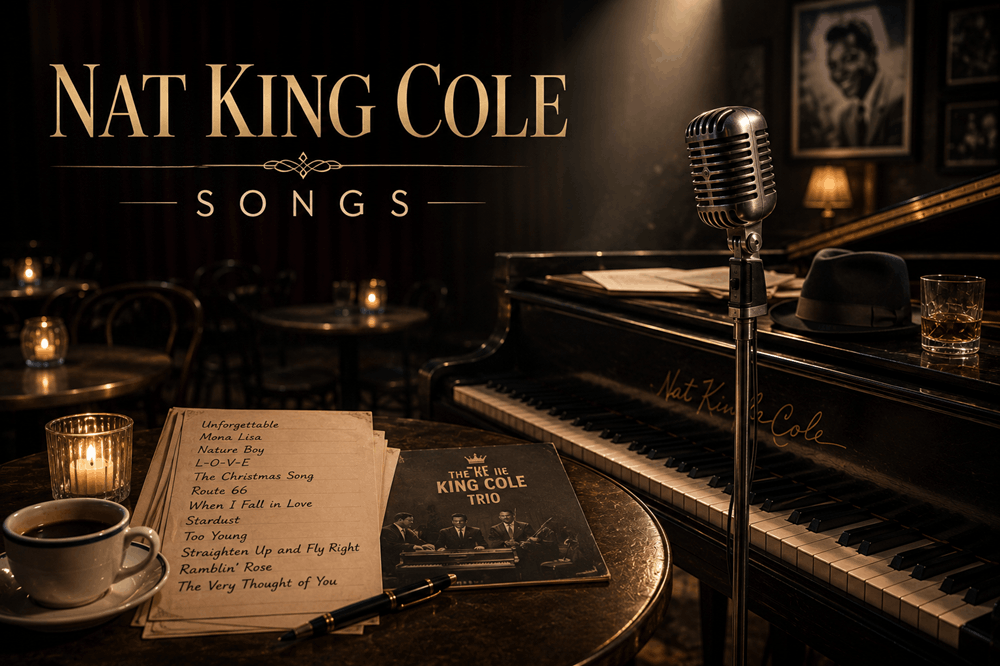
Nat King Cole Songs: 12 Essential Recordings From “Unforgettable” to “L-O-V-E”
The best Nat King Cole songs combine technical control with an unusual sense of ease.
He could swing lightly with the King Cole Trio, transform an old standard into a private confession or sing over a full orchestra without allowing the arrangement to overpower him. His voice was smooth, but it was never emotionally blank. Small changes in timing, emphasis and tone made familiar words feel newly considered.
Cole began as an accomplished jazz pianist and formed the King Cole Trio in the late 1930s. Singing gradually became a larger part of his performances, and his success eventually made him one of the most influential popular vocalists of the 20th century. His official estate credits him with charting 150 singles across Billboard’s pop, R&B and country rankings, while the Recording Academy counts 28 Top 40 hits. (The Nat King Cole)
These 12 songs provide the clearest introduction to his development from quick-witted jazz pianist to one of the defining interpreters of the American popular songbook.
1. “Straighten Up and Fly Right”
“Straighten Up and Fly Right” was Nat King Cole’s breakthrough recording and one of the songs that best preserves his identity as both pianist and singer.
Cole wrote the song and recorded it with the King Cole Trio in 1943. The Library of Congress describes it as an almost perfect example of swing and notes that Cole wrote it in an Omaha hotel room. It later entered the National Recording Registry because of its cultural and historical significance. (The Library of Congress)
The humorous story involves a monkey receiving advice from a buzzard, but the performance never sounds like a disposable novelty.
Cole’s piano dances around the vocal lines. The rhythm moves lightly, and the repeated title becomes both a comic instruction and a broader demand to behave responsibly.
It is an essential starting point because it shows that Cole’s musical identity existed long before the large orchestras and romantic ballads. His vocal charm grew naturally from the rhythmic intelligence of his piano playing.
2. “(Get Your Kicks on) Route 66”
“Route 66” transforms a cross-country journey into one of popular music’s most enduring road songs.
Bobby Troup wrote the composition in 1946 after traveling west toward California. The King Cole Trio made the first widely successful recording, with Cole singing and playing piano alongside guitarist Oscar Moore and bassist Johnny Miller. (Wikipedia)
The lyrics move through American place names, but the trio makes the route feel musical rather than geographical.
Cole’s relaxed delivery suggests a traveler enjoying the journey rather than urgently attempting to reach the destination. Moore’s guitar responds with bright, precise phrases, while the absence of drums gives the recording an unusually open swing.
Later versions moved the song into rock and roll, blues and country. Cole’s performance remains the foundation because it contains movement without hurry.
3. “Nature Boy”
“Nature Boy” introduced a much stranger atmosphere into Cole’s catalog.
Written by the unconventional songwriter eden ahbez, the song was released by Cole in 1948 and became one of his defining hits. The Recording Academy later placed it in the Grammy Hall of Fame alongside “Mona Lisa,” “Unforgettable” and “The Christmas Song.” (Wikipedia)
The arrangement feels almost suspended outside ordinary time.
Strings and a descending melody surround the story of a wandering figure who possesses one essential piece of wisdom. Cole does not treat the character as ridiculous or overly mystical. He sings with complete seriousness, allowing the listener to decide whether the “nature boy” is a prophet, an outsider or an idealized memory.
The song’s conclusion is frequently remembered as a simple statement about love. Cole’s restrained performance gives that idea weight because he never oversells it.
4. “Mona Lisa”
“Mona Lisa” is about the uncertainty hidden inside a familiar face.
Jay Livingston and Ray Evans wrote the song for the film Captain Carey, U.S.A. Nat King Cole’s 1950 recording reached No. 1 and became one of his most important early solo hits. The Recording Academy later inducted it into the Grammy Hall of Fame. (Wikipedia)
The narrator studies the famous portrait as though it were a real person whose expression might finally reveal what she feels.
Is she smiling because she is happy?
Is the smile disguising loneliness?
Or does the viewer simply project his own desires onto her?
Cole never settles the question. His performance is warm but slightly distant, preserving the mystery rather than turning the woman into an ordinary romantic character.
The song helped establish the style that would define much of his 1950s work: an elegant orchestral setting, direct diction and an emotional question left deliberately unresolved.
5. “Unforgettable”
“Unforgettable” became so closely associated with Nat King Cole that its title now seems to describe the singer as much as the person addressed in the song.
Irving Gordon wrote the composition, and Cole released his classic recording in 1951. Four decades later, Natalie Cole combined her voice with her father’s original recording. The resulting duet helped her Unforgettable… With Love project win major Grammy Awards, including Record, Song and Album of the Year. (Songwriters Hall of Fame)
The original performance is less grand than its reputation might suggest.
Cole does not sound as though he is making a dramatic public declaration. He sounds like someone quietly surprised that another person has become permanently fixed in his memory.
That intimacy is what makes the recording endure. The orchestra provides romance, but Cole remains conversational at its center.
Natalie’s later duet added a story about family, memory and recording technology. The 1951 version needs none of that context to work. It is already a complete expression of how one person can remain emotionally present after time and distance should have weakened the connection.
6. “Too Young”
“Too Young” argues that the seriousness of love cannot always be measured by age.
The song became one of Cole’s major early-1950s recordings and is included among the signature hits recognized by the Songwriters Hall of Fame. (Songwriters Hall of Fame)
Its emotional conflict is simple: outsiders dismiss a young couple’s feelings because they assume youth makes lasting commitment impossible.
Cole does not sing defensively. His calmness becomes the argument.
The narrator does not need to prove the relationship through loud promises. He believes time will eventually confirm what the couple already understands.
The performance is especially effective because Cole sounds mature while defending youthful emotion. He gives the lovers credibility without removing the vulnerability that makes their situation moving.
7. “When I Fall in Love”
“When I Fall in Love” presents romance not as a passing thrill but as a decision that should be made completely.
Cole recorded the song for Love Is the Thing, his 1957 album with arranger Gordon Jenkins. The album belongs to the richly orchestrated period that established Cole as one of popular music’s most persuasive ballad singers. His official discography places Love Is the Thing among the central Capitol albums of that era. (The Nat King Cole)
The song could easily become excessively sentimental.
Cole avoids that by singing with patience. He does not rush toward the central promise or treat devotion as something already guaranteed.
Instead, the performance acknowledges why people protect themselves. Love can end suddenly, and the surrounding world rarely allows permanence to remain uncomplicated.
That awareness makes the commitment feel considered rather than naïve.
8. “The Very Thought of You”
“The Very Thought of You” captures the pleasant distraction of being completely absorbed by another person.
Cole made it the title track of his 1958 album, recorded during his peak period as an orchestral pop vocalist. The album appears in the official Nat King Cole discography alongside Love Is the Thing, Just One of Those Things and other major late-1950s projects. (The Nat King Cole)
The narrator cannot complete ordinary tasks because his mind continually returns to the person he loves.
Cole does not make this loss of concentration sound desperate. He treats it as a gentle surrender.
The tempo leaves space between phrases, while the orchestra seems to widen around his voice. The result resembles a daydream that has become more emotionally important than the real world interrupting it.
It is one of his finest examples of making stillness feel musically active.
9. “Stardust”
“Stardust” is a memory song rather than a straightforward love song.
Hoagy Carmichael composed the melody in the 1920s, and Mitchell Parish later supplied the lyrics. The Library of Congress recognizes the composition as one of the central American popular standards, notable for its unusual harmonic structure and long recording history. Cole included his version on Love Is the Thing. (The Library of Congress)
The relationship described in the song is already gone.
What remains is music, recollection and the strange comfort of revisiting something that cannot be restored.
Cole’s performance is especially suited to that emotional distance. He does not sound overwhelmed by grief. He sounds accustomed to carrying it.
The orchestra creates a night-sky atmosphere, but the recording’s real subject is how memory changes loss. The past still hurts, yet remembering it has become one of the narrator’s most treasured possessions.
10. “Ramblin’ Rose”
“Ramblin’ Rose” brought Cole major chart success near the end of his career.
Released in 1962, it reached No. 2 on the Billboard Hot 100 and received a Grammy nomination for Record of the Year. It also became the title track of one of his best-known 1960s albums. (Grammy)
The song addresses a woman who appears unable or unwilling to settle down.
Its language could be judgmental, but Cole introduces tenderness into the narrator’s concern. He seems less interested in controlling her than in understanding what drives her constant movement.
The backing vocals give the recording a country-pop character, showing how comfortably Cole could move beyond the orchestral ballad style that dominated his public image.
His voice remains elegant, but the setting is more informal and communal. The contrast helped the song reach audiences during a period when popular music was changing rapidly.
11. “L-O-V-E”
“L-O-V-E” is one of Cole’s lightest and most immediately joyful performances.
Bert Kaempfert composed the music, and Milt Gabler supplied the English lyrics. Cole recorded it in 1964 for the album L-O-V-E, one of the final studio projects released during his lifetime. He also recorded versions for international audiences in several languages. (Wikipedia)
The song reduces love to four letters and then expands each letter into a different emotional quality.
That concept could feel overly clever, but Cole’s phrasing keeps it playful. He sounds as though he is enjoying the structure rather than carefully demonstrating it.
The brass arrangement swings, the tempo moves quickly and the performance carries none of the distance present in songs such as “Stardust.”
“L-O-V-E” represents the smiling side of Cole’s artistry: precise, stylish and apparently effortless.
12. “The Christmas Song”
“The Christmas Song” is the recording that returns Nat King Cole to the center of popular culture every December.
Mel Tormé and Bob Wells wrote the song during a hot Southern California summer, completing it in roughly 45 minutes. Cole first recorded it with his trio in 1946 and returned to it several times. The full-orchestra stereo version from 1961 became the edition most listeners now recognize. (Grammy)
The song contains familiar seasonal images, but Cole prevents them from feeling decorative.
He sings as though warmth, family and safety are things people genuinely need—not simply objects placed inside a holiday scene.
That emotional meaning was particularly powerful when the original recording appeared after World War II, as many service members were returning home. The Library of Congress later selected the 1961 recording for the National Recording Registry, while the Recording Academy placed it in the Grammy Hall of Fame. (Library of Congress)
Its endurance comes from restraint. Cole does not force wonder into the performance. He creates a quiet space in which listeners can bring their own memories.
More Nat King Cole songs worth hearing
“Sweet Lorraine” helped turn Cole from a pianist who occasionally sang into a vocalist audiences specifically wanted to hear. The Songwriters Hall of Fame traces the shift to an enthusiastic request from a customer during a club performance. (Songwriters Hall of Fame)
“I Love You for Sentimental Reasons” is among his most intimate trio-era ballads, while “A Blossom Fell” became one of his highest-charting later singles. “Those Lazy-Hazy-Crazy Days of Summer” shows his comic, nostalgic side, and “Smile” demonstrates how easily he could make an encouraging song sound touched by sadness. (Grammy)
His Spanish-language recordings also deserve attention. Albums such as Cole Español, A Mis Amigos and More Cole Español reveal how seriously he approached international audiences rather than treating translated performances as minor novelties. (The Nat King Cole)
Where should new listeners begin?
Begin with five songs that reveal the widest range:
- “Straighten Up and Fly Right” for the jazz pianist and trio leader
- “Nature Boy” for mystery and atmosphere
- “Mona Lisa” for orchestral storytelling
- “Unforgettable” for romantic restraint
- “L-O-V-E” for his lighter, swinging side
Listeners drawn to jazz should continue with “Route 66,” “Sweet Lorraine” and the recordings collected on After Midnight.
Those who prefer romantic ballads should choose “When I Fall in Love,” “The Very Thought of You” and “Stardust.”
“The Christmas Song” stands slightly apart from both groups. It is a seasonal recording, but its warmth and control make it one of the clearest expressions of Cole’s entire approach.
Final thoughts
Nat King Cole’s greatest skill was making interpretation sound natural.
He did not write most of the songs that made him famous. His achievement was discovering the emotional center of each one and delivering it without unnecessary display.
“Nature Boy” becomes believable because he respects its mystery.
“Mona Lisa” remains unresolved because he does not pretend to understand the woman’s expression.
“Stardust” carries grief without collapsing beneath it, while “L-O-V-E” turns a simple spelling device into pure charm.
His career also cannot be separated from the piano.
Even after orchestras replaced the small trio on many recordings, Cole continued phrasing like an instrumentalist. He understood rhythm, silence and the expressive possibilities of arriving slightly before or after the expected beat.
The voice was unforgettable.
The musician inside it made the voice matter.