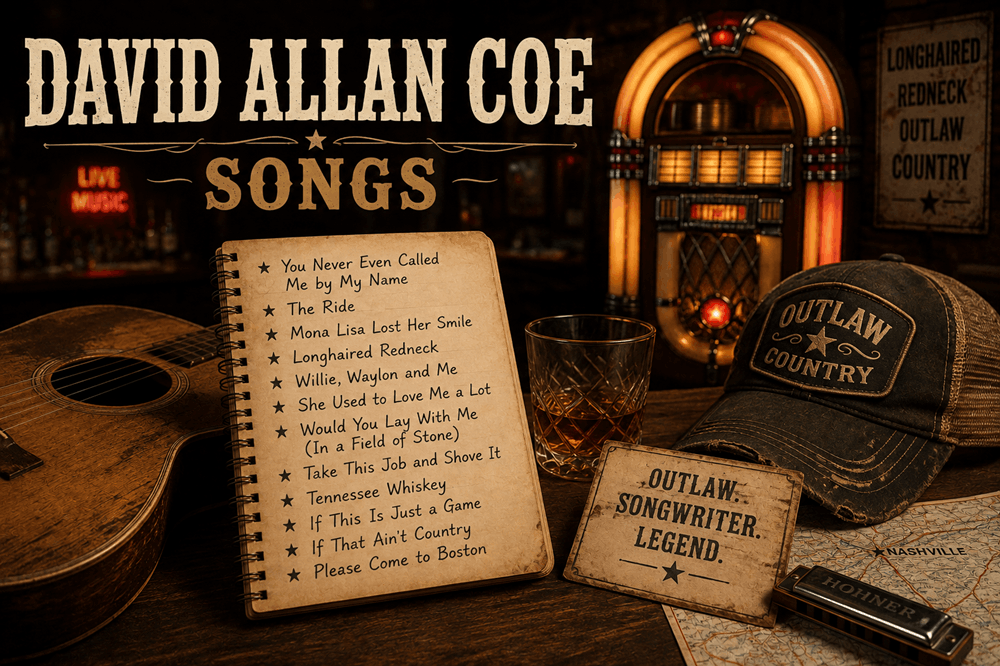
David Allan Coe Songs: 12 Essential Tracks From an Outlaw Country Original
The best David Allan Coe songs combine rebellion, dark humor, regret and traditional country storytelling.
His most recognizable recordings include “You Never Even Called Me by My Name,” “The Ride,” “Mona Lisa Lost Her Smile,” “Longhaired Redneck” and “Willie, Waylon and Me.” He was equally important as a songwriter: Johnny Paycheck made “Take This Job and Shove It” famous, Tanya Tucker turned “Would You Lay With Me” into a No. 1 country hit, and Coe became the first artist to record “Tennessee Whiskey.”
Coe died on April 29, 2026, at age 86, leaving behind a complicated catalog that ranged from polished Nashville ballads to confrontational outlaw-country performances. Billboard credited him with eight Top 40 country singles, including three Top 10 hits.
For listeners discovering his music, these 12 songs provide the clearest introduction to his strengths as a singer, interpreter and songwriter.
1. “You Never Even Called Me by My Name”
“You Never Even Called Me by My Name” is David Allan Coe’s defining singalong and one of country music’s funniest acts of self-criticism.
Steve Goodman and John Prine wrote the original song, although Prine declined an official writing credit because he considered it a playful novelty that might offend serious country listeners. Coe recorded it for his 1975 album Once Upon a Rhyme, and his version reached No. 8 on Billboard’s country chart.
The song begins like a familiar barroom lament but gradually reveals itself as a parody of country conventions. Coe’s spoken section claims the composition cannot be the “perfect” country song because it is missing the genre’s standard subjects. The final verse then piles those subjects together with deliberately excessive efficiency.
What makes the performance endure is Coe’s balance of affection and mockery. He is making fun of country clichés while also celebrating the emotional pleasure of hearing them.
Rolling Stone included the recording in its selection of the greatest country songs, while Pitchfork described it as both a memorable barroom tune and a sharp criticism of Nashville’s commercial mentality.
Listen to “You Never Even Called Me by My Name.”
2. “The Ride”
“The Ride” is a supernatural country story about an aspiring musician hitchhiking from Montgomery toward Nashville.
A mysterious man driving an old Cadillac stops to pick him up. The stranger questions whether the young singer has suffered enough, worked hard enough and developed the emotional depth required to survive the music business.
Only at the end does the traveler understand that his driver was the ghost of Hank Williams.
Written by Gary Gentry and J. B. Detterline Jr., “The Ride” was released in 1983 as the lead single from Castles in the Sand. It reached No. 4 on Billboard’s country chart and remained there for 19 weeks, becoming one of Coe’s largest commercial hits.
Coe’s restrained performance makes the story more effective. He does not exaggerate the ghostly revelation. He tells it with the steady confidence of someone repeating an old highway legend that may or may not be true.
The song is ultimately less about meeting Hank Williams than about the cost of becoming a country singer. Talent matters, but the stranger suggests that credibility must be earned through disappointment, work and emotional endurance.
3. “Mona Lisa Lost Her Smile”
“Mona Lisa Lost Her Smile” shows Coe’s quieter and more vulnerable side.
Written by Johnny Cunningham, the ballad uses Leonardo da Vinci’s famous painting as an image for a woman whose happiness has become unreadable. Coe sings less like an outlaw challenging Nashville and more like a man trying to understand how something once beautiful became distant.
Released from the 1984 album Just Divorced, the song reached No. 2 on Billboard’s country chart, making it Coe’s highest-charting performance as a recording artist. It also reached No. 1 on Canada’s country chart.
Producer Billy Sherrill surrounds Coe’s rough voice with strings, organ and a smoother arrangement than many of his 1970s recordings. AllMusic noted that this polished setting creates a particularly effective contrast with his weathered vocal delivery.
The result is proof that Coe did not need provocation or autobiography to sound convincing. Given the right song, he could deliver conventional heartbreak with unusual emotional gravity.
Listen to “Mona Lisa Lost Her Smile.”
4. “Longhaired Redneck”
“Longhaired Redneck” is Coe’s clearest musical self-portrait.
The song places him between several communities that do not fully trust one another: traditional country listeners, bikers, hippies, barroom audiences and the Nashville music establishment.
Coe presents himself as someone who belongs everywhere and nowhere.
The title track of his 1976 album, “Longhaired Redneck” helped define the public identity he maintained for much of his career. The official recording was released through Columbia and remains one of the central selections on his major retrospective collections.
The humor comes from Coe’s ability to imitate other country stars while insisting that radio programmers and respectable industry figures avoid the rough venues where he performs. Beneath the jokes is a serious complaint: Nashville profits from outlaw imagery while remaining uncomfortable with artists who are genuinely difficult to control.
The song is not just about looking rebellious.
It is about refusing to behave predictably enough to become fully acceptable.
Listen to “Longhaired Redneck.”
5. “Willie, Waylon and Me”
“Willie, Waylon and Me” places Coe inside the history of the outlaw-country movement.
He describes country music as part of a much wider rebellious tradition that includes rock, folk and countercultural performers. Willie Nelson and Waylon Jennings become central figures, but Coe makes sure to insert himself into the title and narrative.
Released during the height of outlaw country’s mainstream visibility, the song appeared on Coe’s 1976 album Longhaired Redneck. It became one of the recordings most closely associated with his belief that he deserved a larger place in the movement’s official story.
The song works partly because Coe sounds both proud and slightly resentful.
He celebrates the movement, but he also understands that Willie and Waylon received a level of public respect that frequently escaped him. His persona was useful to outlaw country’s mythology, yet his unpredictability made the industry reluctant to embrace him completely.
“Willie, Waylon and Me” is therefore both a tribute and a demand for recognition.
Listen to “Willie, Waylon and Me.”
6. “She Used to Love Me a Lot”
“She Used to Love Me a Lot” is built around a devastating realization: love may once have been genuine even when it can no longer be recovered.
The narrator unexpectedly sees a former partner and begins imagining that the encounter might reopen their relationship. Her response makes it clear that the emotional opportunity has already passed.
Written by Kye Fleming, Dennis Morgan and Charles Quillen, the song was released in late 1984 and reached No. 11 on both the American and Canadian country charts. Johnny Cash also recorded it, although his version remained unreleased until the 2014 album Out Among the Stars.
Coe’s performance succeeds because he does not turn the narrator into a victim of cruelty. The woman did love him once. The tragedy is that he understood the depth of that love only after it had become part of the past.
The title does nearly all the emotional work.
She loved him—a lot.
She simply does not anymore.
Listen to “She Used to Love Me a Lot.”
7. “Would You Lay With Me (In a Field of Stone)”
“Would You Lay With Me” demonstrates why Coe’s importance cannot be measured only through his own chart positions.
He wrote the intimate ballad, but Tanya Tucker recorded the best-known version while still a teenager. Her release reached No. 1 on the country chart and became one of the early songs that established Coe as a major Nashville songwriter.
The song is framed as a series of questions about devotion.
Its unusual setting strips romance of comfort and decoration. The narrator does not ask whether someone will remain during an easy life. He asks whether love can survive discomfort, exposure and death.
Coe later recorded the song himself. His rougher voice changes its character. Tucker’s version can sound youthful and vulnerable; Coe’s sounds like someone who has already learned that promises are easier to make than to keep.
The song reveals the tenderness that existed beneath his confrontational persona.
8. “Take This Job and Shove It”
“Take This Job and Shove It” became famous through Johnny Paycheck, but David Allan Coe wrote it.
Paycheck’s recording turned the title into a national catchphrase and a working-class anthem. It reached No. 1 on the country chart and later inspired a film with the same name.
The appeal is immediate.
Many songs describe frustration with work, but this one gives the employee the fantasy of delivering one perfect sentence and walking away. The anger is strengthened by the narrator’s explanation that he tolerated the job partly because of a relationship that has now ended.
Coe’s own recording is worth hearing because he emphasizes the stubbornness behind the words. Paycheck’s hit sounds sharp and explosive; Coe sounds as though resentment has been accumulating for years.
The song illustrates Coe’s gift for creating phrases that feel conversational, memorable and larger than the story surrounding them.
9. “Tennessee Whiskey”
David Allan Coe was the first artist to record “Tennessee Whiskey.”
Dean Dillon and Linda Hargrove wrote the song after meeting at Nashville’s Bluebird Cafe. Coe released his version in 1981, several years before George Jones recorded it and decades before Chris Stapleton transformed it into a modern crossover standard.
Coe’s original arrangement is more traditionally country than Stapleton’s soul-influenced version.
The central comparison remains the same: a loving partner is described through different forms of alcohol, with each image suggesting warmth, smoothness or intoxication.
Listening to Coe’s recording now is valuable because it reveals how dramatically interpretation can reshape a composition. The words were already present, but later singers altered the rhythm, vocal phrasing and emotional atmosphere.
Coe did not write “Tennessee Whiskey,” yet his version represents the first recorded chapter of one of country music’s most durable songs.
10. “If This Is Just a Game”
“If This Is Just a Game” is one of Coe’s strongest direct heartbreak songs.
The narrator is trapped inside a relationship whose rules he does not understand. He suspects the other person may be treating affection strategically while he is experiencing the consequences sincerely.
The song became one of Coe’s eight Top 40 country singles and regularly appears alongside his better-known recordings on career compilations.
Its strength comes from emotional imbalance.
One person can stop playing.
The other cannot stop caring.
Coe’s delivery turns the title into a genuine question rather than a clever metaphor. He sounds less angry than exhausted by uncertainty.
For listeners who know only his humorous or confrontational songs, “If This Is Just a Game” offers a more accurate sense of his range.
11. “If That Ain’t Country”
“If That Ain’t Country” is one of Coe’s attempts to define country authenticity through lived experience rather than industry approval.
The narrator describes poverty, family conflict, alcohol and unstable domestic life, then challenges listeners to explain what could be more “country” than the world he has described.
The song is included on the major collections AllMusic identifies with Coe’s outlaw-country peak and became a long-running part of his concert identity.
Its argument is intentionally uncomfortable.
Coe rejects a clean, sentimental picture of rural life. Country is not simply farms, loyalty and small-town nostalgia. It can also contain neglect, humiliation and people trying to survive without much security.
The recording is effective because Coe does not observe that world from outside.
He performs as though he is defending the legitimacy of people whose lives are too messy for a polished Nashville song.
12. “Please Come to Boston”
“Please Come to Boston” was written and originally recorded by Dave Loggins, but Coe’s version became an important part of his softer repertoire.
The song follows a traveling musician repeatedly asking someone to join him in a new city. Each invitation contains a promise that the next destination will finally provide beauty, freedom or success.
The woman refuses because she recognizes that the narrator is not really searching for a home.
He is searching for a reason to keep moving.
Coe’s voice gives the song a particularly convincing weariness. He sounds like someone capable of making every promise sincerely in the moment without being able to remain in one place long enough to fulfill it.
AllMusic has specifically noted the song’s omission from some otherwise strong Coe greatest-hits collections, suggesting its importance among his familiar interpretations.
The best David Allan Coe songs for new listeners
For a quick introduction, begin with these five:
- “You Never Even Called Me by My Name” for humor and barroom energy
- “The Ride” for supernatural storytelling
- “Mona Lisa Lost Her Smile” for polished heartbreak
- “Longhaired Redneck” for the outlaw persona
- “She Used to Love Me a Lot” for emotional restraint
Listeners interested in Coe as a songwriter should then explore “Take This Job and Shove It,” “Would You Lay With Me” and his original recording of “Tennessee Whiskey.”
AllMusic’s major retrospectives consistently center songs such as “The Ride,” “Mona Lisa Lost Her Smile,” “Willie, Waylon and Me,” “Longhaired Redneck” and “You Never Even Called Me by My Name,” making them the most reliable starting point.
A complicated musical legacy
Any honest discussion of Coe must acknowledge that his catalog includes material far outside the mainstream songs listed here.
He released infamous underground recordings containing racist, misogynistic and explicitly offensive language. Those projects drew lasting condemnation and complicated the reception of his more accomplished songwriting. Coe disputed some interpretations of his work, but the recordings remain part of his public legacy.
This article focuses on his widely released country recordings and songs written for other artists—not because the controversy should be erased, but because those works reveal why musicians and listeners continued to take his talent seriously.
Coe could be funny, self-mythologizing, tender, manipulative, perceptive and needlessly provocative. The contradictions were not separate from his career.
They defined it.
Final thoughts
David Allan Coe’s best songs survive because they sound like they belong to a person rather than a carefully managed image.
“The Ride” turns country history into a ghost story.
“Mona Lisa Lost Her Smile” places a rough voice inside an elegant heartbreak arrangement.
“You Never Even Called Me by My Name” mocks country conventions while becoming one of the genre’s most enduring communal singalongs.
His songwriting for Tanya Tucker and Johnny Paycheck proves that his influence extended well beyond the records released under his own name. His original “Tennessee Whiskey” also demonstrates how one interpretation can begin a song’s history without becoming its final or most famous form.
Coe spent his career demanding recognition as an outlaw, songwriter and country singer.
The strongest songs show that he did not need the mythology.
His voice, storytelling and instinct for memorable phrases were already enough.