
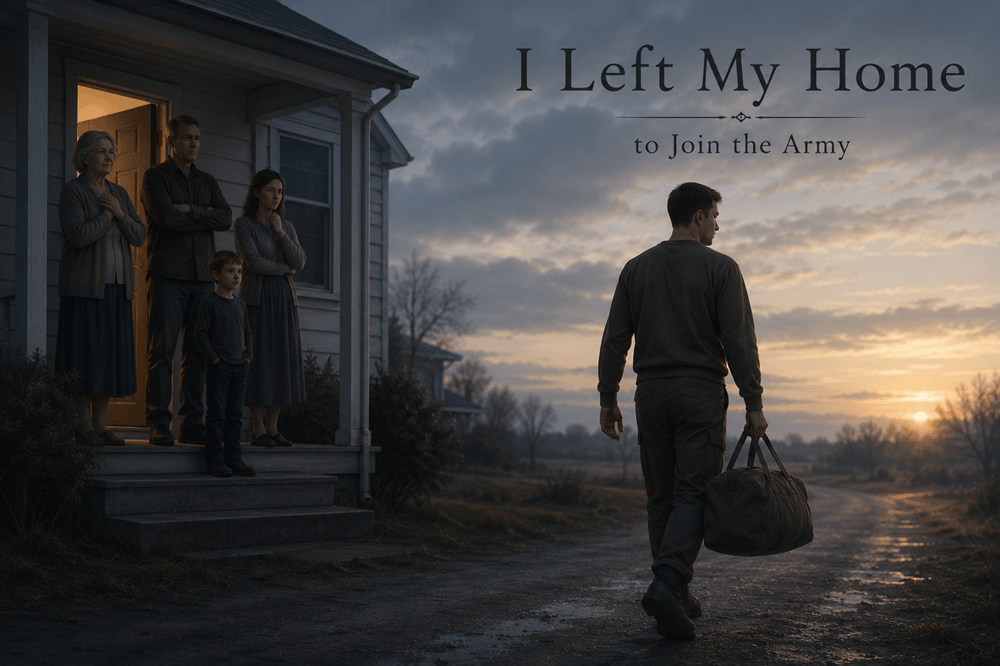
“I Left My Home to Join the Army” Lyrics Meaning: A Cadence About Pride, Fear and the Family Left Behind
“I Left My Home” is a traditional military cadence about the emotional cost of leaving family and civilian life to join the Army.
Its central meaning is simple but painful:
A recruit may leave home voluntarily, yet the decision still causes grief for the people standing at the door—and permanently changes the person walking away.
The cadence contains pride in service, discipline and adulthood. At the same time, it repeatedly imagines death, separation and a family that must continue living without knowing whether its loved one will return.
That tension is what gives “I Left My Home” its power. The rhythm keeps soldiers moving forward, while the words keep looking backward.
What is “I Left My Home” about?
“I Left My Home” describes a recruit saying goodbye before entering military service.
The narrator leaves behind parents, a wife, a child and the ordinary security of home. Different family members respond in different ways. A mother cries because she fears her child may die. A father treats the departure as a sign of adulthood. A wife watches from the doorway, while a young son cannot fully understand why his father is leaving.
These scenes turn enlistment into more than a career decision. Joining the Army affects an entire family.
The recruit gains a new uniform, new responsibilities and a new community. The people at home inherit an empty place, unanswered questions and the fear that the goodbye could become permanent.
The cadence therefore holds two ideas at once:
Military service may be a source of pride and purpose, but service begins with separation.
Why does the cadence begin by naming everyone at home?
Many familiar versions begin by identifying the people—and even the household animals—who were still at home when the recruit left.
At first, the list sounds playful. The caller names parents, siblings and pets, while the formation repeatedly answers. A humorous response then suggests that all those people may be the reason the recruit wanted to leave.
That joke matters because it makes the emotional turn more effective.
The opening presents home as crowded, familiar and almost annoying. It resembles the kind of ordinary family life that people often complain about while they still have it. Once the recruit leaves, however, those same details become symbols of everything that has been lost.
The dog, cat and fish are not important because the cadence is seriously analyzing pets. They represent the small routines that make a place feel like home:
- Hearing familiar voices in another room
- Seeing the same people every morning
- Knowing what will be waiting at the end of the day
- Belonging somewhere without needing to earn that place
The recruit may have wanted independence, but independence feels different once the front door is far away.
The opening joke therefore contains an uncomfortable truth: people do not always recognize the emotional value of ordinary life until they have left it.
“I left my home” means more than changing locations
On the surface, the narrator is simply traveling from home to military training.
At a deeper level, the phrase marks the end of one identity and the beginning of another.
Before leaving, the narrator is primarily someone’s child, spouse, parent or sibling. After joining the Army, that individual becomes part of a formation. Personal habits must give way to schedules, commands, standards and collective discipline.
The word home consequently represents more than a building. It can mean:
- Childhood and family protection
- Familiar routines
- Civilian independence
- Emotional safety
- A life in which war remains distant
- The person the recruit was before military training
Leaving home does not necessarily mean rejecting any of those things. In fact, the sadness of the cadence suggests the opposite. The narrator understands their value precisely because he is moving away from them.
Home becomes something that must now be remembered rather than simply inhabited.
The mother’s fear appears before any battle begins
One of the cadence’s most memorable moments describes the narrator’s mother crying because she believes he may die.
Nothing has happened yet. The recruit has not reached a battlefield, and the cadence does not describe a specific war. The mother is responding to possibility.
That uncertainty is enough.
The person leaving may concentrate on training, achievement, employment, patriotism or the desire to prove something. A parent may see the same decision very differently. She sees the child she raised entering an institution that could eventually send that child into danger.
The cadence does not portray the mother as weak or irrational. Her fear gives the decision its real weight.
Public discussions of military service often use large words such as courage, honor and sacrifice. The mother’s reaction makes sacrifice personal. It is no longer an abstract national ideal. It is the possibility that someone she loves may never come through the door again.
Her tears also expose a limit of courage: the recruit can choose to face danger, but the family cannot control what happens next.
They can only watch, wait and hope.
Why does the father say his child has become a man?
The father responds differently. Instead of openly crying, he shakes the narrator’s hand and treats military service as a passage into adulthood.
His reaction reflects a traditional belief that adulthood is demonstrated through discipline, responsibility and a willingness to face hardship. The handshake recognizes that the child is now making an independent decision with serious consequences.
Yet the moment is not purely triumphant.
A handshake is formal. It is different from the physical comfort normally associated with a parent and child. The gesture suggests respect, but it may also suggest emotional restraint. The father is proud, although he may be hiding the same fear that the mother expresses openly.
His statement also carries an unsettling implication: becoming an adult means moving beyond a parent’s protection.
The father can recognize the narrator’s maturity, but he cannot guarantee his safety. He must accept that his child now belongs partly to a dangerous world outside the family.
Pride and powerlessness occupy the same moment.
The wife and child reveal who else serves
The cadence expands beyond the narrator’s parents by introducing a wife and son.
This changes the recruit’s role. He is not only a child leaving his own parents. He is also a husband leaving a partner and a father leaving a child.
The wife standing at the door represents the adult who understands what military service could mean. She knows that the separation may last for months or years. She may also understand that the person who returns could be emotionally changed by training, deployment or combat.
The son’s reaction is different.
A young child does not necessarily understand military duty, national service or deployment schedules. He understands only that his father was present and is now going away.
That perspective strips the decision of ceremony. To the child, there is no uniformed hero yet. There is simply a parent leaving the yard.
The cadence quietly shows that military sacrifice extends beyond the person wearing the uniform. Spouses manage homes during absences. Children grow through birthdays and ordinary days without a parent nearby. Parents live with the possibility of devastating news.
The recruit leaves once, but the family experiences that absence repeatedly.
Why the call-and-response structure is essential
“I Left My Home” is not structured like an ordinary pop song. It is performed as a military cadence: one person calls a line, and the formation answers.
Cadences help troops march or run together. Their rhythm coordinates movement, supports breathing and creates energy during physically demanding activity. The U.S. Army Center of Military History traces the modern jody-call tradition to Private Willie Lee Duckworth, who introduced his influential “Duckworth Chant” during a long road march in 1944. The Army’s account also explains how these cadences developed through Black call-and-response and blues-influenced work-song traditions.
That history matters because “I Left My Home” uses communal sound to express personal loss.
The caller seems to tell one individual story. The group’s answers reveal that the story belongs to many people.
Every recruit came from a different house. Every family said goodbye in a different way. Once the formation responds together, those separate departures become a shared experience.
The cadence performs the psychological transition described by its lyrics:
At home, the recruit was an individual surrounded by relatives. In formation, the recruit becomes one voice inside a larger unit.
The group does not erase the pain of leaving. It makes that pain survivable by showing that no one is carrying it alone.
The rhythm moves forward while the story looks backward
The emotional power of “I Left My Home” comes partly from the conflict between its function and its subject.
A marching cadence exists to create forward motion. Soldiers must keep their steps aligned and continue toward a destination.
The lyrics, however, are filled with people who remain behind.
The body advances while the mind returns to:
- A crying mother
- A father’s handshake
- A spouse at the doorway
- A child in the yard
- A house that continues without the narrator
That contrast resembles the experience of leaving itself. A recruit may continue through training and service while emotionally revisiting the moment of departure.
There is no long instrumental section or dramatic pause in which the narrator can process those feelings. The repeated beat demands another step.
In that sense, the cadence does not merely describe military discipline. Its structure demonstrates it. Grief is present, but movement cannot stop.
Is “I Left My Home” patriotic or anti-war?
The cadence does not fit comfortably into either category.
It does not condemn the narrator for joining the Army. The father’s approval, the collective voices and the determined rhythm all give military service dignity. The recruit appears willing to accept discipline and danger.
However, the cadence does not romanticize departure either.
Death is introduced almost immediately. Family members do not celebrate without hesitation. The wife expects danger, the mother cries, and the child experiences the decision as abandonment even if the father’s reason for leaving is honorable.
The cadence therefore respects service without pretending that service is emotionally free.
Its message is not that joining the military is automatically glorious or automatically tragic. It is that courage and grief can exist in the same decision.
A person may feel proud to serve and still miss home.
A parent may support that decision and still wish it had never been necessary.
A child may eventually admire the uniform and still remember the day a parent left.
Is the cadence based on one true story?
There is no confirmed single author or family behind the traditional version.
Like many military cadences, “I Left My Home” has circulated through oral tradition. Different callers, units and service branches may change the wording, add verses or emphasize different relationships.
Jonathan Michael Fleming, whose recorded performance helped introduce the cadence to a large civilian audience, states that he did not write the original lyrics. He describes the author as unknown and the cadence as something handed down through generations of military service. Fleming also notes that it attracted widespread attention after a 2021 video showed Drill Sergeant Michael DePalo calling it with a basic-training formation. (Jonathan Michael Fle)
Fleming released a studio recording of the cadence in 2022, helping preserve a recognizable version for listeners who had previously encountered military cadences mainly through short online clips. (YouTube)
Because the cadence does not belong to one clearly documented narrator, its family scenes should not be read as a literal biography. They are representative scenes.
The mother, father, wife and son stand for the many people affected whenever someone leaves for service.
How is it different from the MJHanks, Topher and The Marine Rapper song?
The traditional cadence concentrates mainly on departure.
The 2021 recording by MJHanks, Topher and The Marine Rapper uses the familiar call-and-response foundation but adds rap verses that explore what may happen after the recruit leaves home.
Those newer sections introduce discipline, ambition, combat, military history, fallen service members and the psychological effects of returning from war. The adaptation turns a brief farewell into a wider story of military life.
The two versions are connected, but they serve different purposes.
The traditional cadence captures the doorway moment: the recruit has left, while the family is still reacting.
The rap adaptation looks farther down the road and asks what military service may build, damage or permanently change.
Both versions preserve the same emotional foundation. Before a person becomes a soldier, airman, Marine or veteran, that person belongs to a family.
Why did “I Left My Home” connect with so many civilian listeners?
Many military cadences depend on experiences that civilians may not immediately recognize. “I Left My Home” begins with something almost everyone understands: saying goodbye.
A listener does not need to have completed basic training to understand a mother crying or a child watching a parent leave. The song translates military sacrifice into domestic images rather than relying only on battlefield language.
Its call-and-response format is also immediately memorable. The words are short, the answers are predictable and the rhythm encourages participation. A person can understand the pattern after hearing only a few lines.
Yet the simplicity does not make the cadence emotionally shallow.
The more the central phrase repeats, the more permanent the departure seems. The narrator is no longer explaining why he left or defending the decision. He is stating a fact that cannot be reversed:
He had a home, and then he walked away from it.
That combination of accessibility and unresolved sadness allowed the cadence to move beyond military formations and reach people who had never heard a jody call in person.
Final meaning
“I Left My Home” is about the moment military service stops being an idea and becomes a separation.
The narrator leaves parents, a spouse, a child and the safety of civilian identity. His family responds with pride, fear and grief because no one can know exactly what the decision will bring.
The cadence’s call-and-response structure transforms that private goodbye into a collective experience. One recruit tells the story, but an entire formation answers. Individual families are left behind, while the people who departed learn to move together.
That is the song’s deepest contradiction.
Joining the Army may give someone discipline, purpose and belonging. Yet the first step toward that new identity is taken away from an older one.
The rhythm insists on forward movement.
The words remember everything left at home.
