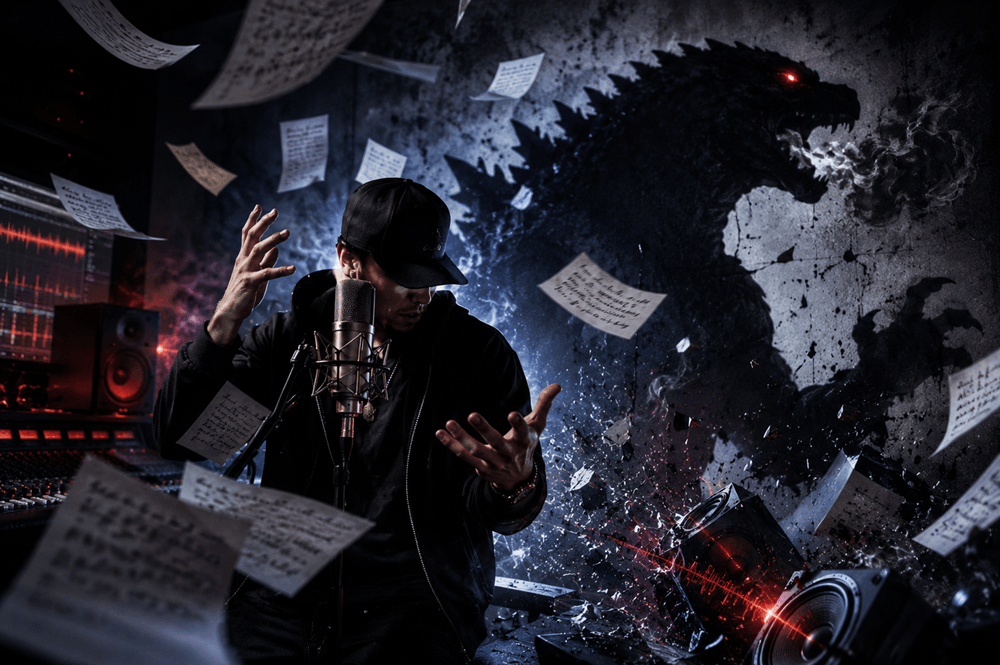
“Godzilla” Lyrics Meaning: Eminem’s Monster Metaphor and Record-Breaking Verse Explained
“Godzilla” by Eminem featuring Juice WRLD is about unleashing a destructive rap persona that feels too powerful, unpredictable and technically skilled for anyone else to control.
Eminem compares himself to Godzilla, the enormous fictional monster known for destroying cities and overpowering nearly everything in its path. In the song, that destruction becomes a metaphor for lyrical dominance.
He is not claiming to be a literal monster. He is saying that when he begins rapping—especially when anger, alcohol or competition activates his darker personality—he becomes an overwhelming force.
Juice WRLD’s chorus adds another dimension. It describes someone who appears normal during the day but changes into a monster at night. That transformation reflects Eminem’s long-running division between Marshall Mathers, the private person, and Slim Shady, the violent and exaggerated character he performs through music.
The central meaning of “Godzilla” is:
Eminem sees his rap ability as a monster within him—one that creates extraordinary performances but is connected to anger, addiction, mental instability and destructive behavior.
The complete authorized lyrics are available on Eminem’s official “Godzilla” page.
What does “Godzilla” mean?
Godzilla is one of cinema’s most recognizable giant monsters.
The character is associated with enormous size, uncontrollable power, destruction and the ability to survive attacks that would defeat an ordinary creature.
Eminem uses that image to describe what happens when his competitive rap instincts take control.
Other rappers may enter a song believing they can challenge him, but he imagines himself as something far beyond their level. Competing with him would be like using an ordinary weapon against a city-destroying monster.
The comparison also communicates isolation.
Godzilla is powerful, but it does not belong comfortably in the human world. Its presence creates panic, and people respond with fear rather than affection.
Eminem’s public image has often worked in a similar way. His talent attracts enormous attention, but his lyrics also create controversy, criticism and fear. He is admired partly because he appears dangerous.
Being the monster gives him power, but it also separates him from everyone around him.
Why does the song begin with alcohol?
Eminem introduces the transformation by describing heavy drinking.
Alcohol appears to make him feel enormous, fearless and destructive. Instead of weakening him, intoxication seems to release the Godzilla-like personality.
This should not be read as a straightforward celebration of drinking.
Eminem has addressed addiction and recovery throughout his career. In “Godzilla,” alcohol functions as part of a deliberately chaotic character—a man becoming more reckless as his sense of control disappears.
The image establishes several themes immediately:
- Intoxication
- Loss of control
- Inflated confidence
- Aggression
- Self-destructive behavior
- Transformation into a darker persona
Feeling like Godzilla may sound powerful, but it is not presented as peaceful or healthy. The monster emerges through excess.
The song repeatedly makes destructive behavior entertaining while leaving signs that the behavior comes from instability.
What does “normal during the day” mean?
Juice WRLD’s chorus describes a person who seems ordinary during the day but becomes monstrous at night.
The contrast can be interpreted in several ways.
Marshall Mathers and Slim Shady
Eminem has long separated his public characters.
Marshall Mathers represents the real person behind the music. Eminem is the professional rapper, while Slim Shady is the exaggerated personality associated with violent jokes, cruelty and provocation.
The daytime figure can therefore represent Marshall behaving like an ordinary person. The nighttime monster represents Slim Shady taking control.
Sobriety and intoxication
Day and night may also represent different mental states.
The narrator appears manageable under normal circumstances. After drinking or entering a party environment, his behavior becomes more unpredictable.
Private life and performance
An artist may appear quiet away from the stage but transform once the music begins.
Eminem’s monster is activated by the opportunity to rap. His technical ability, anger and competitiveness become much larger than his ordinary personality.
The chorus works because all three meanings can exist together.
The monster is a stage persona, an intoxicated personality and a symbol of creative power.
Why does Eminem describe himself as dangerous?
Much of “Godzilla” is based on competitive exaggeration.
Eminem describes his lyrics as weapons and presents other rappers as people who do not understand the danger of challenging him.
This style is deeply rooted in battle rap.
A rapper does not need to make a careful, realistic argument that he is slightly better than an opponent. He creates the largest possible image of superiority.
Eminem therefore compares himself to:
- Giant monsters
- Missiles
- Serial killers
- Mythological creatures
- Explosives
- Wild animals
- Historical conquerors
- Supernatural forces
These comparisons are not meant to form one literal story. They accumulate until Eminem appears almost impossible to defeat.
The song itself becomes evidence for the boast. He does not merely say that he is technically skilled; he demonstrates that skill through dense rhymes, rapidly changing references and an increasingly fast delivery.
The monster is partly created by anger
Eminem’s Godzilla persona becomes strongest when someone challenges or criticizes him.
He repeatedly suggests that enemies are responsible for bringing the monster out. They provoke something dangerous and then suffer the consequences.
This allows him to present aggression as a reaction rather than an unprovoked choice.
The logic is:
- He is calm under ordinary circumstances.
- Someone underestimates or attacks him.
- The darker personality awakens.
- He responds with overwhelming force.
- The challenger regrets approaching him.
This pattern appears throughout Eminem’s music. Criticism often becomes creative fuel.
Instead of quietly defending himself, he enlarges the conflict until it becomes an opportunity to display his writing ability.
The monster therefore needs enemies. Without opposition, it has nothing to destroy.
What does the chorus mean?
Juice WRLD’s chorus gives the song a simple, memorable center.
While Eminem’s verses move rapidly through references and complicated rhyme patterns, the chorus returns to one clear image: a man becoming a monster.
The monster is dangerous to anyone who gets in its way. It breathes fire, creates destruction and moves through glamorous settings while leaving violence behind.
The combination of horror and luxury is important.
Eminem is not describing a monster hiding in an isolated cave. This monster appears at parties, on expensive carpets and inside celebrity culture.
Success has not domesticated him.
He may now have money, recognition and access to glamorous spaces, but the destructive personality remains present.
The chorus suggests that wealth does not remove the darkness. It simply gives the monster a more expensive place to create chaos.
Juice WRLD’s contribution adds emotional weight
Juice WRLD performs the melodic chorus rather than a full rap verse.
His smoother voice contrasts with Eminem’s aggressive delivery, making the monster imagery sound catchy and almost inviting.
That contrast resembles the song’s larger theme. Something dangerous is being delivered through an entertaining performance.
Juice WRLD was known for songs that openly explored substance use, emotional pain and self-destructive thoughts. His voice on a chorus about becoming a monster through intoxication therefore carries significance beyond a conventional feature.
The official music video ends with a dedication to Jarad “Juice WRLD” Higgins, turning the collaboration into a memorial as well as a display of two generations of rap talent. The Recording Academy reported his death at age 21 in December 2019, shortly before “Godzilla” appeared on Eminem’s next album.
The chorus can still be interpreted inside Eminem’s song, but Juice WRLD’s presence makes its alcohol references feel more serious in retrospect.
How does the song connect addiction with power?
“Godzilla” repeatedly creates an uncomfortable relationship between intoxication and confidence.
Alcohol seems to activate the monster. It reduces restraint, increases aggression and allows the narrator to feel invincible.
For someone struggling with insecurity or pressure, that transformation may initially feel attractive. The intoxicated personality appears fearless.
However, the power comes with consequences.
The monster:
- Loses control
- Becomes violent
- Frightens other people
- Acts without considering consequences
- Cannot be easily calmed
- May destroy its own surroundings
This makes the Godzilla metaphor more complicated than a simple boast.
Eminem wants the monster’s creative power, but the monster is connected to behavior that can damage him and others.
The song does not resolve that contradiction. It turns it into entertainment.
What does the mental hospital imagery mean?
Eminem describes himself through images of mental illness, medication, voices and confinement.
Some of these references are exaggerated for rhyme and shock value. However, they support the central idea that the monster is not entirely under his conscious control.
The narrator cannot easily predict whether he will remain the same person from one day to the next.
That uncertainty makes him threatening, but it also suggests vulnerability.
Someone who feels mentally stable does not need to describe his thoughts as an uncontrollable creature living inside him. The monster metaphor allows Eminem to boast about his intensity while also admitting that intensity can become frightening.
The song’s humor should not completely hide this darker implication.
He is powerful because his mind moves unusually fast, but that same speed may make it difficult to find calm.
Why are there so many violent references?
The violence serves several purposes.
First, it continues the Godzilla image. A song named after a destructive monster naturally uses language about attacks, bodies and danger.
Second, violent metaphors are common in competitive rap. Destroying another rapper usually means outperforming them lyrically rather than physically harming them.
Third, the references revive the exaggerated horror-comedy style associated with Slim Shady.
The violent lines are intentionally excessive. Eminem moves from one impossible threat to another so quickly that the result becomes cartoonish rather than realistic.
This does not make the lyrics suitable for every listener. “Godzilla” is an explicit song built around provocation.
However, interpreting every threat literally would miss how the writing functions. The violence is largely a vocabulary for competition.
Pens become weapons. Verses become attacks. Other rappers become victims of technical superiority.
What does Eminem mean when he mentions his influences?
Eminem identifies himself as a product of earlier hip-hop artists, including Slick Rick and Onyx.
These references place his career inside a larger rap tradition.
Even while presenting himself as a nearly unbeatable monster, he acknowledges that his style did not appear from nowhere. Storytelling, aggressive performance and complex rhyme patterns were developed by artists before him.
This moment gives the song a connection to rap history.
Eminem can claim dominance over the current competition while still recognizing the performers who influenced his artistic identity.
It also strengthens his position as a veteran.
He is no longer the young outsider trying to enter hip-hop. He has listened to earlier generations, built his own legacy and now faces younger rappers who grew up listening to him.
The monster has become part of the genre’s history.
Why does he say he has no plans to retire?
Eminem addresses questions about age and career longevity directly.
By 2020, he had already spent decades as one of the world’s most visible rappers. New artists and styles had transformed hip-hop, creating repeated speculation about whether his era had ended.
“Godzilla” responds by rejecting retirement.
Eminem argues that age has not removed his technical ability. In fact, the song’s structure is designed to prove that he can still perform at an extreme level.
This is why the final verse matters beyond speed.
It functions as a competitive statement:
- He is still active.
- He is still technically ambitious.
- He can still create a major collaboration.
- He can still attract enormous attention.
- Younger competitors should not assume he has become harmless.
Godzilla is an appropriate symbol for this stage of his career. The creature may appear to belong to an earlier era, but it continues returning and destroying whatever stands in front of it.
Why does the final verse become so fast?
The song increases its intensity gradually.
Eminem begins at a pace listeners can follow comfortably. As the third verse develops, the rhyme patterns become denser and the delivery accelerates.
This creates the feeling of a transformation happening in real time.
At first, the monster is being described.
By the end, the performance itself has become the monster.
The speed serves several purposes.
It demonstrates control
Rapping quickly is not impressive if the words lose their rhythm or become completely unclear. Eminem maintains internal rhymes and changes emphasis while accelerating.
It creates physical excitement
Listeners may not process every word during the first play, but they can feel the pressure and momentum.
It challenges other rappers
The verse becomes a technical benchmark that others may try to copy or surpass.
It proves the song’s argument
Eminem has spent the track claiming to be an overwhelming lyrical force. The final section provides a performance dramatic enough to support that claim.
The verse is not fast only for novelty. Its acceleration completes the Godzilla transformation.
How fast is Eminem’s rap in “Godzilla”?
According to Guinness World Records, Eminem delivers 225 words during a 30-second section of the third verse.
That equals an average of 7.5 words per second.
Guinness recognizes it as the fastest rap in a No. 1 single, surpassing Eminem’s earlier performances on Nicki Minaj’s “Majesty” and his own “Rap God.”
The record explains part of the song’s popularity, but the verse should not be judged by speed alone.
Its real achievement is combining speed with rhythm, rhyme and an escalating emotional effect.
Many people can speak quickly. Far fewer can make rapid speech function musically.
Is “Godzilla” faster than “Rap God”?
Its fastest section is faster.
“Rap God” became famous partly because of Eminem’s rapid “supersonic” passage. However, Guinness reports that the fastest part of “Godzilla” reaches a higher average rate.
This comparison is appropriate because the two songs serve similar purposes.
Both titles transform Eminem into something beyond an ordinary rapper:
- In “Rap God,” he becomes a divine figure.
- In “Godzilla,” he becomes a giant monster.
Both songs review his career, confront critics and use technical difficulty to support his claims of superiority.
The difference is emotional.
“Rap God” focuses more directly on status and legacy. “Godzilla” feels more chaotic, intoxicated and unstable.
A god rules from above.
A monster destroys whatever happens to be nearby.
Is every line supposed to have a deeper meaning?
No.
Some sections contribute directly to the song’s themes of addiction, dual identity and competition. Others exist mainly to create rhymes, jokes or surprising references.
Eminem moves rapidly between:
- Celebrity names
- Crime references
- Brand names
- Medication
- Sports
- Horror
- Television
- Wordplay
- Sexual jokes
- Rap history
Trying to force all of these references into one continuous narrative would make the song more confusing than it needs to be.
“Godzilla” is partly about meaning and partly about performance.
The accumulation of references demonstrates how quickly Eminem’s mind connects unrelated sounds and ideas. Even when an individual line is included mainly for a rhyme, it contributes to the larger portrait of uncontrolled verbal energy.
The song behaves like the monster it describes: it moves forward rapidly, damages boundaries and rarely pauses to explain itself.
How does “Godzilla” fit into Music to Be Murdered By?
“Godzilla” appeared as the seventh track on Eminem’s 2020 album Music to Be Murdered By, released on January 17, 2020. The official album page lists the record’s full sequence and featured artists.
The album title pays homage to Alfred Hitchcock’s 1958 spoken-word record Alfred Hitchcock Presents Music to Be Murdered By.
Across the album, Eminem repeatedly combines violence, horror imagery, dark humor and technical rap exercises. “Godzilla” fits naturally into that atmosphere.
Its monster metaphor gives the album one of its clearest images.
The song also provides contrast with more serious tracks such as “Darkness.” While both songs involve violence and alcohol, “Godzilla” presents them through exaggerated fantasy and competitive energy.
It is one of the album’s most accessible tracks because Juice WRLD’s chorus gives listeners a simple hook inside Eminem’s dense writing.
What does the music video mean?
The Cole Bennett-directed video turns the song’s metaphors into surreal comedy.
Eminem drinks excessively, wanders through a store, encounters exaggerated violence and experiences a series of impossible transformations. The visuals move with the same unpredictable logic as the lyrics.
Several moments are especially important.
The alcohol creates a distorted world
Eminem’s drinking is followed by physical and visual chaos. This supports the idea that intoxication releases the monster but also destroys his ability to experience reality normally.
Mike Tyson knocks him down
The appearance of former heavyweight champion Mike Tyson turns Eminem’s boastfulness into a joke. Even a self-declared monster can be unexpectedly hit.
Dr. Dre treats him
Dr. Dre’s appearance connects Eminem’s current career with the producer who helped introduce him to a global audience.
The ending honors Juice WRLD
The video closes with images and a spoken reflection connected to the late artist, making the final moments noticeably more serious than the rest of the production.
The official video can be watched through Eminem and Lyrical Lemonade’s “Godzilla” release. It was directed, written and edited by Cole Bennett and includes appearances by Mike Tyson and Dr. Dre.
Why does the video combine comedy with a memorial?
Most of the video is exaggerated and humorous.
Eminem moves through a world where strange events happen without warning, reflecting the playful violence and rapid references in the song.
The Juice WRLD tribute changes that tone.
The sudden seriousness reminds viewers that behind the fictional monsters and cartoon violence was a real young artist whose life had ended.
That contrast gives the song an emotional weight it did not necessarily possess when the hook was originally recorded.
The chorus describes intoxication and transformation as something catchy. The memorial makes those ideas harder to hear as uncomplicated entertainment.
The video does not completely reinterpret the song as a warning about addiction, but it leaves the audience with a reason to consider the cost behind the imagery.
Is “Godzilla” only a technical showcase?
Technical performance is a major part of the song, but it is not the only part.
The record also explores:
- Eminem’s competitive identity
- His relationship with the Slim Shady persona
- The connection between anger and creativity
- The role of alcohol in destructive behavior
- Fear of becoming irrelevant
- The isolation created by fame
- The difference between public power and private instability
These themes are not developed as carefully as they would be in a narrative song such as “Stan” or “Lose Yourself.”
“Godzilla” prioritizes momentum.
Its ideas appear in flashes between jokes, threats and demonstrations of rhyme skill. The listener experiences the monster more than they receive a calm explanation of it.
That approach fits the subject. A controlled essay about losing control would not create the same effect.
Is the monster Eminem’s talent or his addiction?
It can represent both.
The monster is his extraordinary ability to transform thoughts into rapid, complex verses. That ability makes him famous and allows him to overpower competitors.
However, the monster also represents the destructive impulses connected to that creativity:
- Rage
- Obsession
- Compulsion
- Addiction
- Provocation
- Self-isolation
- The inability to stop competing
Eminem does not separate the positive and negative sides neatly.
The same mental intensity that creates remarkable writing may also make ordinary peace difficult. The same aggressive persona that protects him in battle rap may damage relationships outside music.
Godzilla is powerful because it cannot be controlled.
That is also why it is dangerous.
Final meaning
“Godzilla” is Eminem’s metaphor for the enormous, destructive rap personality that emerges when competition, anger and intoxication activate his darkest instincts.
Juice WRLD’s chorus presents the transformation in its clearest form: an apparently normal person becomes a monster under different conditions.
Eminem’s verses then demonstrate what that monster can do.
He overwhelms the song with violent imagery, cultural references, dense rhyme schemes and an accelerating final performance. By the record-breaking section, he is no longer simply telling listeners that he is powerful. He is using the performance to make them feel overpowered.
Yet the song’s power is not entirely triumphant.
The monster is linked to alcohol, mental instability and behavior that damages everything around it. Eminem appears proud of the creature when it defeats competitors, but the lyrics also suggest that he cannot always control when it appears.
The deeper meaning of “Godzilla” is therefore built around a contradiction:
The force that makes Eminem extraordinary is also the force that threatens to consume him.
He wants the monster when he enters the recording booth.
He may not want everything that comes with it.