“Your Idol” Lyrics Meaning: The Saja Boys’ Darkest Song Explained
“Your Idol” by the Saja Boys is about turning admiration into obedience.
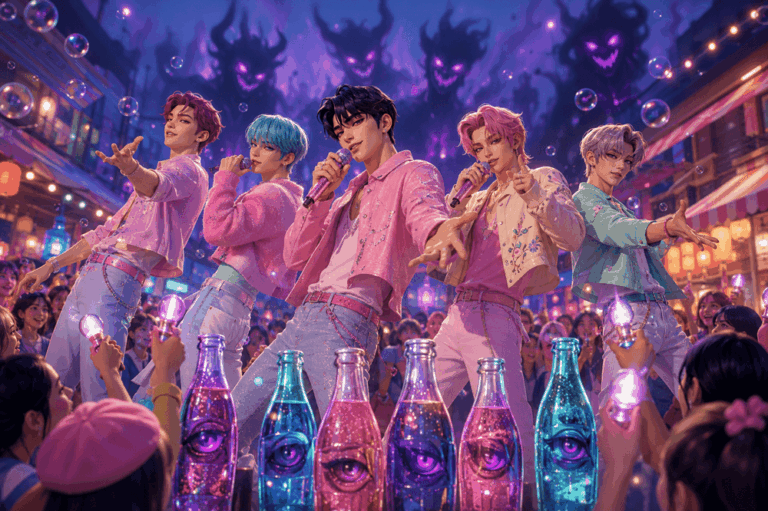
In KPop Demon Hunters, the Saja Boys are demons disguised as a successful K-pop group. Their earlier song, “Soda Pop,” hides their hunger beneath sweetness, flirtation and cheerful choreography. “Your Idol” removes that disguise.
The group no longer pretends to be harmless. Instead, the Saja Boys openly present themselves as supernatural figures who want fans to worship them, depend on them and surrender their souls.
The title contains the song’s central threat:
An idol is supposed to be admired, but the Saja Boys want to become objects of worship with complete power over their audience.
“Your Idol” is therefore not an ordinary song about fame. It is a villain anthem about obsession, spiritual manipulation and the dangerous moment when love for a performer becomes unquestioning devotion.
What does “Your Idol” mean?
The word idol has two closely related meanings.
In popular culture, an idol is a celebrity who is intensely admired. K-pop performers are commonly called idols because they sing, dance, appear in public content and develop close emotional relationships with fans.
In a religious context, an idol is an object or figure that receives worship.
“Your Idol” deliberately combines these meanings.
The Saja Boys begin as celebrities, but they want the relationship with their fans to become something much more powerful. They do not simply want people to stream their music, attend concerts or buy merchandise.
They want submission.
Their fans are encouraged to treat them as:
- The answer to loneliness
- A source of emotional safety
- The only voices worth hearing
- Figures who deserve prayer
- Beings whose love is more important than freedom
- Masters entitled to the audience’s souls
The title sounds affectionate at first. Saying “I can be your idol” could mean becoming someone’s favorite singer.
Within the story, it means becoming the authority that replaces everything else.
How is “Your Idol” different from “Soda Pop”?
The two Saja Boys songs reveal opposite sides of the same strategy.
“Soda Pop” is colorful, charming and deliberately innocent. The group presents its members as playful young men who are overwhelmed by attraction. The supernatural hunger is hidden inside romantic language.
“Your Idol” is the moment when the hidden meaning becomes visible.
Danny Chung, one of the songwriters involved with the film, explained that the two songs were designed to show the group’s duality. He described “Soda Pop” as secretly sinister and “Your Idol” as openly sinister in a Netflix interview about creating the film’s music.
The difference can be summarized simply:
- “Soda Pop” invites the fans closer.
- “Your Idol” reveals why the Saja Boys wanted them close.
The first song is bait. The second is the trap closing.
The song turns fandom into worship
Pop fandom often uses exaggerated language.
Fans may call an artist perfect, describe a concert as a religious experience or say that a performer saved their life. Usually, these statements communicate excitement rather than literal worship.
“Your Idol” takes that language seriously.
The Saja Boys behave as though public admiration has given them spiritual authority. They promise comfort, protection and unconditional love while demanding complete emotional surrender.
This is how the song transforms a familiar relationship into something frightening.
A healthy performer-fan relationship has boundaries. The audience can enjoy the music, leave the concert and continue living independently.
The Saja Boys want to remove those boundaries. They want to live permanently inside the listeners’ minds.
They do not want fans who appreciate them.
They want believers.
Why do the Saja Boys ask for prayer?
Prayer normally expresses trust in a higher spiritual power.
By asking the audience to pray for them, the Saja Boys place themselves inside a religious framework. They no longer sound like entertainers addressing concertgoers. They sound like dark spiritual leaders demanding recognition.
The request is also intentionally confusing.
People usually pray to a divine figure or pray for someone who needs help. The Saja Boys blur those roles. They present themselves as powerful beings while also acting as though they need the fans’ devotion.
That contradiction helps them manipulate the audience.
They appear vulnerable enough to attract sympathy but powerful enough to inspire fear. Fans are encouraged to believe that their loyalty is both an act of love and a sacred responsibility.
The Saja Boys are effectively saying:
Give us your attention because we need you—and obey us because you need us.
This creates a closed emotional system in which every feeling strengthens the group.
What does “Dies irae illa” mean?
The song opens with the Latin words “Dies irae illa.”
The phrase comes from the medieval Latin hymn Dies Irae and refers to the day of wrath, associated with judgment, death and the end of the world. The traditional hymn describes humanity facing divine judgment. A concise historical definition is available through Oxford Reference’s entry on Dies Irae.
Its use in “Your Idol” immediately changes the atmosphere.
This is no longer the bright, romantic world of “Soda Pop.” The Saja Boys are connected with judgment, destruction and supernatural punishment.
The reference also creates a religious inversion.
Traditionally, the Dies Irae warns people to prepare themselves before a higher power. In “Your Idol,” the demons position themselves as that higher power.
They are not afraid of judgment.
They are announcing it.
The religious language is intentionally corrupted
“Your Idol” repeatedly borrows ideas associated with religion:
- Prayer
- Worship
- Sanctuary
- Salvation
- Eternal devotion
- Fire
- The soul
- A final day of destruction
However, the Saja Boys reverse the normal meaning of these ideas.
A sanctuary should protect people from danger. The Saja Boys offer themselves as a sanctuary while secretly creating the danger.
Prayer should lead toward truth or spiritual connection. Their version of prayer leads toward control.
Love should respect another person’s freedom. Their love demands possession.
This corruption of sacred language is what makes the song feel more disturbing than a typical villain track. The group does not merely threaten the fans physically.
It imitates the language people use when searching for hope.
The Saja Boys understand that frightened or lonely people are easier to control when manipulation arrives disguised as comfort.
What does the promise of sanctuary mean?
The Saja Boys present themselves as a place where listeners can escape pain.
They suggest that when life becomes difficult, the fan can return to their music and find relief. That promise resembles the genuine role music plays in many people’s lives.
Songs can provide comfort during loneliness, grief, anxiety or confusion. Fans often form deep attachments to artists whose music helped them survive painful periods.
“Your Idol” turns that positive connection into exploitation.
The Saja Boys want fans to believe that they are the only source of safety. Instead of helping listeners return to their own lives, the group wants them to retreat further into dependence.
A real sanctuary allows a person to rest and then leave.
The Saja Boys’ sanctuary has no exit.
Why do they want to remain inside the listener’s head?
The song describes music playing repeatedly until the performer becomes impossible to forget.
On the surface, this is a clever description of an earworm—a song so catchy that it continues repeating mentally after it ends.
Within the story, the repetition functions like mind control.
Every replay gives the Saja Boys more influence. The fans stop choosing what to think about because the group’s voices occupy their attention continuously.
This reflects a wider theme in the film: music can create collective power.
HUNTR/X uses music to connect with fans and strengthen the protection between the human and demon worlds. The Saja Boys use the same emotional connection in the opposite way. Netflix’s official soundtrack guide identifies the Saja Boys as demons in disguise and lists “Your Idol” among the songs created to advance the film’s supernatural story.
The song is therefore not simply describing obsession.
It is producing it.
“Your Idol” understands parasocial attachment
A parasocial relationship is a one-sided emotional bond in which an audience member feels close to a public figure who does not personally know them.
These relationships are not automatically harmful. Music fans can gain community, inspiration and enjoyment from following an artist.
The danger appears when the relationship replaces real connections or makes the fan vulnerable to manipulation.
The Saja Boys exploit that vulnerability perfectly.
They speak as though they know each listener personally. They promise to understand private pain, offer unconditional love and remain present whenever the fan feels alone.
Yet their message is being delivered to an enormous crowd.
The sense of individual intimacy is manufactured.
Every person believes the group is speaking directly to them, but the same promise is being used to control everyone.
What does obsession mean in the song?
The Saja Boys do not hide their desire to make fans obsessed.
They want constant repetition, emotional dependency and unquestioning loyalty. Obsession is presented as evidence that the relationship is succeeding.
This is very different from mutual love.
In mutual love, both people retain their identities. They care about each other while recognizing each other’s freedom.
Obsession reduces the other person’s world until only one object of attention remains.
That is exactly what the Saja Boys need.
A fan with independent thoughts, relationships and responsibilities may question the group. A fan whose entire identity revolves around the group becomes easier to command.
The Saja Boys therefore treat emotional isolation as devotion.
The less the fans have outside the group, the more powerful the group becomes.
Why do they say they will love fans during destruction?
The Saja Boys connect their love with a world that is burning or collapsing.
This sounds romantic in an extreme way: even if everything ends, they promise to remain beside the listener.
However, the group is partly responsible for the coming destruction.
Their promise is therefore dishonest. They offer comfort during a disaster they are helping create.
This is a common manipulation tactic. A controlling figure creates fear and then offers protection from that fear.
The audience begins to associate safety with the same person causing the danger.
The Saja Boys are not promising to prevent the world from burning.
They are promising to remain in control while it burns.
The difference between giving a heart and giving a soul
One of the song’s most important ideas is the movement from the heart to the soul.
Giving someone your heart usually means loving them. It is emotional and metaphorical.
Giving someone your soul suggests total ownership. The soul represents identity, freedom, morality and the deepest part of a person.
The Saja Boys treat the heart as only the beginning.
Fan affection gave them popularity. Popularity gave them influence. Now they want the final part of the audience that has not yet been surrendered.
This reveals the true structure of their plan:
- Attract attention.
- Encourage affection.
- Turn affection into dependency.
- Turn dependency into obedience.
- Take complete possession.
The fans believe they are participating in a concert.
The demons see them as an offering.
Is the song directed at Rumi?
“Your Idol” is performed to the entire audience, but parts of its message carry special meaning for Rumi.
Rumi is emotionally vulnerable at this point in the story. Her demonic identity has been exposed, her relationship with Mira and Zoey has fractured and the shame she spent years hiding has become public.
The Saja Boys’ promise of sanctuary targets exactly that kind of isolation.
When someone believes they have lost their community, a controlling figure can become more appealing by offering immediate acceptance.
Jinu’s connection with Rumi complicates the song further. He understands her shame because he also carries guilt about his own past. Yet he has allowed that understanding to become part of Gwi-Ma’s plan.
The Saja Boys offer belonging, but it is belonging based on surrender.
Rumi’s eventual resistance begins when she stops believing that acceptance must come from someone who wants to control her.
Is Jinu being honest in “Your Idol”?
Jinu’s performance is both sincere and deceptive.
As leader of the Saja Boys, he participates in the plan to deliver human souls to Gwi-Ma. The promises made during the song are therefore part of an attack.
However, Jinu is not emotionally identical to the other demons.
His connection with Rumi has awakened guilt, empathy and a desire for freedom. This means his performance carries internal conflict even while he continues playing the role expected of him.
He understands the pain of giving away one’s soul because he has already done something similar.
That makes the song especially tragic for him.
The Saja Boys tell fans to surrender completely, while Jinu is beginning to understand the cost of his own surrender.
He stands at the center of a worship performance even though he is not free.
What does Gwi-Ma gain from the song?
Gwi-Ma’s power depends on weakening the bond between HUNTR/X and their fans.
The Saja Boys are created as a rival group capable of redirecting public attention. Once they have the audience’s devotion, that emotional energy can be used to weaken the Honmoon and expose the human world to demons.
“Your Idol” completes this process.
“Soda Pop” made the public curious. The group’s popularity drew fans away from HUNTR/X. “Your Idol” converts that popularity into supernatural surrender.
This is why the song feels like both a concert and a ritual.
The audience is not merely watching the Saja Boys perform. It is participating in the transfer of power.
Why does the music sound darker than “Soda Pop”?
“Your Idol” replaces the bright retro-pop sound of “Soda Pop” with heavier bass, ominous chanting, dramatic strings and a more aggressive vocal performance.
The official credits list the song as written by EJAE, Mark Sonnenblick, Vince, KUSH, 24 and IDO, with production by 24, IDO and Ian Eisendrath. The vocal performers are Andrew Choi, Neckwav, Danny Chung, Kevin Woo and samUIL Lee.
The production creates several emotional effects.
The chanting suggests a ritual
The group vocals sound less like individual pop stars and more like members of a single supernatural force.
The bass creates physical pressure
The low frequencies make the performance feel enormous and difficult to escape.
The strings add judgment and tragedy
Orchestral elements connect the song with cinematic danger rather than ordinary pop competition.
The vocal delivery becomes commanding
The members are no longer trying to appear cute. Their voices sound confident, threatening and certain of their control.
The complete transformation can be seen in the official “Your Idol” song clip from Sony Pictures Animation.
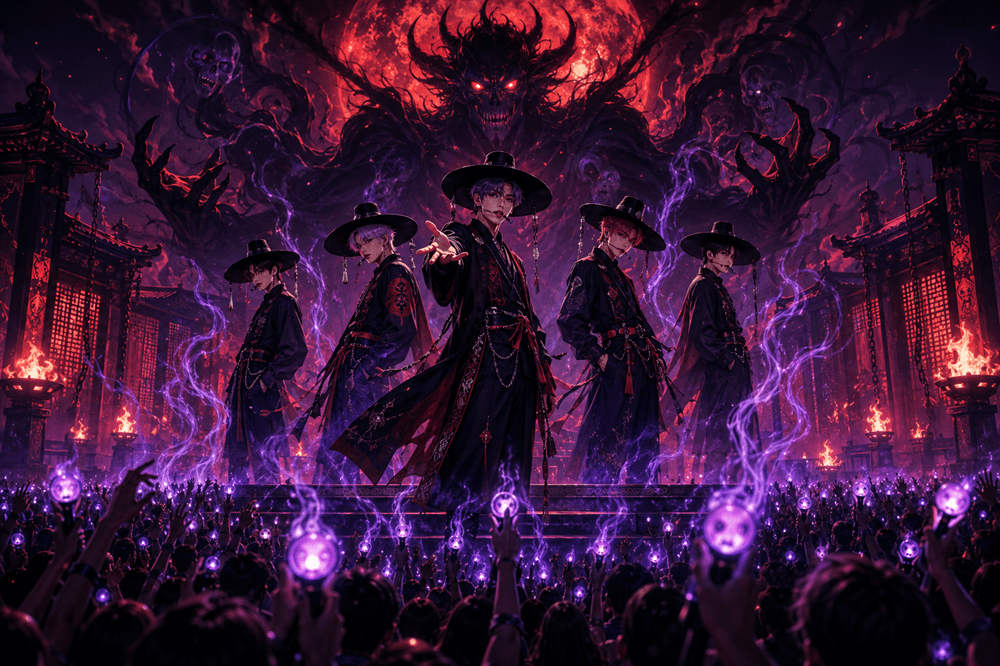
Why are the Saja Boys shown in traditional hats?
During the performance, the group’s visual presentation incorporates dark supernatural clothing and traditional Korean-inspired elements, including hats associated with the imagery behind the word saja.
In Korean mythology and popular storytelling, a jeoseung saja is a messenger of death who guides souls toward the afterlife. The Saja Boys’ name therefore contains a clue about their real purpose.
Their earlier pastel appearance concealed that association.
In “Your Idol,” the darker costumes make it visible. The group no longer resembles an innocent modern boy band. They look like supernatural collectors arriving to claim souls.
The visual change mirrors the musical change:
- Pastels become black and red.
- Smiles become threatening expressions.
- Fan service becomes command.
- Attraction becomes ritual.
- Celebrity becomes death.
Why are the fans unable to resist?
The fans have already been prepared by the group’s earlier success.
They know the songs, recognize the members and feel emotionally attached. When “Your Idol” begins, the Saja Boys are not manipulating strangers.
They are activating a relationship they have carefully built.
This reflects how influence often works in real life. People are less likely to question someone they already admire.
A command from an obvious enemy creates resistance. The same command from a beloved figure may feel trustworthy.
The Saja Boys’ greatest weapon is not their demonic appearance.
It is the affection they earned before revealing it.
Is “Your Idol” criticizing the music industry?
The song can be interpreted as a warning about the darker possibilities of celebrity culture, although the film also clearly celebrates music and fandom.
The problem is not that fans love performers.
The problem is what happens when admiration becomes worship and when performers or companies exploit emotional attachment for power.
“Your Idol” exaggerates several real pressures:
- Artists are marketed as emotionally available to fans.
- Fans are encouraged to stream songs repeatedly.
- Loyalty may be treated as a moral responsibility.
- Purchasing and voting can become tests of devotion.
- Public figures may be presented as solutions to loneliness.
- Personal identity can become tied to membership in a fandom.
The film turns those pressures into a supernatural story.
The Saja Boys literally feed on the devotion that celebrity culture produces.
Why is the song so appealing despite its meaning?
“Your Idol” works because it does not sound like a warning.
It sounds powerful, polished and seductive.
The listener understands that the Saja Boys are villains, yet the song still invites admiration. The choreography, voices and dramatic production make the group appear impressive even when they are openly threatening the audience.
This places viewers in the same uncomfortable position as the fans inside the film.
We know the performance is dangerous.
We still enjoy watching it.
That contradiction is intentional. The song demonstrates how style can weaken judgment. A message may remain disturbing even when it is delivered beautifully, but beauty can make people less willing to question it.
Final meaning
“Your Idol” is about celebrities transforming attention into spiritual and emotional control.
The Saja Boys no longer hide behind the romantic sweetness of “Soda Pop.” They reveal themselves as demons who want fans to pray, surrender their independence and offer their souls.
Religious language gives the performance its darkest meaning. The group promises sanctuary while creating danger, offers love while demanding possession and presents obsession as a form of salvation.
The title captures the entire plan.
The Saja Boys begin as pop idols—performers admired by millions. By the end, they want to become idols in the oldest sense of the word: figures worshipped with complete devotion.
The song’s warning is not that music or fandom is inherently dangerous.
It is that admiration becomes dangerous when it requires you to stop questioning, stop choosing and stop belonging to yourself.
“Your Idol” shows the final stage of the Saja Boys’ manipulation:
First, they make the audience love them.
Then they ask the audience to worship them.
Finally, they come for the soul.