“Soda Pop” Lyrics Meaning: The Sweet Trap Behind the Saja Boys’ Song
“Soda Pop” by the Saja Boys sounds like a bright, innocent song about being irresistibly attracted to someone. Beneath its bubbly K-pop production, however, the lyrics carry a much darker meaning.
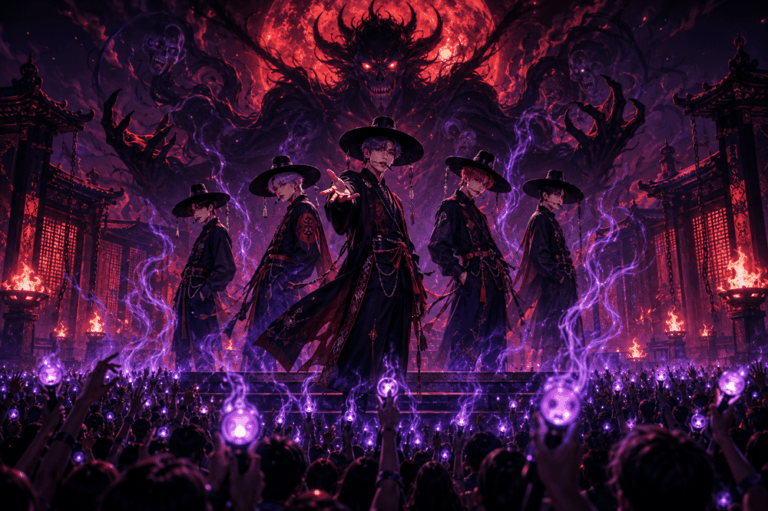
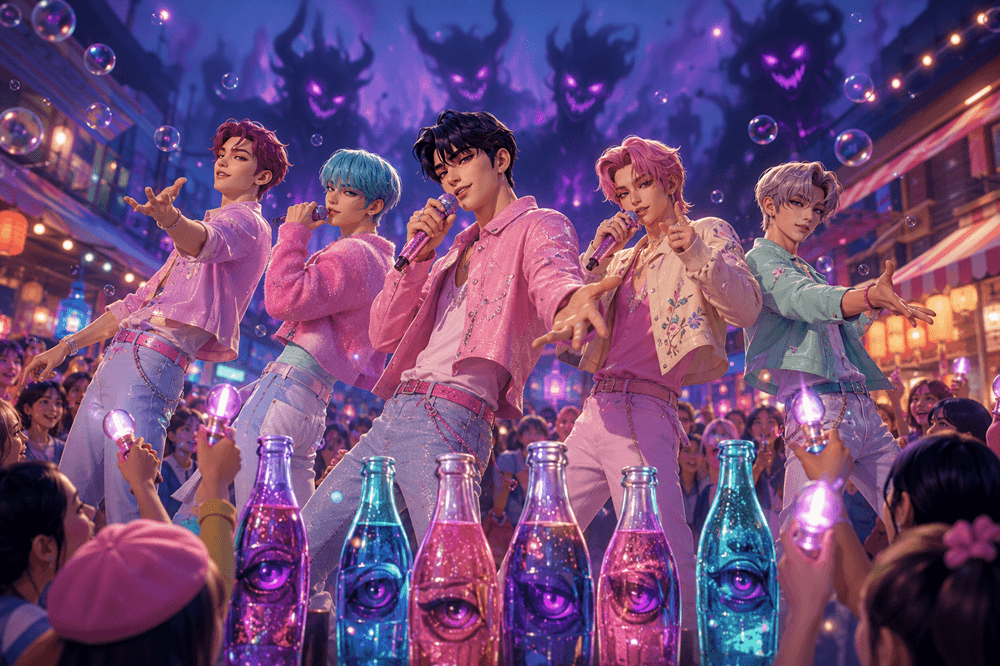
In KPop Demon Hunters, the Saja Boys are not ordinary pop stars. They are demons disguised as a charming boy band, sent to steal fans from HUNTR/X and weaken the supernatural barrier protecting the human world.
Their sweet performance is therefore part of a trap.
The soda metaphor makes the person they desire sound refreshing, addictive and impossible to resist. On the surface, the singers appear romantically thirsty. Within the film’s story, however, their hunger is more literal: they want to consume the energy and souls of the fans attracted to them.
The central meaning of “Soda Pop” is:
The Saja Boys disguise predatory hunger as cute romantic desire, using an appealing pop song to make their intended victims willingly come closer.
What does “Soda Pop” mean?
Soda pop is sweet, fizzy and immediately enjoyable. It provides a quick burst of flavor and energy, making it an effective metaphor for an exciting attraction.
The singers compare the person they want to a refreshing drink. They cannot get enough of this person’s sweetness and continue craving more, even after trying to satisfy themselves.
In an ordinary romantic song, that would mean someone is emotionally captivated by a crush.
In KPop Demon Hunters, the metaphor has a second meaning. The Saja Boys are demons who survive by taking from humans. Their language about drinking, tasting and never feeling full reflects their supernatural appetite.
The person described as soda is not simply loved.
They are being prepared for consumption.
The official Netflix lyric video allows listeners to follow the English and Korean portions without relying on unofficial lyric transcriptions.
Is “Soda Pop” a love song?
It presents itself as a love song, but the affection is deceptive.
The singers tell their target that they need them and cannot stop thinking about them. The language sounds flattering because it makes the listener feel uniquely desirable.
Yet the Saja Boys are not promising an equal relationship. They describe another person mainly as something that can satisfy their hunger.
This creates an important difference:
- Romantic desire values the other person.
- Predatory desire values what can be taken from them.
The Saja Boys blur that distinction. They perform neediness as though it were devotion, making their hunger sound like proof of love.
The listener hears, “You are the only one I need.”
What the demons mean is closer to, “You have something I want to consume.”
What does “fill me up” mean?
The brief phrase “fill me up” carries the song’s main double meaning.
On the romantic level, it suggests that another person completes an emotional emptiness. The singer feels unsatisfied until the desired person enters his life.
On the supernatural level, it describes the demons’ endless appetite. They need human attention, energy and souls to increase their power.
The Korean lyrics reinforce the idea that drinking repeatedly does not satisfy them. No matter how much they consume, they remain hungry.
That endless thirst makes the Saja Boys more dangerous. They are not searching for one meaningful connection. They need a continuing supply of admirers.
The song presents that appetite as cute and flirtatious so that the fans do not recognize the danger.
Why compare a person to a drink?
The drink metaphor turns desire into physical consumption.
A person can admire a beautiful drink, enjoy its sweetness and then empty the container. The drink exists primarily to satisfy the person consuming it.
That is exactly how the Saja Boys view their fans.
Their admirers may believe they are building an emotional connection with the group, but the demons see them as a source of power. Fans are valuable only while they still have something to give.
Soda is also an appropriate symbol because it is designed to be instantly appealing:
- It is brightly packaged.
- It tastes sweet.
- It creates a quick rush.
- It is easy to consume.
- It encourages people to want another serving.
The Saja Boys’ public image works in the same way. Their appearance, choreography and personalities are carefully packaged to create immediate attraction.
The sweetness is real enough to be enjoyable, but it hides what the product is doing.
Why are the Saja Boys still thirsty?
The singers repeatedly suggest that ordinary drinks cannot satisfy them.
This can be interpreted as romantic exaggeration. Nothing else compares with the person they desire, so every substitute feels inadequate.
Within the film, the dissatisfaction reveals the true nature of the Saja Boys. Demonic hunger cannot be permanently satisfied. Consuming one fan only creates a desire for more.
The song therefore describes addiction from the predator’s perspective.
The demons crave attention, but attention does not make them secure. They crave souls, but consuming souls does not make them complete. Their hunger continues because it comes from emptiness rather than genuine need.
This gives the bright chorus an unsettling emotional foundation. The singers sound joyful, but nothing appears capable of making them content.
The sweetness is a disguise
The Saja Boys are introduced as almost impossibly appealing.
They are handsome, coordinated, polite and immediately comfortable in front of a crowd. Their performance gives fans exactly what they expect from a charming K-pop boy group.
Netflix executive music producer Ian Eisendrath explained that the creative goal was to make an extremely “bubblegum-y” boy-band song. The demons needed to appear like the most innocent and appealing performers imaginable, even though their true intentions were evil. The official Netflix guide to the film’s soundtrack also lists the song’s writers, producers and vocal performers.
That contrast is essential to “Soda Pop.”
If the Saja Boys performed an obviously sinister song, HUNTR/X and the fans would immediately recognize them as a threat. Their plan succeeds only if their danger looks harmless.
The pastel clothing, affectionate gestures and sweet lyrics are not separate from their attack.
They are the attack.
How the song manipulates the fans
“Soda Pop” makes attraction feel personal even though it is performed for a large crowd.
Each listener can imagine that the singers are speaking directly to them. The lyrics suggest that the target is uniquely sweet and uniquely capable of satisfying the group.
That is a powerful form of flattery.
Instead of demanding loyalty, the Saja Boys make fans want to give it. They create the feeling that supporting the group is a romantic exchange rather than part of a supernatural plan.
Their strategy depends on several emotional promises:
- You are special.
- We cannot stop thinking about you.
- Nothing else satisfies us.
- We need you close to us.
- Your attention completes us.
These statements make the fan feel powerful. In reality, the Saja Boys are the ones gaining power.
The song shows how manipulation can work most effectively when it feels like admiration.
Is the song criticizing K-pop fandom?
“Soda Pop” can be interpreted as playful satire of idol culture, but it is not simply attacking K-pop or its fans.
The film clearly celebrates K-pop’s music, choreography, fashion and community. At the same time, it exaggerates the intense relationship that can develop between idols and audiences.
Fans often describe performers as people who give them happiness, comfort and energy. Artists may respond by saying that they need their fans and could not exist without them.
In a healthy context, that language expresses gratitude.
The Saja Boys turn it into something literal and dangerous. They truly do need fans because fan attention gives them supernatural power.
The relationship is therefore reversed. Audiences usually consume music and celebrity images. In “Soda Pop,” the celebrities are secretly preparing to consume the audience.
That reversal gives the song its cleverest meaning.
The idols become the consumers
Pop stars are often discussed as products.
Their music, images, personalities and private lives are packaged for public consumption. Fans watch them, buy albums and collect merchandise.
The Saja Boys appear to be another perfectly packaged product. Yet they are not passive objects being consumed by fans.
They are hunters.
The bright packaging attracts people long enough for the group to feed on them. The song turns the normal language of celebrity consumption inside out: the audience believes it is consuming entertainment, while the entertainment is consuming the audience.
The soda metaphor supports both sides.
The Saja Boys look sweet and commercially packaged like a soft drink. At the same time, they treat fans as drinks that can be emptied.
Why does the song mix English and Korean?
The combination of Korean and English reflects the global sound of modern K-pop.
The English phrases make the central hook immediately accessible to international listeners, while the Korean verses preserve the rhythm, vocal texture and cultural identity associated with the genre.
The code-switching also helps the song’s deception.
Listeners do not need to understand every word to respond to the melody, choreography and repeated soda imagery. The emotional message arrives before the complete lyrical meaning does.
That mirrors the experience of the fans in the film. They react to how the Saja Boys make them feel before questioning who the performers really are.
The music creates trust faster than the audience can examine the message.
Who performs “Soda Pop”?
“Soda Pop” is credited to the fictional group Saja Boys, but the singing is performed by Andrew Choi, Neckwav, Danny Chung, Kevin Woo and samUIL Lee.
The song was written by Vince, KUSH, Danny Chung, 24 and DOMINSUK. It was produced by 24, DOMINSUK and executive music producer Ian Eisendrath.
The recording was released as part of the KPop Demon Hunters soundtrack in June 2025 and runs for approximately two minutes and 30 seconds. The complete performance and production credits are available on the official Apple Music song page.
The use of multiple vocalists helps the fictional group sound convincing. Each member contributes a slightly different tone, allowing the song to resemble a genuine boy-band performance rather than a single singer layered several times.
How does the production hide the darker meaning?
The production is bright, clean and highly controlled.
Its light percussion, polished vocal harmonies and energetic rhythm create the sensation of sweetness promised by the title. Nothing in the instrumental initially warns the listener that the performers are demons.
That is why the song works inside the story.
The arrangement places the audience in the same position as the film’s fans. We understand that something may be suspicious, but the music remains enjoyable enough to weaken our resistance.
The melody encourages movement. The voices sound friendly. The chorus is simple enough to remember after one listen.
The production does not illustrate the demons’ true appearance. It illustrates the image they want people to believe.
Why does the song sound innocent?
The Saja Boys adopt the language and behavior of an especially wholesome boy band.
Their charm is deliberately exaggerated:
- They smile constantly.
- They make affectionate gestures.
- They give gifts to fans.
- They perform playful choreography.
- They appear helpful and considerate.
- They dress in soft pastel colors.
The visual sweetness makes the song’s hunger metaphors seem harmless.
Netflix describes the Saja Boys as an irresistible rival group of demons in disguise. Their “Soda Pop” performance occurs during their first major encounter with HUNTR/X, establishing them as both commercial competition and a supernatural threat. Viewers can watch the complete sequence through the official Netflix “Soda Pop” music-video page.
The performance is effective because even HUNTR/X briefly reacts to the group’s appearance and charisma. The demon hunters know that demons exist, yet the Saja Boys’ image is polished enough to disrupt their judgment.
What does the marketplace scene mean?
The Saja Boys make their public entrance in a busy outdoor market.
This setting allows them to present themselves as approachable rather than distant celebrities. They interact with food stalls, move through the crowd and perform directly among ordinary people.
The marketplace also reinforces the song’s theme of consumption.
Food and drinks surround the group while they sing about sweetness, thirst and being filled. The setting turns appetite into the visual language of the entire sequence.
At the same time, the Saja Boys behave like products entering a competitive marketplace. They suddenly appear, capture public attention and begin taking HUNTR/X’s fans.
Their debut is both a musical performance and a hostile commercial takeover.
Why are HUNTR/X threatened by the song?
HUNTR/X receives strength from the connection between the group and its fans.
The Saja Boys’ goal is to take that attention away. As fans transfer their loyalty to the new group, HUNTR/X loses influence and the Honmoon protecting the human world becomes weaker.
This means “Soda Pop” functions as a weapon without sounding like one.
The Saja Boys do not attack HUNTR/X with obvious violence during their debut. They attack the emotional relationship between HUNTR/X and its audience.
Every new admirer becomes a loss for the demon hunters and a gain for the demons.
Netflix’s official film materials explain that the disguised boy band intends to steal HUNTR/X’s fans, weaken the Honmoon and create an opening for Gwi-Ma and the other demons.
Does Jinu mean what he sings?
Jinu performs the flirtatious lyrics as part of the Saja Boys’ plan.
At this stage of the film, the song should not be understood as an honest declaration of love to Rumi or to one particular fan. The group is performing attraction on a mass scale.
However, Jinu later develops a genuine emotional connection with Rumi.
That development creates an interesting contrast. During “Soda Pop,” he uses romantic language as manipulation. Later, he must confront feelings that cannot be reduced to performance or hunger.
The song therefore establishes the false version of intimacy against which his later choices can be measured.
At first, Jinu knows how to imitate affection perfectly.
His deeper struggle begins when some of that affection becomes real.
Is there a sexual meaning?
The song contains flirtatious double meanings, especially in its language about tasting, drinking and craving someone.
However, the lyrics remain suggestive rather than explicitly sexual. The song is designed to sound playful enough for the film’s broad audience while still allowing older listeners to recognize the innuendo.
The physical choreography and the members’ exaggerated attractiveness strengthen that interpretation.
Still, the supernatural meaning is more important than the sexual one. The Saja Boys are not simply expressing physical attraction. They are disguising their desire to drain people of something valuable.
The lyrics work because thirst can represent several forms of appetite at once:
- Romantic longing
- Physical attraction
- Desire for attention
- Hunger for power
- Literal demonic consumption
Why did “Soda Pop” become so popular?
The song succeeds outside the film because it works as a convincing K-pop track even without the story.
Listeners can enjoy the melody, choreography and vocal performances without focusing on the demons or the Honmoon. The central soda metaphor is easy to understand, and the chorus creates an immediate sense of energy.
The contrast also encourages repeat listening.
Once viewers know the Saja Boys’ real purpose, previously innocent lyrics sound more threatening. What first appears to be romantic thirst begins to resemble a confession of predatory hunger.
That change does not require the song itself to change. The listener changes.
“Soda Pop” rewards both experiences:
- Before the revelation, it is a sweet boy-band song.
- After the revelation, it is a villain song hiding in plain sight.
Final meaning
“Soda Pop” is about attraction presented as an irresistible craving.
On the surface, the Saja Boys compare a desirable person to a sweet, refreshing drink. They claim that nothing else can satisfy them and that they need this person to fill an emotional emptiness.
Inside KPop Demon Hunters, those promises are deliberately deceptive.
The Saja Boys are demons using the appearance of a perfect K-pop group to attract fans, weaken HUNTR/X and feed a supernatural hunger. Their language of drinking and tasting describes more than a crush. It reveals how they view human admirers—as sources of energy waiting to be consumed.
The song’s brightness is therefore part of its darkness.
“Soda Pop” sounds safe because danger is more effective when it arrives smiling, dancing and offering exactly the kind of sweetness people already want.